
Bible Games for Kids and Families
Types of Bible games and what each builds, ideas by age, 5 ready-to-play games for home, a 20-minute Sunday school plan and how to judge a Bible game app.
 The Terra Sinai team 12 min read
In this article (10)
Bible games are activities, tabletop games and phone games built around the stories, people and verses of the Bible. They work at home, in Sunday school and on a phone, and there are good options for toddlers, teens, adults and grandparents.
This guide explains what makes a Bible game teach, sorts the game types by the skill each one builds, shows what works at each age, and gives you five ready-to-play games for home with rules and timing. You’ll also find a 20-minute Sunday school plan and a list of what to check in an app.
What makes a Bible game teach
It uses the real text or story. A David and Goliath quiz that asks how many stones David picked up from the stream (five, in 1 Samuel 17:40) sends kids back to the text.
It asks players to recall. In 2006, psychologists Henry Roediger and Jeffrey Karpicke compared students who reread a passage with students who tried to write down from memory what they’d read. In the first experiment, one week later, the students who’d been tested remembered 56% of the material, and the students who reread it remembered 42%. In the second, students who read once and took three tests remembered 61% after a week, and students who read the passage four times remembered 40%. The authors also noted that rereading made students feel more confident. The study used college students and science passages, so it doesn’t measure Bible games directly. Still, a round of Who Am I? or a verse scramble asks for the same effort: digging the answer out of memory.
It ends in conversation. A 2015 review by Kathy Hirsh-Pasek and colleagues in Psychological Science in the Public Interest sums up what makes a children’s app educational: the child is active (thinking about the content while tapping), engaged without distractions, connecting the material to their own life, and interacting with other people. That last point applies to any game. One question at the end, such as “Why wasn’t David afraid?”, helps kids connect the story to their own lives.
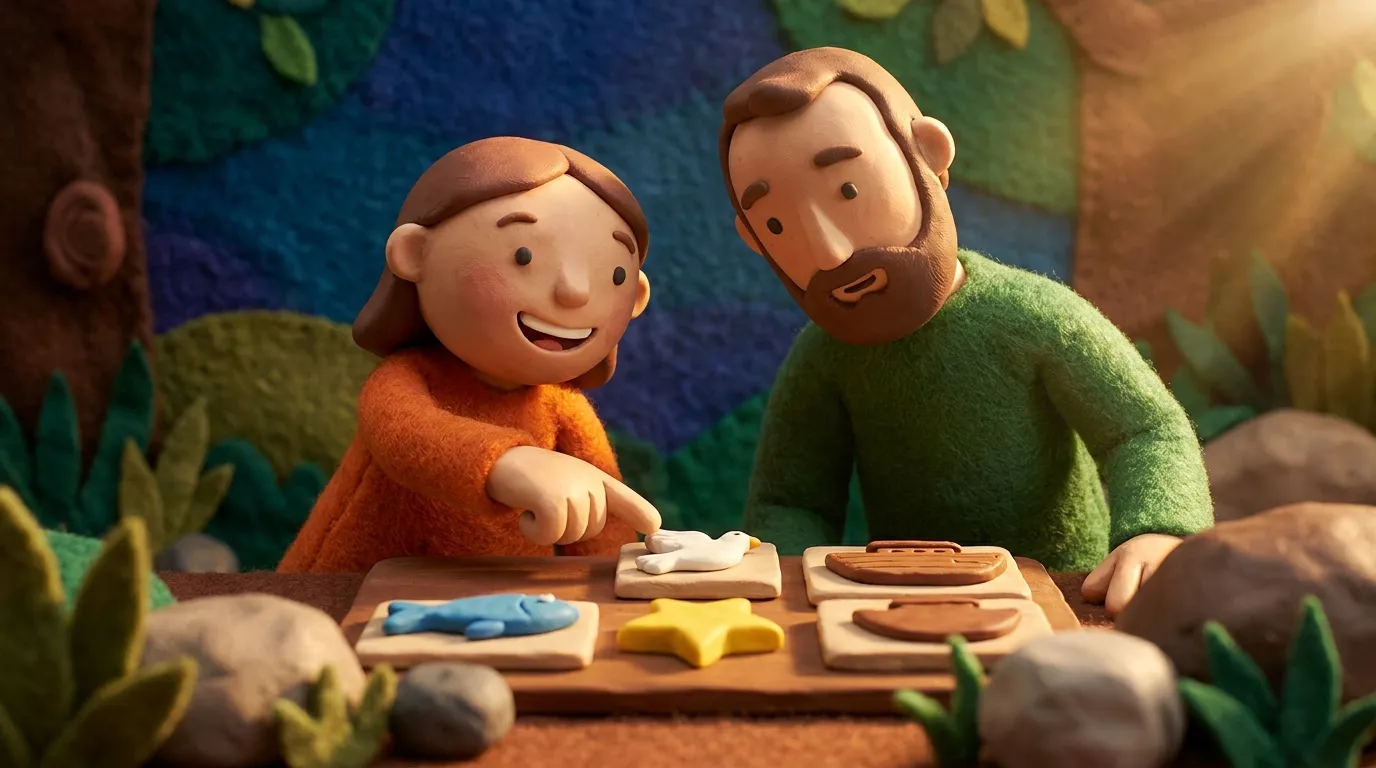 A game teaches more when it ends with a question from the person playing beside you.
Types of Bible games and what each one builds
Each type of game works a different skill. Trivia and Who Am I? build memory; word search helps kids recognize names; verse scramble draws attention to word order; charades asks kids to retell the scene. Pick the one that matches what you want your class or family to practice.
| Game type | What it builds | Suggested age | Time | Supplies |
|---|---|---|---|---|
| Who Am I? | Recalling characters from clues | 6 and up | 10 min | Clue cards |
| Bible charades | Retelling a scene with the body | 4 and up | 10 to 15 min | Folded slips |
| Team trivia | Recalling story facts | 7 and up | 8 to 15 min | Question list |
| Verse scramble | Word order and meaning | 7 and up (readers) | 5 to 10 min | Paper strips |
| Word search | Recognizing and spelling names | 6 and up | 5 to 10 min | Printout or app |
| Crossword | Recalling a word from a clue | 9 and up | 10 to 20 min | Printout or app |
| Bible sudoku | Logic and focus, using the letters of a verse | 6 and up (4x4) | 10 to 20 min | Printout |
| Bible Wordle | Guessing a five-letter Bible word from color clues | 8 and up | 5 to 10 min | Printout or pencil and paper |
| Bible Connections | Sorting 16 words into four Bible groups | 10 and up | 10 to 15 min | Printout |
| Memory match | Linking a character to a scene | 3 and up | 5 to 10 min | Card pairs |
| Sword drill | Finding books and references in the Bible | 8 and up | 10 min | One Bible per child |
| Themed treasure hunt | Retelling the story in order | 3 to 8 | 15 min | Toys or pictures |
| Story games on a phone | Reviewing characters and verses in short levels | 4 and up, with an adult | 10 to 15 min | Phone or tablet |
Recall games: Who Am I?, trivia and crosswords
In these games, kids have to pull the answer from their own memory, the same effort Roediger and Karpicke measured. Pitch the questions so most players get most of them right: the effort of remembering should fit the age of the players.
Search games: word search and memory match
In search games, the job is to find the word in the grid or the matching pair on the table. They’re great for locking in the spelling of hard names (Nebuchadnezzar, Melchizedek) and work well for kids who are still learning to read. To build easy and hard grids at home, see the guide to Bible word search puzzles by age.
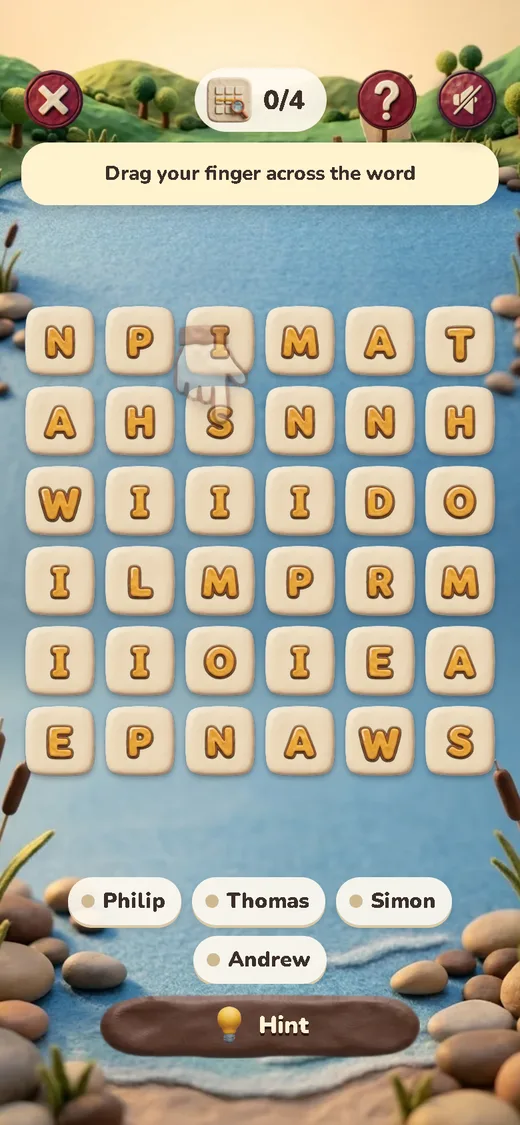 A word search with four apostles: the child drags a finger across each word.
Ordering and retelling games: verse scramble, charades and treasure hunts
Putting a verse in order makes a child notice every word, which sets up memorizing it later. Charades and treasure hunts ask kids to retell the story in the right sequence, a solid check on understanding. If you’d like to go from the game to knowing the verse by heart, the step-by-step guide on how to memorize Bible verses picks up from there.
Bible games by age
As kids grow, what changes is how well they read, how long they can sit still and how they handle losing. Little ones need movement and picture games; ages 6 to 8, short games with simple reading; 9 and up, clue-based challenges and references; adults and seniors, a calm pace and large print.
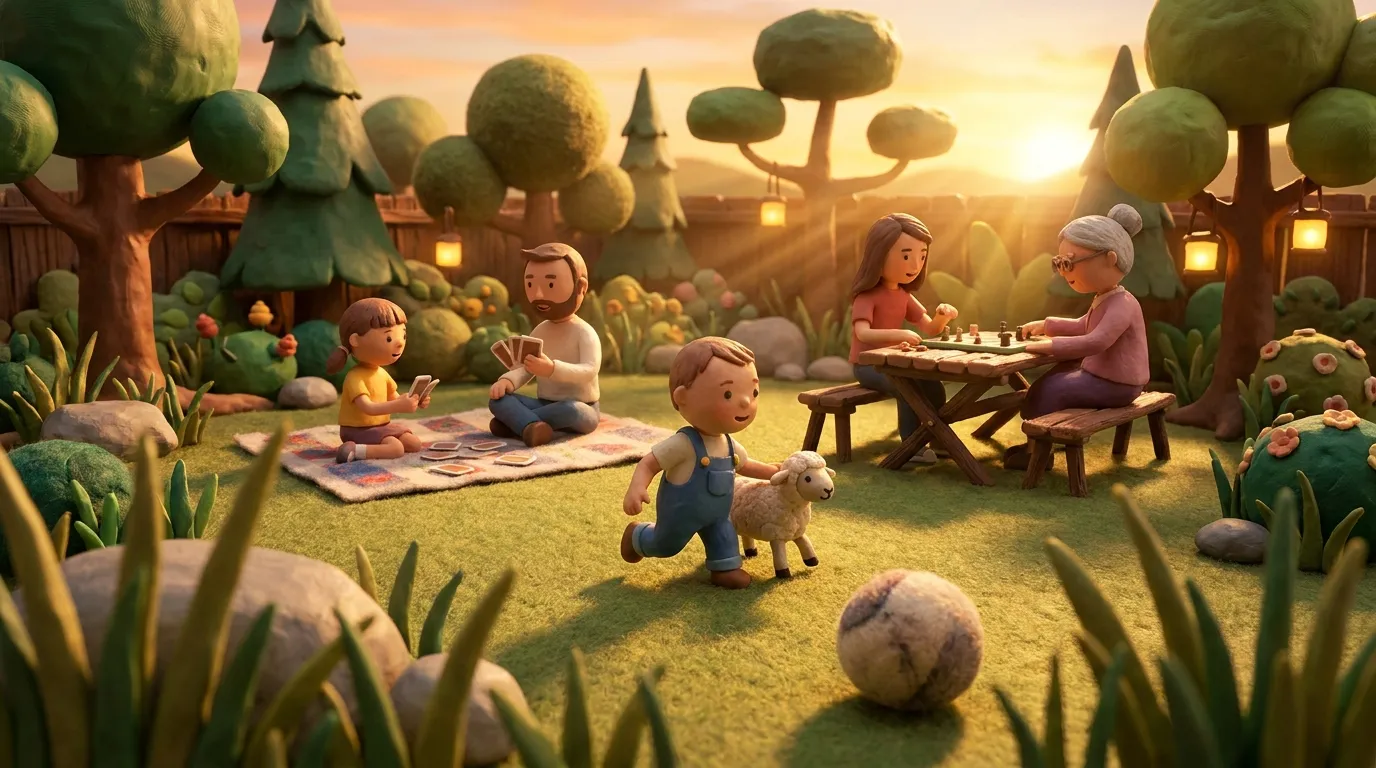 Movement and pictures for little ones, short reading from 6 to 8, clues and references from 9 up: every stage calls for a different kind of game.
Ages 2 to 5
At this age, the best games get kids moving: pretend to be the lions whose mouths stayed shut in Daniel’s den, march single file like the animals boarding the ark, hunt for hidden pictures. One-sentence rules and five-minute rounds. Skip any game where a wrong answer puts a child out.
The World Health Organization doesn’t recommend sedentary screen time for 1-year-olds and advises no more than one hour a day for children aged 2 to 4, adding that less is better. The same guidelines encourage reading and storytelling with a caregiver during quiet time. For this age, tabletop and movement games come first.
Ages 6 to 8
Reading arrives, and with it simple word searches, memory match with names, and yes-or-no trivia. It’s a good age for playing in pairs: the stronger reader helps the other, and both stay in the game.
Ages 9 to 12
Now you can use real clues: crosswords, Who Am I? with three clues from hard to easy, and sword drills. Kids this age love a timer and a scoreboard, so bring out the sand timer and split into teams. “Why?” questions at the end work well here.
Teens
Teens respond best to team games with a real challenge: trivia in rounds with categories (Old Testament, Gospels, Acts), Bible Taboo, and quick debates after a hard question. It works even better when they write the questions for the other team.
Adults and seniors
Adults enjoy crosswords, family trivia and logic puzzles with Bible themes. For seniors, large print, no clock and clear instructions matter most. A word search printed in large type or a phone game without a timer usually goes over well. Listening to the story before playing helps anyone who no longer reads comfortably; the article on the audio Bible explains how to fit listening into a daily routine.
Five ready-to-play Bible games for home
The games below fit into a weeknight, use paper, a pen and things you already own, and each one ends with a question to talk about. The idea is old. Moses told the people to talk about God’s words at home and along the road:
“These words I am commanding you today are to be upon your hearts. And you shall teach them diligently to your children and speak of them when you sit at home and when you walk along the road, when you lie down and when you get up.” (Deuteronomy 6:6-7, Berean Standard Bible)
1. Who Am I? in three clues (10 minutes)
Supplies: 10 cards. On each, one character and three clues, from hardest to easiest.
How to play: the reader gives the first clue. A correct guess on the first clue earns 3 points; on the second, 2; on the third, 1. Example for Joseph: “My brothers sold me.” “I explained Pharaoh’s dreams.” “My father gave me a colorful robe.”
For little ones: use only the easiest clue plus a picture.
Talk about it: “What did this person do when everything went wrong?”
2. Verse scramble (5 to 10 minutes)
Supplies: a short verse written on strips of paper, one or two words per strip. Make two sets for two teams.
How to play: mix up the strips on the table. The first team to put the verse in order wins. In round two, remove one strip and have them fill it in from memory.
For little ones: use only four or five strips and read the verse aloud first.
Talk about it: “Which word in this verse seems most important to you?”
3. Noah’s ark treasure hunt (15 minutes)
Supplies: pairs of toy animals or cut-out pictures, and a shoebox decorated as the ark.
How to play: an adult hides the animals around the room, each one far from its partner. Kids find both animals of each kind and “board” them together. When everyone’s inside, the adult tells the end of the story (Genesis 8 and 9): the dove with the olive leaf, and the rainbow.
For older kids: each pair boards only after the child answers a question about the story.
Talk about it: “How do you think Noah felt when the door of the ark opened?”
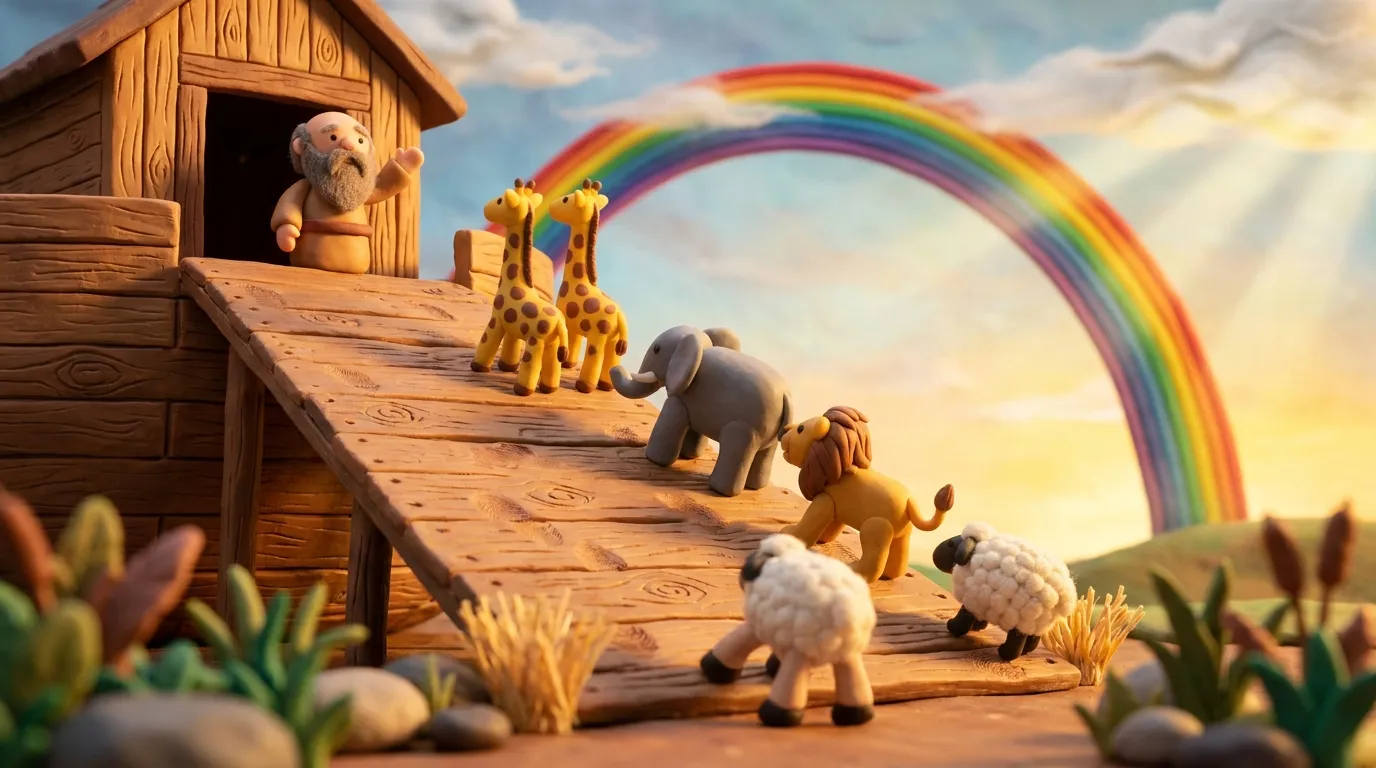 The ark treasure hunt ends with every pair on board.
4. Bible charades (10 to 15 minutes)
Supplies: folded slips with familiar scenes: Jonah swallowed by the fish, David with his sling, Peter walking on the water, Zacchaeus climbing the tree.
How to play: two teams. Each player draws a slip and has 60 seconds to get their team to guess the scene without speaking. Each correct guess scores a point.
For little ones: an adult acts it out and the kids guess together.
Talk about it: “In which of these stories did someone need courage?”
5. Fifteen minutes of a phone game, together (15 minutes)
Supplies: a phone or tablet with a Bible game.
How to play: sit side by side. The child plays and the adult reads the verse or story that shows up between levels. At the end, the child tells someone else in the house what they learned. The American Academy of Pediatrics recommends paying attention to the quality of kids’ screen use, and it points to research linking household rules about balance, content, using media together and talking about it with better well-being.
Talk about it: “Who showed up in the game today? What did they do?”
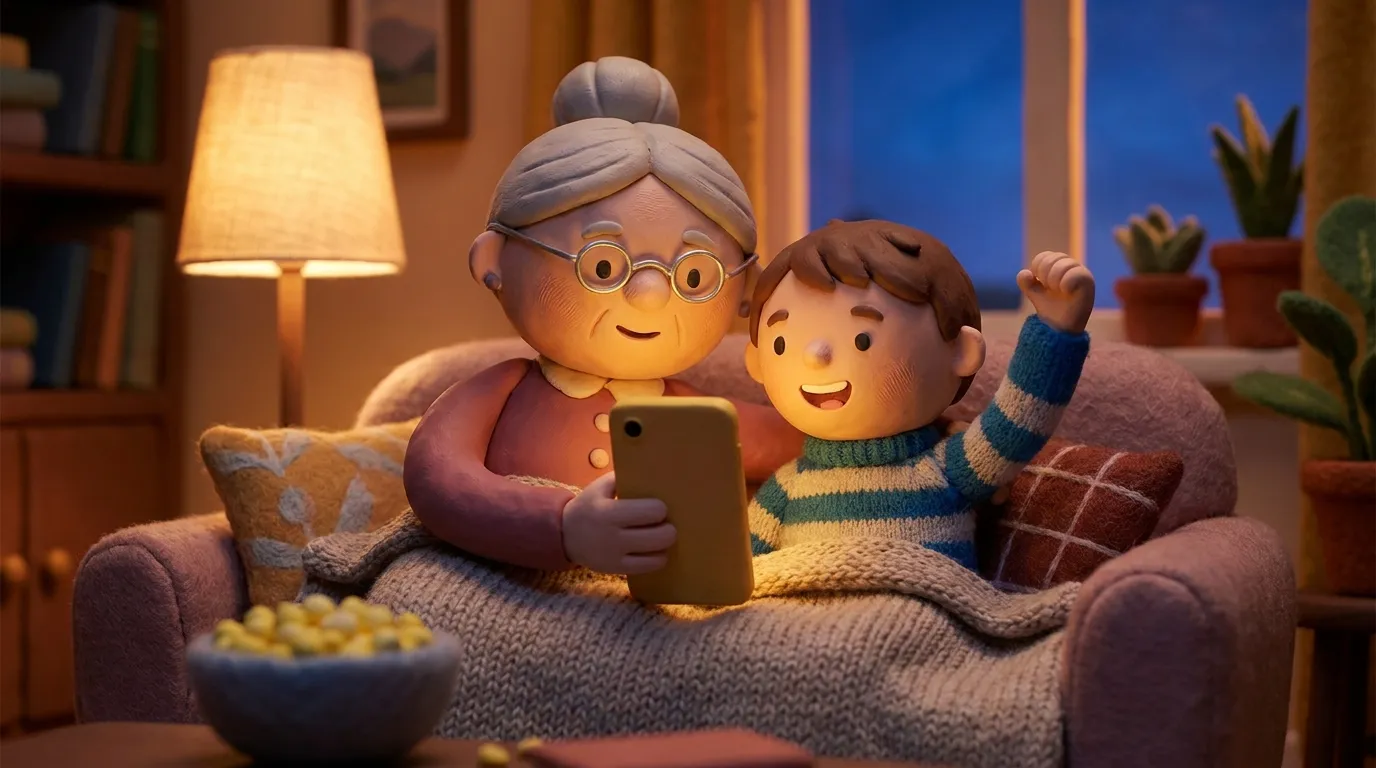 A phone game does more with someone beside you asking what happened.
A 20-minute Sunday school plan
In Sunday school, the game works best right after the story, while it’s still fresh, and before the discussion. In a 20-minute lesson, give the game about 8 minutes. The plan below uses David and Goliath (1 Samuel 17), and it works with any other story too.
| Minute | Step | What to do |
|---|---|---|
| 0 to 3 | Opener | Warm-up question: “What are you afraid of?” |
| 3 to 8 | Story | Tell David and Goliath with a clear beginning, middle and end; show a real or drawn sling |
| 8 to 16 | Game | Two-team trivia with 8 questions about the story |
| 16 to 19 | Discussion | “Why did David trust God?” and “Where do you need courage this week?” |
| 19 to 20 | Close | Say the memory verse together and pray |
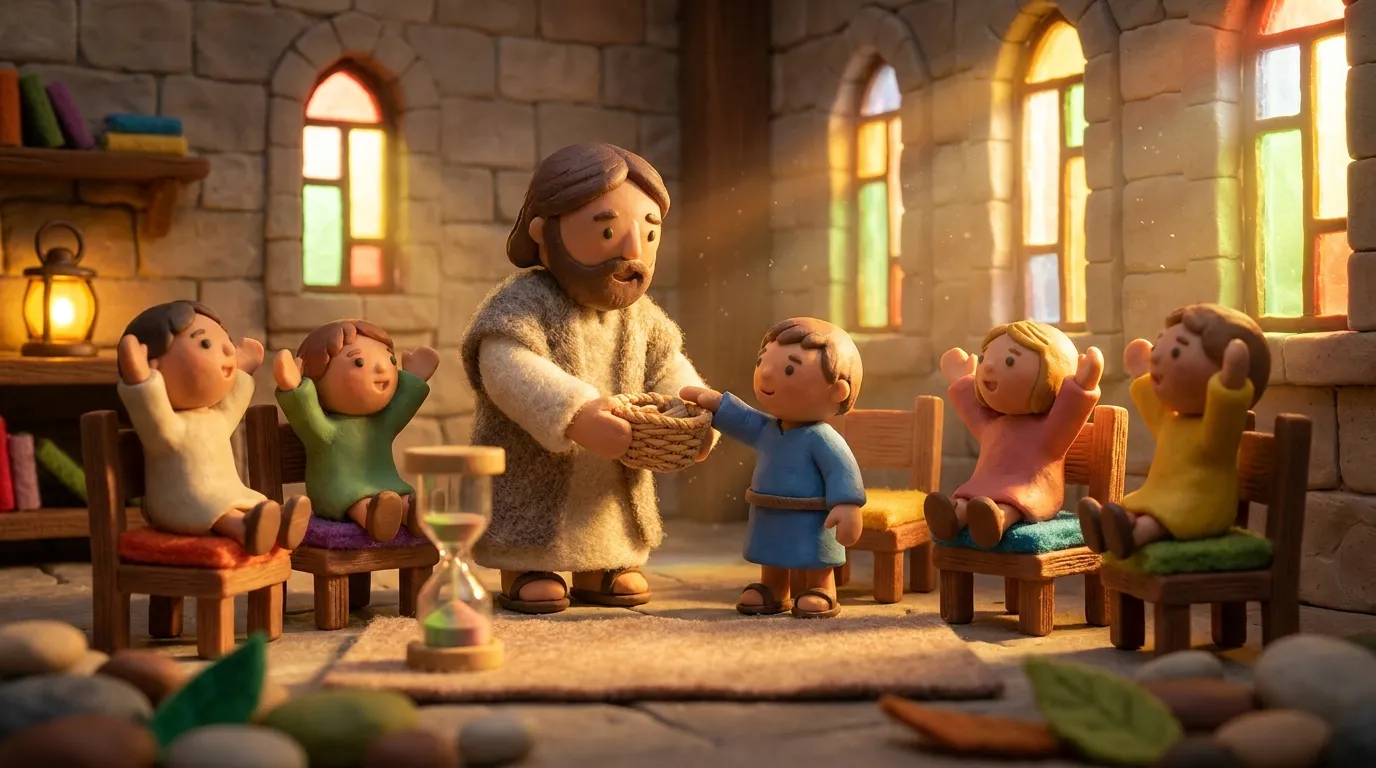 Chairs in a circle, a basket of questions and a sand timer: trivia fits in 8 minutes.
How to run team trivia
Split the class into two teams and give each a sheet of colored paper to raise when they know the answer. Ask questions the story you just told can answer: “Where did David get the stones?”, “How many did he take?”, “What did David do before he faced Goliath?” Answering as a group protects shy kids, and the whole team celebrates the point.
Kids who miss stay in the game, since a child knocked out in round one spends the rest of it staring at the floor. In mixed-age groups, hold up two pictures and let kids who can’t read yet point to the right one. And ask only about what you told, since questions about details that never came up in the story can only be guessed.
If your class spans very different ages, the guide on how to teach the Bible to kids has lesson ideas by age group that pair well with this plan.
Bible game apps: how to judge one
In your first five minutes with a new app, check whether it uses real Bible text with the translation named, whether it asks players to recall, whether ads pop up, whether purchases are easy to tap by accident, whether it works offline, and whether you can make the text larger.
| What to check | How to check it | Why it matters |
|---|---|---|
| Real Bible text | Does the verse show a reference and translation? | Without it, the game only has a Bible theme |
| Asks for recall | Are there levels where the answer isn’t on screen? | Pulling the answer from memory makes it stick |
| Ads | Play three levels and watch for interruptions | Distractions pull kids off task, according to Hirsh-Pasek and colleagues |
| Purchases and links | Tap the store buttons: is there an adult lock? | Apple requires a parental gate for purchases and links in Kids Category apps |
| Works offline | Turn on airplane mode and open a game | Road trips, church classrooms and grandma’s house don’t always have signal |
| Text size and pace | Is there large print, and are there games with no timer? | Seniors and young kids play better without a clock |
The app stores also have their own rules for children’s apps. On the App Store, apps in the Kids Category can’t include links out of the app, purchasing opportunities or other distractions unless they sit behind a parental gate, and they shouldn’t include third-party advertising or analytics. On Google Play, the Families policy bars ads shown to children that take over the screen without a clear way to close them or that can be mistaken for game content.
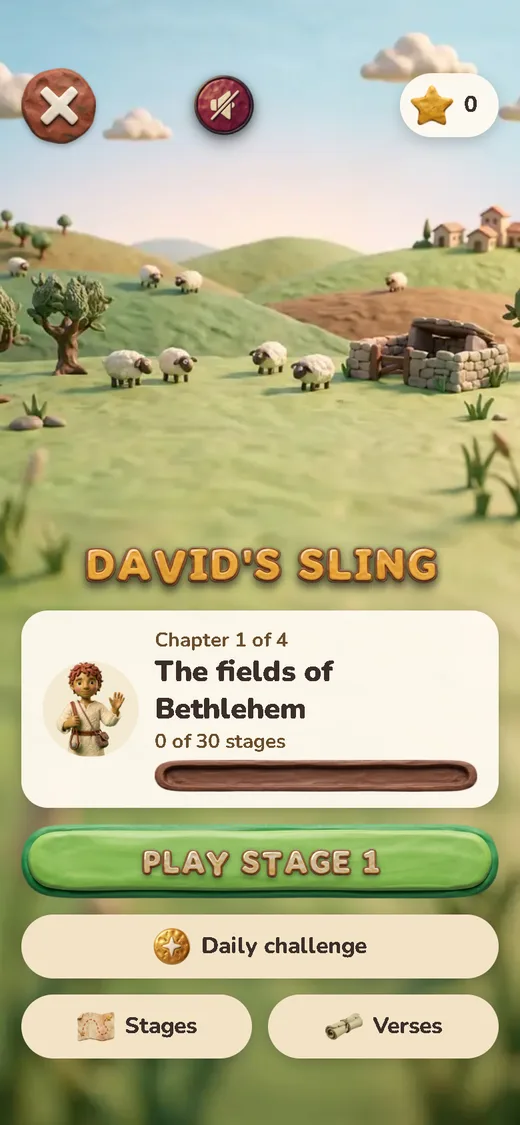 David’s Sling starts in the fields of Bethlehem, with 30 stages in the first chapter.
Our app, Terra Sinai, brings together dozens of games, from word searches and crosswords to story games like David’s Sling and Joseph’s Storehouse. It has no ads, the games work offline (only the audio Bible needs a connection), and when you first open it, your family picks a version by age: a child with an adult nearby, an adult, or a senior with larger text.
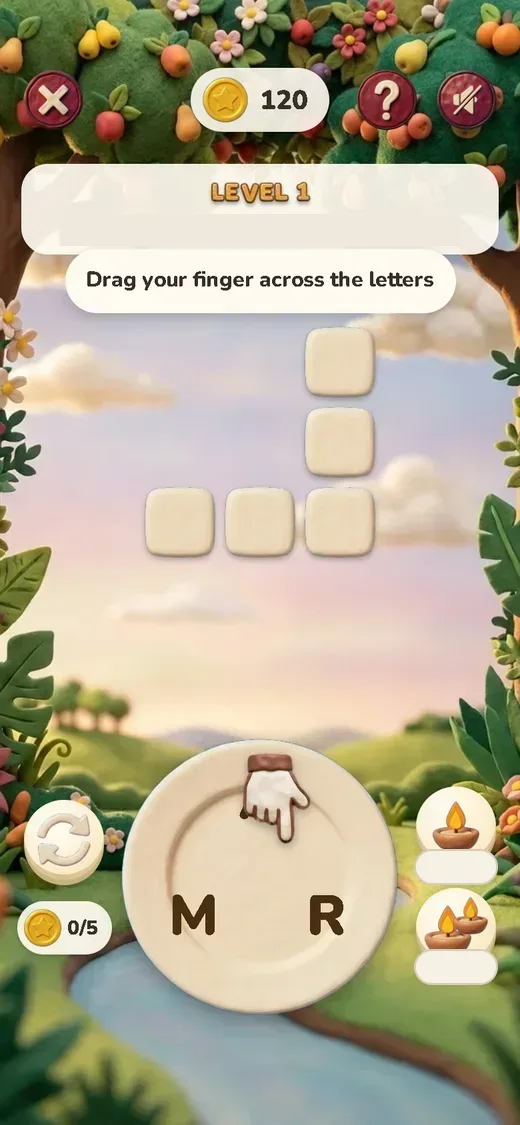 Letter wheel: each level follows a passage, here Abraham in Genesis 12 to 22.
Common mistakes with Bible games
Knocking out kids who miss, requiring reading from kids who can’t read yet, asking about details nobody mentioned, and playing a game with no link to the story are the slips that ruin Bible games most often.
Elimination. “Miss and you’re out” games sideline the very kids who need the most practice. Keep score by team so everyone stays in the game.
Required reading. A 5-year-old facing a word search full of long names will only get frustrated. Use pictures, or pair them with a reader.
Obscure trivia. “How old was Methuselah when he died?” calls for almanac-level memory. With kids, ask what happened, who did it, and why.
A game with no bridge. A high-energy game can get a bridge to the story too: “Now let’s run like Elijah ran ahead of Ahab’s chariot” (1 Kings 18:46).
Where to start this week
Pick one story, one game from the table that fits the age of your players, and one question for the end. In week one, three-clue Who Am I? is the easiest to prepare: ten index cards and a pen. If your family wants game nights to become a habit that lasts for years, the plan for how to memorize the Bible over the long term shows how to review what you’ve learned without losing the thread.
For a quick round before dinner, the Bible Wordle and the Bible word search online each have a new puzzle every day and open in a phone browser.
Sources
- Roediger, H. L., and Karpicke, J. D. (2006). Test-Enhanced Learning: Taking Memory Tests Improves Long-Term Retention. Psychological Science, 17(3). doi.org/10.1111/j.1467-9280.2006.01693.x
- Hirsh-Pasek, K., et al. (2015). Putting Education in “Educational” Apps: Lessons From the Science of Learning. Association for Psychological Science summary. psychologicalscience.org
- World Health Organization (2019). To grow up healthy, children need to sit less and play more. who.int
- American Academy of Pediatrics. Screen Time Guidelines (updated 2025). aap.org
- Apple. App Review Guidelines, 1.3 Kids Category. developer.apple.com
- Google Play. Families Policies. support.google.com
Frequently asked questions
What are some good Bible games for kids?
The most popular at home and in church are Who Am I?, Bible charades, Bible trivia, word search, crosswords, memory match with Bible characters, and sword drills, where kids race to find a verse reference in their Bibles.
What Bible games work for toddlers and preschoolers?
From ages 2 to 5, use movement and picture games: act out the animals boarding the ark, hunt for animal pairs hidden around the room, or match picture cards to the right scene. Keep rules to one sentence and rounds to about 5 minutes, and keep every child in the game.
How do you make a Bible game for Sunday school?
Tell the story first, then play something that makes kids remember it, such as team trivia or putting scenes in order. Give the game about 8 minutes and save 3 minutes to talk about what the story teaches.
Do Bible games help kids memorize Scripture?
They help when they make kids pull the answer from memory. In a 2006 study, students who took tests on a passage remembered 56% of it a week later, and students who reread it remembered 42%.
How much screen time is okay for Bible game apps?
The World Health Organization advises no sedentary screen time for 1-year-olds and no more than one hour a day for ages 2 to 4. The American Academy of Pediatrics adds that playing together and talking about what you played matter a great deal.
Keep reading
-
Fruit of the Spirit for kids: a family guide
Love, joy, peace and the rest of Galatians 5:22-23 in words kids understand, with family moments, games for busy evenings and a four-week verse plan. Read article -
Bible activities for kids: 15 easy ideas
15 Bible activities for kids to do at home with everyday supplies: crafts, puppets, a recipe, a treasure hunt, music and painting, with ages and steps. Read article -
Bible crossword puzzles (printable)
Two printable Bible crossword puzzles with answer keys, every clue checked against the Berean Standard Bible, plus solving tips and how to make your own. Read article