
Bible memory game: printable matching cards
A printable Bible memory game with 12 picture pairs, each tied to a verse checked in the Berean Standard Bible, plus rules, age levels and a class plan.
 The Terra Sinai team 10 min read
In this article (11)
A Bible memory game is the old card game Concentration played with pictures from Bible stories: you flip two cards, and if they match, you keep them. The two sheets below give you 12 pairs to print, from Noah’s ark to the crown of life, and each picture comes with a short verse so the game can lead back to the story. It works for a Sunday school table, a family night on the living room rug or an afternoon with the grandkids.
We checked every verse on this page in the Berean Standard Bible (BSB).
Printable Bible memory game: the two card sheets
Each sheet holds six pictures, and every picture appears twice, so one sheet makes six pairs and both sheets together make twelve.
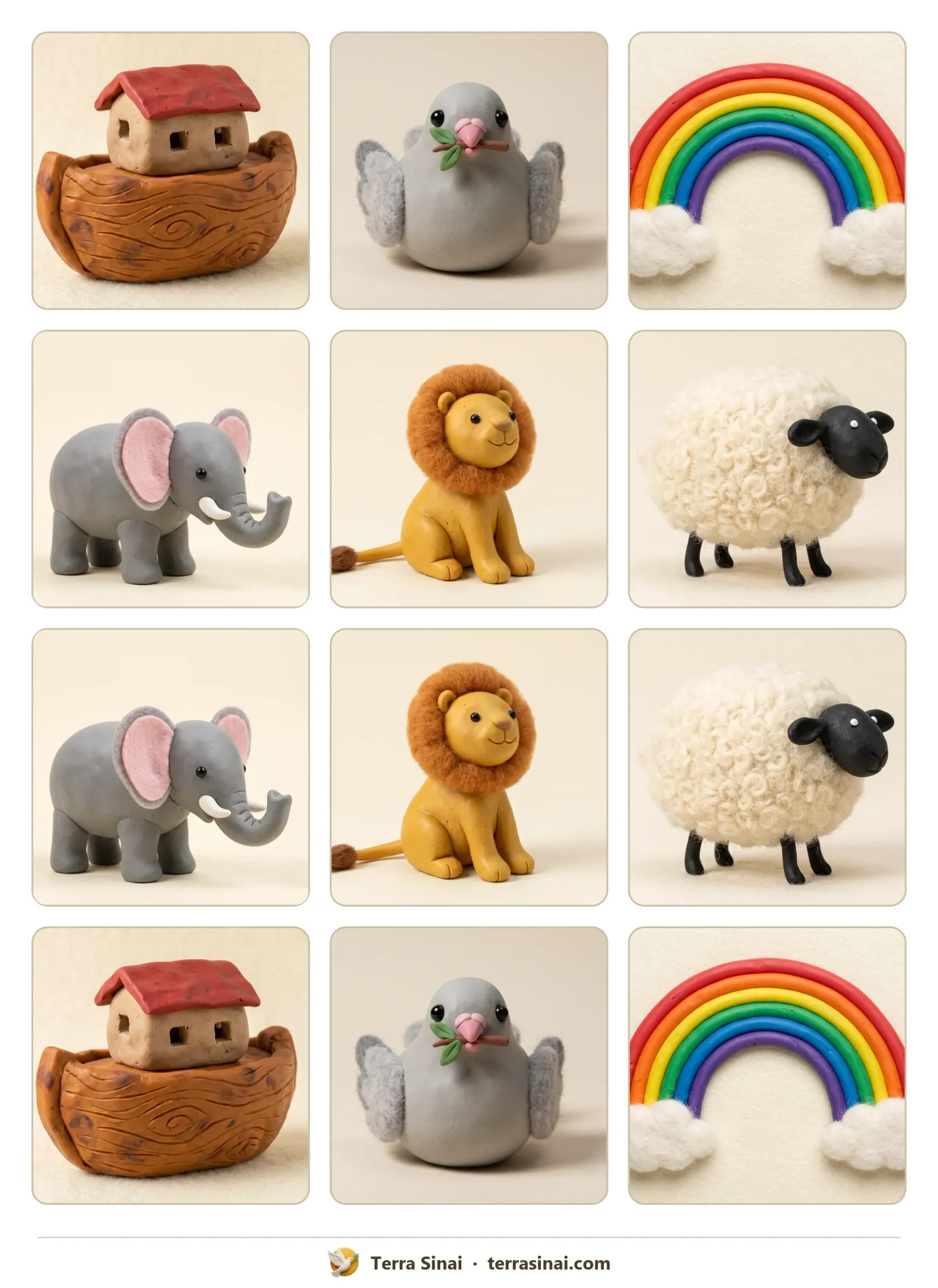 Sheet 1: ark, dove with olive leaf, rainbow, elephant, lion and sheep.
Sheet 2 moves from Noah’s animals to things people carried and used.
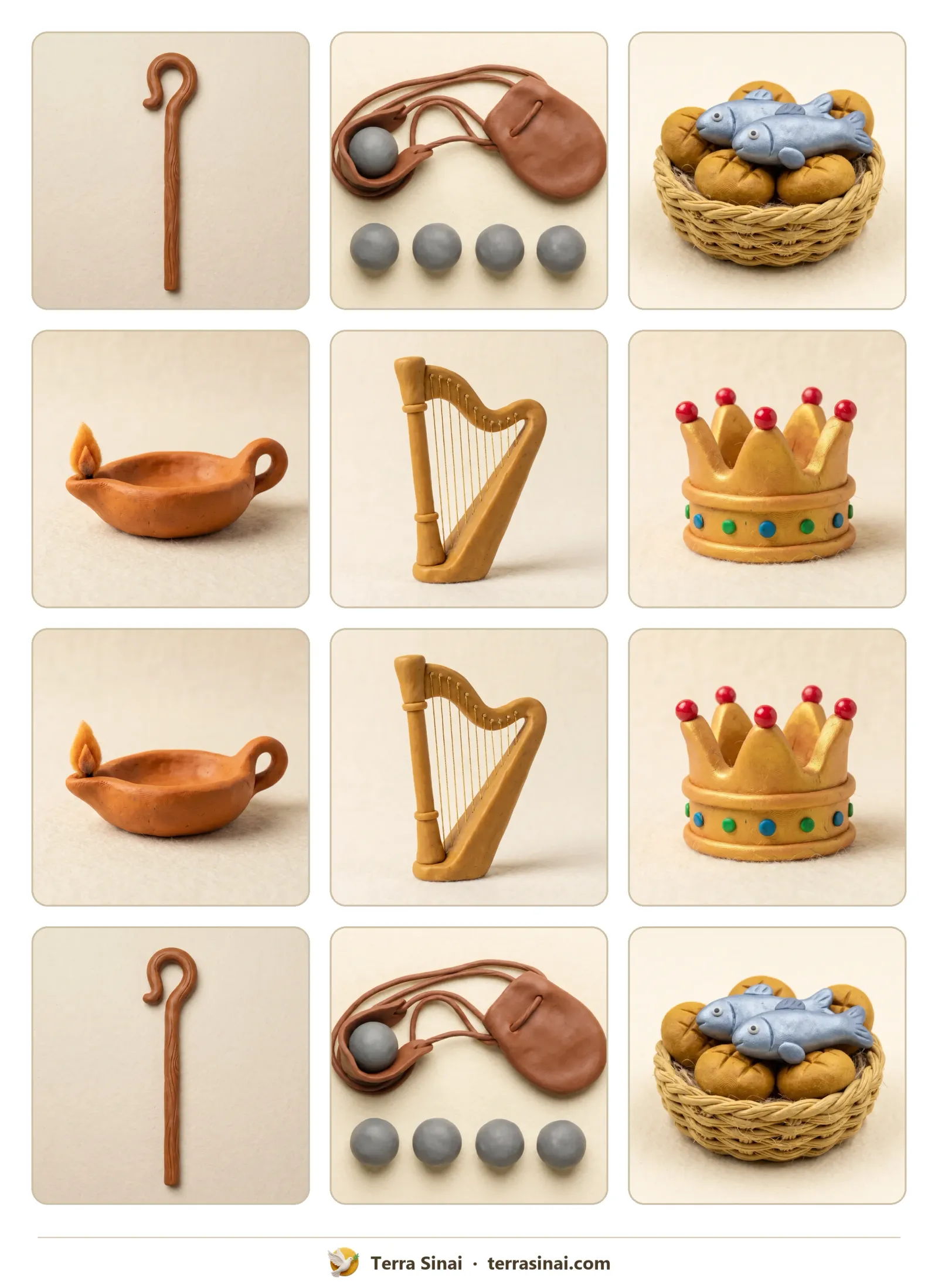 Sheet 2: shepherd’s staff, sling with stones, basket of loaves and fish, oil lamp, harp and crown.
How to print, glue and cut the cards
- Print. Open each sheet, choose letter-size paper and set the scale to 100% or “Actual size.” Print in color if you can.
- Glue. Spread a glue stick over the back of the printed sheet, all the way to the edges, and press it onto a sheet of colored cardstock. Cardstock in the 65 to 110 lb range is easy to find at office supply stores and still cuts with ordinary scissors. Smooth it with your palm from the center out and let it dry for a few minutes.
- Cut. Cut along the gaps between the pictures. Every card now has the same colored back, which keeps players from spotting a card by a smudge or a crease.
- Test. Hold one card up to a window. If you can see the picture through the back, glue on a second layer of cardstock.
- Protect (optional). Clear contact paper or a laminating pouch keeps the cards flat through a lot of Sunday mornings.
Little kids can help with the gluing. If they want to cut, give them round-tip safety scissors and keep the craft knife for the grown-up.
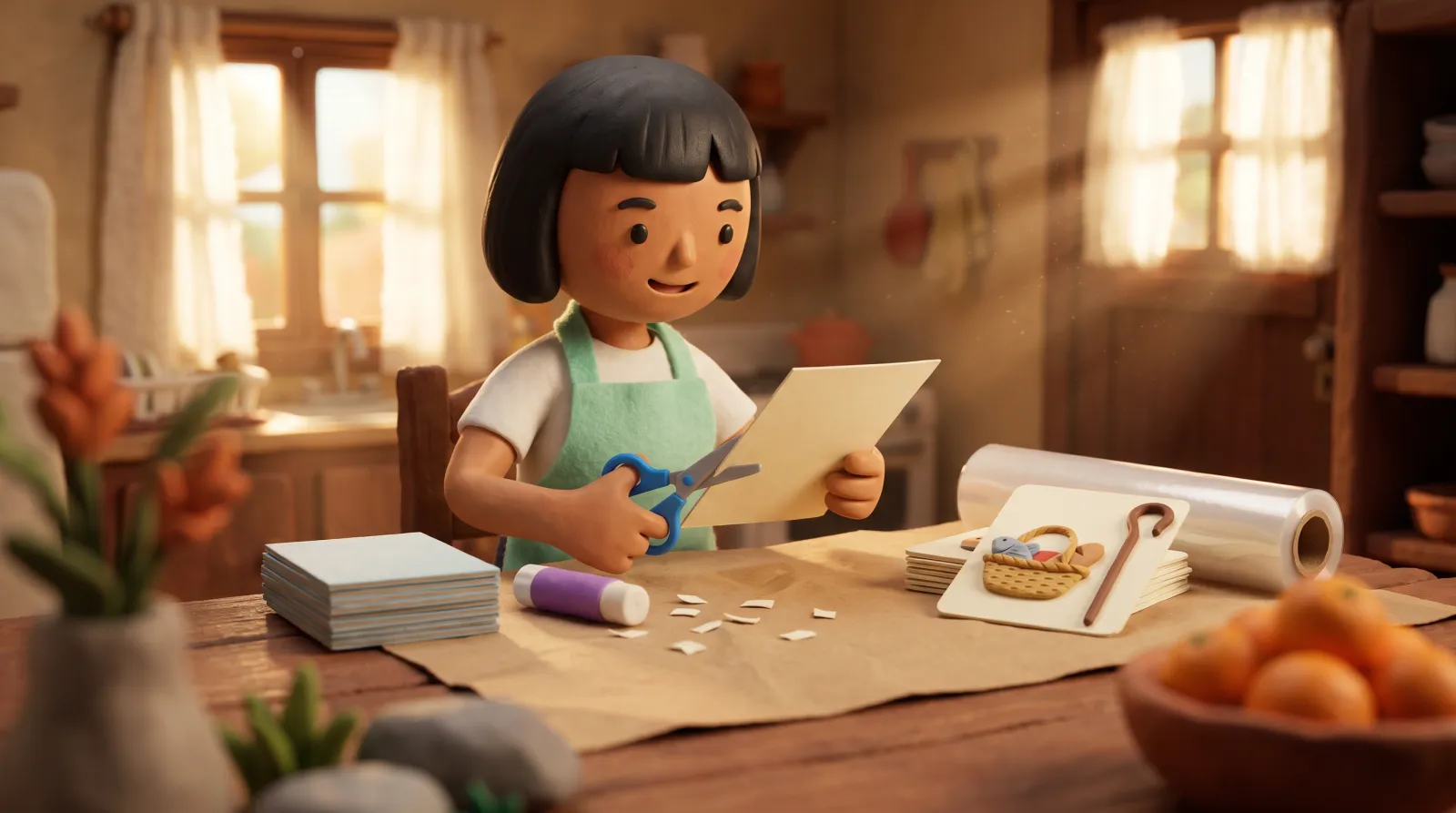 Cutting the cards apart at the kitchen table, with the glue stick and cardboard close by.
The 12 cards and the verse behind each one
Every time a player makes a match, ask them to tell the group what the picture has to do with the Bible. If they get stuck, read the verse in the right-hand column. All twelve quotations come from the BSB.
| Card | Where it’s from | Verse (BSB) |
|---|---|---|
| Wooden ark | God tells Noah how to build it | “Make for yourself an ark of gopher wood” (Genesis 6:14) |
| Dove with olive leaf | The sign that the flood was over | “the dove returned to him in the evening with a freshly plucked olive leaf in her beak” (Genesis 8:11) |
| Rainbow | God’s promise after the flood | “I have set My rainbow in the clouds” (Genesis 9:13) |
| Elephant | The animals entering the ark | “two by two, male and female, as God had commanded Noah” (Genesis 7:9) |
| Lion | Daniel in the lions’ den | “My God sent His angel and shut the mouths of the lions” (Daniel 6:22) |
| Sheep | The parable of the lost sheep | “Rejoice with me, for I have found my lost sheep!” (Luke 15:6) |
| Shepherd’s staff | The shepherd psalm | “Your rod and Your staff, they comfort me.” (Psalm 23:4) |
| Sling with stones | David goes out to meet Goliath | “selected five smooth stones from the brook” (1 Samuel 17:40) |
| Basket of loaves and fish | Jesus feeds the crowd | “Here is a boy with five barley loaves and two small fish.” (John 6:9) |
| Oil lamp | God’s word lights the way | “Your word is a lamp to my feet and a light to my path.” (Psalm 119:105) |
| Harp | David plays for King Saul | “David would pick up his harp and play.” (1 Samuel 16:23) |
| Crown | The reward God has promised | “he will receive the crown of life that God has promised to those who love Him” (James 1:12) |
Noah’s story in Genesis never names an elephant. The card stands for every animal that “came to Noah to enter the ark, two by two, male and female, as God had commanded Noah” (Genesis 7:9). When a child finds the second elephant, read that phrase aloud and let them say it back.
Older kids sometimes ask whether every animal came in twos. Read them Genesis 7:2, where God tells Noah to take “seven pairs of every kind of clean animal.”
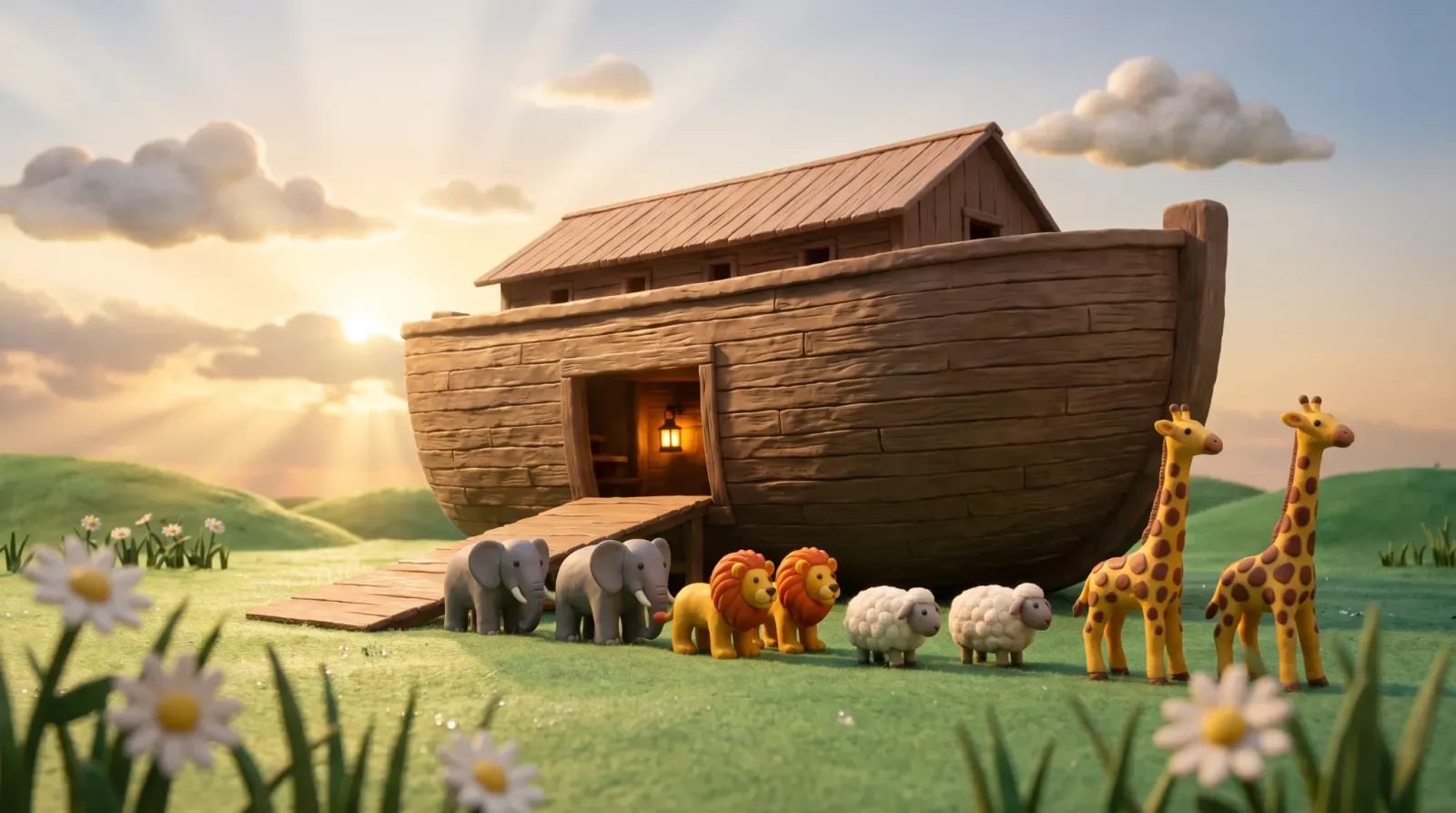 Pairs of clay animals walk up the ramp into the ark, two by two.
How to play the Bible matching game
The rules are the ones from Concentration, the card game also sold as Memory or called Pairs.
- Set up. Shuffle the cards and lay them face down in a grid. For one sheet, three rows of four. For both sheets, four rows of six.
- Take a turn. Flip two cards so everyone can see them.
- Match. If the pictures are the same, the player keeps the pair, says which Bible story it belongs to and takes another turn.
- No match. Turn both cards face down in the same spots. Play passes to the left.
- Finish. When the last pair is picked up, count the pairs. The player with the most wins, and a tie is fine.
Keep the story step light: “That’s the lion, from Daniel” counts. For a younger player, the grown-up can give a hint, like “Who slept near the lions all night?”
Picture and phrase: a version kids write by hand
Once a child can write, keep one copy of each picture and set the other copy aside. On blank cards cut to the same size (3x5 index cards cut in half work well), the child copies a short Bible phrase for each picture, in pencil, with the reference underneath. Now a pair is a picture and its phrase.
| Picture card | Phrase card the child writes |
|---|---|
| Wooden ark | “Make for yourself an ark of gopher wood” (Genesis 6:14) |
| Dove with olive leaf | “a freshly plucked olive leaf in her beak” (Genesis 8:11) |
| Rainbow | “I have set My rainbow in the clouds” (Genesis 9:13) |
| Elephant | “two by two, male and female” (Genesis 7:9) |
| Lion | “shut the mouths of the lions” (Daniel 6:22) |
| Sheep | “I have found my lost sheep!” (Luke 15:6) |
| Shepherd’s staff | “Your rod and Your staff, they comfort me.” (Psalm 23:4) |
| Sling with stones | “with his sling in hand” (1 Samuel 17:40) |
| Basket of loaves and fish | “five barley loaves and two small fish” (John 6:9) |
| Oil lamp | “Your word is a lamp to my feet” (Psalm 119:105) |
| Harp | “David would pick up his harp and play” (1 Samuel 16:23) |
| Crown | “the crown of life” (James 1:12) |
Have the child copy each phrase straight from an open Bible. That way the phrases match the page word for word, and copying gives them one more pass through the verse. If your church reads a different translation, use its wording and let the cards match your pew Bible.
In experiment 1 of Henry Roediger and Jeffrey Karpicke’s 2006 study, college students who practiced recalling a prose passage remembered 56% of it a week later, and those who only reread it remembered 42%. The students in that study read prose passages. To bring the same habit into the game, have a player say the phrase out loud from memory before turning the phrase card over. Kids who like that challenge can take it further with how to memorize Bible verses, which walks through one verse at a time.
Levels by age, from preschool to grandparents
Change the number of pairs and the extra step to fit the people at the table. The ages below are starting points; watch the players and adjust.
| Who’s playing | Pairs | How to play | The Bible step |
|---|---|---|---|
| Ages 3 to 4 | 3 or 4 | Start with the cards face up, then turn them over once the child knows them | A grown-up names the story |
| Ages 5 to 7 | 6 (one sheet) | Standard rules | The child names the story |
| Ages 8 to 11 | 12 (both sheets) | Standard rules, or the picture-and-phrase version | The child says the phrase |
| Teens and adults | 12 | Picture and phrase, or phrase and reference | Say the reference to keep the pair |
| Grandparents and grandkids | 6 | Cards printed large, on a table with good light | Grandparent tells the story in their own words |
In a 2019 study from Aarhus University, 34 six-year-olds, 48 eight-year-olds and 38 adults played a computer version of Concentration with 12 pairs, and the researchers counted the moves and seconds each player needed to find the first nine. By that measure, the 8-year-olds performed just as well as the adults, and both groups outperformed the 6-year-olds. The CDC’s milestones by 5 years include following rules or taking turns when playing games with other children.
A Bible memory game for adults
For adults, take the pictures away and match words. Write each of the 12 phrases on one card and its reference on another, with no pictures at all. To keep “Your word is a lamp to my feet,” a player has to find the card that says Psalm 119:105. For a small group Bible study, add a rule: before keeping any pair, the player reads the verse around it and says one thing it means to them. A round takes about 15 minutes with four or five people.
Playing with grandparents
For grandparents with tired eyes, print the sheets at 150% scale so each card comes out bigger, and play at a table near a window or under a lamp. Keep it to one sheet. The grandparent’s job at every match is to tell the story the way they learned it as a kid.
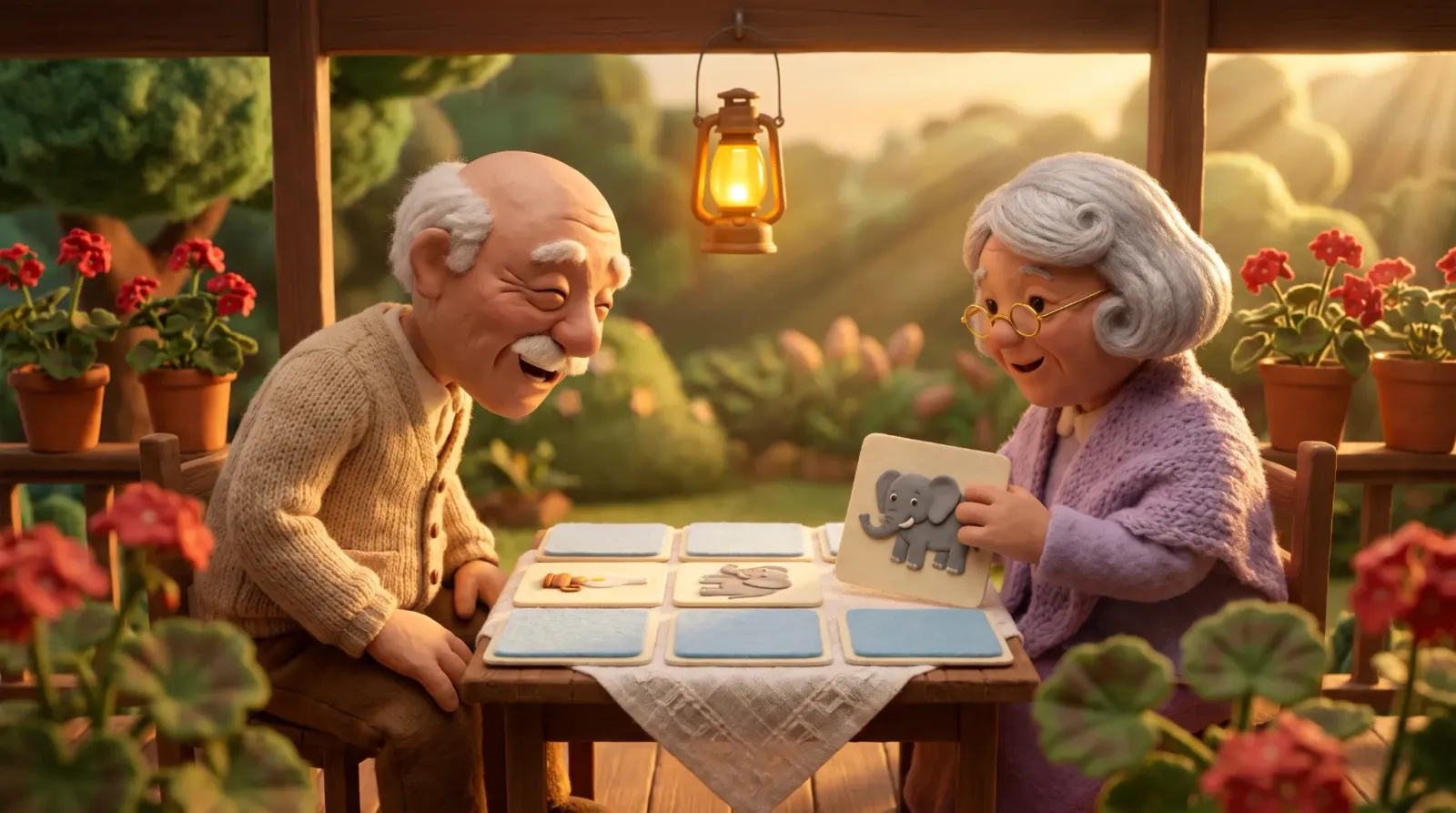 A round on the porch at sunset, with big cards and a lantern overhead.
If you’re looking for more ways to read and play with older family members, see our guide to Bible reading with seniors.
Using the game in Sunday school and VBS
This 15-minute plan uses sheet 1 with a class of six to ten kids.
| Minute | What to do |
|---|---|
| 0 to 3 | Read Genesis 7:9 aloud and ask the class what “two by two” means. |
| 3 to 5 | Lay out sheet 1 face down on a rug or table. Explain the rules and show one turn. |
| 5 to 12 | Kids take turns. Every match earns the pair only after the player names the story. |
| 12 to 15 | Each child holds up one pair and says the verse from the table above, with help from the teacher. |
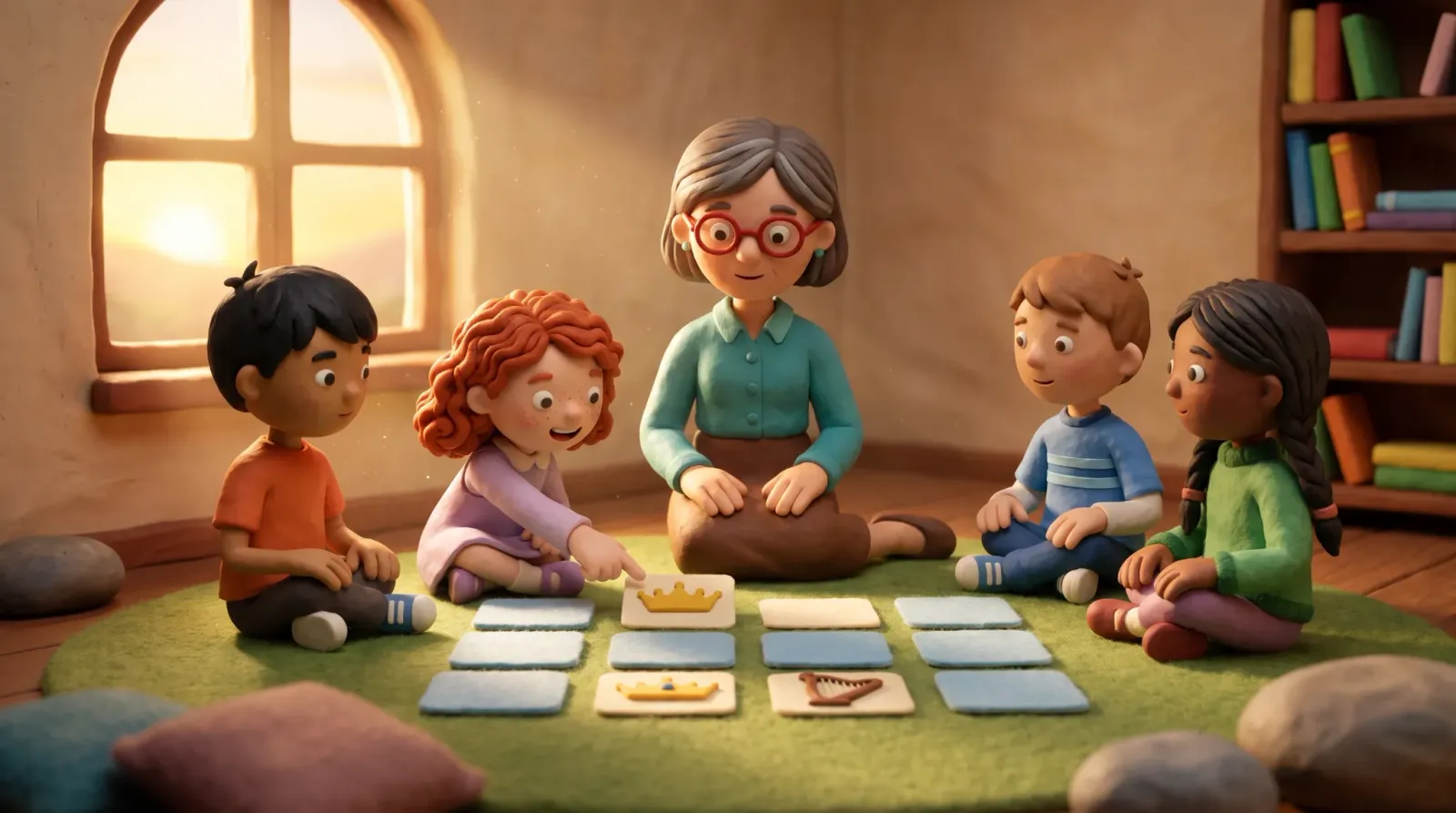 A Sunday school class on the rug, with the crown and the harp face up.
With a bigger class, make two or three sets and split the room into tables of four. Put a helper at each table to read the verses for kids who aren’t reading yet.
At Vacation Bible School, the cards fit a game station in the rotation. If your week covers Noah, use sheet 1 on that day. On a David day, pull out the staff, the sling and the harp from sheet 2 and add the sheep from sheet 1, so the station tells one story. Kids move through stations in about 15 to 20 minutes, which is enough for two quick rounds. Our list of Sunday school games has more ideas for the same time slot, and Bible games for families covers games you can play at home the rest of the week.
How to make your own Bible memory cards
You can make a set for any story your class is studying. Pick six to twelve objects or animals that appear in it, and check each one in the passage before you draw it. For the story of Joseph, Genesis 37:3 gives you the robe his father made him, and Genesis 41 gives you cows and heads of grain from Pharaoh’s dreams.
- Cut the blanks. Cut 2.5-inch squares from cardstock, two for every picture.
- Draw the pairs. Draw each picture twice with markers, or print small clip-art pictures and glue them on. For little ones, draw simple shapes in one or two colors.
- Write the reference. Put the verse reference in small letters in a corner, on both cards of the pair, so anyone can look it up after a match.
- Give them matching backs. Use cardstock of one color for the whole set, or glue the same patterned paper to every back.
- Store them. A zip-top sandwich bag holds a set, and you can label it with the story name.
Older kids enjoy making a set for younger siblings. They read the passage, decide what to draw and check every reference.
What the research says about memory games
We looked for a study showing that a matching card game helps kids remember Bible stories or verses, and we didn’t find one we could stand behind. The game asks players to look carefully, remember where a card was and, with the story step, put a Bible story into their own words. Roediger and Karpicke’s study, mentioned above, is about recalling text, and the picture-and-phrase version is the part of the game that asks for that kind of recall.
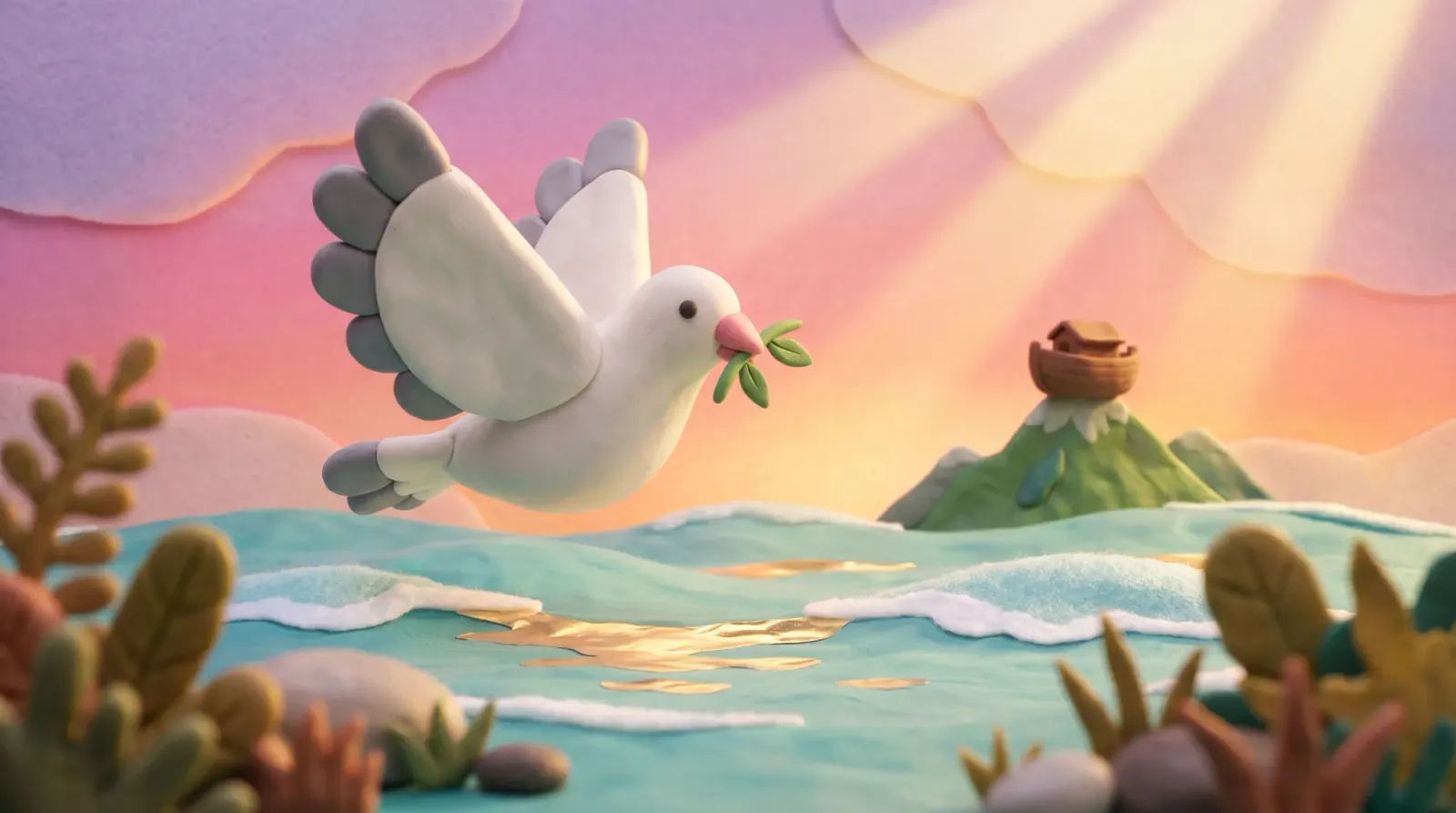 The dove with the olive leaf, from Genesis 8:11, flying home at dusk.
A Bible memory game on your phone
Our app has a matching game called Noah’s Ark. The cards sit in four rows of four on a grassy hill below a clay ark and a rainbow, each one face down with a small ark on its blue back. A verse sits at the top of the screen, with the words “Find the 2 matching animals” just below it.
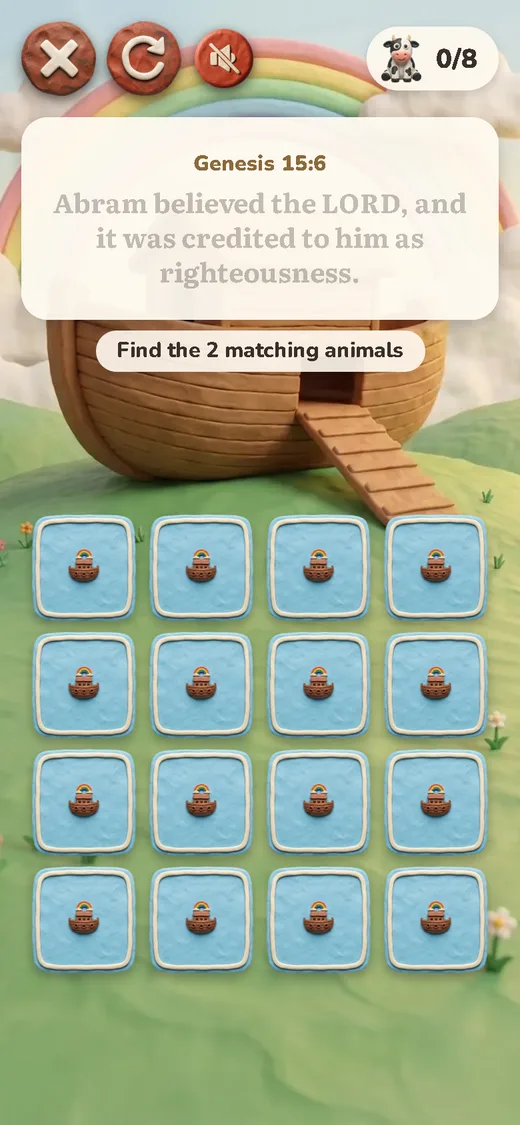 Sixteen blue cards, a cow keeping score and Abram’s verse in gray.
Every time you find two matching animals, part of the verse lights up. In the screenshot below, two pairs are found, a counter in the corner reads 2/8, and “Abram believed the LORD,” from Genesis 15:6, is highlighted.
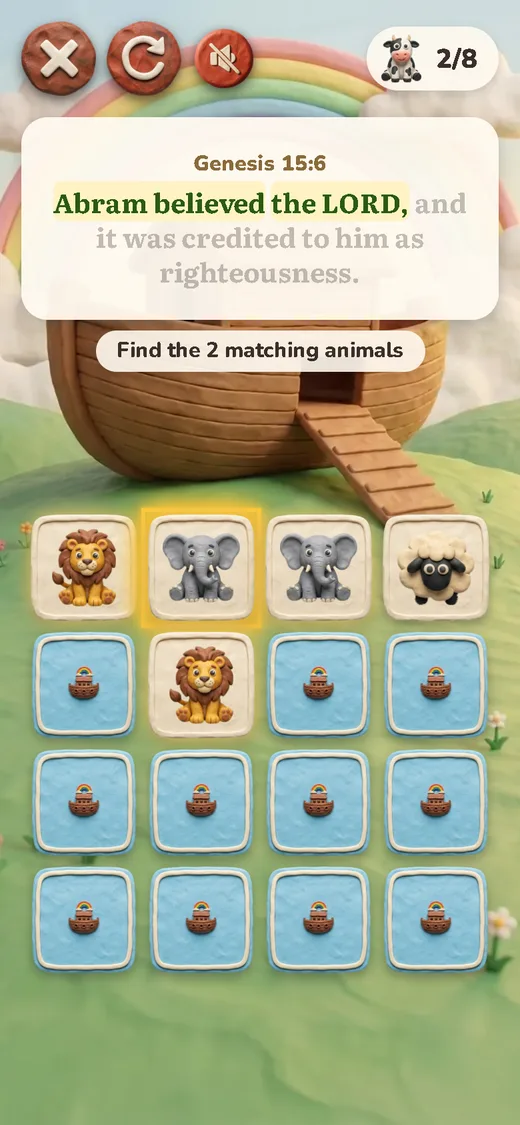 Lions and elephants matched, and “Abram believed the LORD” now shows in green.
For more ways to bring the Bible into play at home, see our Bible activities for kids or try the Who am I? Bible game at your next family night.
Sources
- Roediger, H. L. and Karpicke, J. D. (2006), Test-Enhanced Learning: Taking Memory Tests Improves Long-Term Retention, Psychological Science 17(3), 249-255.
- Krøjgaard, P., Sonne, T., Lerebourg, M., Lambek, R. and Kingo, O. S. (2019), Eight-year-olds, but not six-year-olds, perform just as well as adults when playing Concentration: Resolving the enigma?, Consciousness and Cognition 69, 81-94.
- Centers for Disease Control and Prevention, Milestones by 5 Years, from the Learn the Signs. Act Early. program, consulted October 2026.
- Bible text: Berean Standard Bible (Genesis 6, 7, 8, 9, 15, 37 and 41; 1 Samuel 16 and 17; Psalms 23 and 119; Daniel 6; Luke 15; John 6; James 1).
Frequently asked questions
How do you play a Bible memory game?
Lay all the cards face down in a grid and take turns flipping two at a time. When the pictures match, the player keeps them, names the Bible story they come from and flips again. When they don't, both cards go back face down in the same spots and play moves to the left. Count pairs when the table is empty; the most pairs wins.
What is a Bible matching game?
It's the classic card game Concentration, also sold as Memory or Pairs, played with pictures from Bible stories. The cards on this page show an ark, a dove, a rainbow, a lion, a harp and other pictures, and each one links to a verse.
What age is a Bible memory game good for?
Preschoolers can play with three or four pairs left face up at first. Kids from about 5 to 7 handle one sheet of six pairs, and from 8 up both sheets work. Teens and adults can play the version where a picture has to match a written Bible phrase.
How do I make a memory game at home?
Start with the sheets on this page: glue each one to a single color of cardstock, let it dry flat, then cut along the gaps. Clear contact paper keeps the corners from curling. To make a set from scratch, cut 2.5-inch cardstock squares and draw each picture twice.
Is there a Bible memory game for adults?
Yes. Swap half the picture cards for cards with a short Bible phrase written by hand, so a player has to match the harp to "David would pick up his harp and play," for example. A harder round asks the player to say the reference before keeping the pair.
Keep reading
-
Fruit of the Spirit for kids: a family guide
Love, joy, peace and the rest of Galatians 5:22-23 in words kids understand, with family moments, games for busy evenings and a four-week verse plan. Read article -
How to memorize the books of the Bible
How to memorize the 66 books of the Bible in order: small blocks, a 7-day plan, self-testing, tricks for look-alike names and a version for kids. Read article -
Bible activities for kids: 15 easy ideas
15 Bible activities for kids to do at home with everyday supplies: crafts, puppets, a recipe, a treasure hunt, music and painting, with ages and steps. Read article