
How to memorize the Bible: chapters and books
A plan to memorize whole chapters and books of the Bible: where to start, minutes a day, a 12-week table and review boxes that keep Scripture for years.
 The Terra Sinai team 13 min read

In this article (11)
To memorize the Bible and keep it, choose a whole, connected passage (a psalm, a chapter, then a short book), give it 10 to 15 minutes a day, add one small piece at a time, and recite everything you already know before each new piece. Spaced review, organized into a simple box system, keeps the text with you a year from now.
This guide is about the long game: chapters, books, and review over months and years. The technique for locking in a single verse (break it up, say it aloud, cover it) is in how to memorize Bible verses. Here we take that technique and scale it up.
“Let the word of Christ richly dwell within you as you teach and admonish one another with all wisdom, and as you sing psalms, hymns, and spiritual songs with gratitude in your hearts to God.” (Colossians 3:16, Berean Standard Bible)
What changes when you move from verses to chapters
In a chapter, each sentence cues the next one. In Psalm 23, the shepherd leads to still waters, then guides along right paths, then walks through the valley, then sets a table. The sequence makes sense, and that sense helps you recall what comes next.
The weak spot moves, too: people learning a chapter tend to remember each verse well and stall at the seam between one verse and the next. That’s why chapter review always runs in order, start to finish, with extra attention on those seams.
And the time horizon grows. A short book takes months of work and years of review, so it’s worth having a written plan with weekly targets and a clear rule for review.
How many minutes a day do you need?
Ten to fifteen minutes a day is enough to keep moving. People who’ve memorized whole books describe short daily routines, with a large share of the time going to review.
The numbers below are the ones Andy Davis, Kenneth Berding and Andy Naselli published about their own methods:
| Person | Daily routine | New text | Review | Reported result |
|---|---|---|---|---|
| Andy Davis, pastor in Durham, North Carolina | Up to 15 minutes | 1 verse a day: reads it aloud 10 times, then recites it 10 times without looking, reference included | Before the new verse, recites yesterday’s and all previous verses; after finishing a book, recites the whole book daily for 100 days | 42 books memorized by 2017 |
| Kenneth Berding, New Testament professor | About 15 minutes | Reads the passage aloud 50 times over several days before memorizing | Recites it from memory at least 25 times | Estimates all of Philippians in 3 to 4 months |
| Andy Naselli, New Testament professor | 45 to 75 minutes each morning | 1 or 2 sentences a day, recited word-perfect 10 times | Listens to recordings of his own voice; on Sundays he only reviews | 1 Corinthians in about 14 months, recited at a church service |
All three recite from memory every day and always review what they already have. The time varies a lot: Naselli says his sessions started short and grew as he had more chapters to review. If you’re just starting, 12 minutes a day gets you through a short psalm in two weeks and a chapter of about 20 verses in roughly five weeks.
 Manna came a little each morning. Daily time starts short and grows with review.
Where to start: Psalm 23, Philippians, or the Sermon on the Mount?
Start with Psalm 23. It has 6 verses and 116 words in the Berean Standard Bible, many people already know the first line, and you can finish it in about two weeks. Having one complete passage in your first month gives you momentum for the rest of the plan.
After the psalm, Philippians makes a great first book. It’s only 4 chapters, it reads like a warm personal letter, and chapter 4 holds lines many people want to keep (“Be anxious for nothing”). Save the Sermon on the Mount (Matthew 5 to 7) for when you’ve found your rhythm.
We counted the verses and words of each passage in the Berean Standard Bible, the English translation in our app, and estimated the time at one new verse per weekday (5 a week):
| Passage | Verses | Words (BSB) | Estimated time to learn | Good for |
|---|---|---|---|---|
| Psalm 23 | 6 | 116 | 2 weeks | A first step at any age |
| Psalm 1 | 6 | 123 | 2 weeks | A second short psalm, great for kids |
| 1 Corinthians 13 | 13 | 269 | 3 to 4 weeks | Anyone who wants a well-known chapter |
| Philippians 4 | 23 | 454 | 5 to 6 weeks | A first chapter from a letter |
| Philippians (whole book) | 104 | 2,161 | 5 to 6 months | A first book |
| Sermon on the Mount (Matthew 5 to 7) | 111 | 2,332 | 6 months or more | A second big project |
| Romans 8 | 39 | 904 | 2 to 3 months | Someone who has finished a short book |
The estimates include weeks off for consolidation. Some long verses, like several in Matthew 5, may take two days each. Don’t feel bad about adjusting the pace to fit your week.
Why reciting from memory and spacing your review work
Reciting without looking fixes text in memory. In the second experiment of Henry Roediger and Jeffrey Karpicke (2006) at Washington University in St. Louis, students studied short prose passages. The group that took repeated memory tests, writing down what they remembered without looking, retained 61% of the passage a week later. The group that restudied the same number of times retained 40%, and still felt more confident.
Spacing between reviews matters as well. A large review of research by Nicholas Cepeda and colleagues (2006) pooled 317 experiments and found that the best spacing between reviews grows with how long you want to remember. In a follow-up study with more than 1,350 people and a single review, Cepeda and colleagues (2008) found that to remember something a year out, the review paid off most when it came three to five weeks after the first study session.
In practice: cover the text and recite, every time, and stretch your reviews out gradually, from daily to monthly.
The 12-week plan
This plan takes you from Psalm 23 to two chapters of Philippians in three months, at about 12 minutes a day. That’s 47 verses in all, with two weeks set aside for consolidation only.
 The plan starts in Psalm 23 and reaches Philippians in twelve weeks.
| Week | New passage | Pace | Daily review | Milestone |
|---|---|---|---|---|
| 1 | Psalm 23:1-3 | 1 verse every 2 days | Everything you know of the psalm | Verses 1 to 3 from memory |
| 2 | Psalm 23:4-6 | 1 verse every 2 days | The psalm from the start to where you are | Recite the whole psalm to someone |
| 3 | Philippians 4:4-7 | 1 verse per weekday | Psalm 23 once | Psalm 23 moves to box 2 |
| 4 | Philippians 4:8-13 | 1 to 2 verses per weekday | Phil 4:4 onward | 10 verses of Philippians |
| 5 | Philippians 4:14-19 | 1 to 2 verses per weekday | Phil 4:4 onward | Middle section complete |
| 6 | Philippians 4:1-3 and 4:20-23 | 1 to 2 verses per weekday | Whole chapter in order | Philippians 4 complete |
| 7 | None | Review only | All of Phil 4 daily; the psalm by its box | Recite Phil 4 without stalling |
| 8 | Philippians 2:1-5 | 1 verse per weekday | Phil 2 so far + boxes | Phil 4 moves to box 2 |
| 9 | Philippians 2:6-11 | 1 verse per weekday | Phil 2 so far + boxes | The Christ hymn (2:6-11) |
| 10 | Philippians 2:12-15 | 1 verse per weekday | Phil 2 so far + boxes | 15 verses of Phil 2 |
| 11 | Philippians 2:16-18 | 1 verse every 2 days | All of Phil 2:1-18 | Phil 2:1-18 complete |
| 12 | None | Review only | Everything, once, in order | Recite Psalm 23, Phil 2:1-18 and Phil 4 to someone |
Philippians starts at 4:4 because it’s the best-known section, and wanting to know those lines carries you through the first weeks. Verses 1 to 3 and 20 to 23 come in later, once the chapter has a shape in your head. Weekends are for reciting and listening.
If you miss a day, repeat the last day you completed and continue from there. A week’s delay over three months is normal. New text goes in once the previous piece comes out without looking.
What a 12-minute session looks like
Here’s a typical session in week 9:
- Minutes 0 to 4: recite Philippians 2 from verse 1 as far as you know it, without looking. Where you stall, check the text and recite that spot again together with the verse before it.
- Minutes 4 to 9: the new verse. Read it aloud ten times, then recite it ten times without looking, the way Andy Davis does. Say the reference with it, if you chose to keep the numbers.
- Minutes 9 to 12: open today’s review boxes (next section) and recite the passages scheduled for today.
Keep the text on an index card, in a notebook or on your phone, in the same translation from the first chapter of the book to the last.
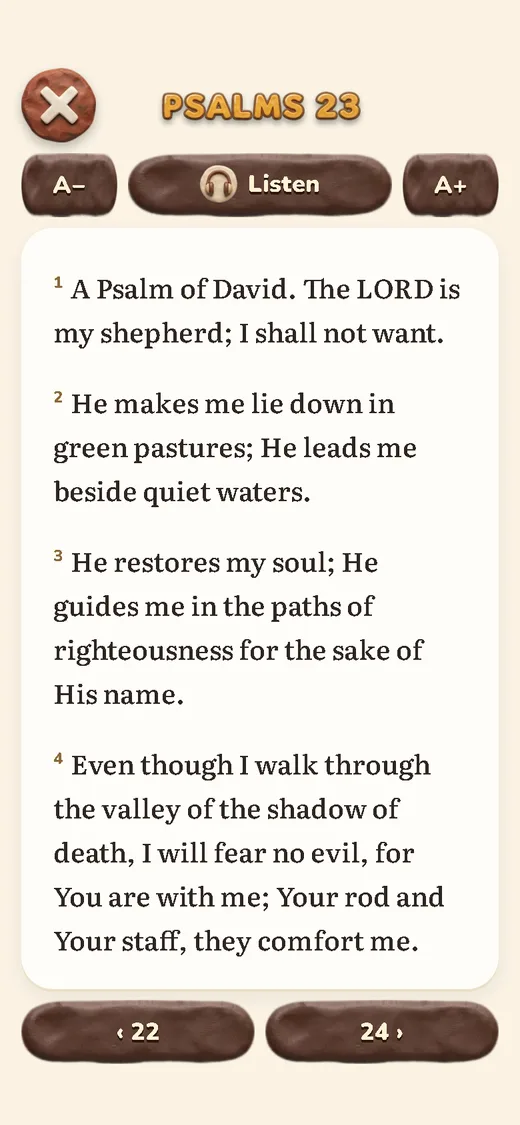 Psalm 23 in the Berean Standard Bible, with adjustable text size for reading and reciting.
Review boxes: the Leitner system applied to chapters
The Leitner system decides what to review today using boxes. German science journalist Sebastian Leitner proposed it in 1972 in his book So lernt man lernen (“How to learn to learn”), according to Wikipedia’s entry. Under the original rule, each card you get right moves up to the next box, which you review less often, and each card you miss goes back to the first box.
For chapters, the card becomes a paragraph (3 to 6 verses that form one thought), and you always recite it together with the last verse of the paragraph before, to practice the seam. Here’s the calendar we suggest:
| Box | When to review | What goes in it | Moves up when | Moves down when |
|---|---|---|---|---|
| 1 | Every day | The passage you’re learning | You recite it 3 days in a row with no errors | Stays in box 1 |
| 2 | Every 3 days | Paragraphs learned in recent weeks | 3 clean reviews in a row | You stall twice at the same spot: back to 1 |
| 3 | Once a week | Solid chapters | 4 clean weeks | Any miss: back to 2 |
| 4 | Once a month | Chapters from months ago | 3 clean months | Any miss: back to 3 |
| 5 | Every 3 months | Passages you’ve held for over six months | Stays in box 5 | Any miss: back to 4 |
In this calendar, a miss sends a passage back just one box, a gentler rule than Leitner’s for someone who dropped one word from a whole chapter. The monthly box falls inside the three-to-five-week range from Cepeda’s study. The quarterly box is our own suggestion for people who want to keep a passage for several years; the study didn’t measure repeated reviews over that span.
 Like Joseph’s granaries, each box stores what you already gathered until it is time to review.
A worked example
In week 3, Psalm 23 leaves box 1 and goes into box 2: you recite it, say, Mondays and Thursdays. In week 5, after three clean reviews, it moves to box 3 and you recite it only on Saturdays. At the start of month 3, it moves to box 4. If one Saturday you swap “green pastures” for something else, the psalm drops one box and you review it more often until it’s solid again.
The boxes can be physical (envelopes with the paragraphs written out) or a list in a notebook with the next review date for each passage. Any format works, as long as you open the list every day and do what it says.
After the first year
Over time, box 5 fills up and box 1 becomes the home of your next book. At 5 verses a week, by the end of a year you’ll hold close to 200 verses, roughly all of Philippians plus a good part of the Sermon on the Mount. Andy Davis adds one more step: when he finishes a book, he recites the whole thing every day for 100 days before starting another.
What people who memorized whole books report
The most detailed public accounts come from pastors and Bible teachers. Each has a different routine, and all three recite every day and review what they already know.
Andy Davis, pastor of First Baptist Church in Durham, North Carolina, had memorized 42 books of the Bible by 2017, according to professor Donald Whitney, who wrote about him in Tabletalk. His method is simple and repetitive: one verse a day, ten readings aloud and ten recitations without looking, always with chapter and verse. Each day, before the new verse, he recites yesterday’s verse and all the ones before it. Davis says he never spends more than fifteen minutes a day. The method is laid out in his booklet An Approach to Extended Memorization of Scripture.
Andy Naselli, a New Testament professor, adapted Davis’s method and took about 14 months to memorize 1 Corinthians, a letter that takes close to an hour to read aloud, as he explains in 11 steps to memorizing an entire book of the Bible. He strips out the verse numbers, memorizes while walking, records himself and listens to the recordings, and only counts a recitation when it comes out with zero mistakes. At the end, he recited the whole letter at a church service.
Kenneth Berding, a New Testament professor at Talbot School of Theology, learned from a former teacher who read a passage aloud 50 times before preaching it. Berding turned that into a method: pick a passage that takes about 15 minutes to read aloud, read it once or twice a day until you reach 50 readings, and only then memorize it. He says that by then, much of the text had already stuck without effort.
 The traveler in Acts 8 read Isaiah aloud. Berding and Naselli also describe reading aloud and listening to recordings.
Berding’s method pairs well with audio. Listening to the chapter read aloud a few times a day, on your commute or while doing dishes, counts as a reading and prepares the ground for memorizing. We cover how to fit that into your routine in the audio Bible guide.
 Psalm 23 read aloud takes under a minute, so it fits several times into a short drive.
Memorizing as a family and at church
Memorizing with other people brings rhythm and some friendly accountability, and the Bible itself describes that model at home:
“These words I am commanding you today are to be upon your hearts. And you shall teach them diligently to your children and speak of them when you sit at home and when you walk along the road, when you lie down and when you get up.” (Deuteronomy 6:6-7, Berean Standard Bible)
In practice, the family picks one passage a month and recites it together at a time you already share, like dinner. Young children join in by hearing the adults repeat it and chiming in on the lines they recognize.
 At dinner, the family recites the month’s passage together, and little ones join the lines they already know.
A 10-minute dinner-table routine
- 2 minutes: one adult reads the month’s passage aloud, slowly.
- 3 minutes: everyone repeats it together, phrase by phrase. The youngest repeat only the first line.
- 3 minutes: each person tries to say the part they know without looking. If someone gets stuck, give them the first word as a hint.
- 2 minutes: one question about the text: “What does this line mean for us today?”
At the end of the month, everyone recites what they can. For kids, the passage can be a single verse from the same chapter; how to teach the Bible to kids has ideas by age. And Bible games for families keep the topic in the conversation between one dinner and the next.
 The Verse of the Day in our app gives you a short line to talk about at dinner.
At church or in a small group
A group can memorize the same chapter, each member at their own pace, and recite it together once a week. Agree on the translation first, since two versions trip each other up when a group recites aloud. When the chapter’s ready, ask your pastor for a few minutes to recite it in a service, the way Naselli did. A date on the calendar helps everyone keep up with review.
Mistakes that stall the plan
When a long-term plan stalls, one of these is usually behind it:
- Starting with the longest passage. Romans 8 or the Sermon on the Mount as a first project can feel endless. Finish a psalm or a short chapter first.
- Leaving a finished book behind. If you finish Philippians and jump to the next book without putting Philippians in the boxes, you’ll lose the letter within a few months. A finished book goes into box 3 and follows the calendar.
- Only reviewing paragraphs on their own. Reciting paragraphs out of order hides weak seams. At least once a week, recite the whole chapter from start to finish.
- Speeding up when things go well. Doubling your new text in a good week overloads box 1, and two weeks later the review no longer fits in 12 minutes. Stick to the pace in the table.
- Cutting review on busy days. When the day gets tight, do the review and leave the new verse for tomorrow.
- Quitting after a stumble. Forgetting a paragraph is part of the process. It drops a box and you keep going.
If your memory feels slower than it used to, cut the pace to one verse every two days and give review more of your time. The plan works at any age, at whatever speed suits you.
Sources
- Roediger, H. L., & Karpicke, J. D. (2006). Test-enhanced learning: taking memory tests improves long-term retention. Psychological Science, 17(3).
- Washington University in St. Louis (2006). Repeated test-taking better for retention than repeated studying.
- Cepeda, N. J., et al. (2006). Distributed practice in verbal recall tasks: a review and quantitative synthesis. Psychological Bulletin, 132(3).
- Cepeda, N. J., et al. (2008). Spacing effects in learning: a temporal ridgeline of optimal retention. Psychological Science.
- Whitney, D. S. (2017). He’s memorized 42 books of the Bible, and you can too. Crosswalk / Tabletalk.
- Naselli, A. (2015). 11 steps to memorizing an entire book of the Bible. The Gospel Coalition.
- Berding, K. (2012). The easiest way to memorize the Bible. Biola Magazine.
- Leitner system. Wikipedia.
Frequently asked questions
How many minutes a day does it take to memorize the Bible?
Ten to fifteen minutes a day is enough to work through whole chapters. Pastor Andy Davis, who has memorized dozens of books, says he never spends more than fifteen minutes a day. Consistency counts for a lot: every day, reviewing before you add new text.
What is a good chapter of the Bible to memorize first?
Psalm 23 is the best place to start: 6 verses and just over 100 words, and many people already know the first line. After that, try a chapter of Philippians (chapter 4 has 23 verses), and later the whole letter or the Sermon on the Mount.
Can you really memorize a whole book of the Bible?
Yes, and there are public accounts of it. Andy Davis had memorized 42 books by 2017, and Andy Naselli took about 14 months to memorize 1 Corinthians. For a first book, Philippians (104 verses) takes a few months at one verse per weekday.
How do I keep from forgetting what I memorized?
Use spaced review: the passage you're learning comes back daily, what's solid comes back every few days, then weekly and monthly. A box system (the Leitner method) organizes this and tells you what to review today.
Should I memorize the verse numbers?
It depends on your goal. Andy Davis always recites chapter and verse, because it helps him find and quote the text. Andy Naselli strips the numbers out to learn the letter as one flowing piece. Pick one approach and keep it until you finish the book.
How long would it take to memorize the entire Bible?
There's no reliable number, and very few people attempt it. A realistic goal: a chapter in weeks, a short book in months, and a growing collection of books over the years, kept alive by review.
Keep reading
-
Bible characters: who they were and where
The main Bible characters in story order, from Adam to Paul, with the book and chapter for each, what they did, what they teach and a section on the women. Read article -

Fruit of the Spirit for kids: a family guide
Love, joy, peace and the rest of Galatians 5:22-23 in words kids understand, with family moments, games for busy evenings and a four-week verse plan. Read article -

Noah's ark story for kids, scene by scene
Noah's ark for kids in read-aloud scenes from Genesis 6-9, every number checked in the text, questions by age, crafts and how to tell the flood gently. Read article