
Fruit of the Spirit for kids: a family guide
Love, joy, peace and the rest of Galatians 5:22-23 in words kids understand, with family moments, games for busy evenings and a four-week verse plan.
 The Terra Sinai team 13 min read
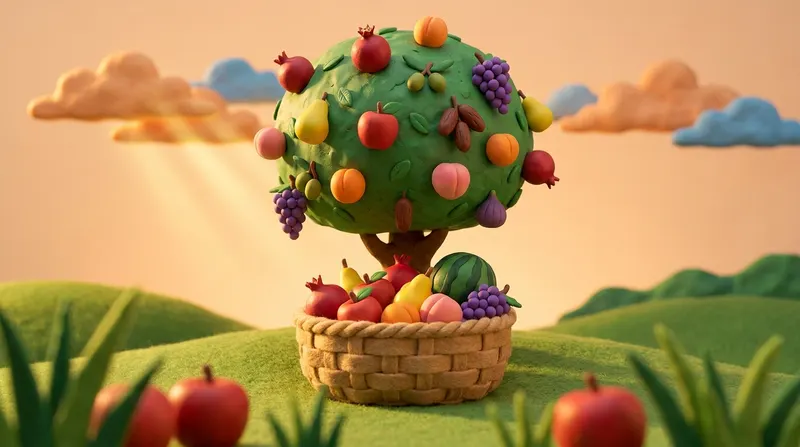
In this article (10)
Paul packs nine qualities into two verses of his letter to the Galatians. In the Berean Standard Bible they’re love, joy, peace, patience, kindness, goodness, faithfulness, gentleness and self-control, and Paul calls them the fruit that God’s Spirit grows in people who follow Jesus. This guide gives you a kid-sized definition for each one, moments from ordinary family life where you’ll spot it, games that fit between homework and bedtime, and a plan for learning the verse by heart in about a month.
But the fruit of the Spirit is love, joy, peace, patience, kindness, goodness, faithfulness, gentleness, and self-control. Against such things there is no law.
(Galatians 5:22-23, Berean Standard Bible)
Where the list comes from
Galatians is a short letter Paul wrote to a group of churches in what’s now central Turkey. In chapter 5 he tells them, “walk by the Spirit, and you will not gratify the desires of the flesh” (Galatians 5:16, BSB), and in verses 19-21 he lists what he calls the acts of the flesh, things like hatred, jealousy and rage. The nine qualities in verses 22-23 answer that list, and the chapter wraps up with “Since we live by the Spirit, let us walk in step with the Spirit” (Galatians 5:25, BSB).
For a family, that context matters. Paul is describing the way a person treats the people around them on a regular Tuesday: at the breakfast table, in the carpool line, on the sidelines of a soccer game.
One fruit with nine parts
Point out the word “fruit” to your kids. Paul uses the singular, and a bunch of grapes on the kitchen table makes that easy to see. The Greek word is karpos, and Bible Hub’s interlinear tags it as a singular noun. The verb right after it, estin (“is”), is singular too.
Hand your child the grapes and ask how many grapes there are. Then ask how many bunches. That’s the picture a lot of Sunday school teachers use: one fruit, nine parts, all growing in the same person. For a preschooler, one line is plenty: “God grows all nine in you at the same time.”
Same verse, different words
If Grandma learned this verse from a King James Bible, she’ll recite it differently. The KJV reads “love, joy, peace, longsuffering, gentleness, goodness, faith, meekness, temperance.” Here’s how those words line up with the BSB, along with a definition a kindergartner can follow.
| BSB | KJV | In kid words |
|---|---|---|
| Love | Love | Caring what happens to someone and doing something about it |
| Joy | Joy | A deep gladness that comes from knowing God is near |
| Peace | Peace | Calm inside, and getting along with the people around you |
| Patience | Longsuffering | Having a long fuse with people and with waiting |
| Kindness | Gentleness | Being warm and friendly to whoever’s next to you |
| Goodness | Goodness | Doing the right, helpful thing, often before anyone asks |
| Faithfulness | Faith | Being someone people can count on |
| Gentleness | Meekness | Being strong and using that strength softly |
| Self-control | Temperance | Being the boss of your own wants |
Look closely at the kindness row. The KJV’s “gentleness” stands where the BSB has kindness, and its “meekness” stands where the BSB has gentleness. If your kids hear one version at church and another at home, sit down with both and match them up together. Let a 9- or 10-year-old be the one who finds the switch.
The Greek behind “patience” is makrothymia, which Bible Hub’s lexicon glosses as patience, forbearance and longsuffering. Pistis, the word behind “faithfulness,” can also mean faith, and that explains the KJV’s choice.
If you grew up Catholic
You may have learned twelve fruits in catechism class. Paragraph 1832 of the Catechism of the Catholic Church explains that the list comes from the Latin Vulgate’s reading of Galatians 5:22-23 and names charity, joy, peace, patience, kindness, goodness, generosity, gentleness, faithfulness, modesty, self-control and chastity. For the felt tree or the memory plan below, just add three more fruits.
Teaching it at each age
The CDC’s milestone checklist notes that by age 5, most children can pay attention for about 5 to 10 minutes during an activity like story time or a craft. Plan each session for that window and come back to it the next day.
| Age | What to try | Question for the week | Piece of the verse |
|---|---|---|---|
| 2 to 4 | Hold up a real piece of fruit, say one word, add a hand motion | “Who gave you a hug today?” | “The fruit of the Spirit is love” |
| 5 to 7 | One quality a week, a drawing for the fridge, a story from your own family | “When did someone wait for you today?” | Three words at a time |
| 8 to 12 | Read Galatians 5:16-26, compare the BSB and the KJV, choose one quality to work on | “Which one comes hardest for you, and when?” | Galatians 5:22-23 with the reference |
Preschoolers settle in when the talk happens at a time they can predict, like right after teeth are brushed. Tweens like having a job, so put them in charge of spotting the week’s quality in a show or a chapter book you’re reading together and hitting pause when they find it. For a family rhythm that works with any passage, our guide on how to teach the Bible to kids lays it out.
If your kid announces, “I’m terrible at patience,” ask what tripped them up and pick one small thing to try next time, like counting to five before answering a sibling.
Love, joy and peace
These three open Paul’s list, and each one gets its own week if you follow the plan in the table above.
Love
When Paul ranks faith, hope and love in 1 Corinthians 13:13, he ends with “the greatest of these is love” (BSB), and love opens the Galatians list too. For kids, love means caring what happens to someone and doing something about it.
Look for it in plain moments: a teenager who drives her little sister to soccer practice without complaining, a neighbor who brings soup when Mom is sick, a dad who reads one more bedtime story even though he’s exhausted. Ask: “Who gave up some of their time for you today?”
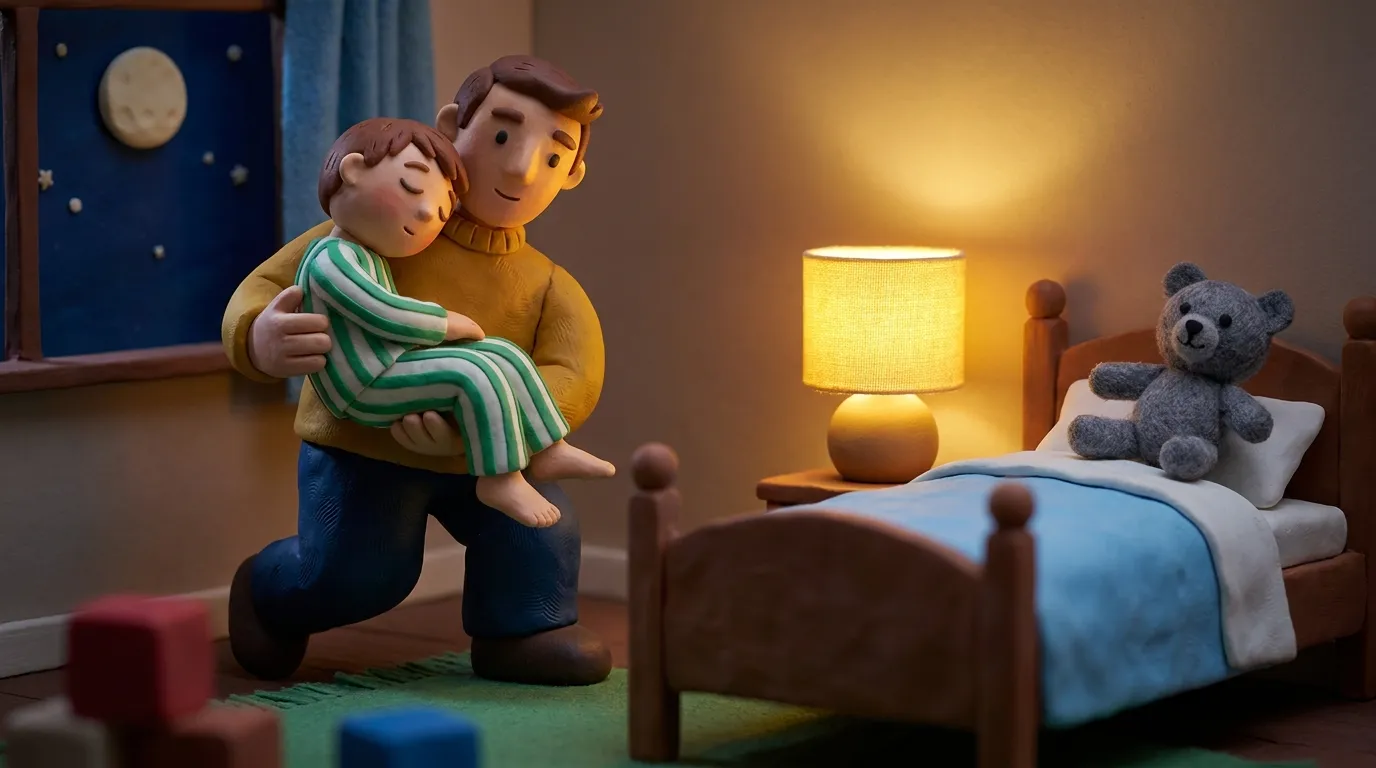 Dad Leo carries his sleepy son to bed.
Joy
Paul wrote Philippians while he was in chains (Philippians 1:13), and that same letter says, “Rejoice in the Lord always. I will say it again: Rejoice!” (Philippians 4:4, BSB). The joy he means is a gladness rooted in God being near, and it can show up in a hard week.
Kids pick it up from the people around them: a family cheer when the baby takes her first steps, a dance playlist on a rainy Saturday, a video call with grandparents who live three states away. Ask: “What was the best part of your day, and who was there?”
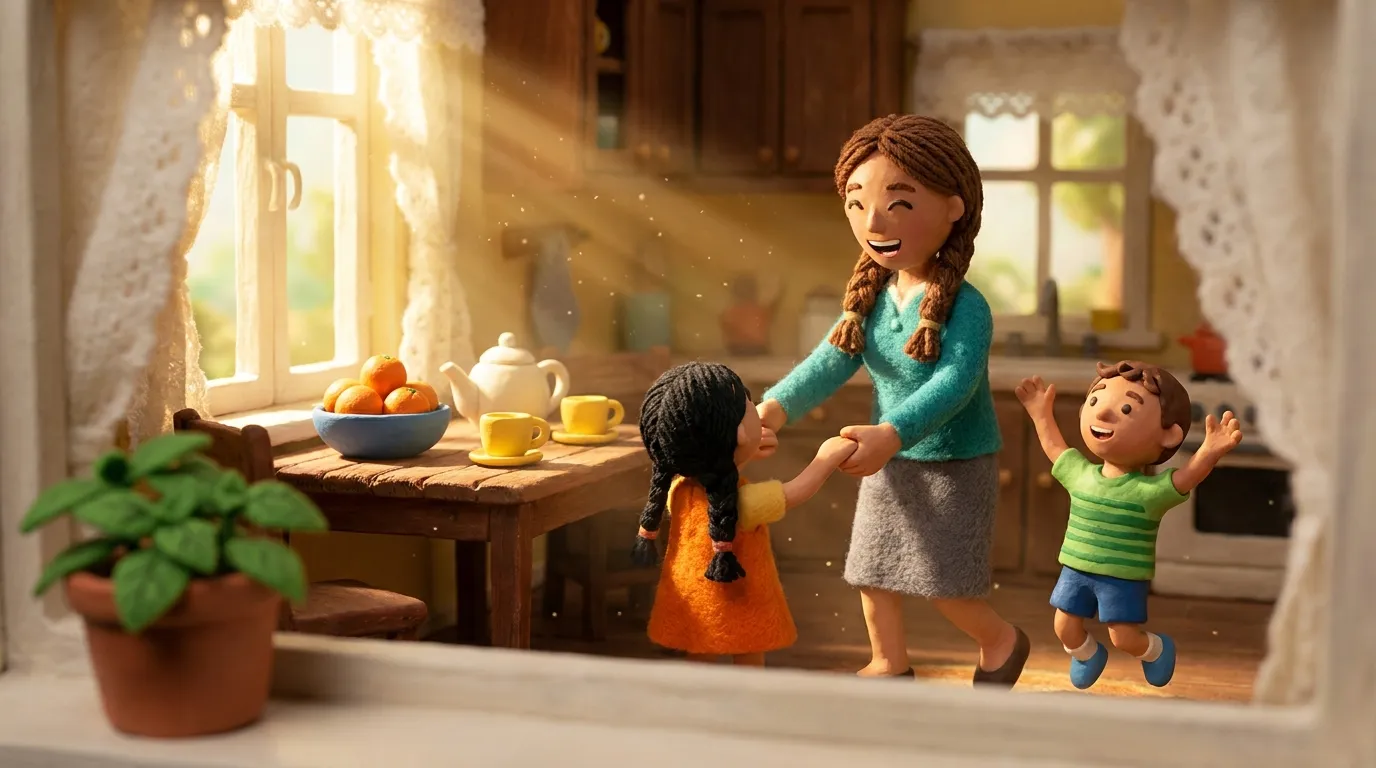 Mom Ana dances with the kids before school.
Peace
Peace has two sides in the Bible: a calm heart that trusts God, and getting along with the people you live with. The second side gets tested early in the morning.
Picture two brothers in the back seat on the way to school, both claiming the window. Pull into a parking spot, give each one thirty seconds to explain without interruptions, and ask them to come up with a deal they can both live with, like trading seats on Wednesdays. Ask at bedtime: “What helped you calm down today?”
Patience, kindness and goodness
The middle of the list shows up in how kids treat siblings, classmates and neighbors.
Patience
Older Bibles call it “longsuffering,” and kids get the idea if you describe a long fuse. Patience means putting up with people and delays calmly, and makrothymia carries that same sense of slow-to-boil.
Kids get practice all day long with a red light that won’t change, a video that keeps buffering, a little brother who takes forever with his shoes. Ask: “What made you feel impatient today, and what did you do about it?”
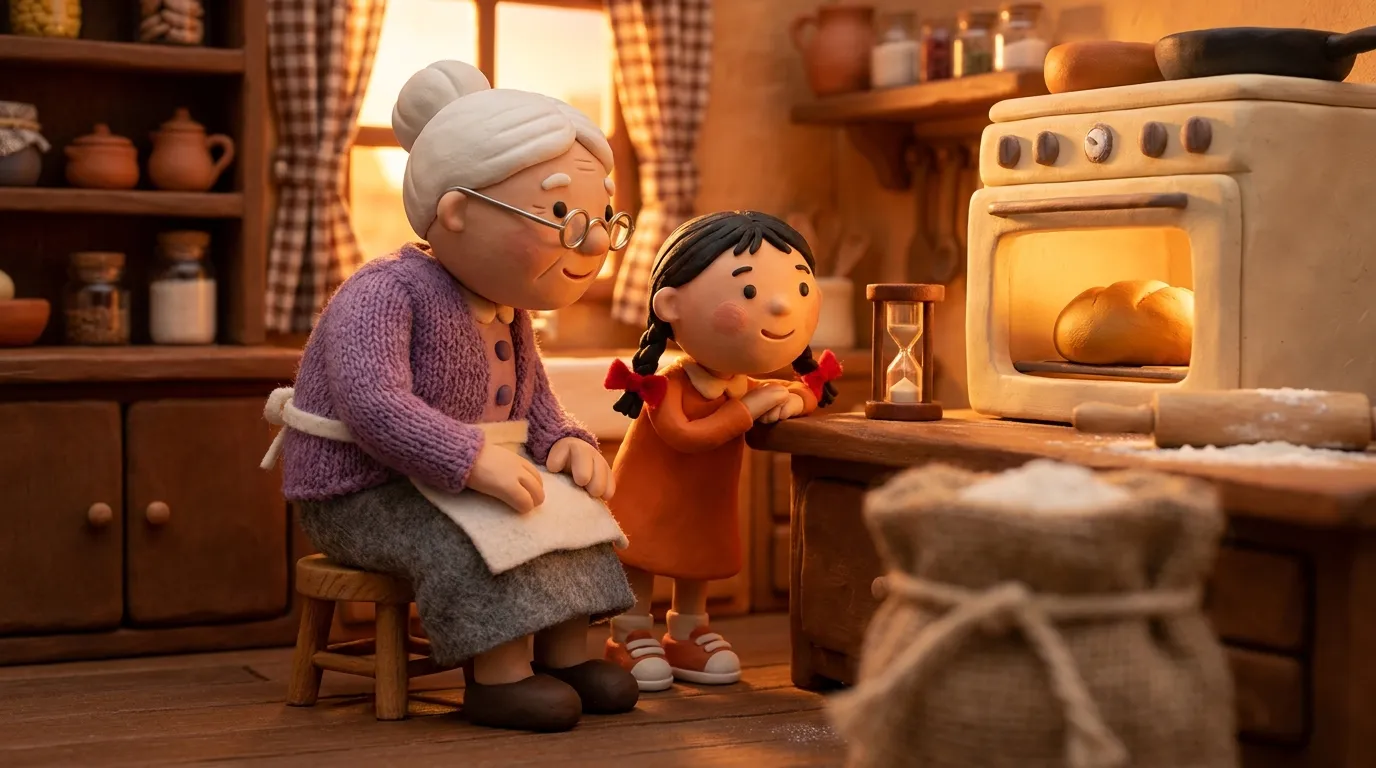 Grandma Rosa and her granddaughter wait for the bread.
Kindness
Kindness is being warm and friendly with whoever’s next to you. Colossians 3:12 tells believers to “clothe yourselves with hearts of compassion, kindness, humility, gentleness, and patience” (BSB), and three words from that verse also appear in Galatians.
At school, kindness might be saving a seat on the bus for a kid who usually sits alone. At church, it’s a fourth grader who helps a visiting family find the kids’ classroom. Ephesians 4:32 makes a good bedtime line for this week: “Be kind and tenderhearted to one another, forgiving each other just as in Christ God forgave you” (BSB). Ask: “Who looked lonely today, and what could you do tomorrow?”
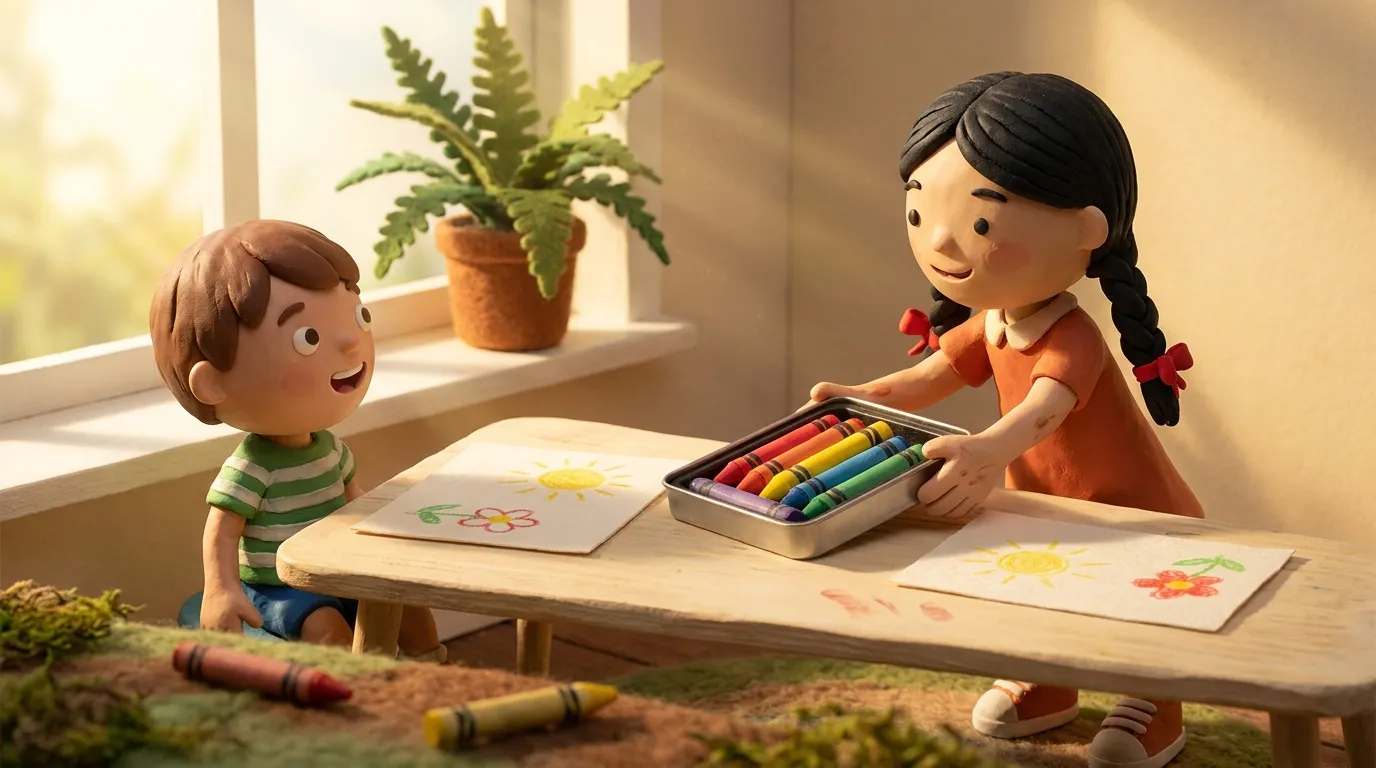 Sharing the crayon tin with a little brother.
Goodness
Goodness is doing the right and helpful thing, often before anyone asks. Maybe your son rakes the leaves for the older couple next door, or your daughter fills a shoebox for the church’s Christmas gift drive. Ask: “What’s something you could help with this week before anyone asks?”
Faithfulness, gentleness and self-control
The end of the list is about steady habits and strength held in check.
Faithfulness
Faithfulness means being someone people can count on. Kids can practice it with a job that belongs to them alone, like taking the recycling to the curb on Thursday night, feeding the class hamster on their assigned week, showing up on time for a teammate who needs a ride. A check mark on the family calendar every time they follow through lets them see the habit build. Ask: “Who counted on you this week, and did you come through?”
Gentleness
Gentleness is strength used softly. A big kid has plenty of chances: helping a preschooler down the slide at the park, brushing a little sister’s tangled hair without yanking, holding a friend’s new puppy the way its owner showed them. Ask: “When did you have to be careful with your hands today?”
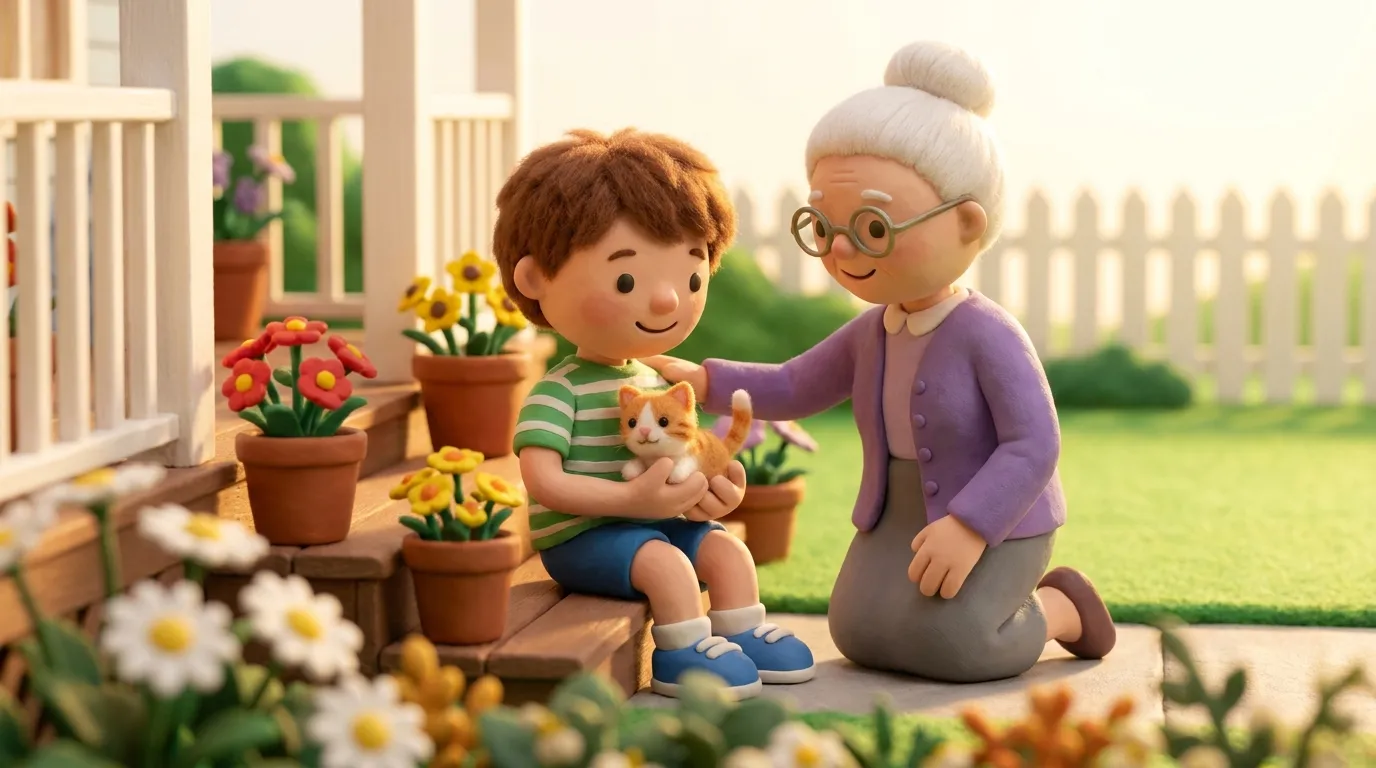 A kitten on the porch steps, with Grandma close by.
Self-control
Self-control sits at the end of Paul’s list, and kids understand it as being the boss of their own wants. Harvard’s Center on the Developing Child says self-regulation skills grow fast between ages 3 and 5, and that games with rules give those skills a workout.
The real tests come at odd moments: a screen-time timer that goes off mid-episode, a brother who knocks over the block tower, a sister who gets the front seat again. Ask: “What was the hardest thing you said no to today?”
Games and crafts for a busy week
Each of these fits into 5 to 20 minutes and uses things you probably have at home.
Freeze dance. Put on an upbeat song and have everyone dance. When the music stops, everyone freezes in place. Harvard’s activity guide for 3- to 5-year-olds includes this game because kids have to stop their bodies and shift their attention the moment the music cuts out. Call out a pose for the next freeze (“freeze like a statue holding a baby”) and ask which quality they just practiced.
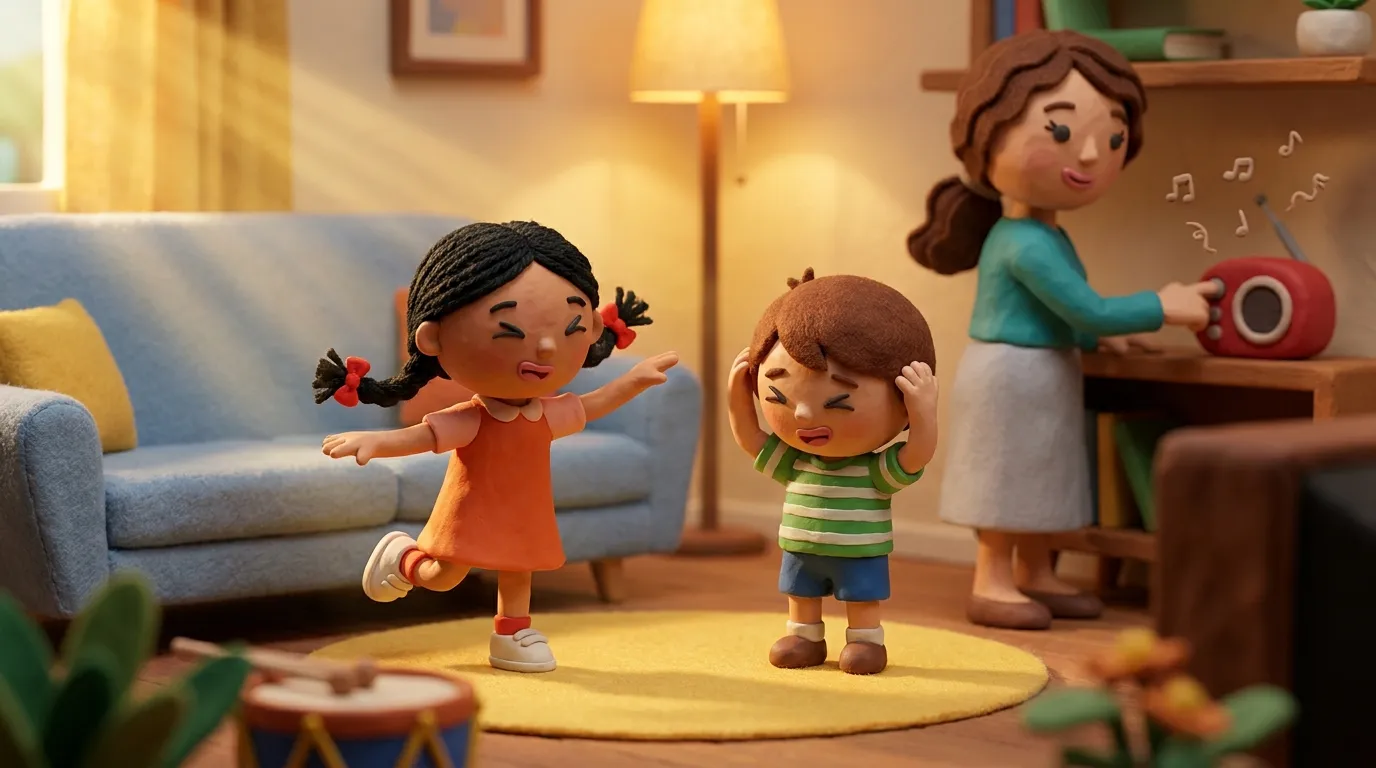 Mom hits the radio button, and both kids freeze.
Fruit bowl charades. Write the nine qualities on slips of paper and drop them into an empty fruit bowl. Each person draws one and acts it out without words, kneeling to tie an imaginary shoe for kindness, say, or sitting on their hands for self-control, while everyone else guesses. A grown-up reads the slip for kids who can’t read yet, and whoever guesses right names a time someone at home showed that quality this week.
Bake something that makes you wait. Mix up a batch of drop cookies or a yeast bread, with a grown-up handling the oven. Harvard’s guide lists cooking as executive function practice: kids wait for instructions, keep the steps in mind and pay attention while they measure. Set a kitchen timer where your child can see it and talk about patience each time they check it.
A felt fruit tree. Tape a big cardboard tree to the fridge or a closet door and keep nine felt or construction-paper fruits in a zip-top bag beside it. When your child catches someone in the family living out one of the qualities, they pick a fruit, stick it on and tell the story at dinner. If your child isn’t reading yet, have them draw the face of the family member on the back of each fruit they stick up. You’ll find more crafts like this in Bible activities for kids.
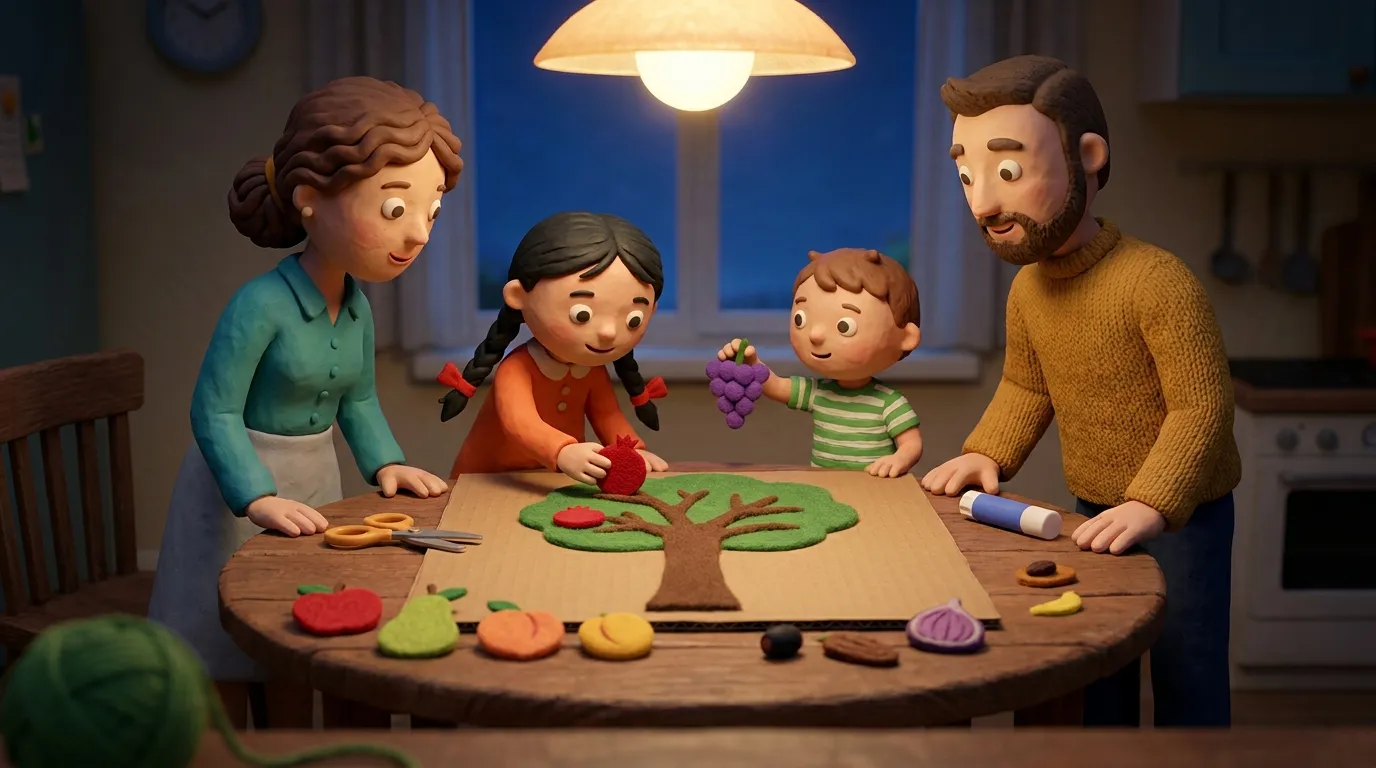 The whole family works on the felt tree after dinner.
A fruit-merging game. Our app has a Fruit of the Spirit game built on the Galatians list. Your child slides a finger to choose where each fruit drops into a clay jar, and two matching fruits that touch merge into the next, bigger one. The smallest is an olive for self-control, and the pieces climb through grapes, dates, apricots and the rest until they reach a pomegranate for love. The first time each fruit appears, the game shows Galatians 5:22-23 with that word highlighted, so by the time all nine have appeared, your child has read the verse nine times, and the Fruit button on the game’s menu brings it back whenever they want.
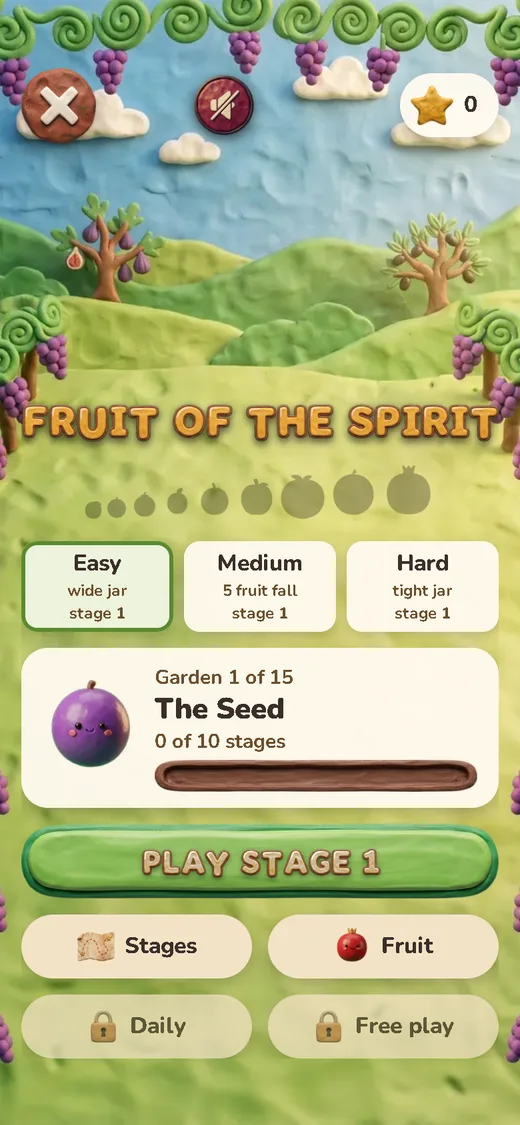 The opening screen of the Fruit of the Spirit game.
Memorizing Galatians 5:22-23 in four weeks
A list of short words is easy to chant in the car. Add one chunk a week and say the whole thing from the start each time:
- Week 1: “But the fruit of the Spirit is love, joy, peace,”
- Week 2: “patience, kindness, goodness,”
- Week 3: “faithfulness, gentleness, and self-control.”
- Week 4: “Against such things there is no law,” plus the reference, Galatians 5:22-23.
Little ones can play it as a call-and-response in the car: you say one word, they shout the next, and a sibling gets to whisper a hint when someone’s stuck. Kids 8 and up can record themselves saying the verse on a phone and play it back to catch any word they skipped. There are more techniques in how to memorize Bible verses, and more short verses sorted by age in Bible verses for kids.
Older kids can add John 15:5, where Jesus explains where fruit comes from:
I am the vine and you are the branches. The one who remains in Me, and I in him, will bear much fruit. For apart from Me you can do nothing.
(John 15:5, Berean Standard Bible)
Next time you buy grapes, keep a bunch on the stem and let your kids find where each grape is attached. Ask what happens to a grape that falls off, then read the verse again and ask who the branches are.
Fruit of the Spirit vs. gifts of the Spirit
Kids who hear about both at church often mix them up. The gifts appear in 1 Corinthians 12, where Paul says the Spirit gives different abilities to different people.
Now to each one the manifestation of the Spirit is given for the common good.
(1 Corinthians 12:7, Berean Standard Bible)
In verses 8-10 he names the message of wisdom, the message of knowledge, faith, gifts of healing, the working of miracles, prophecy, distinguishing between spirits, speaking in various tongues and the interpretation of tongues.
Ask your kids to think about the people who serve at church. The greeter at the door, the teacher in their classroom and the volunteer running the sound board each use a gift for the good of everyone. The fruit is what you notice in how those same people treat a fussy toddler or a visitor who shows up late, and Paul expects it of everyone who lives by the Spirit (Galatians 5:25).
Catholic teaching also names seven gifts of the Holy Spirit: wisdom, understanding, counsel, fortitude, knowledge, piety and fear of the Lord (Catechism, paragraph 1831). If your church explains the gifts another way, the church-volunteer example still works.
How we made this guide. The site’s editorial team wrote and reviewed it in October 2026. Scripture quotes come from the Berean Standard Bible, and the KJV wording was checked on Bible Hub. For the Greek, we used Bible Hub’s interlinear and lexicon; for the Catholic lists, the Catechism on the Vatican’s website. The activities draw on Harvard’s executive function guide for 3- to 5-year-olds, and the attention-span figure comes from the CDC’s milestones. Treat the ages and examples as starting points for your own family and church.
Sources
- Bible Hub, Galatians 5:22 Interlinear (karpos singular, the verb estin, makrothymia, pistis)
- Bible Hub, Strong’s Greek 2590: karpos
- Bible Hub, Strong’s Greek 3115: makrothumia
- Bible Hub, Galatians 5, King James Version
- Vatican, Catechism of the Catholic Church, paragraphs 1830-1832 (twelve fruits and seven gifts)
- Center on the Developing Child, Harvard University, Executive Function Activities for 3- to 5-year-olds (freeze dance, cooking)
- CDC, Milestones by 5 Years (5 to 10 minutes of attention)
- Berean Standard Bible, Galatians 5, text from bible.helloao.org
Frequently asked questions
What are the 9 fruits of the Spirit?
Galatians 5:22-23 lists love, joy, peace, patience, kindness, goodness, faithfulness, gentleness and self-control, in the wording of the Berean Standard Bible. Paul describes them as the character God's Spirit grows in people who follow Jesus.
What does the King James Version call the fruit of the Spirit?
The KJV reads "love, joy, peace, longsuffering, gentleness, goodness, faith, meekness, temperance." Longsuffering matches patience, faith matches faithfulness, meekness matches gentleness and temperance matches self-control. Watch out for "gentleness": in the KJV it sits where newer Bibles put kindness.
Is it fruit or fruits of the Spirit?
In the Greek of Galatians 5:22, the noun karpos is singular and so is the verb estin ("is"). Paul is describing one fruit with nine qualities, which is why many teachers use a bunch of grapes or a single orange with its segments to explain it. People say "fruits of the Spirit" all the time, and they mean the same list.
How many fruits of the Holy Spirit are there in the Catholic Church?
Twelve. Paragraph 1832 of the Catechism of the Catholic Church lists charity, joy, peace, patience, kindness, goodness, generosity, gentleness, faithfulness, modesty, self-control and chastity, following the Latin Vulgate's reading of Galatians 5:22-23.
What is the difference between the fruit of the Spirit and the gifts of the Spirit?
The fruit in Galatians 5 is character Paul expects in everyone who lives by the Spirit. The gifts in 1 Corinthians 12:7-10, such as prophecy, healing and speaking in tongues, are given to different people "for the common good." Catholic teaching also names seven gifts of the Holy Spirit in Catechism paragraph 1831.
How do you teach the fruit of the Spirit to preschoolers?
Keep sessions to a few minutes, use a real piece of fruit and a hand motion for each word, and ask the same simple question every night for a week. The CDC notes that most 5-year-olds can pay attention for about 5 to 10 minutes during an activity, so short and frequent fits that age.
Keep reading
-
Bible activities for kids: 15 easy ideas
15 Bible activities for kids to do at home with everyday supplies: crafts, puppets, a recipe, a treasure hunt, music and painting, with ages and steps. Read article -
Bible Games for Kids and Families
Types of Bible games and what each builds, ideas by age, 5 ready-to-play games for home, a 20-minute Sunday school plan and how to judge a Bible game app. Read article -
How to teach the Bible to kids, age by age
An age-by-age guide to teaching kids the Bible, with a 15-minute family devotional and a ready-to-teach David and Goliath lesson with questions by age. Read article