
How to memorize Bible verses: a 7-day method
How to memorize a Bible verse: break it into chunks, test yourself, use first letters and review on spaced days. A 7-day plan with Joshua 1:9.
 The Terra Sinai team 15 min read
In this article (9)
To memorize a Bible verse, split it into three or four chunks, close your Bible and say each chunk from memory, then review it on spaced days: the next day, on day three, after a week, and so on. Pulling the words out of memory takes effort, and that effort strengthens the memory. This guide covers what memory research shows, which tools help (first letters, saying it aloud, writing by hand, singing) and a 7-day plan using a real verse, Joshua 1:9.
The psalmist already described memorizing as putting something somewhere safe:
“I have hidden Your word in my heart that I might not sin against You.” (Psalm 119:11, Berean Standard Bible)
This article is about locking in one verse. To memorize whole chapters or books over months and years, see our long-term plan for memorizing the Bible.
What memory science says about memorizing text
Memory research points to two practices as the most effective: testing yourself and spacing out your reviews. A 2013 review by John Dunlosky and colleagues evaluated ten study techniques and gave a “high utility” rating to those two. Rereading and highlighting, which students use a lot, landed in the low-utility group (Dunlosky et al., 2013).
Test yourself without looking
The best-known study on this comes from Henry Roediger and Jeffrey Karpicke at Washington University in St. Louis. In experiment 1, students read short passages and then either reread them or took a test, writing down everything they remembered without looking. On a final test five minutes later, the rereading group recalled 81% of the ideas and the testing group 75%. Two days later, the numbers were 54% and 68%. After a week, 42% and 56% (Roediger and Karpicke, 2006).
Experiment 2 also measured confidence. The group that read the passage four times gave their own memory the highest rating (4.8 on a 7-point scale) and, a week later, recalled 40% of the ideas. In the group that read it once and took three tests, the rating was 4.0 and recall was 61%. For anyone memorizing Scripture, the practical lesson is to close your Bible and try, even while you still feel unready.
The study used science passages and counted the ideas students recalled, without requiring exact wording. Memorizing a verse means getting the words right, which is a slightly different goal. Dunlosky’s review found the benefit of self-testing across many ages and kinds of tasks, so it sits at the center of the method in this guide.
 Reciting without looking, with someone checking, helps you remember longer than rereading.
Review within the first hours
In 1880, the German psychologist Hermann Ebbinghaus measured his own forgetting by memorizing lists and relearning them after different delays. In 2015, researchers Murre and Dros repeated the experiment, with one volunteer spending 70 hours learning and relearning lists after delays from 20 minutes to 31 days. The curve came out very close to the original: memory drops quickly in the first hours and the loss slows down over the following days (Murre and Dros, 2015). The authors also noticed a small bump at the 24-hour mark and mention sleep as a possible reason, which still needs to be confirmed.
In practice, your first review has to come early: the same day and the next day.
Space out your reviews
A study of more than 1,350 people tested different gaps between first learning and review, with final tests up to a year later. The best gap depended on how long people needed to remember. For a test one week out, the ideal gap was roughly 20% to 40% of that time (one to three days). For remembering a year out, it dropped to 5% to 10% (about three to five weeks) (Cepeda et al., 2008). The review calendar further down follows the same logic, with short gaps at first that grow as the verse settles in.
The tools that help a verse stick
Each tool below has a job in the plan. Use several of them across the week, and keep testing yourself without looking in every session.
Break the verse into chunks
A whole verse is a lot to hold at once. Split it where the sentence naturally pauses, usually at a question mark, a comma or a change of idea. For Joshua 1:9 in the Berean Standard Bible, a natural split is:
- “Have I not commanded you to be strong and courageous?”
- “Do not be afraid; do not be discouraged,”
- “for the LORD your God is with you”
- “wherever you go.”
A common way to practice is to build up: chunk 1, then 1 and 2, then 1, 2 and 3. That build-up repeats the beginning many times and the ending only a few, so the last part of the verse tends to stay weak. To even it out, also do some rounds back to front: say only chunk 4, then 3 and 4, then 2, 3 and 4, and finally the whole verse. That way every chunk gets about the same amount of practice.
About translations: if your church reads the NIV, ESV or KJV, memorize in that version and keep it to the end. The wording of Joshua 1:9 differs a little from one translation to the next, and the method works the same with any of them.
 Like Nehemiah’s wall, a verse goes up one chunk at a time.
Use the first letter of each word
Write down only the first letter of each word and keep the punctuation. Joshua 1:9 becomes:
H I n c y t b s a c? D n b a; d n b d, f t L y G i w y w y g.
With those letters in front of you, try to say the full verse. The letters give you a small amount of help: your memory still has to find each word, and the first letter gets you unstuck when you freeze. We didn’t find a large study devoted to this technique with Bible verses. It works as a form of cued recall, which is the mechanism Roediger and Karpicke tested.
Say the verse out loud
Speaking aloud helps you remember. Psychologists call this the production effect: across eight experiments, words spoken during study were remembered better than words read silently, and even mouthing them without sound helped (MacLeod et al., 2010). The rule at home is simple: every recall attempt gets spoken, even in a whisper.
Write it from memory, by hand
Writing the verse from memory on a sheet of paper and then checking it against your Bible shows you exactly which word slipped. Writing by hand is also slow, so each word gets attention. A small error, like writing “will be with you” where the text says “is with you,” jumps out right away. In the 7-day plan, writing comes in on days 4 and 7 as a way to test yourself.
Sing the verse
Singing helps you remember phrases. In an experiment with 60 adults learning Hungarian phrases, the group that learned by singing recalled and reproduced the phrases better than the groups that spoke them or spoke them rhythmically (Ludke, Ferreira and Overy, 2014). Scripture itself ties singing to the Word:
“Let the word of Christ richly dwell within you as you teach and admonish one another with all wisdom, and as you sing psalms, hymns, and spiritual songs with gratitude in your hearts to God.” (Colossians 3:16, Berean Standard Bible)
You don’t need to write a song. Fit the verse to a tune you already know, like “Twinkle, Twinkle, Little Star,” and sing it slowly.
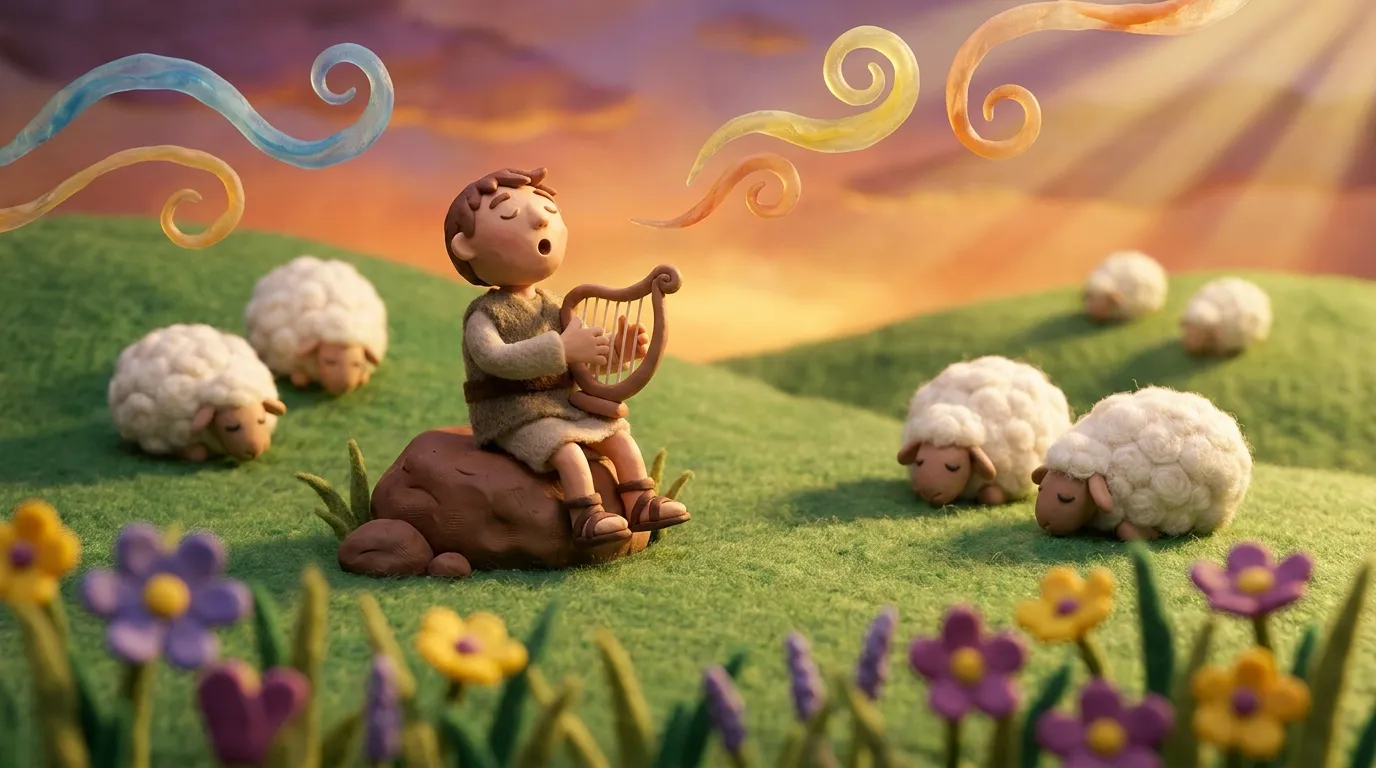 David sang the psalms. Set the verse to a tune you already know.
The tools at a glance
| Tool | What it does for memory | What the research shows | Best time to use it |
|---|---|---|---|
| Testing yourself without looking | Makes you retrieve the text | Strong: high utility in a 2013 review | Every day, every session |
| Spaced review | Revisits the text before it fades | Strong: the ideal gap grows with the time frame | Day 2 onward |
| Chunking | Makes each task smaller | Common practice, no verse-specific study | Days 1 and 2 |
| First letters | Gives a minimal cue for testing | Works as cued recall | Days 2 to 4 |
| Saying it aloud | Makes the memory more distinctive | Production effect in 8 experiments | Always |
| Writing by hand | Shows the exact error | Works as a full test; no verse-specific study | Days 4 and 7 |
| Singing | Uses the melody as a thread | Better phrase recall in adults | Day 5, and with kids |
Step by step: Joshua 1:9 in 7 days
The plan takes about 10 minutes a day and ends with the verse spoken and written with no cues. We chose Joshua 1:9 because it’s well known, medium in length and splits cleanly into four chunks. The same routine works for any verse of one or two sentences.
“Have I not commanded you to be strong and courageous? Do not be afraid; do not be discouraged, for the LORD your God is with you wherever you go.” (Joshua 1:9, Berean Standard Bible)
Before you start, pick one translation and keep it to the end. Two versions of the same sentence compete in your memory.
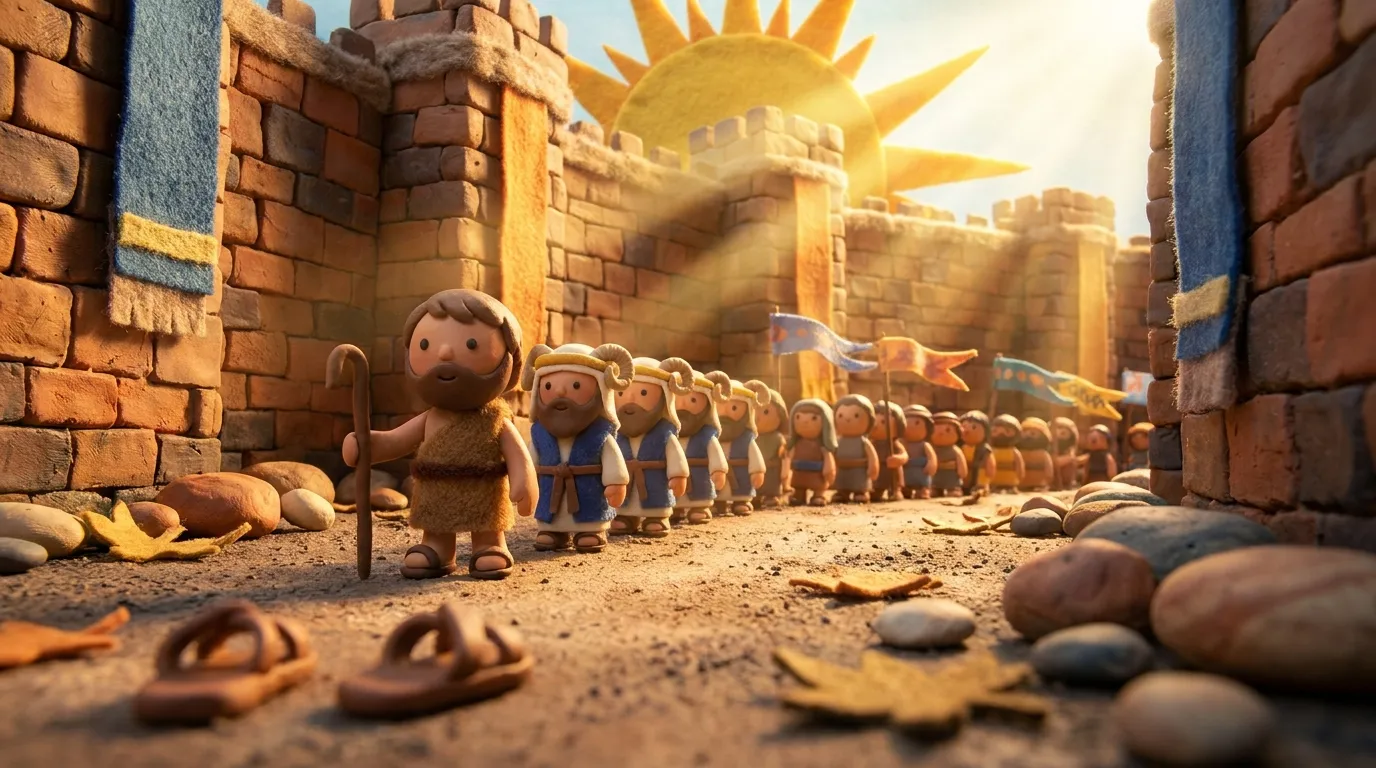 Joshua marched around Jericho for seven days. The plan for Joshua 1:9 has seven days too.
Day 1: understand it and learn chunks 1 and 2
Read all of Joshua 1:1-9. The setting is the death of Moses and the moment Joshua takes over leadership of Israel. Say in your own words, in one sentence, what the verse promises. Then read chunk 1 aloud three times, cover the text and try to say it. Do the same with chunk 2 and put them together, saying them once starting from chunk 2 and once from the top. Repeat the recall attempt twice more during the day, for example at lunch and before bed.
Day 2: recall first, then add
Start without looking: try to say chunks 1 and 2 from memory before you open your Bible. Only then check. Next, learn chunks 3 and 4 the same way you did on day 1 and do one back-to-front round (4, then 3 and 4, and so on). Write the reference and the first letters (H I n c y t b s a c…) on an index card and keep it in your pocket.
Day 3: the whole verse with cues, plus audio
Say the whole verse using only the first-letter card, always with the reference at the start and end: “Joshua 1:9 … Joshua 1:9.” Listening helps if you learn by ear: record your own voice on your phone or listen to the chapter narrated. In our app, the Bible tab includes the narrated Bible (the audio needs an internet connection), and you’ll find more options in our audio Bible guide.
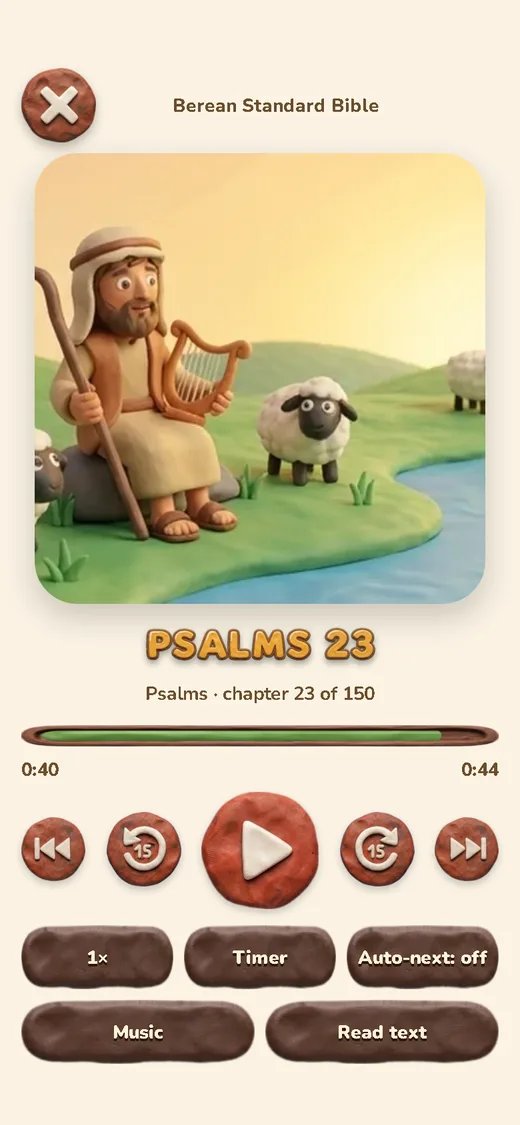 The audio player screen with Psalm 23 narrated.
Day 4: write it from memory
Take a blank sheet and write the whole verse, with the reference, using no cues. Then check it against your Bible and circle every word you changed or left out. Those weak spots are your focus for the rest of the day: repeat the part that slipped, then the whole verse.
 Write it from memory first, then open your Bible to check.
Day 5: sing it and recite it to someone
Fit the verse to a familiar tune and sing it two or three times. Then recite it to someone in your home who follows along in the Bible and flags any slip. Saying it to another person adds a little pressure, a lot like a real test.
Day 6: recall it in different places
Say the verse with no cues in three places: on a walk, in the kitchen and before bed. Changing locations keeps the memory from depending on a single setting. Try also using the verse in a prayer, or in a moment of the day when you felt afraid or worn out.
Day 7: the final test
First thing in the morning, before any review, write the verse and its reference on a blank sheet. Then say it aloud. If you got it right both times with no errors, the verse moves to the review calendar below. If one part still slips, repeat days 5 and 6 and take the test again the next day.
The plan at a glance
| Day | Time | What to do | Today’s test |
|---|---|---|---|
| 1 | 10 min + 2 quick attempts | Read the context, learn chunks 1 and 2 | Say 1 and 2 without looking, 3 times that day |
| 2 | 10 min | Recall 1 and 2, learn 3 and 4, one back-to-front round, make the card | Start without looking |
| 3 | 10 min | Whole verse with first letters and audio | Say it with the card, plus reference |
| 4 | 10 min | Write from memory and circle errors | Blank sheet |
| 5 | 10 min | Sing it and recite it to someone | Someone else checks |
| 6 | 5 to 10 min | Say it in three different places | No cues at all |
| 7 | 5 min | Written and spoken test | Twice with no errors |
Your review calendar after the first week
After day 7, review the verse at growing intervals: 3 days, 1 week, 2 weeks, 1 month and then once a month. Each review takes under a minute: say the reference, say the verse without looking and check.
| Review | When | What to do | If you slip |
|---|---|---|---|
| 1st | 3 days after the test | Say it without looking and check | Review again the next day |
| 2nd | 1 week later | Say it and write it once | Go back to a 3-day gap |
| 3rd | 2 weeks later | Say it without looking | Go back to a 1-week gap |
| 4th | 1 month later | Say it without looking | Go back to a 2-week gap |
| Maintenance | Once a month | Say it along with your other memorized verses | Shorten the gap until it holds |
These intervals are a starting point based on the Cepeda study. That study used simple trivia facts, and a Bible verse may need a little more review. For remembering a year out, the ideal gap in the study was three to five weeks, which lines up with a monthly review in the maintenance phase. The “if you slip” column fits the calendar to each verse: when a verse slips, it goes back to the previous gap.
 The twelve stones at the Jordan were there to help people remember. Your review calendar does the same for a verse.
Common mistakes when memorizing Bible verses
Each mistake below comes with its fix.
Only rereading. Reading a verse ten times feels like progress, and in experiment 2 of Roediger and Karpicke, the group that reread the most was the most confident about its memory and recalled the least a week later. Close your Bible and try to say the verse, even if you don’t feel ready.
Studying it all at once. An hour of repetition in a single day packs every attempt into the same stretch of time. Spread the practice out: ten minutes a day for six days gives your memory a gap between one attempt and the next.
Skipping the reference. Plenty of people know the words and can’t say where they are. Say the reference at the start and end of every attempt, from day 1.
Switching translations midway. Two versions of the same verse compete in your memory. Pick one and stay with it.
Memorizing without understanding. Words with no meaning attached are the first to go. Reading the chapter and putting the verse in your own words on day 1 gives it an anchor.
Stopping reviews once you know it. Without review, a verse that’s solid today can fade within a few months. Monthly maintenance takes less than a minute per verse.
How to adapt the method for kids and older adults
The method stays the same at any age: chunks, testing without looking and spaced review. With kids and older adults, adjust the length of each session and the kind of cue.
For kids
For young children, choose one-sentence verses like Psalm 119:105 and create a hand motion for each chunk:
“Your word is a lamp to my feet and a light to my path.” (Psalm 119:105, Berean Standard Bible)
“Your word” with hands open like a book, “is a lamp to my feet” pointing at the feet, “and a light to my path” with an arm tracing a road ahead. The motion works as the cue for a child who’s still learning to read.
Sessions of 3 to 5 minutes work well. Make the test a game: you say the verse and stop in the middle so your child can finish it, or you “mess up” a word on purpose so they can correct you. Singing helps a lot at this age. Word games built around the verse, like a Bible word search, work as review on the following days. To build a family routine, see also how to teach the Bible to kids and our picks of Bible games for families.
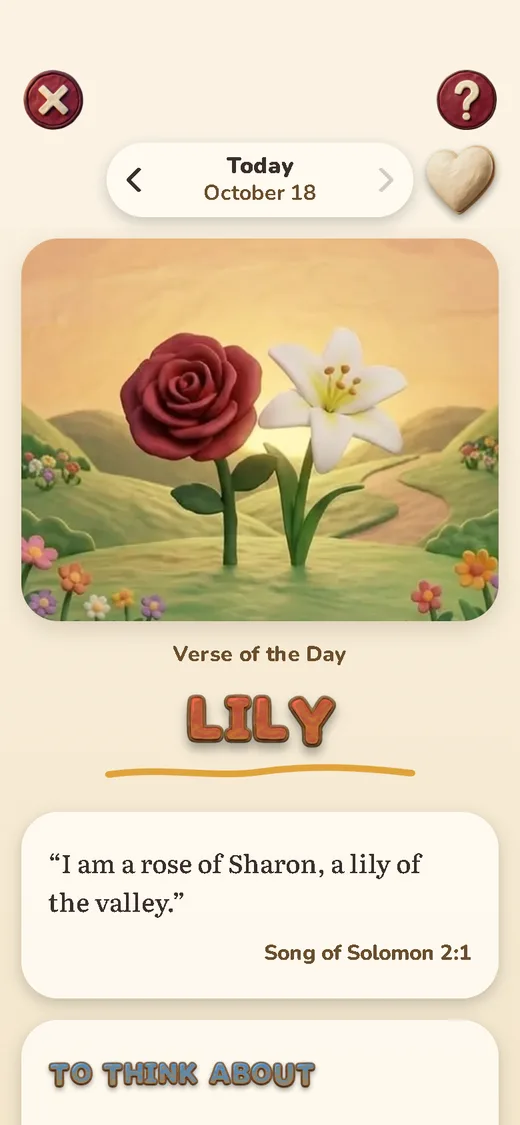 The Verse of the Day screen with Isaiah 46:4, an illustration and the key word CARRY.
For older adults
For older adults, start with print size: write the card in large letters, with the verse split into lines, one chunk per line. Add audio too: recording the verse in your own voice and listening on a walk or before bed is often comfortable for someone whose eyes tire from reading.
Research adds two pointers. Older adults tend to underuse self-testing when they study on their own, and a 2024 experiment found that a short explanation of how and when to test yourself improved memory for both younger and older adults (Ariel, Babineau and Tauber, 2024). So before you begin, explain why the method asks you to close the Bible and try. A 2025 study found that in older adults, practicing only part of the material hurt recall of the part they didn’t practice (Liu, Kent and Briscoe, 2025). The practical fix is to end every session by saying the whole verse, even when the day’s practice focused on a single chunk.
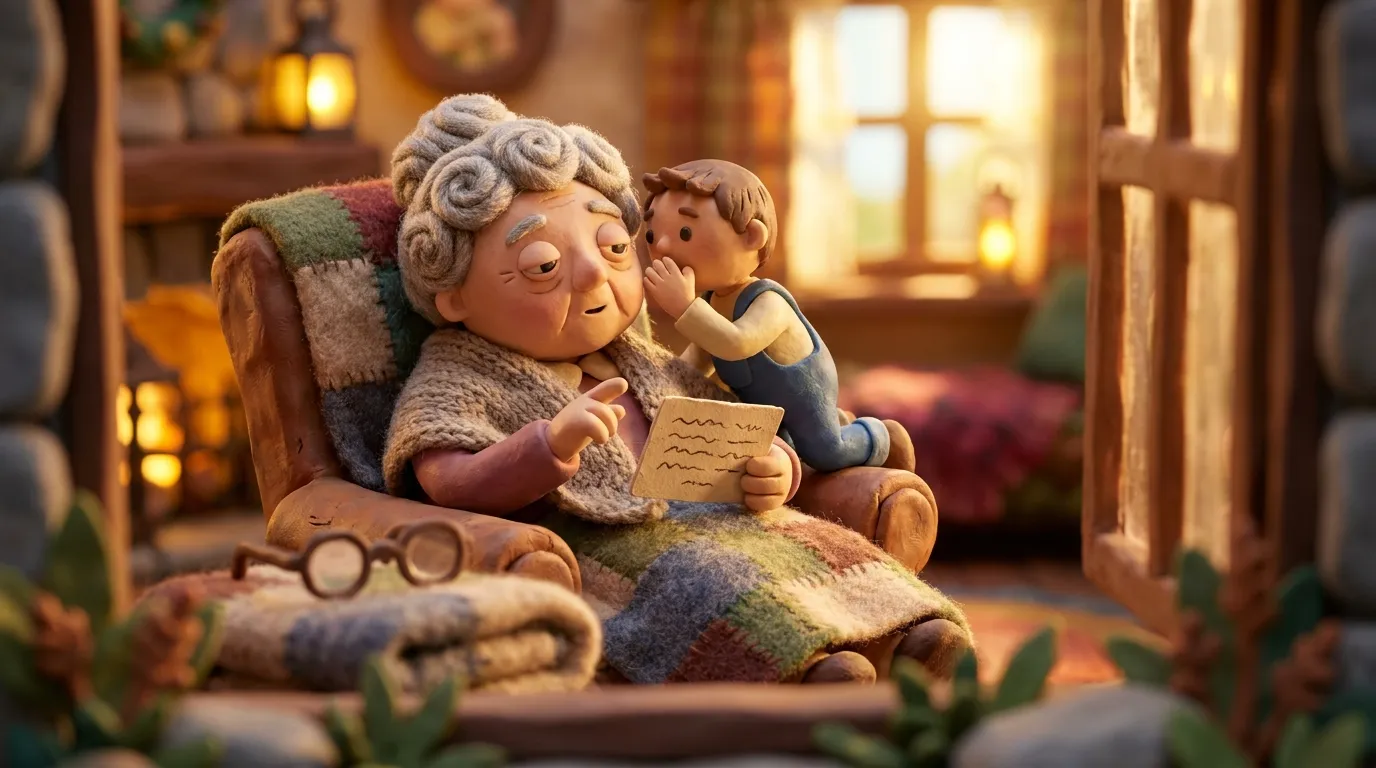 Practicing aloud with a grandchild nearby makes self-testing easier to keep up.
When to move on to the next verse
Start a new verse once the current one passes the day 7 test. In week two, you learn the new verse with the 7-day plan and do the short reviews of the previous one, which take under a minute. One verse a week, kept up with reviews, adds up to dozens of verses in a year with short sessions.
For whole passages, like Psalm 23 or a chapter from Paul’s letters, the plan needs a different structure, with bigger blocks and reviews that run for years. That approach is laid out in our guide to memorizing the Bible for the long term.
Sources
- Roediger, H. L., and Karpicke, J. D. (2006). Test-Enhanced Learning: Taking Memory Tests Improves Long-Term Retention. Psychological Science, 17(3).
- Dunlosky, J., et al. (2013). Improving Students’ Learning With Effective Learning Techniques. Psychological Science in the Public Interest.
- Cepeda, N. J., et al. (2008). Spacing effects in learning: a temporal ridgeline of optimal retention. Psychological Science.
- Murre, J. M. J., and Dros, J. (2015). Replication and Analysis of Ebbinghaus’ Forgetting Curve. PLOS ONE.
- MacLeod, C. M., et al. (2010). The production effect: delineation of a phenomenon. Journal of Experimental Psychology: Learning, Memory, and Cognition.
- Ludke, K. M., Ferreira, F., and Overy, K. (2014). Singing can facilitate foreign language learning. Memory & Cognition.
- Ariel, R., Babineau, A., and Tauber, S. K. (2024). Teaching older adults to use retrieval practice improves their self-regulated learning. Aging, Neuropsychology, and Cognition.
- Liu, S., Kent, C., and Briscoe, J. (2025). Effects of Selective Retrieval Practice on Older Adults: Lesser Benefits, Greater Losses. Behavioral Sciences.
Frequently asked questions
How long does it take to memorize a Bible verse?
A medium-length verse like Joshua 1:9 fits into a 7-day plan of about 10 minutes a day. By the end of the week you can say it with no cues, and spaced reviews over the following weeks make it last.
What is the most effective way to memorize Bible verses?
Test yourself (close your Bible and try to say the verse) and spread your reviews over several days. A 2013 review of ten study techniques rated those two as the most useful; rereading and highlighting were rated low.
How many times a day should I repeat a verse?
Make three attempts to say it without looking, a few hours apart: morning, lunch and evening. On each attempt your memory has to find the words on its own, and that search strengthens it.
Why do I memorize a verse and forget it a few days later?
Forgetting is fastest in the first hours and days, as the Ebbinghaus forgetting curve shows. Without a review in that window, much of it fades. Reviewing the next day, on day three and then at longer intervals holds the verse in place.
How do I memorize the verse reference too?
Treat the reference as part of the verse: say "Joshua 1:9" before and after the text on every attempt, and write it at the top of your card. That way it gets stored together with the words.
Can young children memorize Bible verses?
Yes, with short verses, one hand motion for each chunk and a simple tune. Sessions of 3 to 5 minutes, played as a game, work well at that age.
Keep reading
-
Bible characters: who they were and where
The main Bible characters in story order, from Adam to Paul, with the book and chapter for each, what they did, what they teach and a section on the women. Read article -
How to memorize the books of the Bible
How to memorize the 66 books of the Bible in order: small blocks, a 7-day plan, self-testing, tricks for look-alike names and a version for kids. Read article -
Bible verses for kids: 20 short, easy picks
20 short Bible verses for kids to memorize, by theme (courage, fear, friendship, thankfulness, obedience, God's love), with ages and a motion for each. Read article