
Bible Connections: printable puzzles
Five printable Bible Connections puzzles, from easy to tough, with an answer key, plus how to play, solving strategy and how to build your own.
 The Terra Sinai team 12 min read
In this article (9)
Bible Connections is a printable connections game built from Scripture: 16 words, four hidden groups of four, and your job is to find what ties each group together. The five puzzles below go from easy to tough, and the answer key waits at the bottom of the page, so you can print the grids and keep the answers to yourself.
We built every group from the Berean Standard Bible (BSB), then searched the text of each story for every word to make sure no word could truthfully land in two groups. Some words were planted to look like they belong somewhere else.
Bible Connections puzzles to print
Each grid has 16 words. Find four groups of four. Write the groups on the back of the sheet, or cut the words into tiles and slide them around the table. When you’re done, scroll to the answer key and see how you did.
Puzzle 1 (easy)
A good first round for kids who’ve had a year or two of Sunday school.
| Patience | Love | Dove | John |
| Joy | Matthew | Rooster | Mark |
| Peace | Gnats | Hail | Luke |
| Raven | Quail | Locusts | Frogs |
Puzzle 2 (medium)
Every word here comes from the Old Testament. Read all 16 before you commit to a group.
| Fish | Tambourine | Sinai | Nineveh |
| Judah | Flute | Benjamin | Lyre |
| Dan | Worm | Reuben | Nebo |
| Carmel | Harp | Plant | Ararat |
 Four piles of blank tiles and two solvers leaning in for a closer look.
Puzzle 3 (medium-hard)
People and things from both testaments, with at least one well-known decoy.
| Sarai | Manna | Jehu | Abram |
| Simon | Sulfur | Rain | Ahab |
| Shepherd | Fire | Gate | Jacob |
| David | Vine | Way | Saul |
Puzzle 4 (hard)
You’ll need to know the stories in some detail.
| Baal | Baker | Leaven | Net |
| Dreams | Whirlwind | Foxes | Pillars |
| Jawbone | Ravens | Robe | Pharaoh |
| Broom | Mustard | Riddle | Pearl |
Puzzle 5 (hardest)
The toughest grid on the page. Keep a Bible handy.
| Obadiah | 3 John | Deborah | Jacob |
| Mark | Esau | Perez | Eve |
| Anna | Philemon | Jude | Miriam |
| Zerah | Ham | Huldah | Job |
How to play Bible Connections
The format comes from Connections, the daily game from The New York Times, which sums it up on its game page as grouping “words that share a common thread.” A 2024 profile from NYU’s Interactive Telecommunications Program, where Times puzzle editor Wyna Liu studied, describes the game’s groups as ranging “from the most straightforward to a real head-scratcher.” A Today explainer from August 2023 notes that the game launched in beta that June and that players get four chances before the round ends.
The printed version plays the same way:
- Read all 16 words out loud, or silently if you’re solving alone.
- Pick four words you believe share one link, and name the link.
- Check that link against the other 12 words. If a fifth word fits the same idea, you haven’t found the real group yet.
- Lock in the group and cross the four words off.
- Repeat until the board is empty. With three groups solved, the last four words sort themselves.
Want to keep score? Give each player or team four mistakes, the way the Times does. For younger kids, skip the limit and let them try as many times as they like. If your family already plays Bible Wordle, this is a good next game.
 Pinned tiles let a whole class see the board at once.
Strategy: how to spot the decoys
Every puzzle on this page has decoys, so the first four words that seem to match may be a trap. Before you name a group, run a quick count: how many words could fit this idea? If more than four words fit, one of them belongs elsewhere.
Here’s how that count works on a small example that isn’t in any puzzle above. Say a board contains these eight words: Pishon, Gihon, Tigris, Euphrates, Ur, Haran, Canaan and Egypt.
Euphrates looks like it could go either way. Genesis 2:10-14 names it as the fourth river flowing out of Eden, and in Genesis 15:18 God promises Abram’s descendants the land “from the river of Egypt to the great River Euphrates.” So which group gets it? Count the other side. Ur, Haran and Canaan all come from Genesis 11:31, where Terah’s family sets out “from Ur of the Chaldeans for the land of Canaan” and settles in Haran. Genesis 12:10 adds Egypt, where Abram went during a famine. That’s four places on the family’s road already, so Euphrates goes with the rivers.
Habits that help on every grid:
| Habit | What it looks like |
|---|---|
| Say the link out loud | “These are all…” forces you to name a real category |
| Count candidates | More than four words fit? Look for a tighter category |
| Start with the oddballs | A strange word has fewer possible homes, so place it first |
| Look past the meaning | A group can be about spelling or sound |
| Leave the easy match for last | An obvious four can hide a decoy |
| Check the verse | When two solvers disagree, open the Bible and read the passage |
If a kid insists a word belongs in a group, ask for the verse and read the passage together.
“Your word is a lamp to my feet and a light to my path.” (Psalm 119:105, Berean Standard Bible)
Using Bible Connections in class or at home
Bible Connections fits a 15-minute slot in a Sunday school hour. Kids work in pairs and talk through their guesses. To defend a group, a pair has to retell part of the story behind it. For more game ideas built around a lesson, see our collection of Sunday school games.
Here’s a 15-minute plan for a class of 9- to 12-year-olds:
| Minute | What happens |
|---|---|
| 0 to 2 | Hand out one puzzle per pair, face down |
| 2 to 3 | Explain the rules and the four-mistake limit |
| 3 to 11 | Pairs solve; a pair that locks in a group shows the teacher quietly |
| 11 to 14 | Go through the answer key; each pair reads one group and the note beside it |
| 14 to 15 | Ask which trap word fooled the most pairs, and why |
In that last minute, ask each pair to name the verse that rules their decoy out. If you want a quick review game for the following week, our Bible trivia questions pair well with the same stories.
 Four baskets on the coffee table and a pile of tiles in the middle.
At home, Bible Connections works after dinner with the plates cleared. Ask the youngest player to read the 16 words aloud. An adult keeps the answer key face down until the end. Mixed-age families do well with Puzzle 1 or 2, where a younger kid can spot one group while the adults argue about the rest. Our page on Bible games for families has other options for the same table.
For teens and adults, try Puzzles 4 and 5. Play them in teams of two, give each team its own copy, and compare answers at the end.
 One more tile goes into the purple basket.
How to make your own Bible Connections puzzle
Expect a homemade grid to take about an hour, most of it spent checking that each word fits only one group.
- Choose four categories. Mix kinds: one group of people, one of objects, one tied to a single story, one built on wordplay or sound. A mix of kinds gives you room to plant decoys.
- List five or six candidates per category. Pull them from the passage itself, and check spelling in the translation your group uses.
- Keep four per group. Drop the ones that are too obscure for your players.
- Run the cross-check. Take every word and ask, for each of the other three groups, “Could this word truthfully go here?” If the honest answer is yes, swap the word out.
- Plant one or two decoys on purpose. A decoy is a word with a real tie to a second group’s theme, placed so solvers have to check the verse to sort it. Write down which verse settles it, because you’ll want that note for the answer key.
- Shuffle the grid. Make sure no row holds a full group.
- Test it on someone. Hand it to a friend who hasn’t seen it. If they find a second valid solution, fix it before you print.
Step 4 caught us more than once while building this page. A word we’d picked for one story kept showing up in the text of another, so we replaced it. The answer key notes a few of those swaps.
 A pencil, blank cards and four colored mats on a desk at night.
If your group prefers a puzzle with clues and a grid of squares, try our printable Bible crossword puzzles. For pre-readers, a Bible word search asks only for spotting letters.
Bible Connections on your phone
Our app has a version called Daily Connections. The screen shows three woven baskets, each labeled with a category name such as “Little creatures of the Bible” or “In Peter’s life.” Below them sit nine tiles. The instruction at the top reads “Tap a tile, then the right basket,” a counter above it reads 0/9, and a Hint button sits at the bottom.
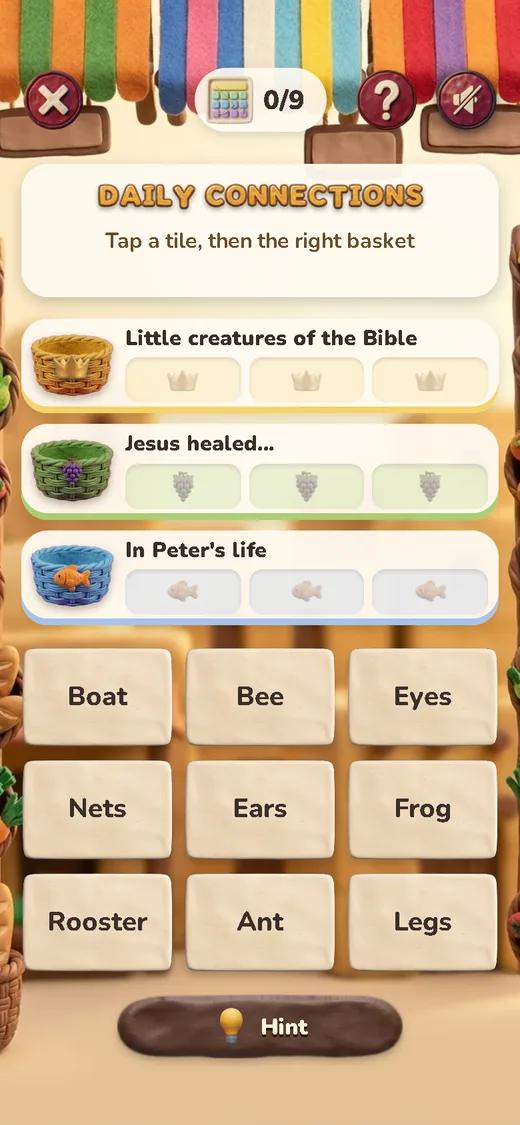 Three baskets wait at the top, and the tiles sit underneath.
Answer key
Each puzzle lists its four groups from easiest to hardest, with the verses and the decoys explained. Colors run from yellow for the easiest group to purple for the hardest.
Puzzle 1
- Yellow, the four Gospels: Matthew, Mark, Luke, John.
- Green, plagues on Egypt: Frogs (Exodus 8:2), Gnats (Exodus 8:16), Hail (Exodus 9:18), Locusts (Exodus 10:4).
- Blue, fruit of the Spirit: Love, Joy, Peace, Patience. Galatians 5:22 lists “love, joy, peace, patience, kindness, goodness, faithfulness.”
- Purple, birds in Bible stories: Raven and Dove, both sent out by Noah (Genesis 8:7-8); Quail, which covered the camp in the wilderness (Exodus 16:13); Rooster, which crowed right after Peter’s third denial, just as Jesus had said (Matthew 26:34, 74-75).
The traps: Dove pulls toward the fruit of the Spirit, since at Jesus’ baptism the Spirit of God descended “like a dove” (Matthew 3:16). Paul’s list in Galatians 5:22 has no dove in it, so the dove stays with Noah’s birds. Locusts fly, so they tempt you toward the birds. Exodus 10:4 puts them in the plague account, and that’s their group. (They were also John the Baptist’s food, Matthew 3:4.)
Puzzle 2
- Yellow, sons of Jacob: Reuben, Judah, Benjamin, Dan (Genesis 35:23-25).
- Green, instruments in Psalm 150: Harp, Lyre, Tambourine, Flute (Psalm 150:3-4).
- Blue, mountains: Sinai (Exodus 19:11), Carmel (1 Kings 18:19), Ararat, where the ark came to rest on “the mountains of Ararat” (Genesis 8:4), and Nebo (Deuteronomy 34:1).
- Purple, the book of Jonah: Fish (Jonah 1:17), Plant and Worm (Jonah 4:6-7), and Nineveh (Jonah 1:2).
The traps: Ararat sits in a story about a boat, so it can drift toward Jonah’s group. It belongs to Noah’s story (Genesis 8:4). Dan shows up in Deuteronomy 34:1, where the LORD shows Moses the land from Mount Nebo “as far as Dan.” No verse calls Dan a mountain, so it stays with Jacob’s sons.
Puzzle 3
- Yellow, kings of Israel: Saul (1 Samuel 11:15), David (2 Samuel 5:3), Ahab (1 Kings 16:29), Jehu (2 Kings 9:3).
- Green, “I am” sayings of Jesus in John: Gate (John 10:9), Shepherd (John 10:11), Way (John 14:6), Vine (John 15:1).
- Blue, it came down from the sky: Manna, “bread from heaven” (Exodus 16:4); Sulfur and Fire on Sodom and Gomorrah (Genesis 19:24); Rain in Noah’s day (Genesis 7:12).
- Purple, given a new name by God or Jesus: God renamed Abram as Abraham (Genesis 17:5), Sarai as Sarah (Genesis 17:15) and Jacob as Israel (Genesis 35:10), and Jesus told Simon he’d be called Cephas, or Peter (John 1:42).
The traps: Saul looks like a name-change candidate because the apostle Paul was first called Saul. Acts 13:9 only says he was “also called Paul,” with no renaming by God, so this tile is the first king of Israel. Manna points toward Jesus’ words “I am the bread of life” (John 6:35). The “I am” group holds only the words Jesus used about himself, and manna is the food God sent in the wilderness, so it goes with the things that came down from the sky. We dropped Solomon from the kings during testing, since 2 Samuel 12:25 says the LORD “sent word through Nathan the prophet to name him Jedidiah because the LORD loved him,” which would have let him into the new-name group.
Puzzle 4
- Yellow, Joseph’s story: Robe (Genesis 37:3), Dreams (Genesis 37:5), Baker (Genesis 40:1), Pharaoh (Genesis 41:14).
- Green, Samson’s story: Riddle (Judges 14:12), Foxes (Judges 15:4), Jawbone (Judges 15:15), Pillars (Judges 16:29).
- Blue, parables in Matthew 13: Mustard (13:31), Leaven (13:33), Pearl (13:45-46), Net (13:47).
- Purple, Elijah’s story: Ravens (1 Kings 17:6), Baal (1 Kings 18:21), Broom, the tree he sat under (1 Kings 19:4), Whirlwind (2 Kings 2:11).
The traps: Baker sits next to Leaven, and a woman mixing leaven into flour sounds like baking; the baker is Pharaoh’s, from Joseph’s prison days. Foxes call to mind Jesus’ words “Foxes have dens” (Matthew 8:20), which aren’t a parable. In Judges 15:4, Samson caught 300 of them. Our first draft had Honey, Cup, Grain and Treasure in this puzzle. Each one also turned up in another story’s text (honey and treasure in Genesis 43, a cup in 1 Kings 17:10, grain in Judges 15:5), so they came out.
Puzzle 5
- Yellow, prophetesses: Miriam (Exodus 15:20), Deborah (Judges 4:4), Huldah (2 Kings 22:14), Anna (Luke 2:36). The BSB calls each of them “the prophetess” or “a prophetess.”
- Green, twins: Esau and Jacob (Genesis 25:24-26), Perez and Zerah (Genesis 38:27-30).
- Blue, one-chapter books: Obadiah, Philemon, Jude, 3 John.
- Purple, Bible names that are everyday English words: Job (work), Mark (a sign), Eve (the night before), Ham (the meat). Adam named his wife Eve (Genesis 3:20), and Ham was a son of Noah (Genesis 5:32).
The traps: Job and Mark are books of the Bible, so they tempt you toward the one-chapter group. Job has 42 chapters and Mark has 16. Eve is the first woman in Scripture, and she looks at home with the prophetesses, but the Bible never gives her that title. Esau has a link to Obadiah, whose short book speaks against Esau’s descendants (Obadiah 1:6). He still goes with his twin.
Spelling: names follow the BSB. Check them against your class Bible before you make copies.
Sources
- The New York Times. Connections, NYT Games.
- NYU Tisch ITP/IMA. Connecting with the Editor of “Connections,” Wyna Liu ‘14, fall 2024.
- Jeffrey, J. Connections is the NYT’s new Wordle alternative. Here’s how to play. Today, August 29, 2023.
- Berean Standard Bible, text read through the helloao.org Bible API (Genesis 2, 3, 5, 7, 8, 11, 12, 15, 17, 19, 25, 35, 37, 38, 40, 41 and 43; Exodus 8, 9, 10, 15, 16 and 19; Deuteronomy 34; Judges 4, 14, 15 and 16; 1 Samuel 11; 2 Samuel 5 and 12; 1 Kings 16, 17, 18 and 19; 2 Kings 2, 9 and 22; Psalms 119 and 150; Jonah 1 and 4; Obadiah; Matthew 3, 8, 13 and 26; Luke 2; John 1, 6, 10, 14 and 15; Acts 13; Galatians 5).
Frequently asked questions
What is Bible Connections?
It's a Bible version of the word-grouping game The New York Times calls Connections. You get 16 words from Scripture and sort them into four groups of four that share something. Every group on this page was checked against the Berean Standard Bible.
How do you play a Bible Connections game?
Look over all 16 words, pick four you think belong together, and say what links them. If you're right, set that group aside and keep going. The NYT version gives you four mistakes; at home you can keep that rule or drop it for younger players.
Is there a printable connections game with answers?
Yes. This page has five printable Bible Connections puzzles in rising difficulty, and the answer key sits at the very bottom with a short explanation of every group and every trap word.
How do I make my own Christian connections puzzle?
Choose four categories, list five or six candidate words for each, and keep four. Then test every word against every other category. If a word could truthfully go in two groups, swap it out. Last, ask someone who hasn't seen it to solve it.
What age is Bible Connections good for?
Kids around 8 can handle an easy grid with an adult reading along. The harder grids on this page lean on less familiar stories and wordplay, so they suit teens and adults with a Bible open.
Keep reading
-
Bible crossword puzzles (printable)
Two printable Bible crossword puzzles with answer keys, every clue checked against the Berean Standard Bible, plus solving tips and how to make your own. Read article -
Bible Wordle: rules, tips and 5-letter words
How to play Bible Wordle, a guessing strategy built for Bible names, 80 five-letter Bible words with verse references and paper rounds with an answer key. Read article -
Bible Games for Kids and Families
Types of Bible games and what each builds, ideas by age, 5 ready-to-play games for home, a 20-minute Sunday school plan and how to judge a Bible game app. Read article