
How to teach the Bible to kids, age by age
An age-by-age guide to teaching kids the Bible, with a 15-minute family devotional and a ready-to-teach David and Goliath lesson with questions by age.
 The Terra Sinai team 13 min read
In this article (9)
The best way to teach the Bible to kids is to match the method to the age: short stories with gestures and lots of repetition for ages 2 to 4, retelling and drawing for 5 to 7, reading the actual text and connecting events for 8 to 10, and open questions with honest conversation for 11 to 13. At every age, three things carry the most weight: a short routine, the same story told more than once, and questions after the telling.
These age ranges draw on what the CDC and Jean Piaget’s theory describe about each stage, and every section ends with something you can do today, at home or in a Sunday school class.
Moses told Israel to talk about God’s words at home, on the road, at bedtime and first thing in the morning:
These words I am commanding you today are to be upon your hearts. And you shall teach them diligently to your children and speak of them when you sit at home and when you walk along the road, when you lie down and when you get up.
(Deuteronomy 6:6-7, Berean Standard Bible)
Notice the settings: home, the road, bed, morning. The passage pictures a conversation scattered through the day in small pieces.
 At home, along the road and at bedtime: Deuteronomy 6 spreads the conversation across the day.
What kids understand at each age
Children change enormously between 2 and 13, and the way you tell Bible stories has to keep up. Column two of the chart comes from the CDC, which publishes what most children can do by each age, and from Jean Piaget’s stages of cognitive development as summarized by StatPearls on the NCBI Bookshelf. Our own suggestions, based on those milestones, fill the last two columns. Use them as a guide; every child moves at their own pace.
| Age | What most kids can do (CDC, Piaget) | What it changes in teaching (our suggestion) | Length (our suggestion) |
|---|---|---|---|
| 2 to 4 | Pretend play and imitation; by 4, says words from a story and tells what comes next in a well-known one | One scene at a time, gestures, sounds, objects, the same story many times | 3 to 7 minutes |
| 5 to 7 | By 5, retells a story with two events, answers questions about it and pays attention for 5 to 10 minutes | “What happened next?” questions, retelling in their own words, drawing | 8 to 12 minutes |
| 8 to 10 | Reasons logically about concrete events (concrete operational stage, ages 7 to 11) | Reading from a Bible, sequencing events, maps, linking one story to another | About 15 minutes |
| 11 to 13 | Abstract and hypothetical thinking begins (formal operational stage, from about 11) | Open questions, real doubts, flawed characters, applying it to life | 15 to 20 minutes |
Ages 2 to 4: one scene, one gesture, many repeats
Toddlers and preschoolers learn through imitation and make-believe, which Piaget placed in the preoperational stage, roughly ages 2 to 7. In practice, a small child understands a story when they can do something with it: roar like Daniel’s lions, rock Jonah’s boat, count the animals walking into the ark.
The CDC lists “tells what comes next in a well-known story” as a milestone by age 4. That’s your sign that repetition is working. When you tell Noah for the tenth time and your child shouts “and then the rainbow!”, they’ve learned the sequence. Keep telling the same story as long as they keep asking for it.
Pick one story a week, tell it in five or six short sentences, use one object (a toy boat, a stuffed sheep) and end the same way every time. A single key phrase can serve as the memory verse: “God takes care of me.”
Then listen to what comes back. Harvard’s Center on the Developing Child calls this back-and-forth between a child and an attentive adult “serve and return,” and explains that it helps build the brain connections behind language and social skills. If your child points at the lion and roars, roar back and ask, “And what did the lion do to Daniel?”
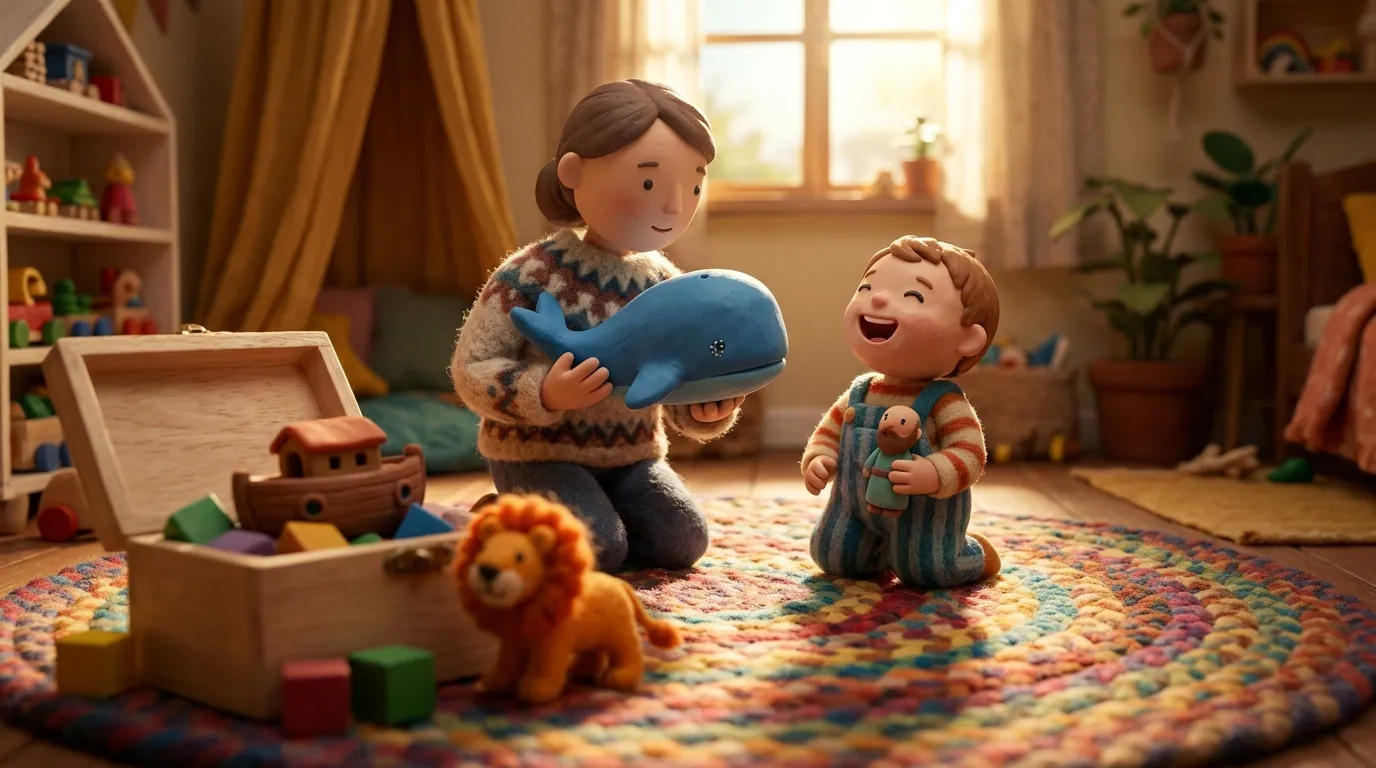 Story props in their hands let a small child tell the story with you.
Ages 5 to 7: retelling in their own words
By age 5, according to the CDC, most children can retell a story with at least two events and answer simple questions about a book after you read it. That makes it a good age to ask them to tell the story back to you. To retell it, they have to pull it out of memory, and that effort helps it stick.
Psychologists call this retrieval practice. In the first experiment of a 2006 study by Henry Roediger and Jeffrey Karpicke, students who took a recall test on a passage remembered 56% of it a week later, and students who only reread it remembered 42%. With a child, the test is just a conversation: “Who showed up first?” “What did he carry in his bag?”
Drawing helps too. Try “Draw the part you liked best,” followed by “Tell me what’s happening in your picture.” Many kids in this range are starting to read, and short picture books with the Bible text in large print let them read a line at a time with you.
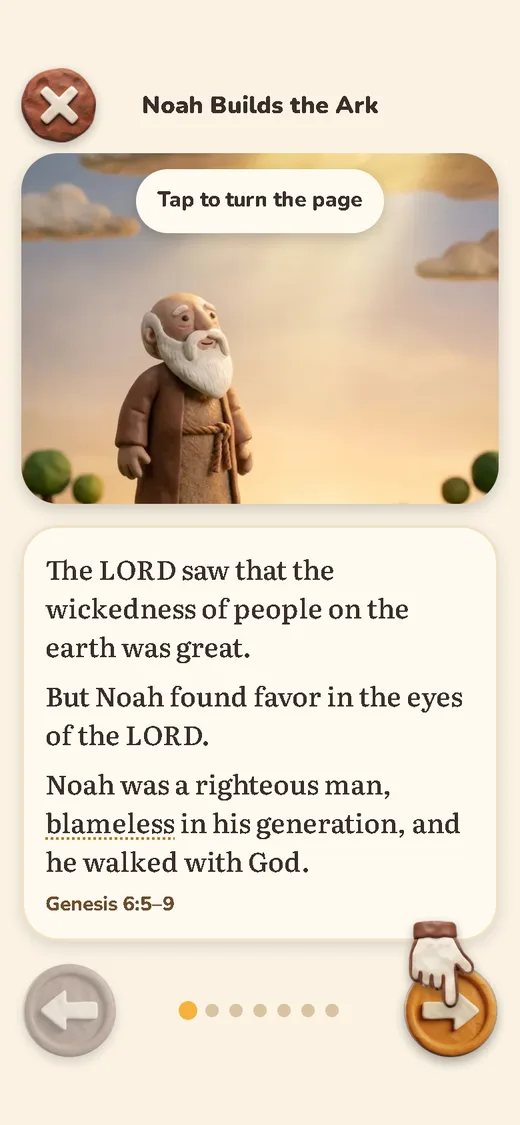 A short Bible text with a big illustration, made for reading together.
Ages 8 to 10: reading the text and connecting events
Between 7 and 11, in Piaget’s description, children apply logic to concrete things: they put events in order, compare, and see cause and effect. This is the time to open a Bible, find the book and chapter, and read the passage aloud together. Kids this age can follow a story across many chapters, like Joseph’s in Genesis 37 to 50.
A timeline on the wall (Abraham, Joseph, Moses, David, Jesus), a map for finding places and the question “Why do you think he did that?” all work well. Word games and verse-finding challenges fit perfectly here; see the ideas in Bible games for families and the Bible word search guide. It’s also a good age to learn one verse a week with the methods in how to memorize Bible verses.
Ages 11 to 13: open questions and honest talk
Around 11, formal operational thinking begins: preteens start handling abstract ideas and hypotheticals. They notice tensions in the text, push back on pat answers and get interested in characters who fail. David after Bathsheba, Peter’s denial and the book of Job make for rich conversations at this age.
Ask open questions that leave room for more than one answer: “What would you have done in his place?” “What bothers you about this passage?” Accept “I don’t know” as an honest answer, including your own. Let them read the passage alone first and bring one question to the conversation. For a long-range plan beyond single verses, see how to memorize the Bible over the years.
A 15-minute family devotional, step by step
A family devotional with kids fits into 15 minutes when it follows the same order every time: gather, tell, ask, keep one line and pray. A fixed order means kids know what comes next, which saves you explaining. The full 15 minutes suits kids 8 and up. For ages 5 to 7, trim the questions and aim for 8 to 12 minutes; for ages 2 to 4, cut each part roughly in half.
 Same place, same time: the routine does half the work.
| Minute | Part | What to do |
|---|---|---|
| 0 to 2 | Gather | Same spot and time (after dinner or before bed). Phones off the table. |
| 2 to 6 | Tell or read | A short passage, 5 to 15 verses. For little ones, tell it in your own words. |
| 6 to 10 | Ask | Three questions: one about facts (“What happened?”), one about feelings (“How did he feel?”) and one about life (“When have you felt that way?”). |
| 10 to 12 | Keep one line | One phrase from the passage, said three times with a hand motion. |
| 12 to 14 | Pray | Everyone says one thing: one thank-you and one request. |
| 14 to 15 | Close | Always the same ending: a blessing, a hug, a short song. |
Keep the passage short: read two full chapters of Genesis and a 5-year-old’s eyes will glaze over. Save the questions for when the reading is done so the story runs all the way through. And give the child a part to play: turning the page, picking the song, holding the story object.
On tired nights, swap the reading for an audio Bible and just do the questions. Listening together on the couch or in the car keeps the habit alive. There are more ideas in using an audio Bible as a family.
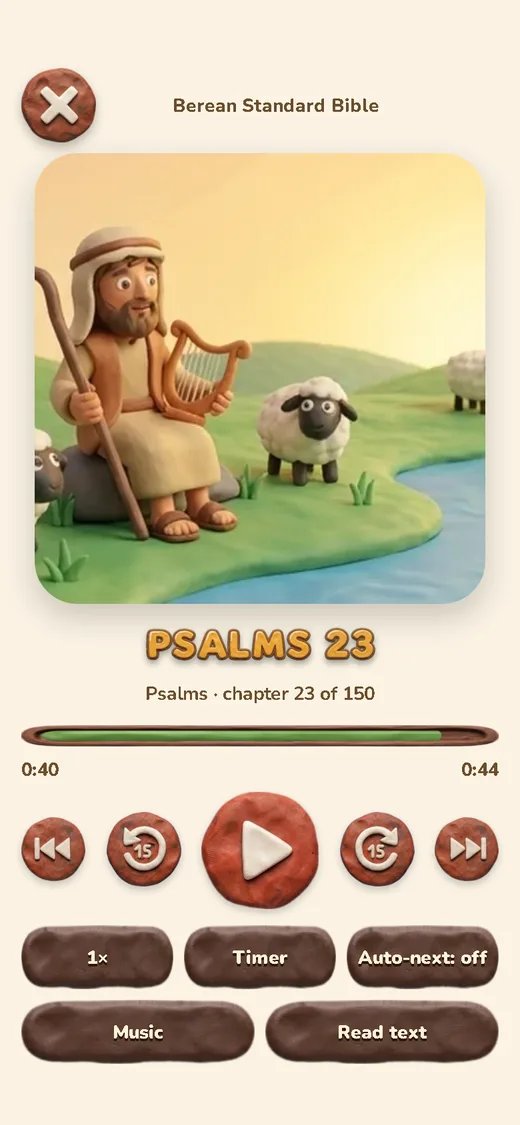 On busy nights, listen to the chapter together and just ask the questions.
Lesson plan: David and Goliath in 20 minutes
David and Goliath (1 Samuel 17) is one of the stories kids request most, and it works from age 2 to 13 because the questions change with each age group. This plan works at home or in a Sunday school class, with one child or twenty.
 Five smooth stones from the brook: the detail kids remember most.
Prep and opening hook
Before class (5 minutes of prep): read all of 1 Samuel 17. Grab a cloth bag, five small stones and a strip of fabric to use as a sling. A big blanket on the floor can be the valley.
Minutes 0 to 3, the hook. Hold up the closed bag and ask what a shepherd might carry in it. Let them guess. Pull the stones out one at a time.
The story in six scenes
Minutes 3 to 10, the story. Tell it scene by scene, dropping your voice at the tense moments:
- Israel’s army and the Philistine army camped on opposite sides of the Valley of Elah (verses 1 to 3).
- Goliath, the champion from Gath, who came out every morning and evening for forty days to challenge Israel (verses 4 and 16).
- David, the youngest of Jesse’s sons, from Bethlehem, sent to the camp with roasted grain and ten loaves of bread for his brothers and ten portions of cheese for their commander (verses 12 to 18).
- King Saul dressing David in his own armor, and David taking it off because he couldn’t walk in it (verses 38 and 39).
- Five smooth stones from the brook, the sling in his hand, and David’s words to the giant (verses 40 and 45).
- The stone striking Goliath’s forehead and the giant falling facedown (verse 49).
Verse 45 anchors the lesson:
But David said to the Philistine, “You come against me with sword and spear and javelin, but I come against you in the name of the LORD of Hosts, the God of the armies of Israel, whom you have defied.”
(1 Samuel 17:45, Berean Standard Bible)
Questions by age
Minutes 10 to 15, questions by age. Pick the row that matches your group:
| Age | Fact question | Meaning question | Life question |
|---|---|---|---|
| 2 to 4 | How many stones did David pick up? (count on fingers) | Was David alone? Who was with him? | What are you scared of? God is with you too. |
| 5 to 7 | What did David bring to his brothers? | Why did David take off the king’s armor? | What might a “giant” be for a kid your age? |
| 8 to 10 | How many days did Goliath challenge Israel? (40) | Why didn’t any grown soldier go out to fight? | Tell about a time you did the right thing while you were scared. |
| 11 to 13 | What experience did David tell Saul about to show he could go? (the lion and the bear, verses 34 to 37) | What did David mean by “the battle is the LORD’s” (verse 47)? | What does courage mean to you? Can you be brave and scared at the same time? |
Activity and closing
Minutes 15 to 18, activity. Little ones retell the story with the stones, one stone per scene. Ages 5 to 10 draw the armor scene and the stones scene side by side. Ages 11 to 13 write two sentences on what David already knew about God before he walked into the valley.
Minutes 18 to 20, prayer and the line. Say “I come in the name of the Lord” together, and each person names one fear they’re handing to God.
Next week, before you start a new story, ask out of nowhere: “How many stones?” and “What did David say to the giant?” That’s retrieval practice again, now spaced out over time. To reinforce it at home, our app, Terra Sinai, has a game called David’s Sling whose levels travel through the fields of Bethlehem and the Valley of Elah.
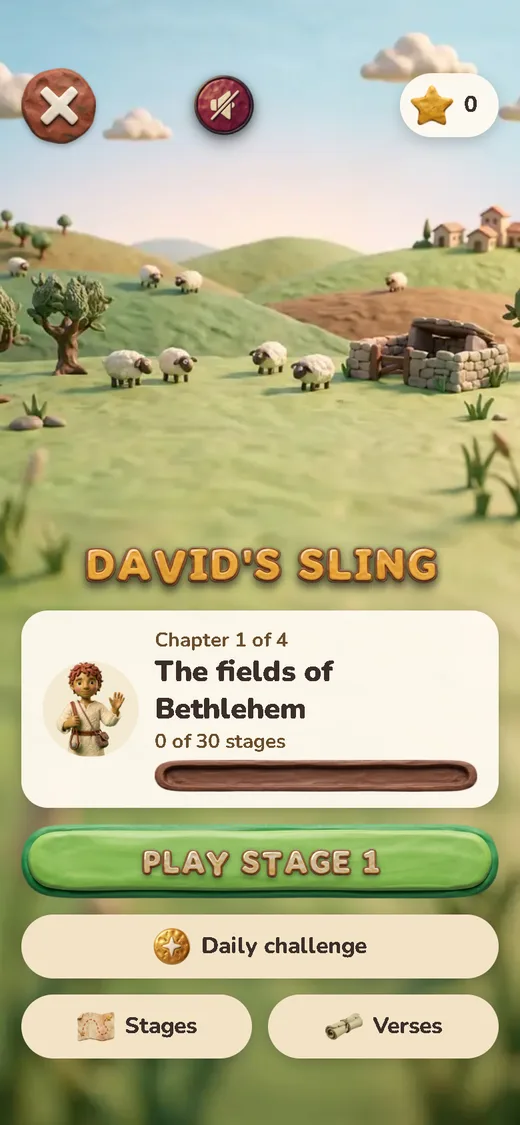 After the lesson, the levels revisit the places in the story.
How to handle the hard stories in the Bible
Plenty of Bible stories include war, death and judgment. A safe rule is to tell the truth without graphic detail, at the depth the child can carry. Take Goliath: for a 3-year-old, “the stone hit the giant and he fell down” is enough. Verse 51, where David cuts off Goliath’s head, can wait until 10 or 11, when the child reads the chapter for themselves.
- Center the story on who was kept safe. With the flood, little ones hold on to the ark, the animals and the rainbow promise. The conversation about judgment comes later.
- Tell what the text says, without inventing details to soften it. If a child asks, “What about the people who didn’t get on the ark?”, answer in simple words with what the Bible says, and that God is just. A made-up ending causes confusion when they read the Bible on their own.
- Hold back the ones that need maturity. The binding of Isaac (Genesis 22), the plagues of Egypt in detail and the visions of Revelation usually land better after 9 or 10.
- Watch how your child’s body reacts. Coming back to it fearfully, asking for the light on, trouble falling asleep: these are signs it came too soon. Spend a few weeks on stories of God’s care, then return to it.
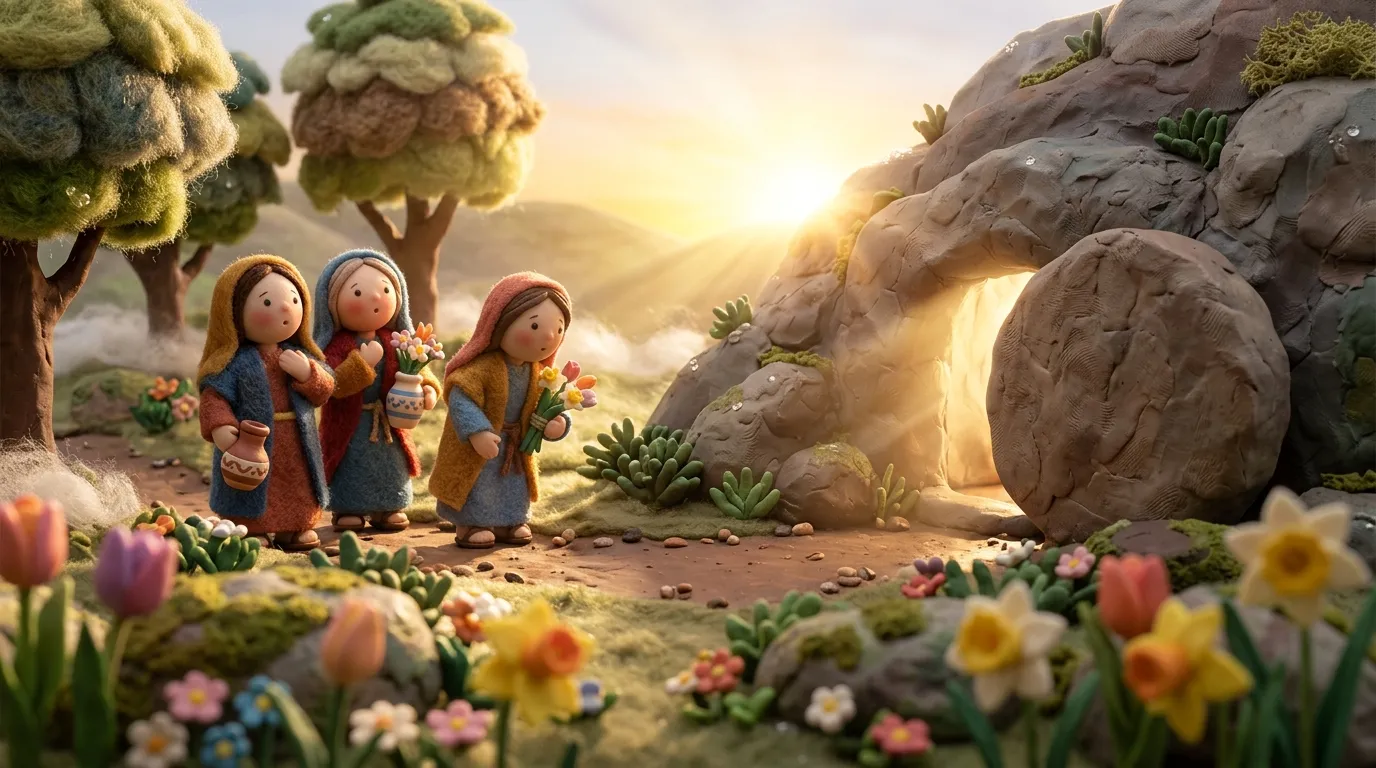 Easter morning helps you tell about the cross without describing the pain.
The death and resurrection of Jesus deserve particular care. Even very young children can hear that Jesus died and that God brought him back to life. Tell them he suffered and died on the cross, without describing the pain. Easter morning and the empty tomb are the part kids will ask to hear again.
Screen time: how much, when and how
Bible apps and videos help when they come after the conversation and have a limit. The World Health Organization’s 2019 guidelines recommend no sedentary screen time before age 2, and no more than 1 hour a day for ages 2 to 4, adding “less is better.” A Bible game counts inside that hour.
In January 2026 the American Academy of Pediatrics released new recommendations on digital media. For families, the AAP recommends creating a Family Media Plan, modeling good habits with your own devices and carving out screen-free times and places, such as the car, dinnertime or weekends. Family devotions are a natural candidate for a phone-free time.
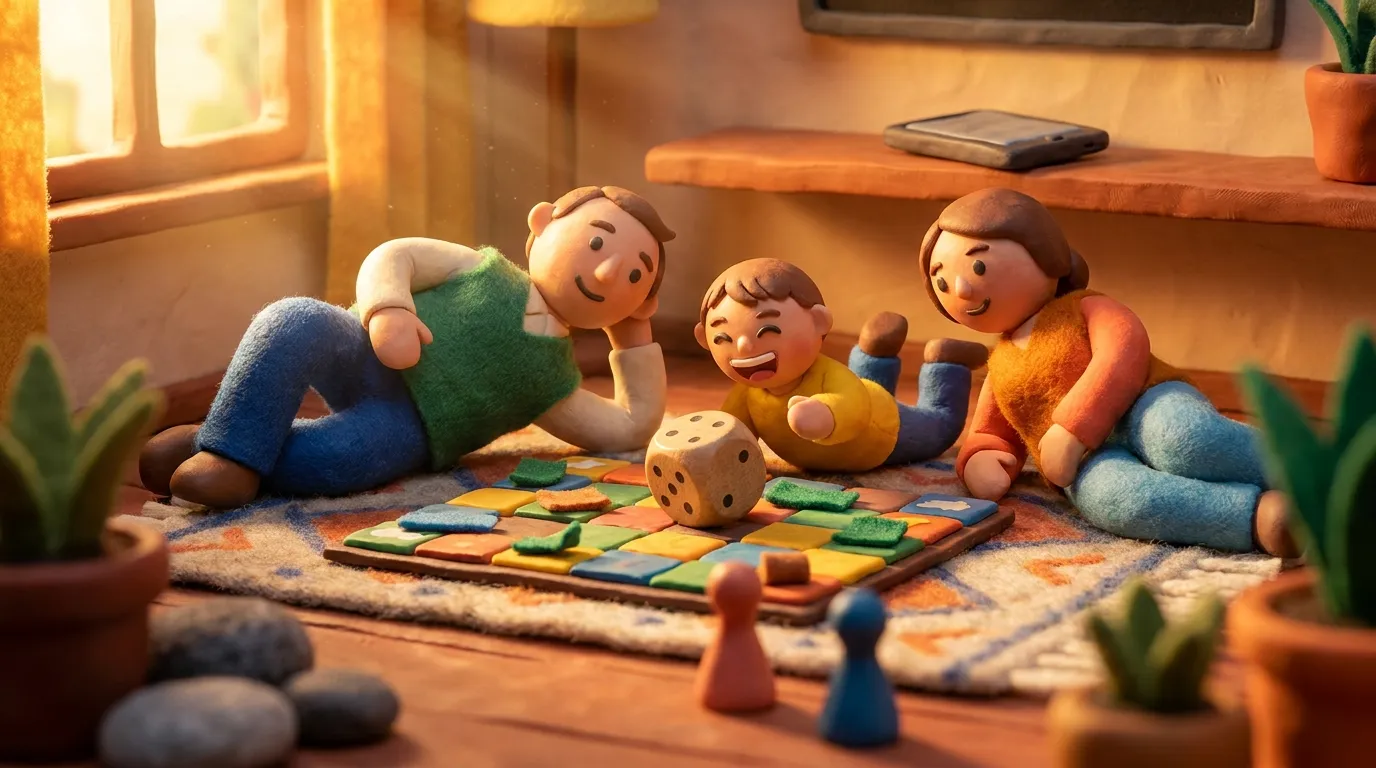 Screens on a timer, with the board game close by.
In practice, agree on these with your kids:
- The story comes first. The game or video is dessert after a story you already told.
- Short sessions with a clear end. Ten to fifteen minutes, with an hourglass or timer the child can see.
- Play together when you can. Asking “Which part of the story are you on?” keeps the conversation going during the game.
When choosing, look for apps with no ads, the actual Bible text and offline play, so the device doesn’t open the door to other content. Our app has no ads, the games work offline, and when you open it you can pick the kids’ version, designed for playing with an adult nearby.
The best Bible stories for each age
Pick three stories from your child’s age range and tell them over a month, swapping one each week. Repeating a few stories builds familiarity, and familiarity is where the good questions come from. The table is a starting point; if your child loves a story from the next row up, go for it.
| Age | Story | Where to find it | What it opens up |
|---|---|---|---|
| 2 to 4 | Creation | Genesis 1 | God made everything, and made it good |
| 2 to 4 | Noah’s ark | Genesis 6 to 9 | God cares and keeps his promise |
| 2 to 4 | Baby Moses in the basket | Exodus 2 | God protects the little ones |
| 2 to 4 | Jesus and the children | Mark 10:13-16 | Jesus wants children close |
| 2 to 4 | The lost sheep | Luke 15:3-7 | God goes looking for the lost |
| 5 to 7 | David and Goliath | 1 Samuel 17 | Courage and trust |
| 5 to 7 | Daniel in the lions’ den | Daniel 6 | Faithfulness and protection |
| 5 to 7 | Jonah | Jonah 1 to 3 | Obeying and starting over |
| 5 to 7 | Zacchaeus | Luke 19:1-10 | Jesus changes a life |
| 5 to 7 | Jesus calms the storm | Mark 4:35-41 | Fear and peace |
| 8 to 10 | Joseph in Egypt | Genesis 37 to 50 | Jealousy, forgiveness and God’s plan |
| 8 to 10 | The Exodus and the sea | Exodus 12 to 15 | Freedom and trust |
| 8 to 10 | Ruth and Naomi | Ruth 1 to 4 | Loyalty and care |
| 8 to 10 | Esther | Esther 4 to 7 | Courage to speak up |
| 8 to 10 | Paul’s shipwreck | Acts 27 | Faith in the middle of danger |
| 11 to 13 | David and Psalm 51 | 2 Samuel 11 and 12, Psalm 51 | Failure, guilt and forgiveness |
| 11 to 13 | Peter denies Jesus and is restored | Luke 22; John 21 | Falling and coming back |
| 11 to 13 | Job | Job 1, 2 and 38 to 42 | Suffering without easy answers |
| 11 to 13 | The Sermon on the Mount | Matthew 5 to 7 | How Jesus asks us to live |
| 11 to 13 | Abraham and Isaac | Genesis 22 | Trust and provision |
Common mistakes when teaching kids the Bible
Most missteps come from good intentions.
- Ending every story with a canned moral. “And the lesson is: obey.” Let a question lead them to the point themselves.
- Reading passages that are too long. When their eyes drift, stop there and pick it up tomorrow.
- Switching stories every night. Familiarity comes from repetition.
- Using the Bible as punishment. Assigning a passage as a consequence ties Scripture to something bad.
- Pretending to know everything. “I don’t know, let’s look it up together” models humility and shows that the Bible can be studied.
You’ll know it’s working when your child asks for the story again, finishes your sentences, and one day, without being asked, tells it to a younger sibling.
How this guide was made. Written by the site’s editorial team and reviewed in October 2026. Developmental milestones were checked against the CDC pages and the NCBI summary, screen-time guidance against the WHO and AAP, and Bible quotations were copied from the Berean Standard Bible. The lengths and age ranges are general guidance; if you have questions about your child’s development, talk to your pediatrician.
Sources
- CDC, Milestones by 4 Years (updated May 2026)
- CDC, Milestones by 5 Years (updated May 2026)
- Scott, H. K., and Cogburn, M., Piaget, StatPearls, NCBI Bookshelf
- Roediger, H. L., and Karpicke, J. D. (2006), Test-Enhanced Learning: Taking Memory Tests Improves Long-Term Retention, Psychological Science 17(3), 249-255
- World Health Organization, To grow up healthy, children need to sit less and play more (April 24, 2019)
- American Academy of Pediatrics, Creating a child-friendly digital world (January 20, 2026)
- Harvard Center on the Developing Child, Serve and Return
Frequently asked questions
What age should you start teaching the Bible to a child?
You can start very early, with stories of a few sentences, pictures and gestures. By 4, the CDC notes, many children can tell what comes next in a well-known story, and by 5 they can retell a story with at least two events. Let the stories grow longer over time.
How long should a family devotion with young kids be?
Our suggestion: 3 to 7 minutes for ages 2 to 4, 8 to 12 minutes for ages 5 to 7, and about 15 minutes from age 8. The CDC lists paying attention for 5 to 10 minutes during an activity as a milestone by age 5, which is why the time grows with age.
Which Bible story is best to start with for toddlers and preschoolers?
Stories with a strong picture and a safe ending: creation, Noah and the ark, baby Moses in the basket, the birth of Jesus, Jesus blessing the children and the lost sheep. Each fits in a few sentences, and a small child can see the scene in their head.
How do you explain violent Bible stories to kids?
Tell what happened truthfully, leave out graphic detail and match the depth to the age. With little ones, focus on who God protected. With older kids, read the text together and talk through the questions it raises. If a child turns anxious or has trouble sleeping, go back to gentler stories for a while.
Is it OK for young kids to use a Bible app or game?
The WHO recommends no sedentary screen time before age 2 and no more than 1 hour a day for ages 2 to 4, with less being better. Treat the app as a short follow-up to a story you told first, and play along when you can.
What if my child won't sit still for family devotions?
Shorten it, move it to a different time and give their hands a job: hold an object from the story, make a sound effect, draw the scene. A quick question every minute pulls attention back without a scolding. Then tell the same story again next week.
Keep reading
-
Bible activities for kids: 15 easy ideas
15 Bible activities for kids to do at home with everyday supplies: crafts, puppets, a recipe, a treasure hunt, music and painting, with ages and steps. Read article -

Fruit of the Spirit for kids: a family guide
Love, joy, peace and the rest of Galatians 5:22-23 in words kids understand, with family moments, games for busy evenings and a four-week verse plan. Read article -
Bible stories for kids: 10 to read aloud
Ten short Bible stories for kids ages 2 to 7, written to read aloud in 4 to 10 minutes, with suggested ages, questions to talk about and a bedtime routine. Read article