
Bible sudoku: 6 printable puzzles with answers
Six printable Bible sudoku puzzles, from 4x4 letter grids with LOVE and HOPE to easy and medium 9x9, each with a verse, solving tips and an answer key.
 The Terra Sinai team 10 min read
In this article (13)
Six printable Bible sudoku puzzles are below, starting with a tiny 4x4 grid spelled with the letters of LOVE and working up to a medium 9x9 number grid. Each one comes with a short verse to read before you start. They fit a Sunday school table, a kitchen counter after dinner or a grandparent’s porch, and the answer key sits at the bottom of the page.
A short program generated every grid and checked that each one has exactly one solution. We checked every verse against the Berean Standard Bible (BSB).
Bible sudoku puzzles: six grids to print
Hit Ctrl+P on a computer, or use the Print option in your phone’s Share menu. You’ll get the grids and verses first, the answer key starts on its own page, and the tips and pictures stay off the paper. Use a pencil. Every puzzle follows one rule: each symbol appears exactly once in every row, every column and every box outlined by the thicker lines.
Puzzle 1 (4x4, beginner): LOVE
Use the letters L, O, V and E. Each 4x4 grid has four boxes of 2x2 squares.
“We love because He first loved us.” (1 John 4:19, Berean Standard Bible)
| L | V | ||
| V | E | ||
| E | L | ||
Puzzle 2 (4x4, beginner): HOPE
Use the letters H, O, P and E. This grid gives you one fewer letter to start with.
“Now may the God of hope fill you with all joy and peace as you believe in Him, so that you may overflow with hope by the power of the Holy Spirit.” (Romans 15:13, Berean Standard Bible)
| O | E | ||
| O | |||
| E | P | ||
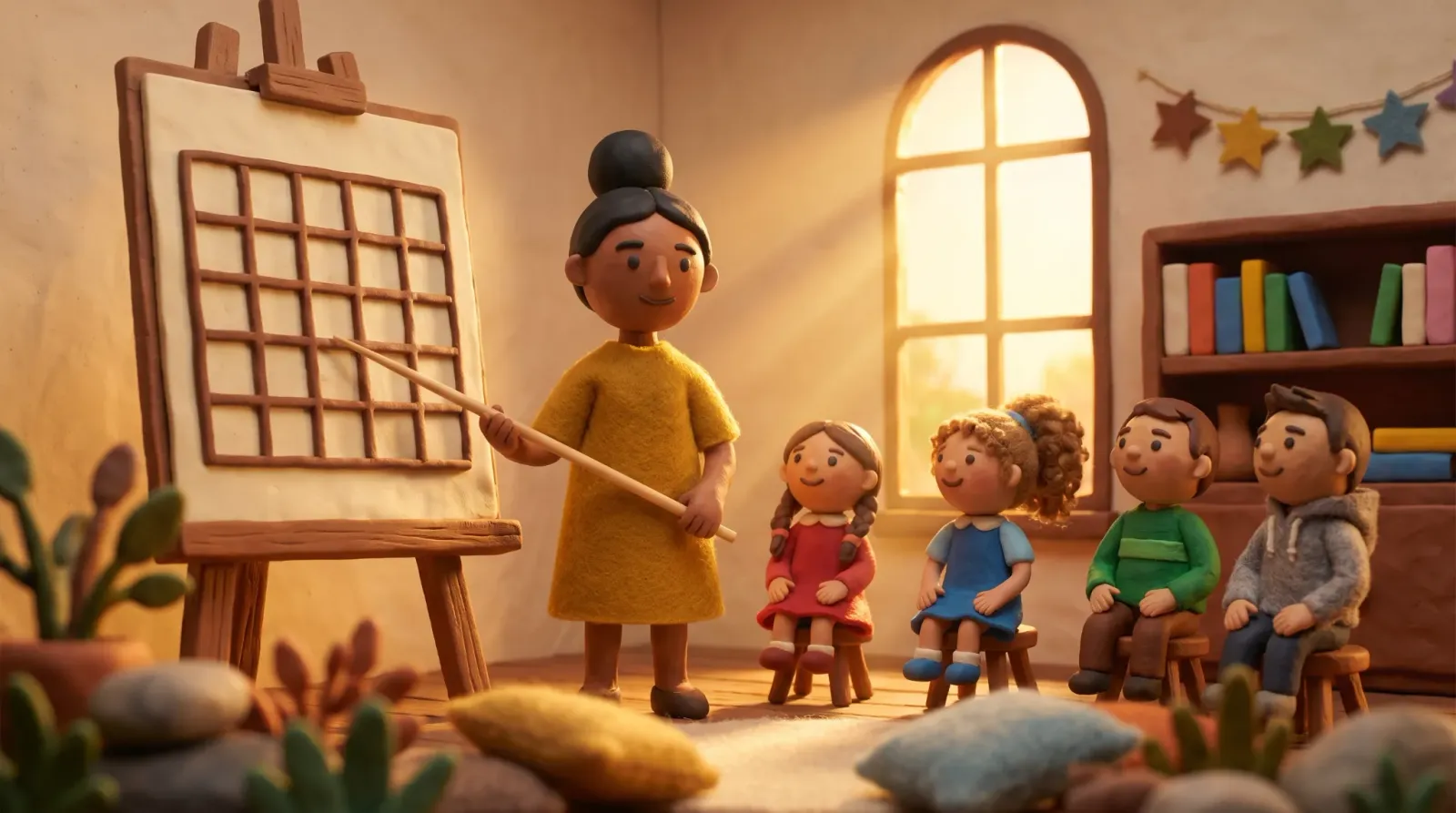 Marta shows where each 2-by-3 box starts.
Puzzle 3 (6x6, easy): CHRIST
Use the letters C, H, R, I, S and T. In a 6x6 grid each box is two rows tall and three columns wide.
“I can do all things through Christ who gives me strength.” (Philippians 4:13, Berean Standard Bible)
| C | I | ||||
| H | T | ||||
| T | I | H | R | S | |
| S | I | T | |||
| R | |||||
| T |
Puzzle 4 (6x6, easy to medium): DANIEL
Use the letters D, A, N, I, E and L. Same box shape as Puzzle 3, with fewer letters given.
“To these four young men God gave knowledge and understanding in every kind of literature and wisdom. And Daniel had insight into all kinds of visions and dreams.” (Daniel 1:17, Berean Standard Bible)
| N | L | ||||
| A | E | ||||
| N | D | A | |||
| D | L | ||||
| D | N | ||||
| L |
 Daniel prays while the lions sleep.
Puzzle 5 (9x9, easy): the stars
Use the digits 1 through 9. Each 9x9 grid has nine boxes of 3x3 squares.
“He determines the number of the stars; He calls them each by name.” (Psalm 147:4, Berean Standard Bible)
| 9 | 4 | |||||||
| 7 | 8 | 6 | 3 | 5 | ||||
| 1 | 2 | 9 | 5 | 8 | 6 | |||
| 2 | 7 | 1 | 8 | |||||
| 6 | 1 | 9 | ||||||
| 1 | 8 | 2 | 7 | 3 | ||||
| 8 | 3 | 4 | 6 | 5 | 1 | 2 | ||
| 9 | ||||||||
| 2 | 5 | 3 | 9 | 7 |
Puzzle 6 (9x9, medium): number our days
Use the digits 1 through 9. This one starts with fewer givens, so plan on making notes.
“So teach us to number our days, that we may present a heart of wisdom.” (Psalm 90:12, Berean Standard Bible)
| 8 | 1 | 3 | ||||||
| 9 | 3 | |||||||
| 2 | 6 | 7 | 9 | |||||
| 6 | 2 | 4 | 5 | 8 | ||||
| 3 | 5 | 8 | 6 | |||||
| 8 | 1 | 3 | 4 | |||||
| 6 | 2 | 5 | ||||||
| 8 | 1 | 5 | 6 | |||||
| 4 |
How to play sudoku
Sudoku asks you to fill every empty square so that each row, each column and each box holds every symbol once. There’s no arithmetic involved, so a 4x4 grid of letters works for a child who can’t add yet.
Before you start a letter grid, say the word out loud with your child and point to each letter. The letters can sit in any order, so LOVE might show up as V, L, E, O in one row and E, O, V, L in the next, as long as no letter repeats in a row, column or box.
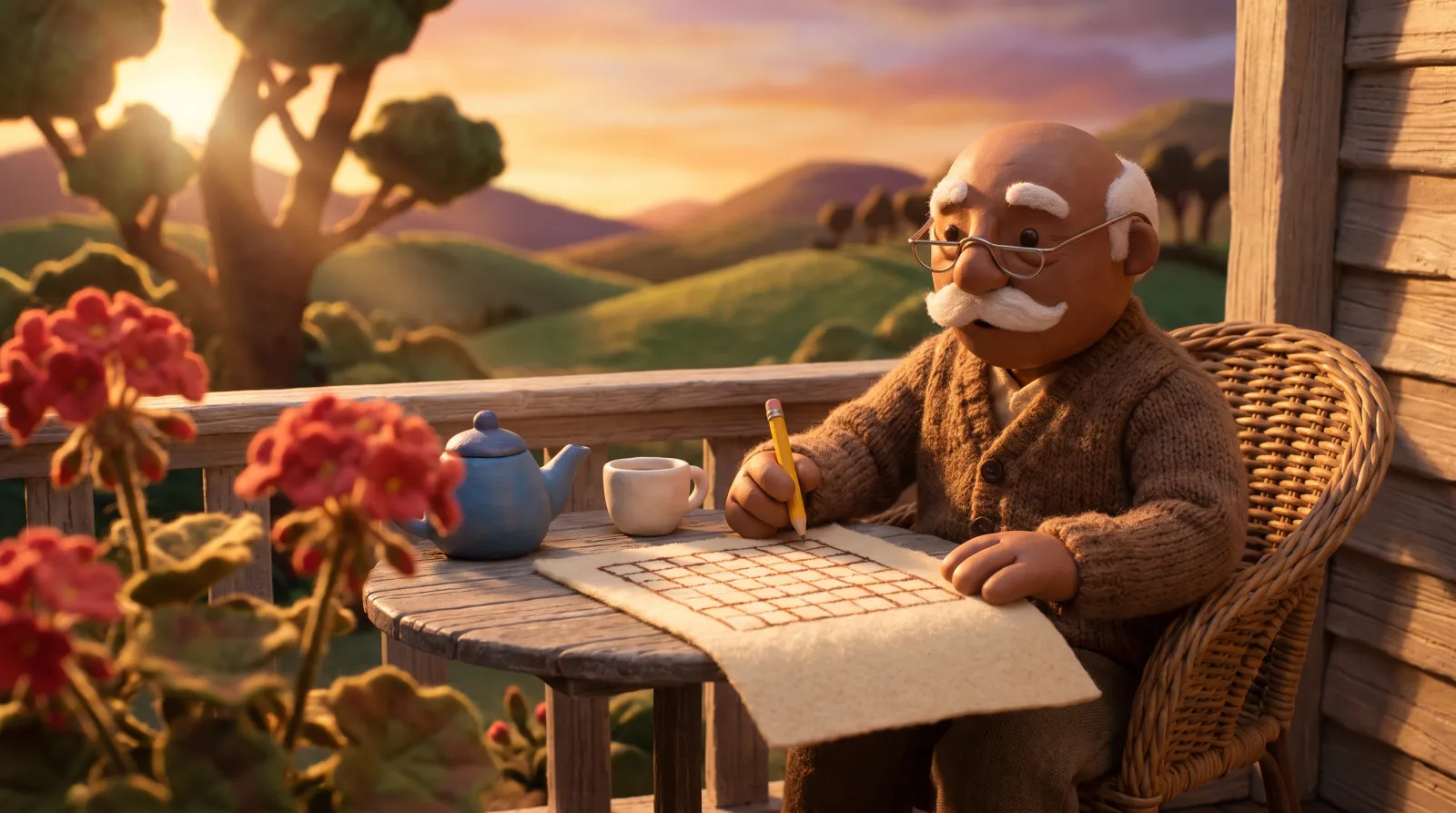 Grandpa Antonio works a 9x9 on the porch at sunset.
Sudoku solving techniques, step by step
A tiny practice grid is a handy place to learn the moves. This one uses the digits 1 to 4 and isn’t one of the six puzzles above, so you can work it with your kids without spoiling anything.
| 1 | 4 | ||
| 4 | 1 | ||
| 2 | 3 | ||
| 2 |
- Find what’s missing. The top row has 1 and 4, so the two empty squares need a 2 and a 3.
- Check the column. The third column already has a 1 and a 2. The empty square at the top of that column can’t be 2, so it’s 3, and the square beside it takes the 2.
- Look for the only home. Row 3 needs a 1 and a 4. Column 2 already has a 4, so the 4 in row 3 has to go in column 3, and the 1 goes in column 2.
- Keep going. Each new number gives its row, column and box one more clue. Finish the grid and check that every row, column and box has 1, 2, 3 and 4.
SudokuWiki, Andrew Stuart’s solving guide, uses names like hidden single and naked pair, and the table below pairs each move with what you do.
| Technique | What you do | When it helps |
|---|---|---|
| Scanning | Pick one symbol, sweep the rows and columns that already hold it, and find the last open square for it in a box | Early in any puzzle |
| Single candidate | Pick one empty square and cross off every symbol in its row, column and box | When a square has only one option left |
| Hidden single | In one row, column or box, find a symbol that fits in just one square | When every square still looks open |
| Notes | Write the possible symbols small in a corner of the square | 6x6 and 9x9 grids, especially Puzzle 6 |
| Naked pair | Two squares in one row that can only hold the same two symbols take those symbols off every other square in that row | Medium and harder 9x9 grids |
| Check as you go | After each new symbol, scan its row, column and box for a repeat | Always |
Teach kids to start with the symbol that shows up most often in the givens. It already blocks the most squares, so its remaining spots are easy to find. For the 9x9 grids, a light pencil and an eraser save a lot of frustration, and an adult can model the notes step on the first few squares of Puzzle 5.
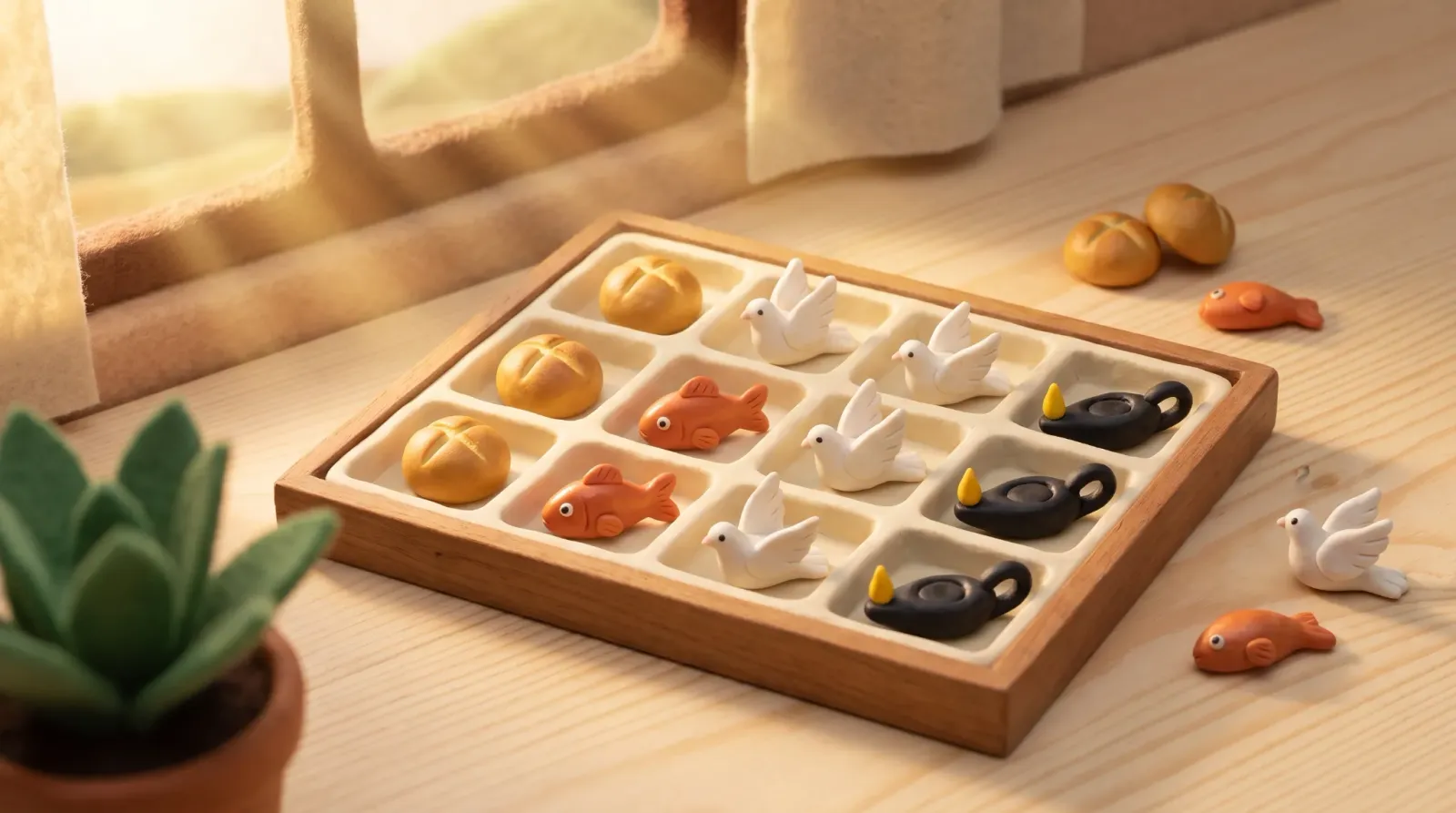 Bread, fish, dove and lamp, the four symbols of a picture sudoku.
Sudoku for kids: which grid fits which age
Start with a 4x4 grid of letters or pictures. The ages below are rough starting points, so move a child up a size once the current grid feels easy.
| Age | Grid | Symbols | What helps |
|---|---|---|---|
| 4 to 5 | 4x4 | Letters of a short word, or pictures | An adult reads the rule and points to one row at a time |
| 6 to 8 | 4x4, then 6x6 | Letters of a name like DANIEL | Say the letters out loud before starting |
| 8 to 10 | 6x6, then easy 9x9 | Letters or digits | Notes in the corner of each square |
| 11 and up | Easy and medium 9x9 | Digits | Notes, naked pairs, a timer if they like a challenge |
| Adults and seniors | Any 9x9 | Digits | Large print and a sharp pencil |
For younger kids, keep the first session short. Stop after one finished 4x4 grid if attention starts to fade. If your child still wants letters to spell real words, a Bible word search works well for that stage, and older kids who like clues can try our printable Bible crossword puzzles.
A 20-minute Sunday school plan
Bible sudoku fits a short slot between the lesson and pickup. Print Puzzle 1 or 2 for preschool and early elementary classes, Puzzles 3 and 4 for grades 2 to 4, and Puzzle 5 for older kids.
| Minute | What to do |
|---|---|
| 0 to 3 | Read the verse above the puzzle out loud and ask one question about it, like “Who loved first?” for 1 John 4:19. |
| 3 to 6 | Draw the practice grid from this page on the whiteboard and solve the first two squares together. |
| 6 to 15 | Kids work in pairs, one holding the pencil and one checking rows and columns. They swap halfway. |
| 15 to 18 | Pairs who finish help another pair by pointing to a row, without saying the answer. |
| 18 to 20 | Everyone says the verse together one more time. |
 Nine clay fruits, one for each digit in a 9x9 grid.
Working in pairs keeps everyone moving. A child who’s stuck can talk through the rule with a partner, and the checker gets plenty of practice spotting repeats. For more ideas for the same class, see our list of Sunday school games.
Bible sudoku at home and with grandparents
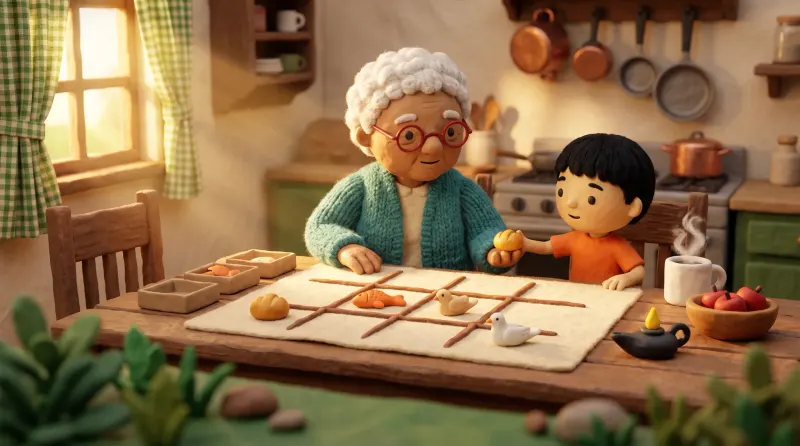
At home, a sudoku fills the gap while dinner finishes cooking or the last ten minutes before bed. Print a grid, set a pencil on top, and let whoever sits down first start it. Someone else can pick up where they left off. The verse at the top of each puzzle gives you something to talk about once the grid is done.
 One writes, and her friend checks with a magnifying glass.
A puzzle gives a grandparent a reason to sit down with a grandchild. Print the 9x9 grids enlarged, one per page, so the squares are big and clear. Let the grandchild teach the 4x4 rule first, then switch roles on the 9x9. If you have a grandparent at home who reads Scripture on a phone, our guide to a Bible app for seniors covers screen size and audio.
How to make your own Bible sudoku
A homemade grid lets you match the puzzle to this week’s lesson. Start with a word whose letters don’t repeat. HOPE and LOVE have four different letters, so they fit a 4x4 grid, and JOSEPH, ISRAEL and GOSPEL each have six, which fits a 6x6. A word like FAITH has five letters, so it won’t fill either size.
- Write the finished grid first. Put the word across the top row, then fill the remaining rows so no letter repeats in any row, column or box. Check every box twice.
- Erase a few squares at a time. After each round, solve what’s left from scratch, without peeking at your finished copy.
- Watch for swaps. If you reach a spot where two letters could trade places and both versions follow the rules, the puzzle has two answers. Put one of those letters back.
- Stop while it’s still fun. For a 4x4 grid, leaving five or six letters in place usually gives young kids enough to start.
Write the verse at the top of the sheet, and keep your finished grid as the answer key.
Symbol Sudoku on a phone
Kids who like tapping a screen can play the same kind of puzzle on a phone. In our app, Symbol Sudoku uses little clay pictures as its symbols: a loaf of bread, an orange fish, a black oil lamp and a white dove.
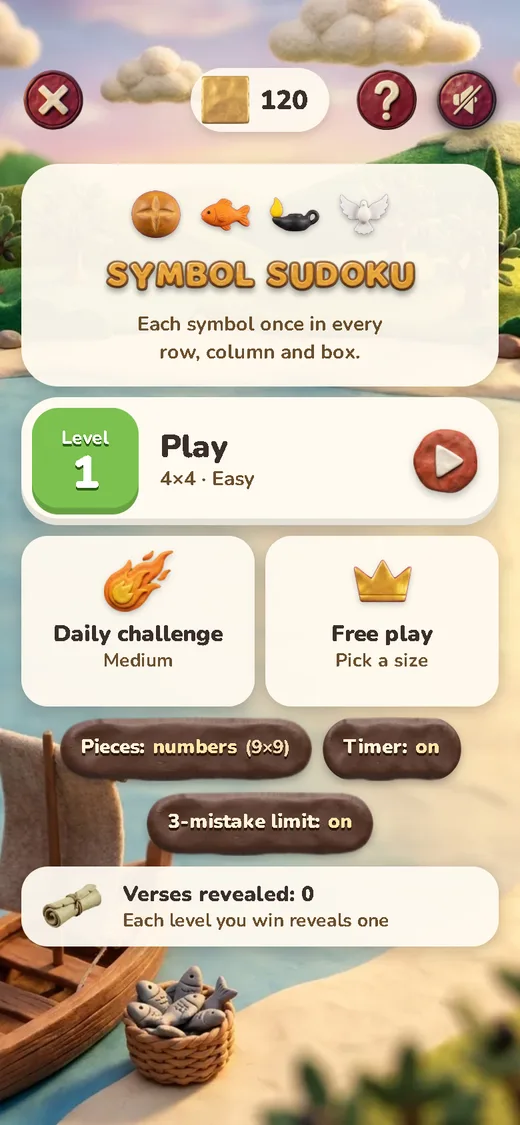 The start screen shows Level 1 at 4x4 Easy, the daily challenge and the Verses revealed counter.
The start screen offers a Level 1 grid at 4x4 Easy, a daily challenge at Medium and a mode where you pick the grid size. You can switch the pieces to numbers on a 9x9 grid, turn the timer on or off, and keep or drop a 3-mistake limit. A counter tracks verses, and each level you win reveals one.
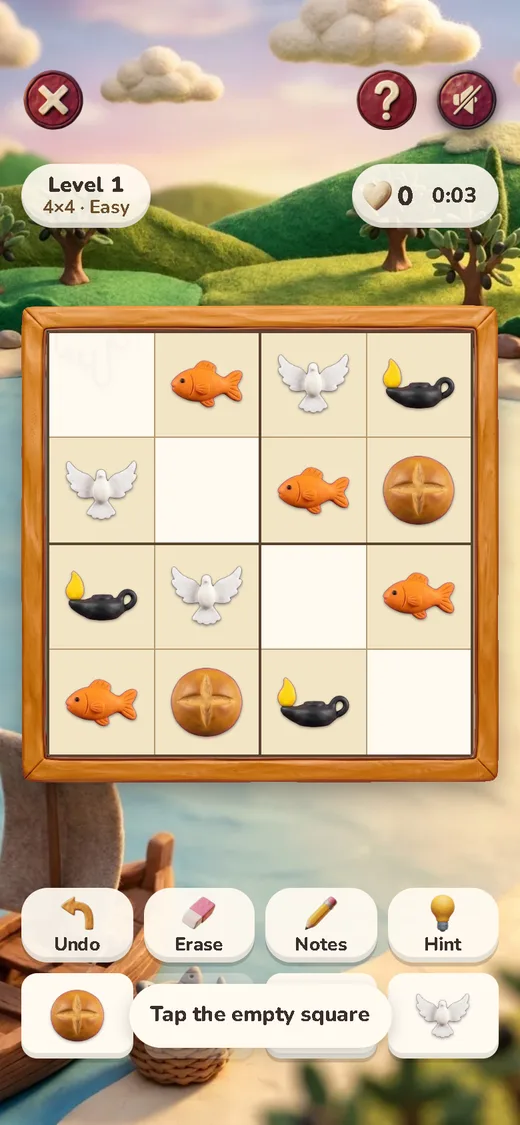 Level 1 on a 4x4 board, with Notes and Hint buttons below the grid.
During a game, the board has Undo, Erase, Notes and Hint buttons, so the notes technique from this page carries over to the screen.
What the research says about sudoku and the brain
PROTECT, an online study run by the University of Exeter and King’s College London, asked more than 19,000 adults aged 50 and over how often they did word and number puzzles such as crosswords and Sudoku, then gave them a set of thinking tests. The results appeared in 2019 in the International Journal of Geriatric Psychiatry. The more regularly people did the puzzles, the better they scored on tasks of attention, reasoning and memory. That’s an association from one point in time. Lead researcher Anne Corbett said the team can’t say the puzzles necessarily reduce the risk of dementia.
A 2020 Cochrane review by Nicola Gates and colleagues looked at a related question: whether computerized brain-training programs of 12 weeks or longer help healthy adults 65 and older. It found eight randomized trials with 1,183 participants. The authors reported low-quality evidence of small benefits right after training, said those benefits were of uncertain clinical importance, and found no evidence that the effect on overall thinking lasted 12 months. The review studied training programs, and Sudoku wasn’t tested on its own.
So we offer these grids as a family pastime, with a verse to read together when each one is done.
 Her daughter shows off the puzzle sheet before bed.
Where sudoku came from
Britannica traces the puzzle form to a New York-based puzzle magazine that printed it in 1979 as Number Place. Nikoli, the Japanese puzzle publisher, says it found the puzzle in that American magazine and brought it to its readers in 1984. The long Japanese title was later cut down to sudoku, where “su” means number and “doku” means single, and in 1986 Nikoli set a rule that the starting clues sit in a symmetrical pattern. Britannica dates the worldwide wave to November 15, 2004, when The Times of London printed its first one.
Answer key
Check your grid row by row. If one row doesn’t match, look for the first square that differs and work forward from there.
Puzzle 1 (4x4): LOVE
| L | E | V | O |
| O | V | E | L |
| E | L | O | V |
| V | O | L | E |
Puzzle 2 (4x4): HOPE
| O | H | P | E |
| P | E | H | O |
| E | P | O | H |
| H | O | E | P |
Puzzle 3 (6x6): CHRIST
| S | R | T | C | I | H |
| H | C | I | S | T | R |
| T | I | H | R | C | S |
| C | S | R | I | H | T |
| R | T | C | H | S | I |
| I | H | S | T | R | C |
Puzzle 4 (6x6): DANIEL
| N | E | L | A | I | D |
| I | D | A | E | L | N |
| L | N | D | I | A | E |
| E | A | I | N | D | L |
| D | I | E | L | N | A |
| A | L | N | D | E | I |
Puzzle 5 (9x9, easy)
| 3 | 6 | 5 | 8 | 9 | 7 | 2 | 4 | 1 |
| 7 | 8 | 4 | 2 | 6 | 1 | 9 | 3 | 5 |
| 1 | 2 | 9 | 5 | 3 | 4 | 7 | 8 | 6 |
| 6 | 9 | 2 | 7 | 1 | 3 | 8 | 5 | 4 |
| 4 | 7 | 3 | 6 | 5 | 8 | 1 | 2 | 9 |
| 5 | 1 | 8 | 4 | 2 | 9 | 6 | 7 | 3 |
| 8 | 3 | 7 | 9 | 4 | 6 | 5 | 1 | 2 |
| 9 | 5 | 1 | 3 | 7 | 2 | 4 | 6 | 8 |
| 2 | 4 | 6 | 1 | 8 | 5 | 3 | 9 | 7 |
Puzzle 6 (9x9, medium)
| 4 | 8 | 6 | 5 | 2 | 9 | 1 | 7 | 3 |
| 7 | 5 | 9 | 4 | 3 | 1 | 8 | 6 | 2 |
| 2 | 1 | 3 | 6 | 7 | 8 | 9 | 4 | 5 |
| 6 | 7 | 2 | 1 | 9 | 4 | 3 | 5 | 8 |
| 3 | 4 | 5 | 7 | 8 | 2 | 6 | 1 | 9 |
| 8 | 9 | 1 | 3 | 5 | 6 | 7 | 2 | 4 |
| 1 | 6 | 8 | 2 | 4 | 3 | 5 | 9 | 7 |
| 9 | 2 | 7 | 8 | 1 | 5 | 4 | 3 | 6 |
| 5 | 3 | 4 | 9 | 6 | 7 | 2 | 8 | 1 |
Sources
- University of Exeter. Regular crosswords and number puzzles linked to sharper brain in later life, May 2019.
- Gates, N. J.; Rutjes, A. W.; Di Nisio, M. et al. Computerised cognitive training for 12 or more weeks for maintaining cognitive function in cognitively healthy people in late life. Cochrane Database of Systematic Reviews, 2020.
- Brooker, H.; Wesnes, K. A.; Ballard, C. et al. The relationship between the frequency of number-puzzle use and baseline cognitive function in a large online sample of adults aged 50 and over. International Journal of Geriatric Psychiatry, 2019.
- Wilson, R. Sudoku. Encyclopaedia Britannica.
- Nikoli. Sudoku.
- Stuart, A. Getting Started. SudokuWiki.org.
- Bible text: Berean Standard Bible (Psalm 90 and 147; Daniel 1; Romans 15; Philippians 4; 1 John 4).
Frequently asked questions
What is a Bible sudoku?
It uses the ordinary sudoku rules with symbols drawn from Scripture: the letters of a word like LOVE or DANIEL, little pictures such as a fish or a dove, or plain digits paired with a verse. Each symbol appears once in every row, every column and every box.
What age can kids start doing sudoku?
Our suggestion: try a 4x4 grid of letters or pictures around 4 or 5 with a grown-up beside them, a 6x6 grid around 6 to 8, and an easy 9x9 around 8 or 9. Watch how your child handles the first grid and adjust.
How do you play sudoku for beginners?
Pick one row, column or box and ask which symbols are missing. Then look at a single empty square and cross off every symbol already sitting in its row, column and box. When only one symbol is left, write it in. Repeat until the grid is full.
Do you need to be good at math to play sudoku?
No. Sudoku has no adding or subtracting at all. The digits are labels, which is why the same puzzle works with letters or pictures, and why a 4x4 letter grid makes a gentle first puzzle for a young child.
Is sudoku good for your brain?
There's an association. In the PROTECT study at the University of Exeter, adults 50 and older who did Sudoku and crosswords more regularly scored higher on tests of attention, reasoning and memory. The lead researcher said that doesn't show the puzzles lower dementia risk, and a 2020 Cochrane review of brain-training programs rated the evidence as low quality.
How do you make sudoku easier for kids?
Shrink the grid to 4x4, use letters or pictures, and give more filled-in squares at the start. Let kids work in pencil, and show them how to jot small notes in a corner of a square when they're not sure yet.
Keep reading
-
Fruit of the Spirit for kids: a family guide
Love, joy, peace and the rest of Galatians 5:22-23 in words kids understand, with family moments, games for busy evenings and a four-week verse plan. Read article -
How to memorize the books of the Bible
How to memorize the 66 books of the Bible in order: small blocks, a 7-day plan, self-testing, tricks for look-alike names and a version for kids. Read article -
Bible activities for kids: 15 easy ideas
15 Bible activities for kids to do at home with everyday supplies: crafts, puppets, a recipe, a treasure hunt, music and painting, with ages and steps. Read article