
Bible activities for kids: 15 easy ideas
15 Bible activities for kids to do at home with everyday supplies: crafts, puppets, a recipe, a treasure hunt, music and painting, with ages and steps.
 The Terra Sinai team 15 min read
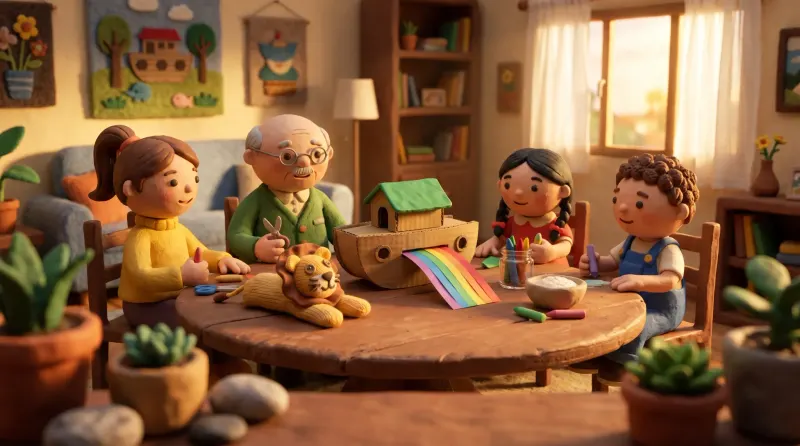
Download the printable storybooks
Three Bible stories as PDFs: a cover with your child's name, one scene per page with its verse, and a last page to draw on. Laid out on A4; on US Letter, choose "Fit to page".
-
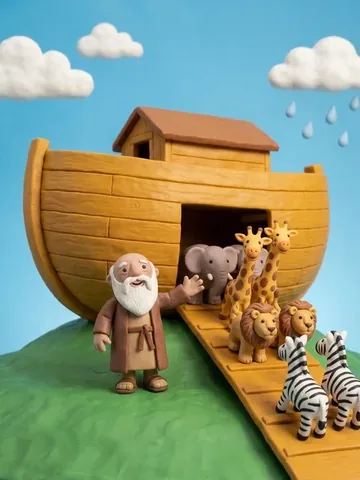
Noah Builds the Ark
Genesis 6–7 PDF · 9 pages
Download PDF Noah Builds the Ark -
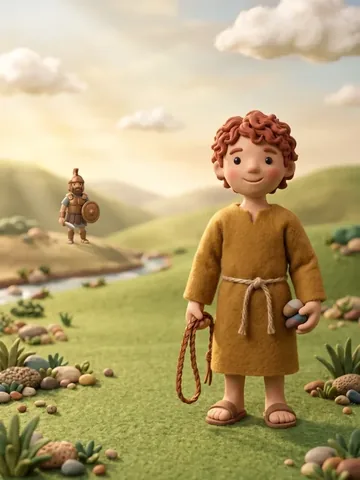
David and the Giant
1 Samuel 17 PDF · 10 pages
Download PDF David and the Giant -
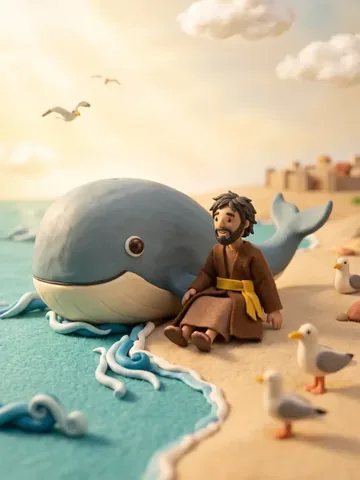
Jonah and the Big Fish
Jonah 1–4 PDF · 10 pages
Download PDF Jonah and the Big Fish
In this article (11)
If you’ve got a cardboard box, a few pots and pans and a short Bible story, you’ve got a rainy Saturday covered. Pick one of the 15 Bible activities for kids below by age or by the time you have, anywhere from 15 minutes to an hour, and jump to its supplies and steps. Each one is built on a Bible passage, listed right beside it.
Jesus made room for the kids when others tried to send them away:
But Jesus said, “Let the little children come to Me, and do not hinder them! For the kingdom of heaven belongs to such as these.”
(Matthew 19:14, Berean Standard Bible)
All 15 activities at a glance
| # | Activity | Ages | Time | Supplies | Story |
|---|---|---|---|---|---|
| 1 | Cardboard box ark | 4 to 8 | 40 min | Box, tempera paint, construction paper, toy animals | Noah (Genesis 6:15-16) |
| 2 | Cellophane window rainbow | 3 to 6 | 20 min | Colored cellophane, tape, a sunny window | The rainbow promise (Genesis 9:13) |
| 3 | Play dough basket for baby Moses | 3 to 7 | 30 min | Flour, salt, water, oil, cream of tartar, green paper | Moses in the river (Exodus 2:3) |
| 4 | Joseph’s robe from fabric scraps | 5 to 10 | 30 min | Fabric scraps, white glue, brown paper | Joseph’s robe (Genesis 37:3) |
| 5 | Toilet paper roll sycamore tree | 3 to 7 | 25 min | Toilet paper roll, green paper, glue | Zacchaeus (Luke 19:4) |
| 6 | Paper bag puppets | 4 to 9 | 30 min | Paper lunch bags, yarn, markers | Daniel and the lions (Daniel 6:22) |
| 7 | Cardboard box puppet theater | 5 to 12 | 45 min | Big box, blue cloth, craft sticks | Jonah (Jonah 1:17) |
| 8 | Find the lost sheep | 2 to 6 | 15 min | Stuffed sheep or cotton-ball sheep | The lost sheep (Luke 15:4-6) |
| 9 | Shoebox walls of Jericho | 4 to 10 | 20 min | Shoeboxes, pots, spoons | Jericho (Joshua 6:20) |
| 10 | Five little loaves | 6 to 12 | 60 min | Flour, yogurt, baking powder | Five loaves and two fish (John 6:9-11) |
| 11 | Five smooth stones treasure hunt | 5 to 10 | 30 min | Five stones, cloth pouch, drawn clues | David and Goliath (1 Samuel 17:40) |
| 12 | Pots-and-pans praise band | 3 to 8 | 25 min | Pots, wooden spoons, a can of rice | Psalm 150:4-5 |
| 13 | Crayon-resist storm painting | 4 to 9 | 25 min | Crayons, watercolors, cardstock | Jesus calms the storm (Mark 4:39) |
| 14 | The house on the rock | 6 to 12 | 30 min | Trays, sand, a big rock, watering can | Matthew 7:24-25 |
| 15 | Flashlight in a dark room | 4 to 10 | 20 min | Flashlight, blanket | Let there be light (Genesis 1:3-5) and Psalm 119:105 |
The five-minute setup
Before you pull out the supplies, tell the story in five or six sentences while you hold something from it: a toy animal for Noah, a rock for David, a flashlight for creation. Go straight into the craft while the story’s fresh, and save the verse for the very end.
Then close the book and ask two things: what did you make, and what was happening in that part of the story? Researchers have measured what that kind of recall does. In experiment 1 of Henry Roediger and Jeffrey Karpicke’s 2006 study, college students tested on a passage remembered 56% of it a week later; for a passage they’d only reread, it was 42%. With a 5-year-old, one question does the job: “Who walked into the ark?”
Most activities in the table run 15 to 30 minutes, which is our own estimate. One of the CDC’s milestones for age 5 is paying attention for 5 to 10 minutes during activities (CDC, the Centers for Disease Control and Prevention), so build in a break to talk every 5 to 10 minutes. Lost them halfway? Box up the supplies and pick it back up tomorrow.
Looking for a story for each day of the week? Try Bible stories for kids. And for what to expect at each age when you teach, see how to teach the Bible to kids.
Safety first
Hand out blunt-tip safety scissors and stay close while the kids cut. Anything hot or sharp beyond that, from the big scissors to the oven, the stove and the kettle, is yours. And flip the glue and paint over before you open them: the label should say “nontoxic.”
Before the craft supplies come out, clear the table of pebbles, loose rice, buttons and tiny paper bits, and keep your eyes on any child under 5. According to the American Academy of Pediatrics (AAP), most children who die from choking are under 5, and balloons, balls, marbles, toy parts and small, round foods cause the most choking deaths. Snack time counts too: hold off on whole grapes, popcorn and nuts until after age 4.
If a child swallows some of the play dough, call Poison Help at 1-800-222-1222. It’s cooked and smells like bread, and it’s very salty, so make it a rule up front that it stays out of mouths, and have everyone wash up at the end.
Crafts from the recycling bin
1. Cardboard box ark
Ages: 4 to 8. Time: 40 minutes. Supplies: a medium cardboard box, tempera paint, construction paper, glue, toy animals.
God gave Noah exact dimensions: “The ark is to be 300 cubits long, 50 cubits wide, and 30 cubits high,” with a door in the side and three decks (Genesis 6:15-16, Berean Standard Bible). Read that out while your child paints the box brown. You cut a window near the top; they make a paper door and glue on a green roof. Then line up the toy animals two by two and march them in. “Who do you think got on first?” works well right there.
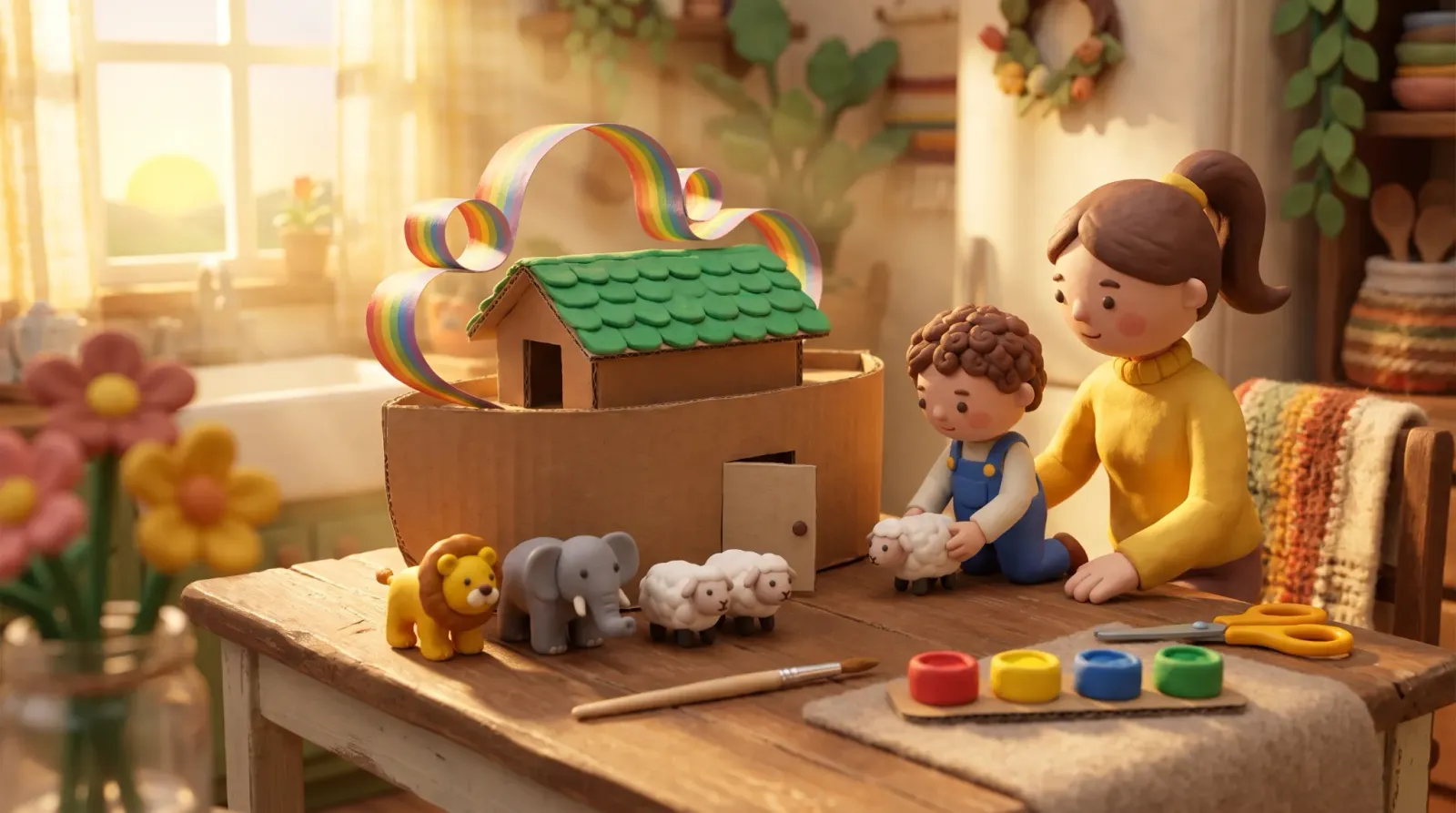 A door, a window, a green roof and the animals lined up two by two.
2. Cellophane window rainbow
Ages: 3 to 6. Time: 20 minutes. Supplies: strips of cellophane in rainbow colors, clear tape, a window that gets sun.
Save this one for the day after the ark. Start by reading the verse out loud:
I have set My rainbow in the clouds, and it will be a sign of the covenant between Me and the earth.
(Genesis 9:13, Berean Standard Bible)
Then tape the strips to the glass side by side in an arch. When the sun hits it, the colors land on the floor. Have your child stand on their favorite color and say it with you: “God keeps His promises.”
3. Play dough basket for baby Moses
Ages: 3 to 7. Time: 30 minutes. Supplies: 2 cups flour, 1/2 cup salt, 2 cups water, 2 tablespoons vegetable oil, 4 teaspoons cream of tartar, green paper.
The cooking part is yours. Put everything in a pot over low heat and stir constantly for 3 to 5 minutes, until the dough pulls away from the sides and forms a ball. Let it cool before your child touches it. The FDA advises against letting kids play with raw flour dough, which is why this dough is always cooked. Store-bought nontoxic play dough works too.
While you both shape an oval basket and a tiny baby, tell Exodus 2. Moses’ mom hid him for three months. When she couldn’t hide him any longer, she put him in a papyrus basket and set it among the reeds along the Nile, and his sister watched from a distance (Exodus 2:2-4). Your child lays the baby in the basket and tucks it between green paper reeds. If you want to keep it, the dough air-dries in two to three days, depending on how thick it is.
4. Joseph’s robe from fabric scraps
Ages: 5 to 10. Time: 30 minutes. Supplies: fabric scraps, white glue, a robe shape cut from brown paper.
Raid the sewing basket or the bag of outgrown clothes. Genesis 37:3 says Israel loved Joseph and “made him a robe of many colors” (Berean Standard Bible). Each child glues on as many scraps as they like. While it dries, ask, “How do you think his brothers felt when they saw it?” If your child’s hooked, keep going at bedtime: one chapter a night from Genesis 37 to 50 gets you to the family reunion in about two weeks. You can skip chapter 38, which is about Judah and Tamar.
5. Toilet paper roll sycamore tree
Ages: 3 to 7. Time: 25 minutes. Supplies: a toilet paper roll, green paper, glue, a little Zacchaeus drawn on paper.
You snip strips down from the top of the roll and fold them out like branches. Your child glues on green paper leaves and perches Zacchaeus up in the branches. Tell them Zacchaeus was short, so he climbed a sycamore tree to see Jesus go by (Luke 19:4). To finish, you play Jesus: walk past the tree and look up.
Puppets, skits and getting the wiggles out
6. Paper bag puppets: Daniel and the lions
Ages: 4 to 9. Time: 30 minutes. Supplies: two brown paper lunch bags, yellow yarn, markers, paper.
One bag is the lion, with a yellow yarn mane. The other is Daniel, in a blue paper robe. With a puppet on each hand, your child acts out the scene: the king shows up at the den and calls down in a deep voice, and Daniel answers. Help them say Daniel’s big line: “My God sent His angel and shut the mouths of the lions” (Daniel 6:22, Berean Standard Bible).
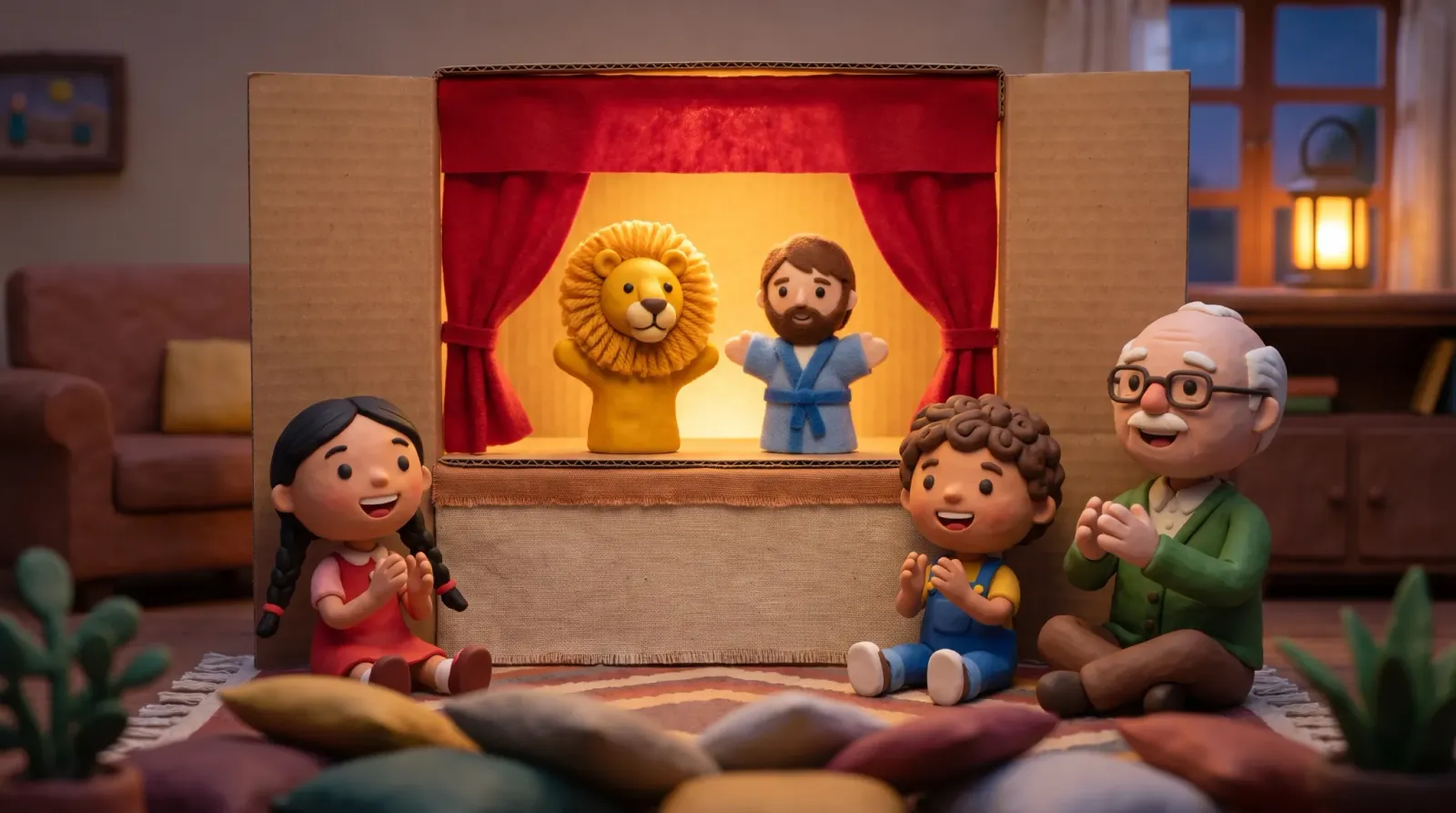 The box stage with the paper bag puppets ready for the show.
7. Cardboard box puppet theater: Jonah
Ages: 5 to 12. Time: 45 minutes. Supplies: a big box, a blue cloth or old sheet, craft sticks, paper, tape.
An adult cuts a big window in the front of the box, and the blue cloth hangs across the bottom as the sea. Kids draw Jonah, the boat and the great fish and tape each one to a craft stick. Hand out the parts and run the scenes in order: Jonah runs, the storm hits, the fish swallows him (Jonah 1:17) and Jonah prays from inside the fish (Jonah 2:1). When the curtain comes down, ask, “What did Jonah learn?”
8. Find the lost sheep
Ages: 2 to 6. Time: 15 minutes. Supplies: a stuffed sheep, or cotton balls glued onto a paper sheep.
While your child covers their eyes, hide the sheep somewhere in the living room. Tell Luke 15:4-6, where the shepherd leaves the ninety-nine and goes looking for the one that’s lost. Then let the search begin. When your child finds it, have them carry it on their shoulders like the shepherd and shout what he tells his friends: “Rejoice with me, for I have found my lost sheep!” (Luke 15:6, Berean Standard Bible).
9. Shoebox walls of Jericho
Ages: 4 to 10. Time: 20 minutes. Supplies: shoeboxes, pots and wooden spoons.
How many times did Israel circle Jericho? Joshua 6 says once a day for six days, then seven times on day seven. Build a tall shoebox wall in the living room and let your kids march around it with a pot and a wooden spoon. Each single lap stands for one day; on the last “day,” they go around seven times in a row. On the final lap, everyone yells together and a gentle nudge brings the boxes down. In Joshua 6:20 the city wall falls at the people’s shout. Got a Sunday school class that’s been sitting for a while? This one lets them burn off some energy.
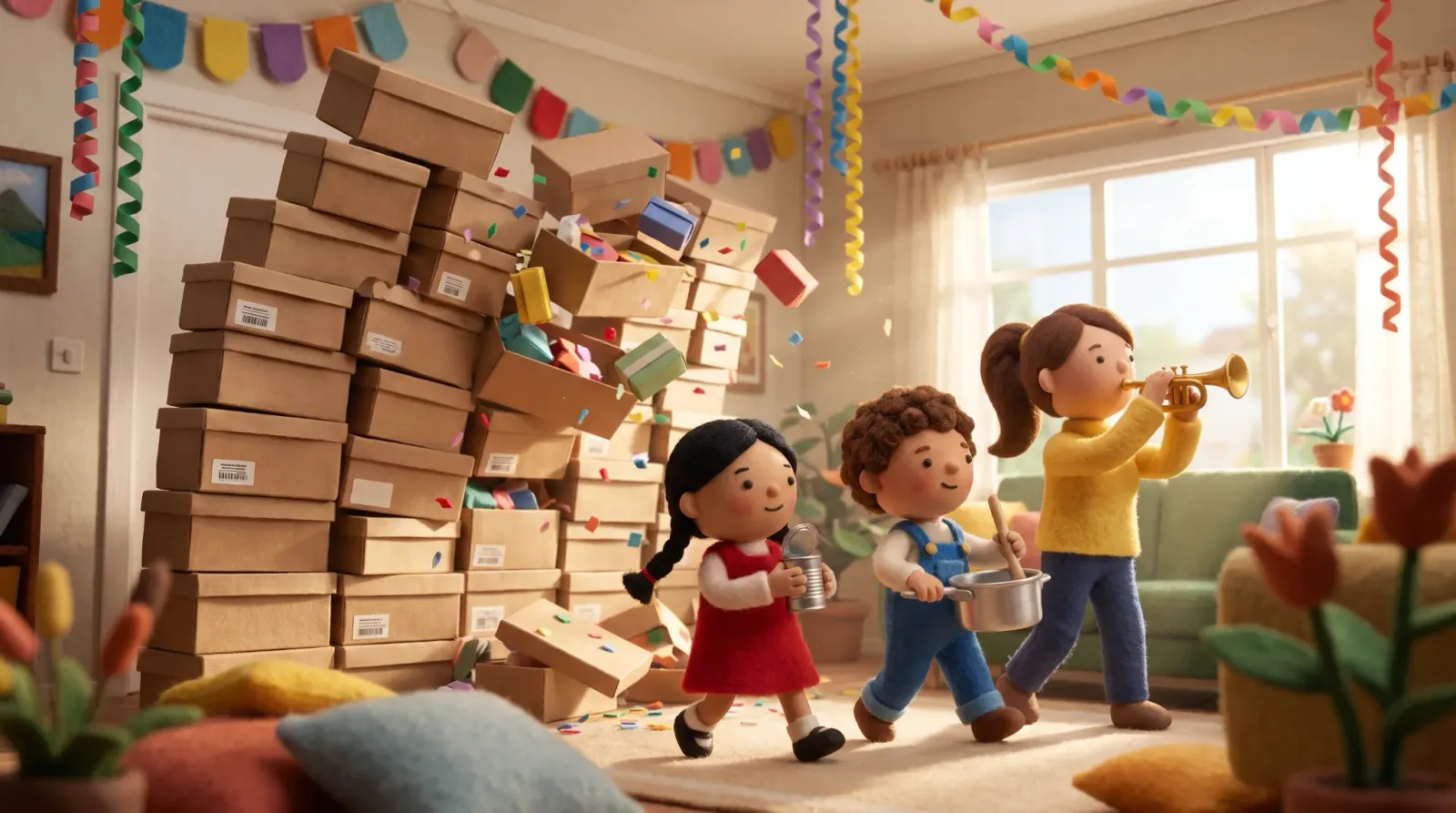 Seven laps, lots of noise and a wall of shoeboxes on the floor.
In the kitchen
10. Five little loaves
Ages: 6 to 12 (younger kids can help knead). Time: 60 minutes, including baking. Supplies: 1 cup all-purpose flour, 1 teaspoon baking powder, a pinch of salt, 1/2 cup plain yogurt.
Check for wheat and dairy allergies before you start. Then read John 6:9: “Here is a boy with five barley loaves and two small fish” (Berean Standard Bible). Jesus took the loaves, gave thanks and handed them out (John 6:11). Mix the ingredients until the dough stops sticking to your hands, divide it into five balls and bake at 400°F for 15 to 20 minutes, until golden. The oven’s an adult job.
Nobody tastes the raw dough, because raw flour can carry bacteria (FDA, Handling Flour Safely). After kneading, everyone washes their hands with soap and water. When the rolls come out, do what Jesus did before anyone takes a bite: give thanks. Feeding a whole class? Double or triple the recipe.
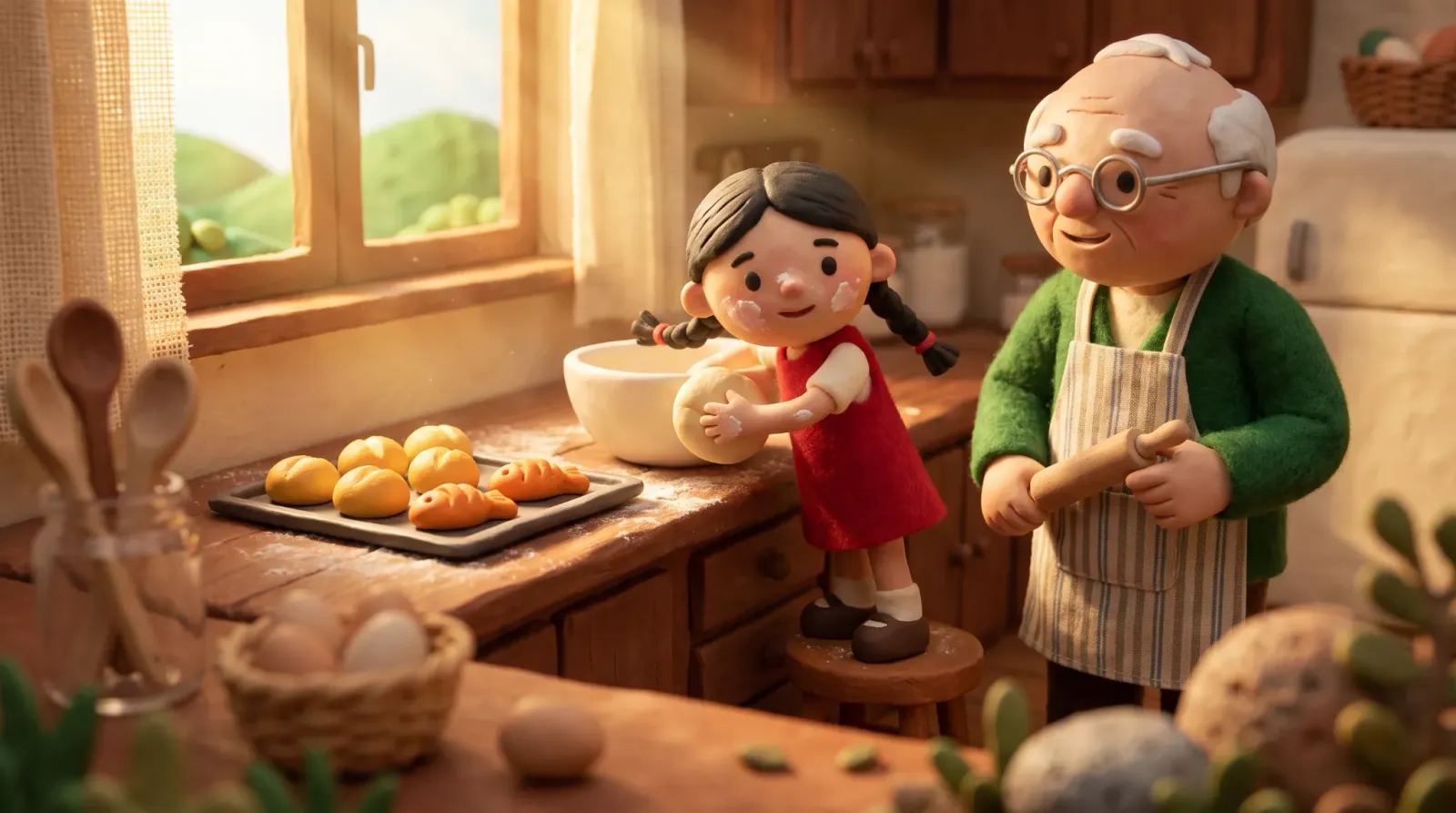 Five golden rolls and a little girl with her hands in the dough.
Treasure hunts, music and science
11. Five smooth stones treasure hunt
Ages: 5 to 10. Time: 30 minutes. Supplies: five smooth, clean stones, a small cloth pouch, five drawn clues, a treasure box.
In 1 Samuel 17:40, David picks five smooth stones from the brook and puts them in his shepherd’s bag. Hide five stones around the backyard or the house, with a drawn clue for each: a tree, the bathroom sink, a kitchen chair. Every stone goes straight into the pouch, and nobody throws anything. Whoever finds the fifth one opens the treasure box, which can hold a card with the verse. If kids under 5 are playing, use five big felt balls.
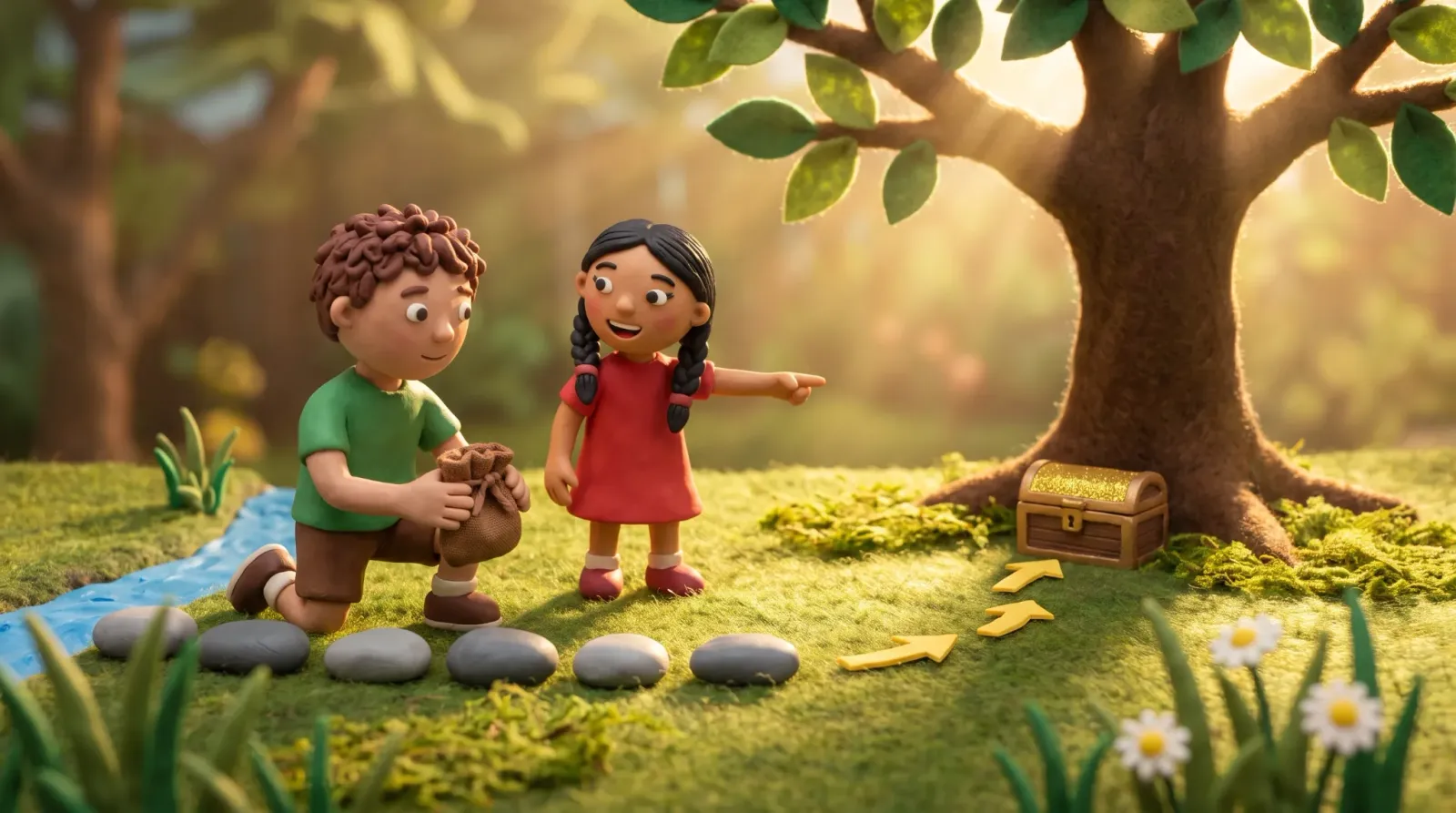 The clues lead to the backyard stream and the chest under the tree.
If your child wants more David another day, our app, Terra Sinai, has a game called David’s Sling that starts out in the fields of Bethlehem.
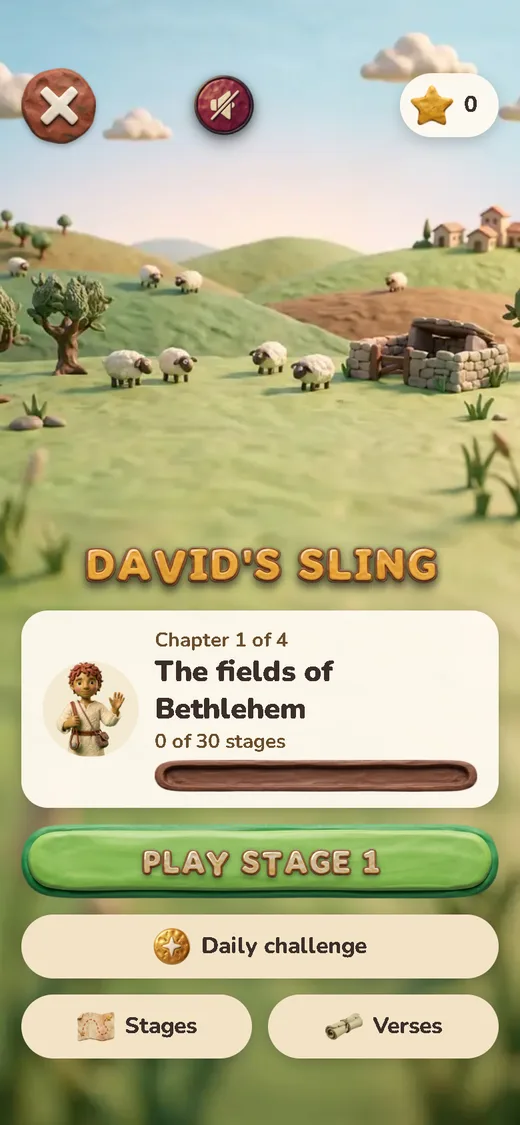 David’s Sling opens with the sheep in the fields of Bethlehem.
12. Pots-and-pans praise band
Ages: 3 to 8. Time: 25 minutes. Supplies: pots, wooden spoons, lids, a can of rice taped shut.
Pull the pots and lids out of the cabinet and read the verses that name the instruments:
Praise Him with tambourine and dancing; praise Him with strings and flute. Praise Him with clashing cymbals; praise Him with resounding cymbals.
(Psalm 150:4-5, Berean Standard Bible)
The lids are the cymbals and the can of rice is the shaker. Tape the can shut before anyone gets it, since loose rice is a choking hazard for little ones. Everyone picks an instrument and you play a praise song they know. Halfway through, raise your hand: everybody freezes in silence until it comes down.
13. Crayon-resist storm painting
Ages: 4 to 9. Time: 25 minutes. Supplies: crayons, watercolors (or watered-down paint), cardstock.
Your child draws a boat with crayon, pressing hard. Then they brush blue watercolor over the whole page: the wax keeps the paint from soaking in, and the boat pops out of the waves. While it dries, read Mark 4:39, where Jesus commands, “Silence!” and “Be still!” and the wind dies down (Berean Standard Bible). They can add a yellow sun on the horizon. Ask how the disciples felt when the wind stopped, and have them tell you who’s who in the picture.
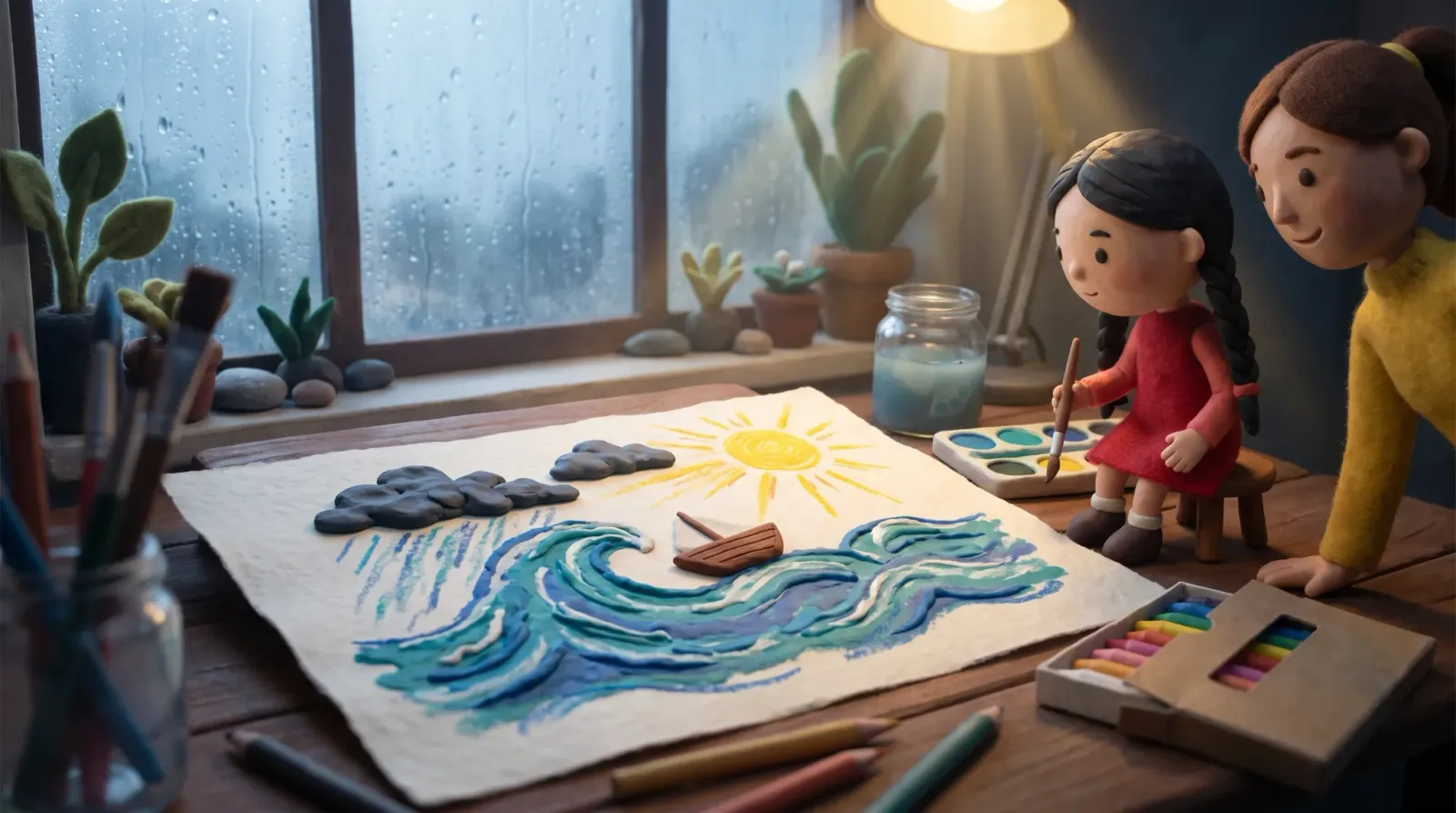 The crayon boat shows up as soon as the blue watercolor goes on.
14. The house on the rock
Ages: 6 to 12. Time: 30 minutes. Supplies: two deep trays, sand, a big rock or a stepping stone, two little houses made from milk cartons, a watering can.
Do this one outside or next to the kitchen sink. Fill one tray with sand, put the rock in the other and set a house on each. Before the “rain,” ask, “What do you think will happen?” Your child pours water from the watering can over both houses. The one on the sand tips and slides. Have them tell you what they saw, and then read what Jesus said about the wise man who built his house on the rock: the rain and wind beat against that house, and it stood firm (Matthew 7:24-25).
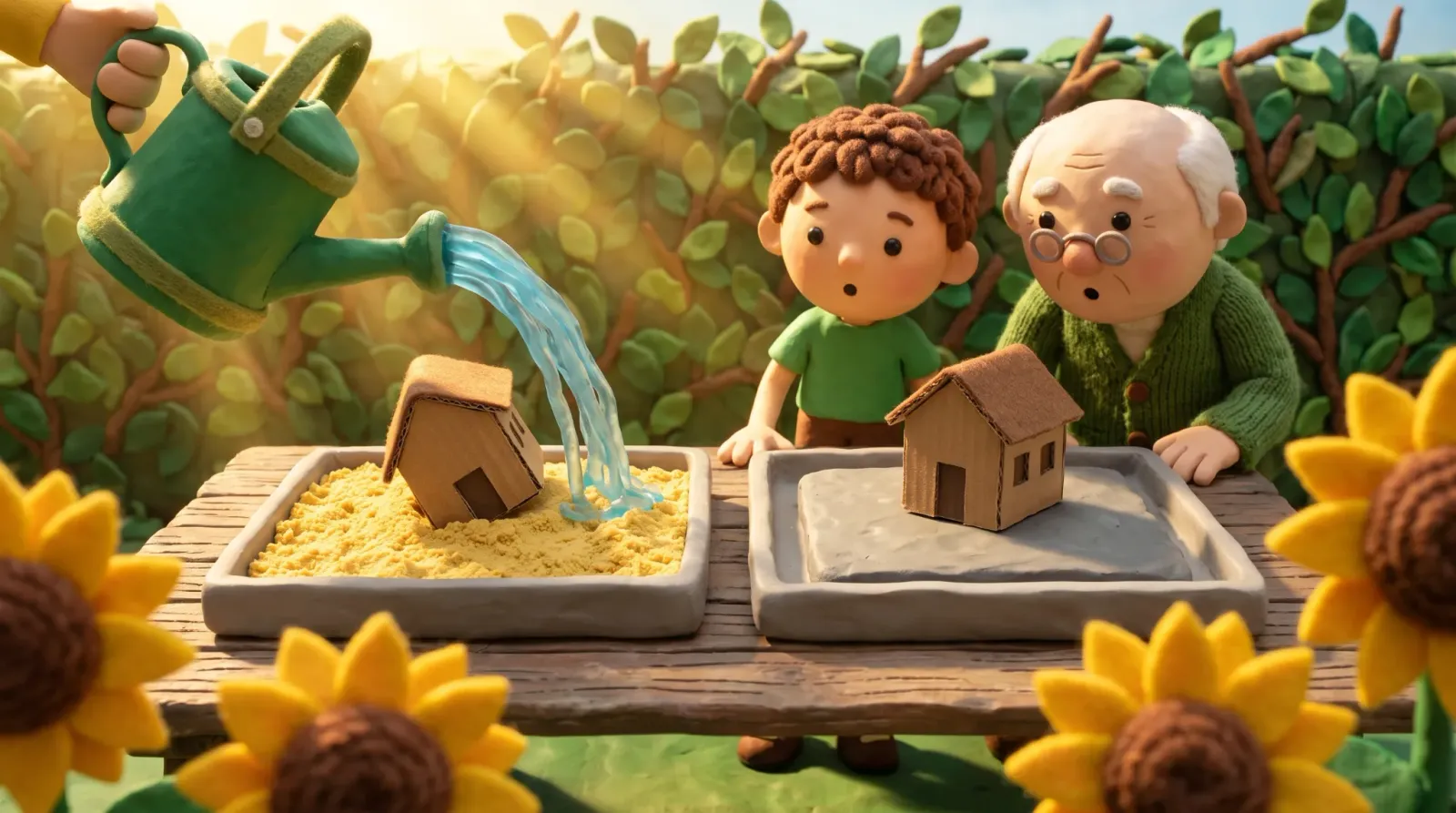 Both little houses get the same rain from the watering can.
15. Flashlight in a dark room
Ages: 4 to 10. Time: 20 minutes. Supplies: a flashlight (no candles), a blanket, a room you can make dark.
Turn off the lights and sit quietly in the dark for a few seconds, under the blanket if you want a fort. Click on the flashlight and read Genesis 1:3-5, where God says, “Let there be light.” Your child makes hand-shadow animals on the wall and picks one from creation. To close, read:
Your word is a lamp to my feet and a light to my path.
(Psalm 119:105, Berean Standard Bible)
Let your child keep the flashlight by their bed for a day as a reminder of the verse.
Picking by age, and for Sunday school
Got preschoolers? Stick with 2, 3, 5, 8 and 12 (8 works from age 2); they keep hands and bodies busy and wrap up fast. The CDC’s milestones say most 5-year-olds can tell a story with at least two events and answer simple questions about one they just heard (CDC’s milestones), so from then on, ask them to retell the scene. Early elementary kids can do nearly everything here; give each one a part in the skits (6 and 7). Older kids, 9 to 12, will like the measuring and baking in 10 and the experiment in 14, and they make great teachers for a younger sibling.
For a Sunday school class or a VBS rotation, start with a movement activity (9 or 11), move on to a craft (1 or 4) and close with a calm one (13 or 15). Pack one bag of supplies per team ahead of time. You’ll find more ideas for groups in Sunday school games.
To help the story’s verse stick after the activity, see Bible verses for kids and how to memorize Bible verses.
Short on craft supplies one afternoon? Our app, Terra Sinai, has picture books with short Bible text and clay illustrations, and its games work offline.
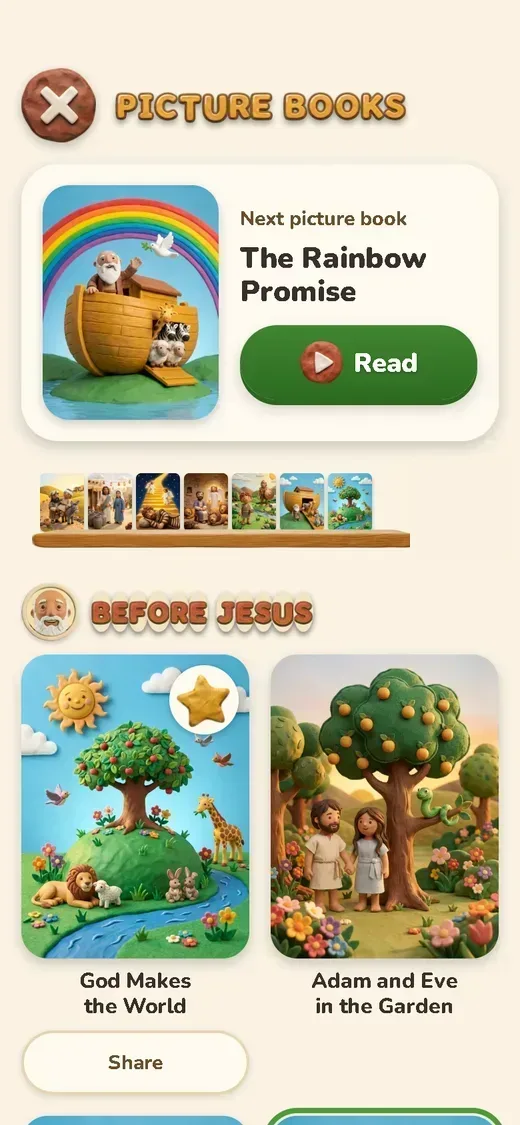 The Rainbow Promise, to read before the cellophane goes up.
Questions to wrap up each activity
When you’re done, pick one from each kind:
- What happened: “Who climbed a tree to see Jesus?”
- How it felt: “How do you think Jonah felt inside the fish?”
- Their own life: “Who’s someone you could help this week?”
Got a shrug and an “I dunno”? No big deal. Walk them back through the scene in a sentence or two, then ask again while you’re cleaning up together. For more games to play as a family, check out Bible games for families.
How this guide was made. Written by the site’s editorial team and reviewed in October 2026. The verses are copied from the Berean Standard Bible. We checked the recipes against the FDA’s flour safety page, the choking warnings against the AAP and the attention spans against the CDC’s milestones, and we read Roediger and Karpicke’s study in the original. Ages and timings are suggestions; if you’ve got questions about your child’s development, talk with your pediatrician.
Sources
- American Academy of Pediatrics, Choking Prevention for Babies & Children (HealthyChildren.org)
- CDC, Milestones by 5 Years
- FDA, Handling Flour Safely: What You Need to Know
- Roediger, H. L. and Karpicke, J. D. (2006), Test-Enhanced Learning: Taking Memory Tests Improves Long-Term Retention, Psychological Science 17(3), 249-255
Frequently asked questions
What Bible activities can I do at home with kids?
Start with what's in the recycling bin and the kitchen cabinets: a cardboard box ark for Noah, paper bag puppets for Daniel and the lions, a shoebox wall for Jericho, a pots-and-pans band for Psalm 150, five little rolls for the feeding of the five thousand and a hunt for David's five stones. Each one takes 15 to 60 minutes.
Which Bible activity works for ages 2 to 4?
From age 2, hiding the lost sheep around the living room. From age 3, a homemade-instrument band, a cellophane rainbow on the window or shaping Moses' basket out of cooked play dough. Keep it to 10 to 20 minutes and stay right next to your child, since small parts, loose grains and whole hard foods are choking hazards at that age.
How long should a Bible activity last?
This guide suggests 15 to 30 minutes for kids ages 4 to 10. The CDC lists paying attention for 5 to 10 minutes during activities among its milestones for age 5, so break the activity into short steps and let anyone who's still into it keep going.
How do I tie the activity to the Bible story?
Tell the story first, in five or six sentences, and go straight into the activity. When you're done, ask your child to tell you what they made and what happened in the story. In an experiment with college students, those who practiced recalling a passage remembered 56% of it a week later, and those who reread it remembered 42% (Roediger and Karpicke, 2006).
Can I use these activities in Sunday school or VBS?
Yes. Split the class into teams of four, pack one bag of supplies per team and tell everyone how much time they have before you start. Scissors and the oven stay with the teacher or another adult helper.
Do I need printables for these Bible activities?
You won't need a printer for any of them. Templates like Joseph's robe or Zacchaeus' tree are quick to sketch by hand on a brown paper bag or kraft paper.
Keep reading
-
How to teach the Bible to kids, age by age
An age-by-age guide to teaching kids the Bible, with a 15-minute family devotional and a ready-to-teach David and Goliath lesson with questions by age. Read article -
Fruit of the Spirit for kids: a family guide
Love, joy, peace and the rest of Galatians 5:22-23 in words kids understand, with family moments, games for busy evenings and a four-week verse plan. Read article -
Bible stories for kids: 10 to read aloud
Ten short Bible stories for kids ages 2 to 7, written to read aloud in 4 to 10 minutes, with suggested ages, questions to talk about and a bedtime routine. Read article