
Audio Bible: a 1-year plan and daily routines
How long the audio Bible takes, what research says about listening, routines for commutes, bedtime, seniors and kids, and a 1-year plan with daily times.
 The Terra Sinai team 10 min read
In this article (10)
Listening to the whole Bible takes about 76 hours in the Berean Standard Bible at the narration pace we measured. Spread over 365 days, that’s about 12 to 13 minutes a day, shorter than most commutes. The research also reassures anyone who wonders whether listening “counts”: on average, people who listen understand nearly as much as people who read, as long as they stay engaged.
This guide shows where those numbers come from, when audio is the best choice, how to fit listening into a commute, bedtime, a senior’s routine and a child’s day, and a 1-year plan with the time each day takes. At the end, one table compares the kinds of audio Bibles and another lists what to test in an app.
How long it takes to listen to the whole Bible
Listening to the complete Bible takes about 65 to 85 hours, depending on the translation and the narrator. Crossway, which produces the ESV audio Bible, puts a complete audio Bible at 70 to 75 hours of listening (The Gospel Coalition, 2024). Jackie Hill Perry’s full ESV recording runs 65 hours and 10 minutes (Crossway, 2024). Slower readers with long pauses go past 85 hours.
To get a figure for one specific translation, we ran the numbers on the Berean Standard Bible. We counted the words in all 1,189 chapters (about 725,000) and timed our app’s narration (a synthetic voice) of Psalm 23, which has 116 words and plays in 44 seconds, close to 158 words per minute. Dividing one by the other:
| Section | Listening time (estimate) | Per day, over 1 year |
|---|---|---|
| Whole Bible | about 76 hours | 12 to 13 minutes |
| Old Testament (929 chapters) | about 58 hours | 9 to 10 minutes |
| New Testament (260 chapters) | about 18 hours | 3 minutes |
| The four Gospels | about 8 hours 20 minutes | |
| Psalms | about 4 hours 10 minutes | |
| Mark | almost 1 hour 30 minutes | |
| Ruth or Philippians | about 15 minutes each |
These are estimates. One timed chapter can’t capture every pause in a long recording, and every translation has its own word count. Our 76 hours come in a little above Crossway’s 70 to 75 hours for the ESV, since narration pace varies from reader to reader. For planning, it’s safer to budget the higher number. The average chapter takes just under 4 minutes.
 At about 12 minutes a day, the whole Bible fits into the four seasons of one year.
Listening and reading: what the research shows
For understanding a text, listening and reading produce very similar results. The broadest review on the question, a meta-analysis of 46 studies with 4,687 participants across age groups, found no reliable difference between the two (Clinton-Lisell, 2022). For audio Bible listeners, the same review offers two useful findings:
- Reading came out ahead when readers set their own pace. With audio, the narrator sets the pace unless you pause and skip back.
- Reading also did better on inference questions, the ones that ask you to connect ideas. On literal questions (“who did what”), the two came out even.
A separate experiment with 91 adults compared an audiobook, an e-text and both at once. Comprehension was the same in all three groups, both right afterward and two weeks later (Rogowsky, Calhoun and Tallal, 2016).
Audio’s weak spot is attention. In a University of Waterloo study in Canada, participants read one passage silently, read one aloud and listened to someone read a third. While listening, their minds wandered most, they remembered the least and they found the material least interesting. Reading aloud held attention best (Varao Sousa, Carriere and Smilek, 2013).
So audio gives you nearly everything reading does, as long as you use a few habits to stay focused. They’re in the last section.
When audio is the best choice
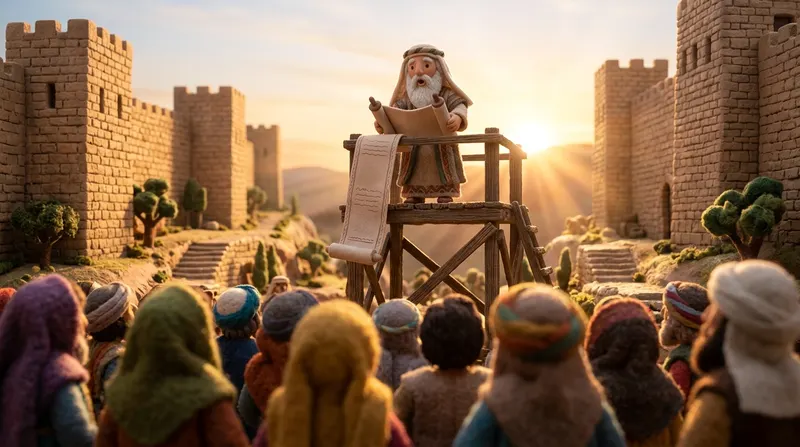
Audio works well when your eyes are busy, tired or struggling, and when the text was written to be heard. Much of the Bible was. In Nehemiah, an entire city stands in the square and listens to the Law read aloud for hours.
“So Ezra read it aloud from daybreak until noon as he faced the square before the Water Gate, in front of the men and women and those who could understand. And all the people listened attentively to the Book of the Law.” (Nehemiah 8:3, Berean Standard Bible)
- Long narrative books. Heard aloud, Genesis, Exodus, Samuel, Kings and Acts move at the pace of a story being told, and plenty of people who tend to stall in them make it to the end.
- Poetry and Psalms. They were written to be sung and recited, and a voice brings out their rhythm and repetition.
- Whole books in one sitting. Hearing Philippians start to finish in 15 minutes shows the thread of the entire letter.
- Tired or low vision. For people who see poorly, audio is often the simplest way into the text.
- Spare minutes in the day. The drive, the dishes, the walk: moments when your ears are free.
When you want to study a passage, compare verses or stop on every phrase, the printed text helps more. That’s why many people do both: listen to the chapter, then reread the verse that caught their attention.
 The daily commute is the easiest place to start listening, and the whole family can listen together.
How to build a listening routine
The routine that lasts is one tied to something you already do every day. Pick a fixed trigger (starting the car, washing dishes, getting into bed) and attach a fixed block of audio to it.
On the commute
If your commute is 25 minutes each way, the drive in covers more than a day and a half of the yearly plan, which asks for about 15 minutes on weekdays. One approach: play a narrative book on the way in and keep the drive home for music or quiet so you don’t burn out. Download chapters before you leave when the app allows it, since tunnels and subways drop the signal. Behind the wheel, stick with story books and save dense letters like Romans for home, with the text open.
At bedtime
At night, choose short, calm passages: Psalms, Proverbs, the closing chapters of John. Set a 15 to 20 minute sleep timer and keep the volume low. If you fall asleep partway, start the next night from the last passage you remember, and the plan keeps your pace.
 Samuel heard God call him at night. For bedtime listening, use short chapters, low volume and a sleep timer.
For seniors and people with low vision
At least 2.2 billion people worldwide have a near or distance vision impairment, and most people with vision loss are over 50 (World Health Organization, 2026). For these listeners, a few details matter a lot:
- Few, large buttons. Play, pause and skip back should be easy to find with a finger, even without reading glasses.
- “Resume where I left off.” Someone who listens in short stretches shouldn’t have to hunt for the chapter every time.
- Listening together. A grandchild who queues up the day’s chapter for grandma, or a small group that hears the same book each week, gets people talking and keeps the habit alive.
If the person still reads but with effort, pair audio with large print: they listen and glance at the enlarged text whenever they want to check a word. In our app, Terra Sinai, choosing the senior version at first launch turns on larger text. Between chapters, a Bible word search is a calm activity that reviews names heard that day.
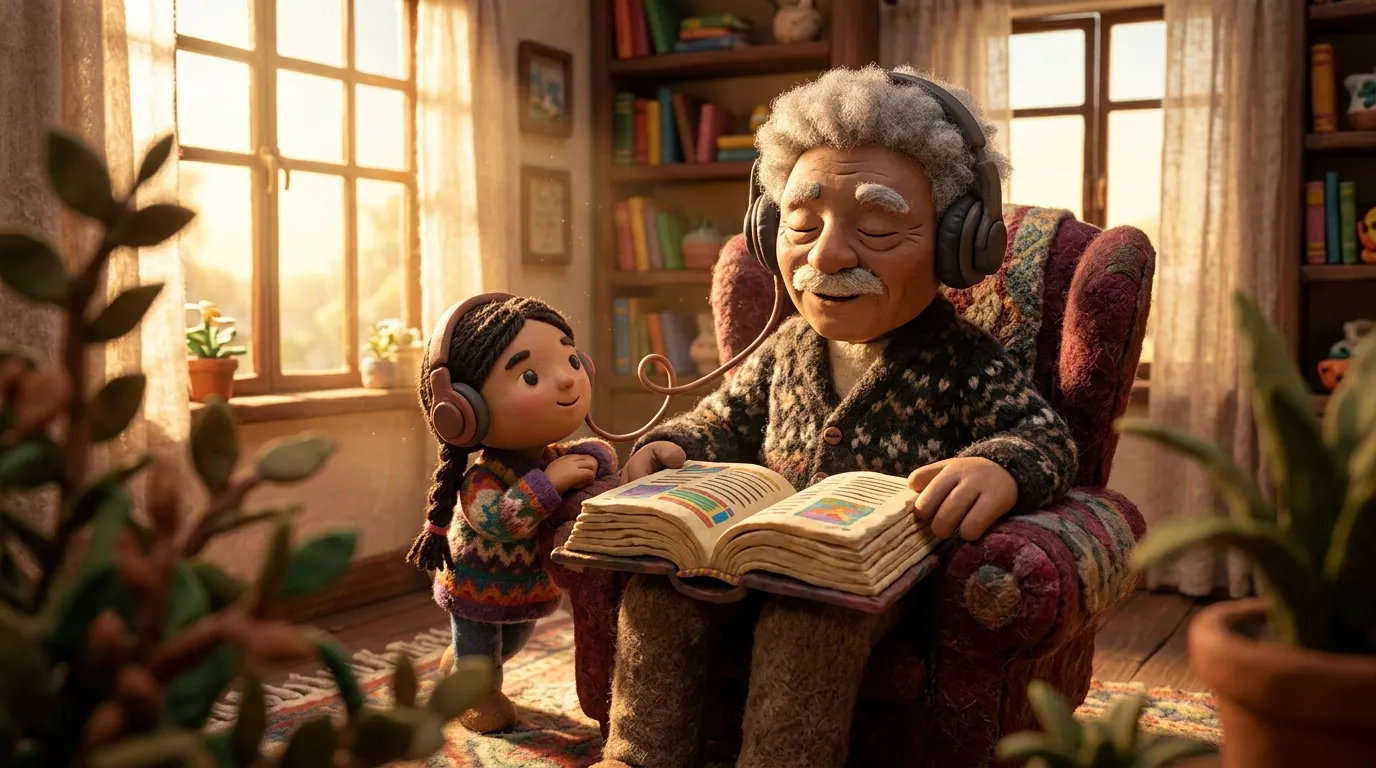 Audio plus large print helps people who read with effort: listen, then check a word when needed.
With kids
With young children, audio works best with an adult nearby. The WHO recommends that children under 5 spend that time in activities with a caregiver, and it names reading and storytelling as very important for development (World Health Organization, 2019). Audio playing with the phone face down while you draw the scene together fits that guidance well.
A 15-minute routine that works: listen to a full story (David and Goliath, 1 Samuel 17, runs about 10 minutes), ask one question (“what was David afraid of?”) and have your child retell it in their own words. For more ideas by age, see the guide on how to teach the Bible to kids.
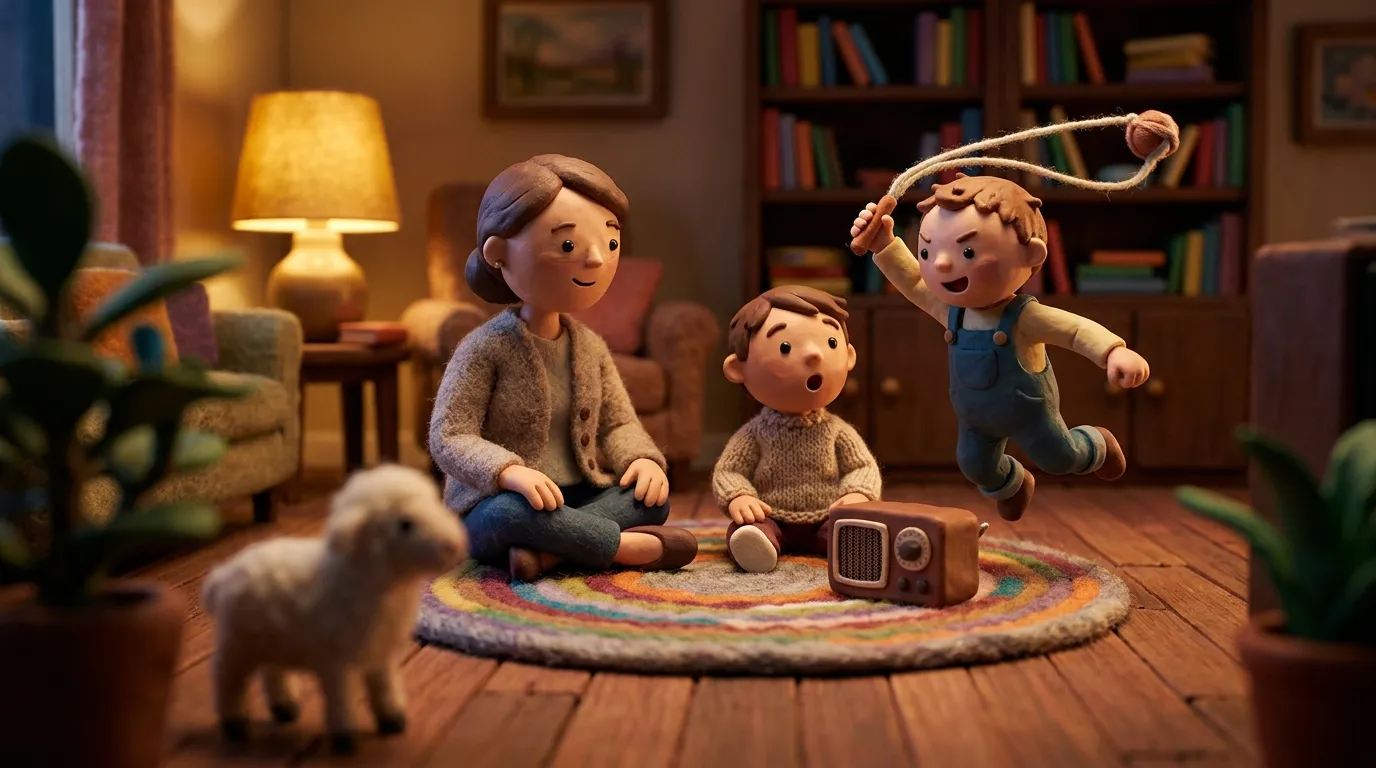 With kids, audio does more with an adult close by to ask questions and let them retell it.
A plan to listen to the Bible in 1 year
The easiest plan to stick with runs the Old and New Testaments as two parallel tracks and leaves one day a week to catch up:
- Monday to Saturday: 3 Old Testament chapters.
- Monday to Friday: 1 New Testament chapter.
- Sunday: free, for catching up.
Over 52 weeks that adds up to 936 Old Testament chapters (it has 929) and 260 New Testament chapters (exactly the 260 it has). In the Berean Standard Bible at the pace we measured, each weekday takes about 15 minutes and Saturday about 11.
| End of week | Old Testament | New Testament |
|---|---|---|
| 13 (end of Q1) | Ruth 2 | Luke 21 |
| 26 (midyear) | Job 32 | Romans 13 |
| 39 (end of Q3) | Isaiah 23 | 1 Timothy 5 |
| 52 | Malachi 4 | Revelation 22 |
If you lose a whole week, jump to this week’s spot and use Sundays to hear what you missed. Leviticus and the genealogies in Chronicles are where most people stall; on those days, listening at 1.25x with the text on screen helps you push through.
If you also want to commit passages to memory over the year, the guide on how to memorize the Bible with a long-term plan shows how to review whole chapters without losing pace.
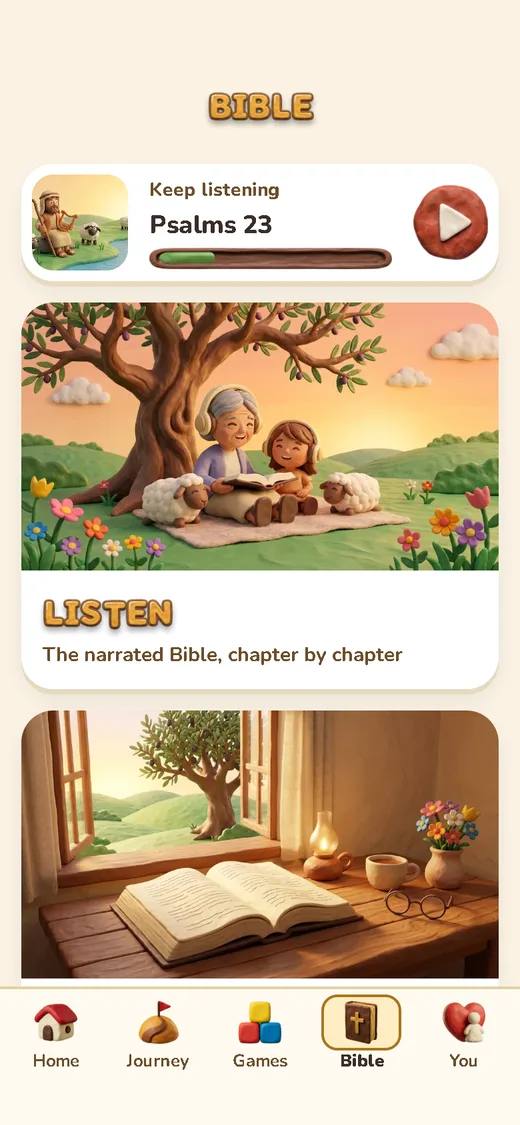 The continue-listening card keeps your place.
Types of audio Bibles, compared
Each type of audio Bible fits a different moment in the day, and the table shows what each one does best.
| Type | What it is | Best for | Watch out |
|---|---|---|---|
| Narrated (voice only) | One voice reads the whole text, no score | Bible-in-a-year plans, study, long sessions, sleep | Can tire listeners who drift easily |
| Dramatized | A cast voices the characters, with sound effects and music | Story books, kids, commutes | Larger downloads; effects can distract in letters and poetry |
| With background music | Narration over a soft music bed | Prayer, nighttime, winding down | Loud music hurts comprehension |
| Synthetic voice | A computer-generated voice reads the text | Free translations with no human recording, read-along text | Some voices sound flat; play a sample first |
Try more than one narrator on the same chapter. The voice you like is the one you’ll want in your ears for 76 hours.
 One narrating voice, a dramatized cast or music underneath: each type of audio Bible fits a different moment.
What to check in an audio Bible app
Before you settle on one, open a familiar chapter such as Psalm 23 and test these points:
| What to check | Why it matters |
|---|---|
| Translation | Listen in the version you read, or a plainer one to start |
| Plays offline? | For commutes and subways, only downloadable chapters work |
| Speed control | 1.25x to 1.5x helps in long stretches; return to 1x for poetry |
| Skip back 15 seconds | Brings back the sentence you missed without restarting the chapter |
| Sleep timer | A must for bedtime listening |
| Auto-play next chapter | Handy in the car, so a whole book plays without touching the phone |
| Text alongside audio | Lets you check names and reread the verse that hit home |
| Resume where you stopped | Key for seniors and anyone who listens in pieces |
On speed, a study of lecture videos found little comprehension loss up to 2x and a decline beyond that (Murphy and colleagues, 2022). That study used lectures, and Scripture has ancient names and poetry, so the safe range for the Bible sits lower.
In our app, the Bible tab plays a chapter-by-chapter narration in a synthetic voice, with no ads, speed control, a timer, 15-second skips, optional music and a “Read text” button. The audio needs an internet connection to play.
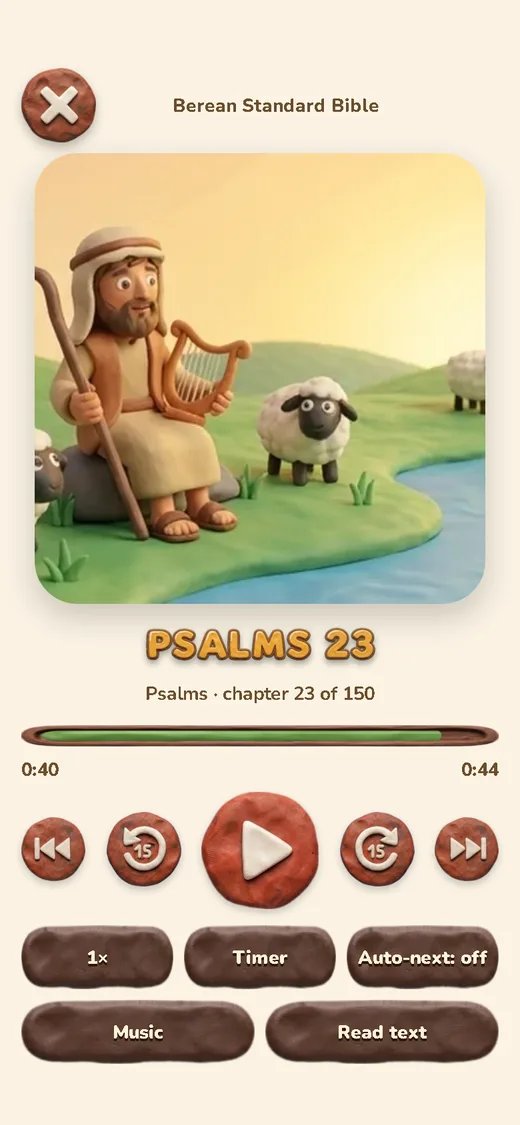 Speed, timer and auto-next sit on one screen.
How to listen closely and remember what you heard
Because minds wander more while listening, these simple habits help what you hear stick:
- Pause at the end of the chapter and say one sentence out loud. “Today Abraham left Haran.” Speaking held attention best in the 2013 study.
- Skip back 15 seconds without guilt. That button hands you control of the pace, which gave reading its edge in the meta-analysis.
- Open the text when a passage gets dense. Listening and reading together matched the other formats on comprehension in the 2016 study, and it helps names stick.
- Pick one verse a week to keep. The guide on how to memorize Bible verses has review methods that fit in 5 minutes.
Paul puts the case for the ear in one line:
“Consequently, faith comes by hearing, and hearing by the word of Christ.” (Romans 10:17, Berean Standard Bible)
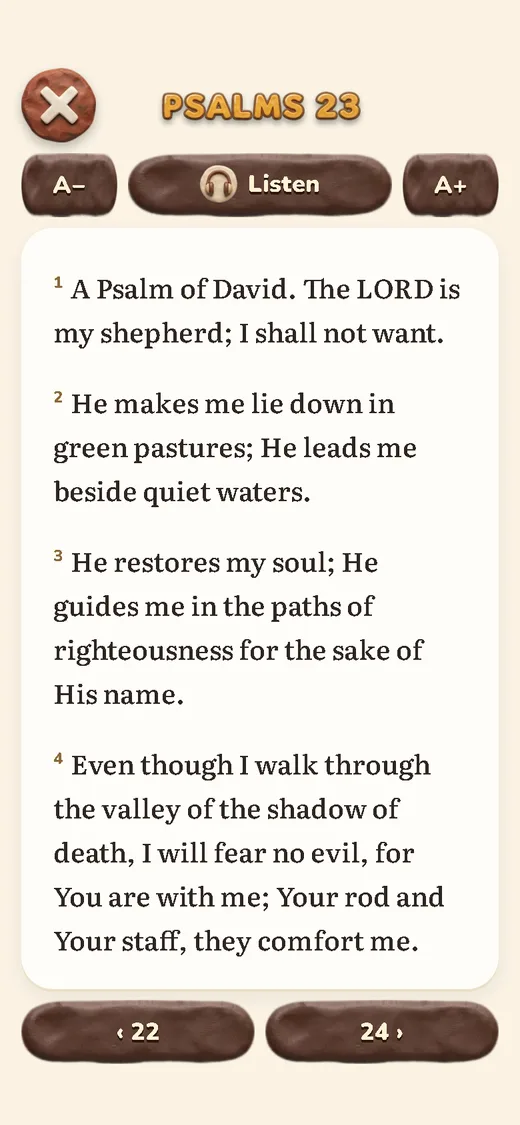 On the reading screen, the text enlarges and the Listen button sits at the top.
To review what you heard in a lighter way, Bible games for families help you recall names, places and stories from the plan.
Sources
- Clinton-Lisell, V. (2022). Listening Ears or Reading Eyes: A Meta-Analysis of Reading and Listening Comprehension Comparisons. Review of Educational Research.
- Rogowsky, B. A.; Calhoun, B. M.; Tallal, P. (2016). Does Modality Matter? The Effects of Reading, Listening, and Dual Modality on Comprehension. SAGE Open.
- Varao Sousa, T. L.; Carriere, J. S. A.; Smilek, D. (2013). The way we encounter reading material influences how frequently we mind wander. Frontiers in Psychology.
- Murphy, D. H. and colleagues (2022). Learning in double time: The effect of lecture video speed on immediate and delayed comprehension. Applied Cognitive Psychology.
- World Health Organization (2026). Blindness and vision impairment.
- World Health Organization (2019). To grow up healthy, children need to sit less and play more.
- The Gospel Coalition (2024). ‘That Thing Is Alive’: How the Bible Affected Its 6 Newest ESV Audio Readers.
- Crossway (2024). Jackie Hill Perry on Recording the Entire ESV Bible.
Frequently asked questions
How long does it take to listen to the whole Bible?
Between about 65 and 85 hours, depending on the translation and narrator. Crossway puts a full audio Bible at 70 to 75 hours. For the Berean Standard Bible at the narration pace we measured (about 158 words per minute), it comes to roughly 76 hours: 58 for the Old Testament and 18 for the New. That works out to about 12 to 13 minutes a day for a year.
Is listening to the Bible as good as reading it?
For understanding the text, nearly. A 2022 meta-analysis of 46 studies found no reliable difference between listening and reading. Reading had a small edge when people read at their own pace and on questions that required inference. Listening with the text open and pausing when needed brings the two very close.
Can I listen to the Bible to fall asleep?
Yes. Pick short, calm chapters such as Psalms and Proverbs, keep the volume low and set a 15 to 20 minute sleep timer. If you drift off midway, start the next night from the last passage you remember.
What is the difference between a narrated and a dramatized audio Bible?
In a narrated audio Bible, one voice reads the whole text, which is easy on long sessions and good for study. In a dramatized audio Bible, a cast voices the characters with sound effects and a music score, which tends to bring the story books to life for kids.
Can I speed up an audio Bible?
Yes, within limits. A study of lecture videos found little loss of comprehension up to 2x and a drop beyond that. Scripture has ancient names and poetry, so 1.25x to 1.5x is a comfortable ceiling for most listeners; slow back down for hard passages.
Where should I start listening to the Bible?
With the Gospel of Mark, which runs almost an hour and a half end to end and moves fast. Then add Genesis and a few Psalms a day. Starting with story books builds the habit before you reach the law codes and genealogies.
Keep reading
-
Bible app for seniors: large text and audio
Make a Bible app for seniors easy to read: bigger text on iPhone and Android, audio, dark mode, gentle games, and ways to help from far away. Read article -
Bible characters: who they were and where
The main Bible characters in story order, from Adam to Paul, with the book and chapter for each, what they did, what they teach and a section on the women. Read article -

Fruit of the Spirit for kids: a family guide
Love, joy, peace and the rest of Galatians 5:22-23 in words kids understand, with family moments, games for busy evenings and a four-week verse plan. Read article