
The Bible from Genesis to Revelation, in order
The Bible from Genesis to Revelation: all 66 books in order, grouped into 8 blocks, with listening times and a four-week plan for first-time readers.
 The Terra Sinai team 14 min read
In this article (10)
Genesis opens a Protestant Bible and Revelation closes it, and the 64 books in between bring the total to 66: 39 in the Old Testament and 27 in the New, 1,189 chapters in all. The plot tying them together is usually boiled down to four words: creation, fall, redemption and new creation.
Bible overview: the storyline from Genesis to Revelation
D. A. Carson gives the Bible’s storyline four beats: creation, fall, redemption and consummation (Carson, Desiring God). This guide calls the last beat new creation, after the promise from the throne in Revelation 21:5: “Behold, I make all things new.”
- Creation (Genesis 1 and 2). God speaks, and light, sky, land, plants and animals appear. On day six He makes people in His image (Genesis 1:27) and puts them in a garden to tend it (Genesis 2:15).
- Fall (Genesis 3 to 11). Adam and Eve eat from the one tree God told them to leave alone, and the damage spreads: Cain kills Abel, violence fills the earth before the flood, and the builders at Babel set out to make a name for themselves (Genesis 11:4).
- Redemption (Genesis 12 through Acts). God promises that all the families of the earth will be blessed through Abraham (Genesis 12:3), and the promise runs through Israel, its kings and prophets, and finally Jesus’ death and resurrection.
- New creation (Revelation 21 and 22). A loud voice from the throne announces, “Behold, the dwelling place of God is with man” (Revelation 21:3).
The first verse of the Bible sets the stage:
“In the beginning God created the heavens and the earth.” (Genesis 1:1, Berean Standard Bible)
Revelation 21 picks up the same pair, heaven and earth, and makes them new:
“Then I saw a new heaven and a new earth, for the first heaven and earth had passed away, and the sea was no more.” (Revelation 21:1, Berean Standard Bible)
The idea of one storyline goes back to the walk to Emmaus in Luke 24, when the risen Jesus spent the road walking two of His followers through the Old Testament:
“And beginning with Moses and all the Prophets, He explained to them what was written in all the Scriptures about Himself.” (Luke 24:27, Berean Standard Bible)
Once you know the outline, every book has an address on it. Isaiah preached while Uzziah, Jotham, Ahaz and Hezekiah ruled Judah (Isaiah 1:1). Paul wrote Romans to believers in a city he hadn’t been able to visit yet (Romans 1:13).
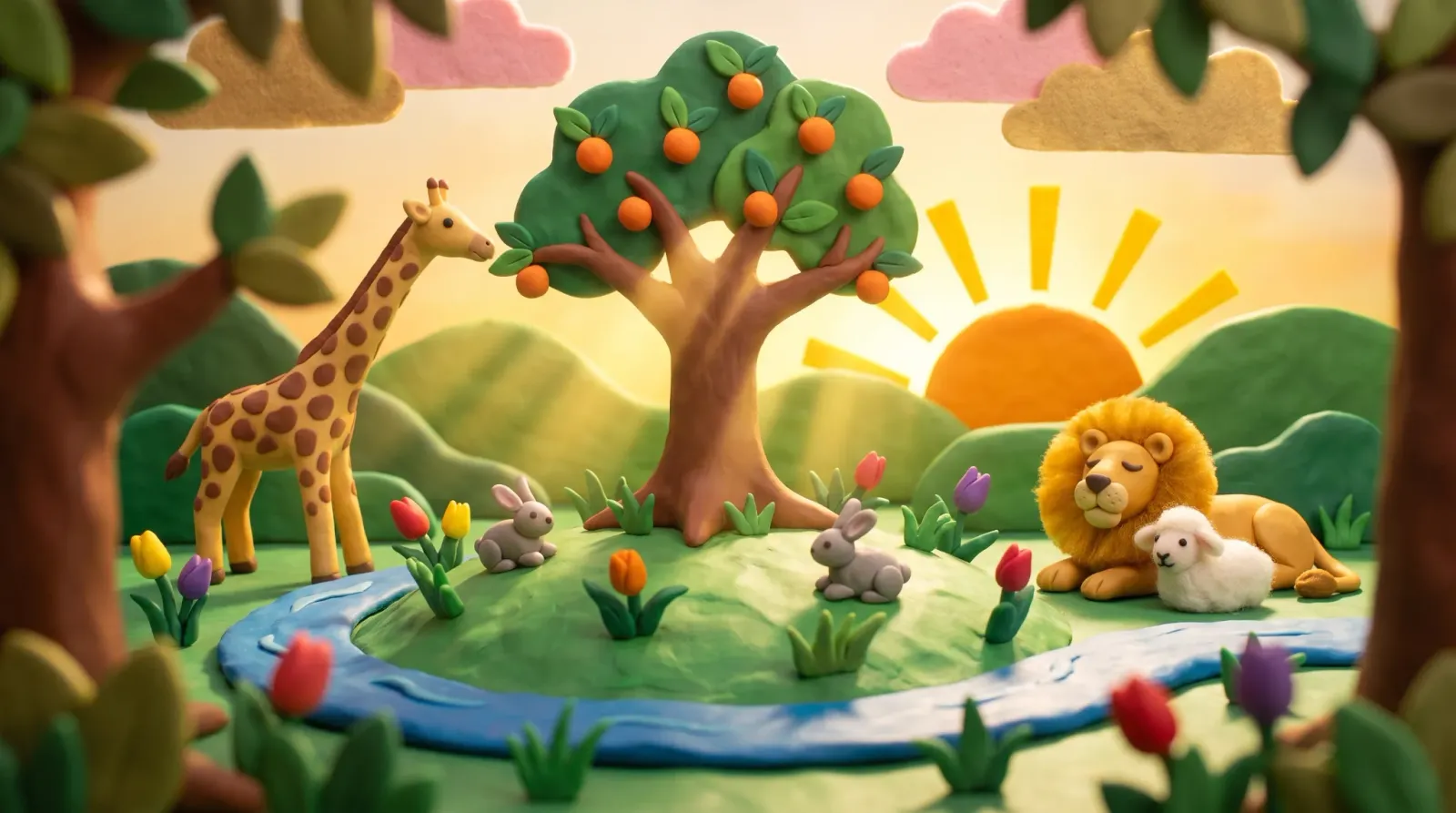 A lion rests next to a lamb by a blue river in a clay garden at sunrise.
Books of the Bible in order: the 8 blocks
The 8 blocks below follow the order of your Bible’s table of contents, four in each testament. For each block, the table gives the chapter count, an estimate of the listening time and a one-line summary. Those numbers are ours: we counted chapters and words in the Berean Standard Bible (724,811 words) and divided by 158 words per minute, the pace we clocked on a recorded reading of Psalm 23. A different translation or reader will shift the totals a little.
| Block | Books | Chapters | Listening (estimate) | What happens |
|---|---|---|---|---|
| Pentateuch | Genesis to Deuteronomy (5) | 187 | 14.8 h | From Eden to Egypt, then Sinai and the edge of Canaan |
| History | Joshua to Esther (12) | 249 | 19.4 h | Conquest, judges, kings, a split kingdom, exile and the trip home |
| Poetry and wisdom | Job to Song of Songs (5) | 243 | 8.2 h | Israel’s prayers, songs and hard-won advice, plus Job’s suffering |
| Prophets | Isaiah to Malachi (17) | 250 | 15.9 h | God’s messengers warn, comfort and point ahead to a coming King |
| Gospels | Matthew to John (4) | 89 | 8.3 h | Jesus’ teaching, miracles, death and resurrection |
| Acts | Acts (1) | 28 | 2.4 h | The first believers carry the news from Jerusalem to Rome |
| Letters | Romans to Jude (21) | 121 | 6.3 h | Paul, Peter, James, John, Jude and the author of Hebrews write to churches and friends |
| Revelation | Revelation (1) | 22 | 1.2 h | John’s visions of Christ’s victory and a new heaven and earth |
The full count comes to about 76.5 hours, 58.3 of them in the Old Testament and 18.1 in the New. Each row is rounded on its own, so the New Testament rows add up to 18.2. Spread over a year, that’s about 13 minutes a day, and our audio Bible guide has a plan built on short daily sessions.
The Old Testament, block by block
Of the Bible’s 1,189 chapters, 929 belong to the Old Testament. Written mostly in Hebrew, they carry Israel’s story up to the generation that came home from Babylon.
Pentateuch: from the garden to the edge of the promised land
Genesis through Deuteronomy make up the Pentateuch, which Jewish tradition calls the Torah, or Law. Moses is the leading figure from Exodus 2 on, and Deuteronomy ends with his death on Mount Nebo, after God shows him the land (Deuteronomy 34:1-5).
Jacob’s family goes down to Egypt in Genesis 46, seventy people in all once the two sons born to Joseph there are counted (Genesis 46:27). Joseph, the brother they once sold, keeps them fed from the grain he stored for Pharaoh (Genesis 47:12), and when the book closes, the household is still living in Egypt (Genesis 50:22). Chapters 12 to 50 follow four generations of that family, starting with Abraham, whom Carson places around 2000 B.C.
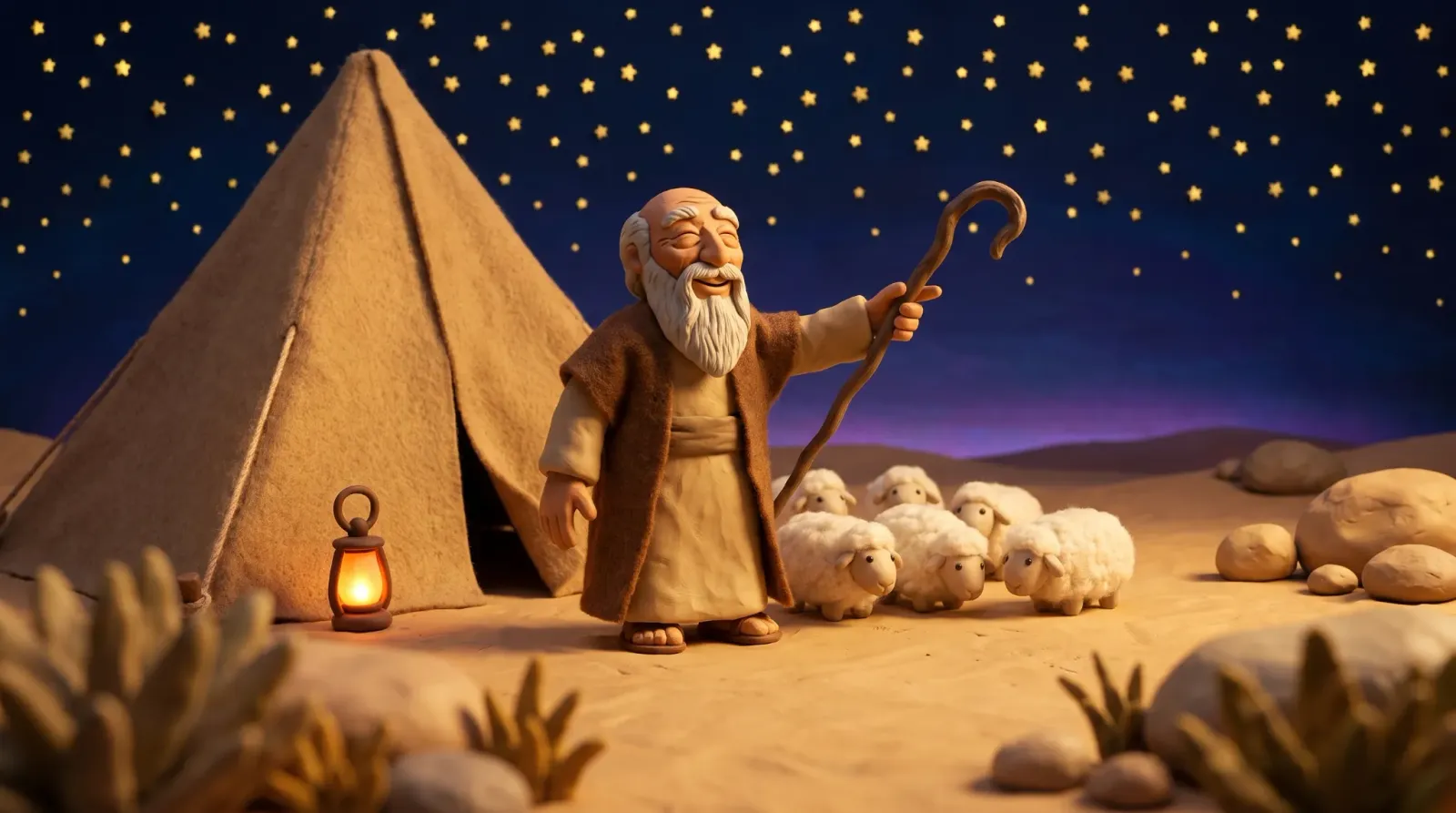 Abraham’s night under the stars, when God promises him a family too big to count.
In Exodus, God hears Israel crying out in slavery, calls Moses at the burning bush, sends the plagues, opens the sea and gives the Ten Commandments at Sinai. Leviticus is the handbook for worship at the tabernacle, its priests, offerings and feasts. Numbers counts the tribes twice, at Sinai and a generation later on the plains of Moab, with forty years in the wilderness in between. Deuteronomy is Moses’ last word to that second generation before they cross the Jordan.
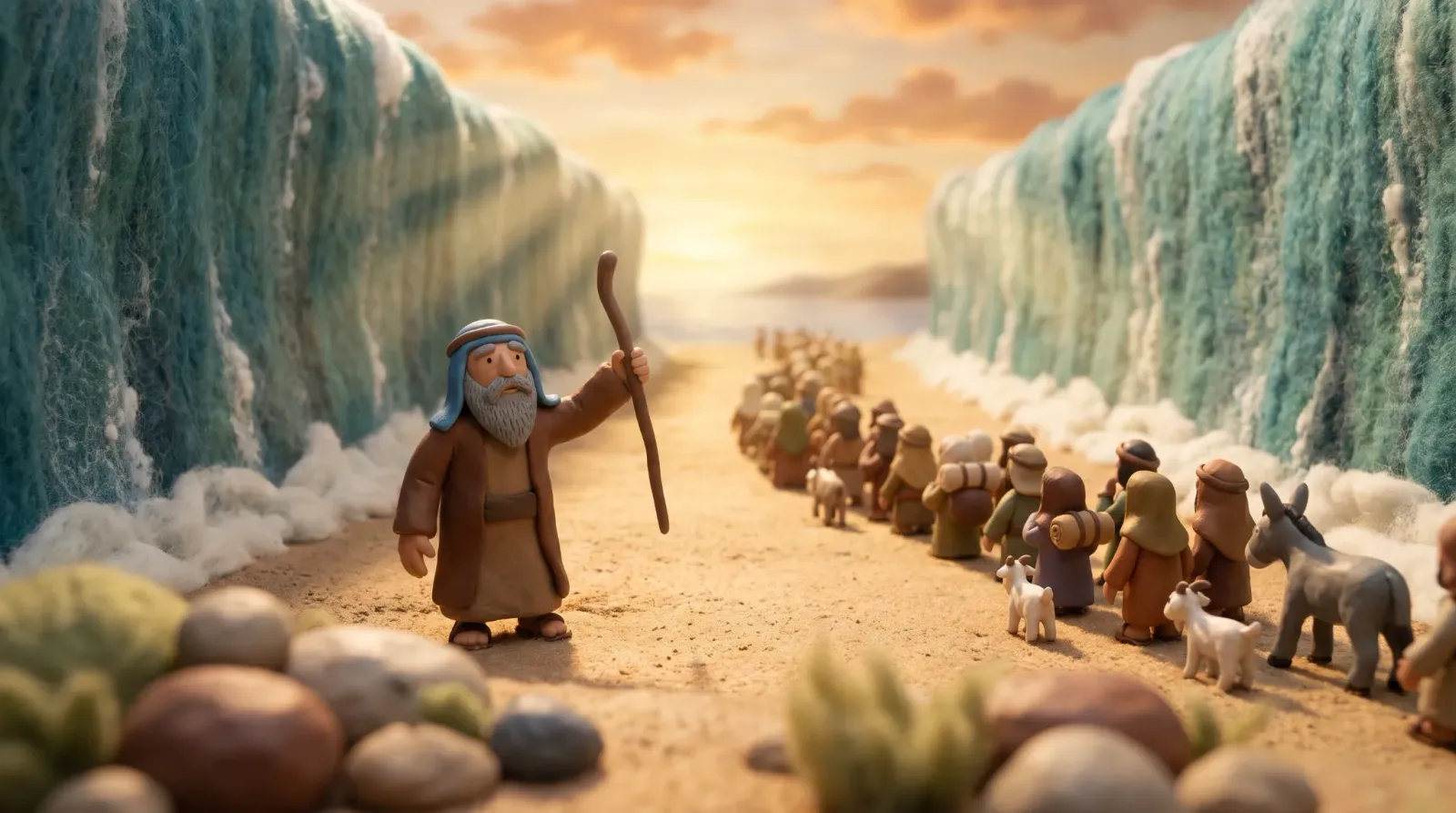 Walls of water on both sides, and a dry path down the middle.
Start a straight-through Bible-in-a-year plan on January 1, and at about three chapters a day you’ll open Leviticus near the end of the month. Plenty of readers stall in its long sections on offerings and skin disease (Leviticus 1 to 7 and 13 to 14). If that happens, read chapter 16, the Day of Atonement, and chapter 19, home of “love your neighbor as yourself” (Leviticus 19:18), and keep going into Numbers. You can come back for the rest on a later read-through.
Numbers 33 lists the camps from Rameses to the plains of Moab. Our app’s Exodus Path game puts the route on a clay map, one stop at a time.
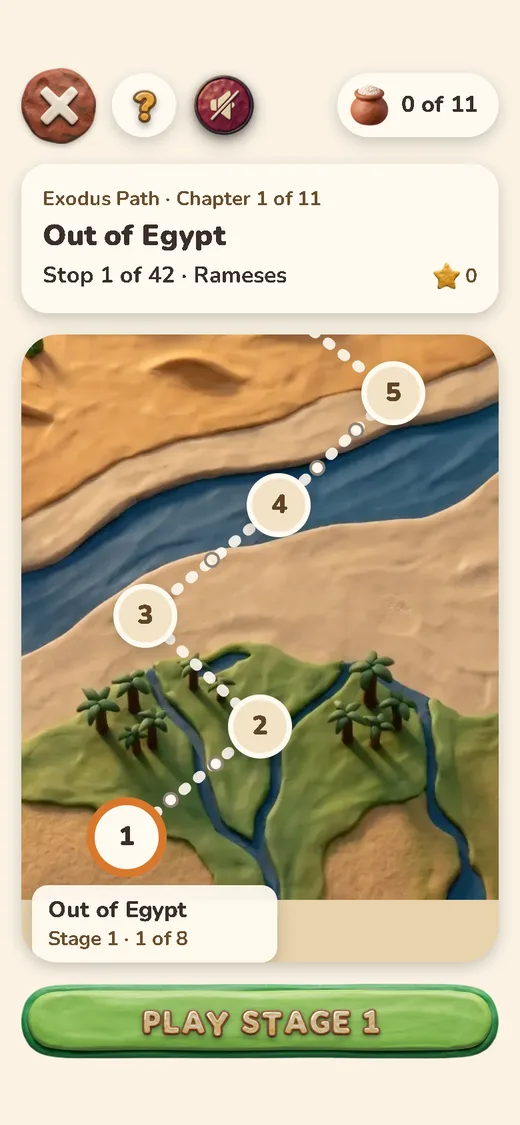 Stop 1 of 42 on the Exodus Path map is Rameses, down among the palms by the river.
History: from the land to the exile
A lot of Sunday school classics live in these twelve books, Joshua through Esther: the walls of Jericho, Gideon and his fleece, Samson, Ruth gleaning barley, young Samuel hearing his name in the night, David and Goliath, Elijah calling down fire on Mount Carmel. Strung together, they tell what happened to Israel in the promised land, from the conquest under Joshua, through the judges and the first kings, Saul, David and Solomon, to the split into two kingdoms and the fall of both.
Second Kings ends with Jerusalem in ruins: in 587 or 586 B.C., Babylon destroys the city and its temple (Britannica), closing a stretch that Carson figures runs close to five hundred years from 1 Samuel on. Chronicles then retells those centuries and ends with Cyrus of Persia inviting the exiles to go home and rebuild the temple (2 Chronicles 36:22-23). Ezra picks up right there, with the temple, and Nehemiah follows with Jerusalem’s wall. Esther stays behind in Persia, at the palace in Susa, where a Jewish queen goes to the king uninvited to stop Haman’s plot (Esther 4:16).
In 2 Kings 8 to 14, the royal names get tangled. Ahab’s son Joram rules Israel while Jehoram son of Jehoshaphat rules Judah (2 Kings 8:16), and the BSB spells both men both ways elsewhere (2 Kings 1:17; 1 Chronicles 3:11). Each kingdom also has an Ahaziah and a Joash, sometimes written Jehoash. The order of the kings sorts them out. In Judah, Joram, Ahaziah and Joash follow one another from father to son (1 Chronicles 3:11). In Israel, Ahaziah reigns first, Jehoram follows him (2 Kings 1:17), and Jehoash son of Jehoahaz takes the throne two kings after Jehu (2 Kings 13:10).
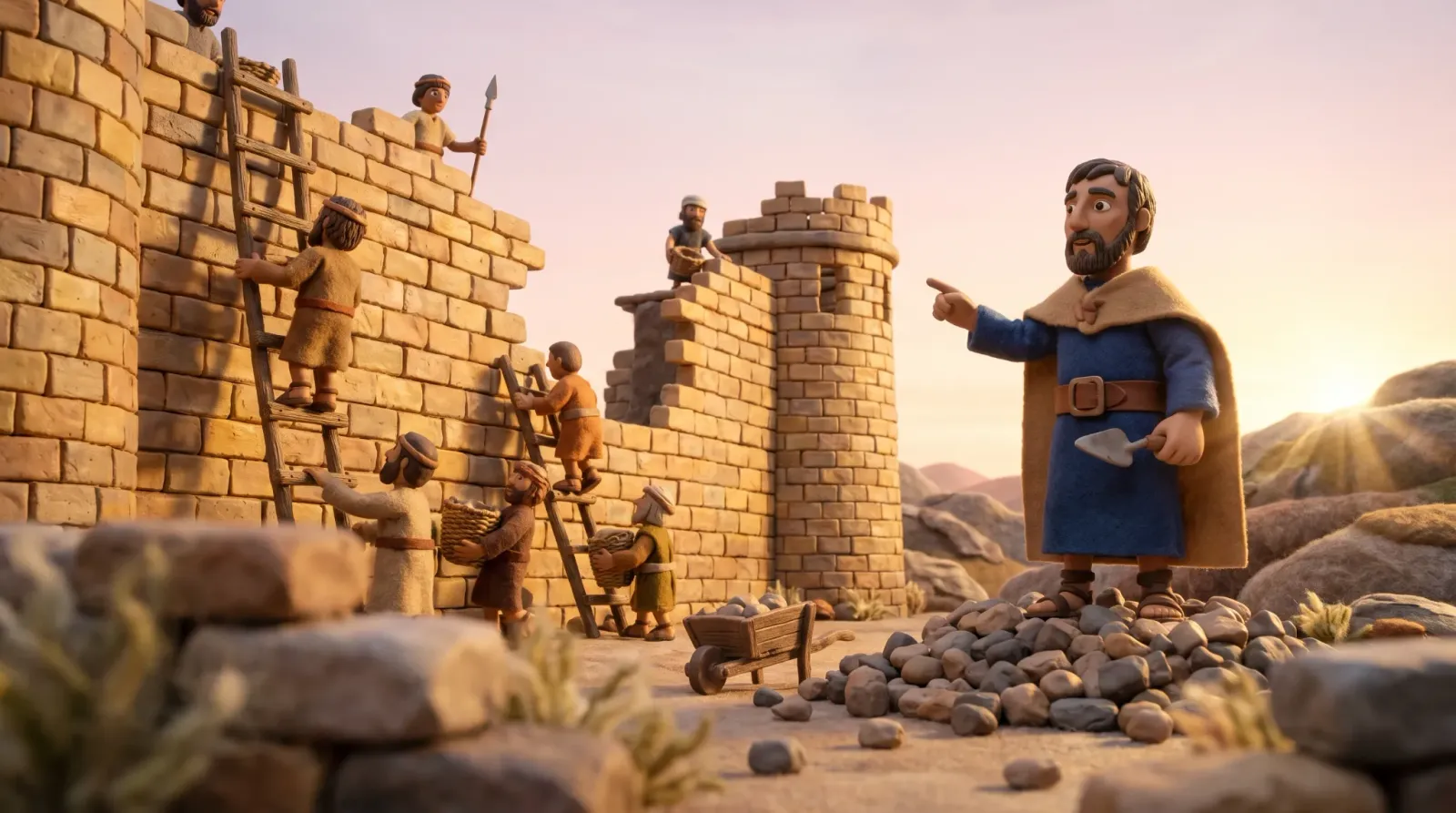 Golden bricks, ladders and Nehemiah pointing the way as the wall goes back up at dawn.
Poetry and wisdom: the people’s answer
Hebrew poets often say a thing twice, with the second line echoing the first: “Your word is a lamp to my feet and a light to my path” (Psalm 119:105, Berean Standard Bible). That echo runs through Job, Psalms, Proverbs, Ecclesiastes and Song of Songs. Psalms is the big one, with 150 prayers and songs. Proverbs packs advice into one-liners, Job spends 42 chapters on a good man’s suffering, Ecclesiastes opens with “Futility of futilities” (Ecclesiastes 1:2), and Song of Songs is a love song for a bride and her beloved (Song of Songs 4:8). Allow about 8 hours for the whole block, a little over 4 of them in Psalms.
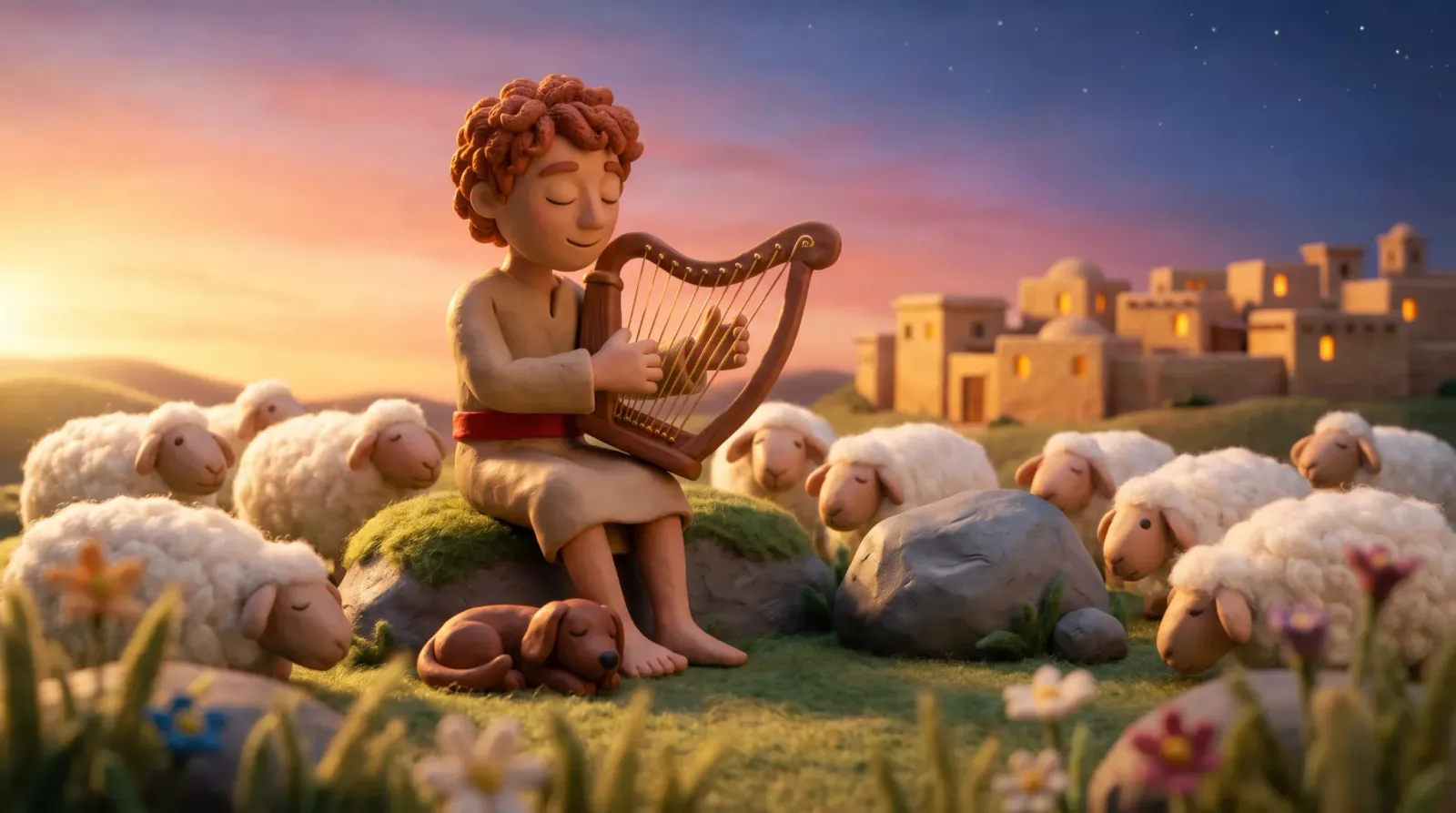 Young David with his harp and his sheep at dusk.
Prophets: warning and comfort
The prophetic books run from Isaiah to Malachi, 17 in all. Open a Hebrew Bible and the prophets look different. Its three sections are the Law, the Prophets and the Writings, and Daniel and Lamentations sit in the Writings (Britannica). Christian Bibles pull those two in with the prophets and group all 17 by length. Isaiah, with 66 chapters, leads the five Major Prophets, and Lamentations rides along because tradition credits it to Jeremiah. The twelve Minor Prophets run from Hosea to Malachi, and Obadiah, a single chapter, is the shortest book in the Old Testament.
Some preached before Babylon took Judah (Isaiah, Hosea, Amos), some during the exile (Ezekiel, Daniel) and some after the return (Haggai, Zechariah, Malachi). The New Testament keeps quoting them. At Pentecost, Peter explains the crowd’s astonishment with Joel (Acts 2:12-21), and Matthew reads Jesus’ entry into Jerusalem on a donkey as the fulfillment of Zechariah 9:9 (Matthew 21:4-5).
For a first taste, try Daniel 1 to 6, a run of stories from the royal courts of Babylon and Persia that ends in the lions’ den.
The silence between the testaments
Malachi, the last book of the Old Testament, and Matthew, the first of the New, sit about 400 years apart, with Nehemiah’s story near the start of that gap (Carson). Historians fold those centuries into the Second Temple period, which runs from the rebuilt temple’s completion in 515 B.C. to its destruction by Rome in A.D. 70 (Britannica).
By Matthew’s day, Israel has a king named Herod (Matthew 2:1) and later a Roman governor, Pilate (Matthew 27:2). New religious parties have formed as well: in Matthew 3:7, John the Baptist sees Pharisees and Sadducees coming to his place of baptism.
The New Testament, block by block
The New Testament’s 260 chapters take about 18 hours to hear, roughly a quarter of the Bible’s total listening time.
Gospels: the life of Jesus
Matthew, Mark, Luke and John tell the same life four times over. Matthew opens with Jesus’ family tree and keeps pointing back to Old Testament promises. Mark is the shortest at 16 chapters, which is why it leads off our four-week plan. Luke has stories the other three leave out, like the ten lepers (Luke 17:11-19) and the angel’s visit to Zechariah in the temple (Luke 1:8-13), and John gives five chapters to a single evening, the Last Supper (John 13 to 17). Together they run about 8.3 hours.
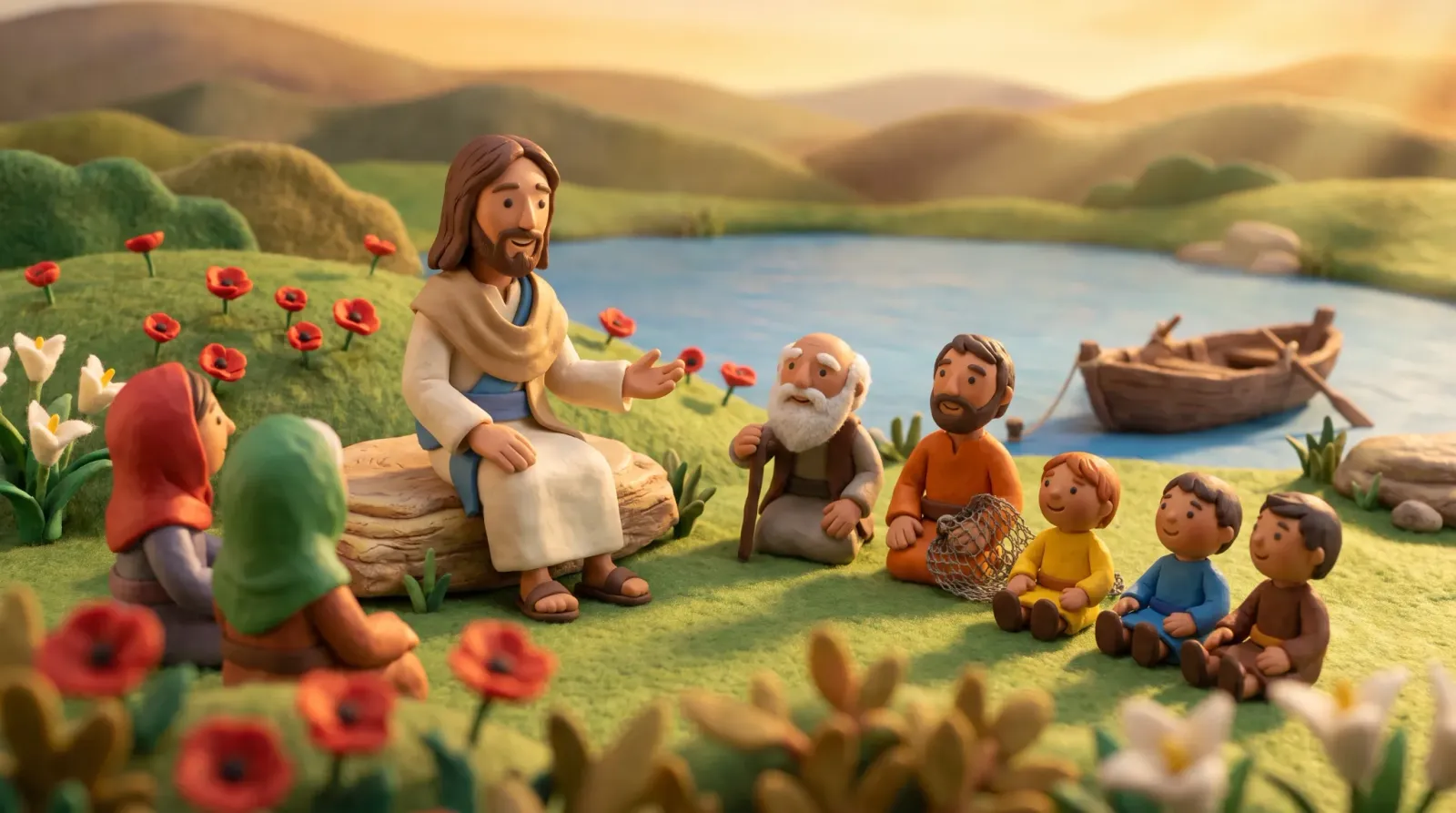 Clay Jesus on a lakeside rock, talking with a few listeners among the flowers.
Acts: the church is born
Acts 1:8 works as the book’s table of contents. Jesus tells His followers they’ll be His witnesses “in Jerusalem, and in all Judea and Samaria, and to the ends of the earth,” and the chapters roughly follow that map: Jerusalem in chapters 1 to 7, Judea and Samaria in 8 to 12, and from chapter 13 on, Paul’s travels, which end in Rome. Read it right after Mark to keep the story moving.
Letters: written to real people
Romans through Philemon carry Paul’s name, nine to churches and four to individuals: Timothy twice, Titus and Philemon. Hebrews through Jude, the eight General Epistles, were mostly meant to circulate among churches. Whichever one you open, look for the trouble it answers. Galatians pushes back on teachers who told Gentile believers to be circumcised (Galatians 5:2), and 1 Thessalonians comforts a church grieving members who had died (1 Thessalonians 4:13). For a first letter, try Philippians, about 14 minutes in audio.
Revelation: the final vision
Revelation 1:3 blesses “the one who reads aloud the words of this prophecy” and those who hear it. Its last two chapters bring back the river and the tree of life from Eden (Revelation 22:1-2) and show God at home with His people:
“He will wipe away every tear from their eyes, and there will be no more death or mourning or crying or pain, for the former things have passed away.” (Revelation 21:4, Berean Standard Bible)
First-time readers can start with the seven short letters in chapters 2 and 3, which show what those churches were up against, and then read chapters 21 and 22.
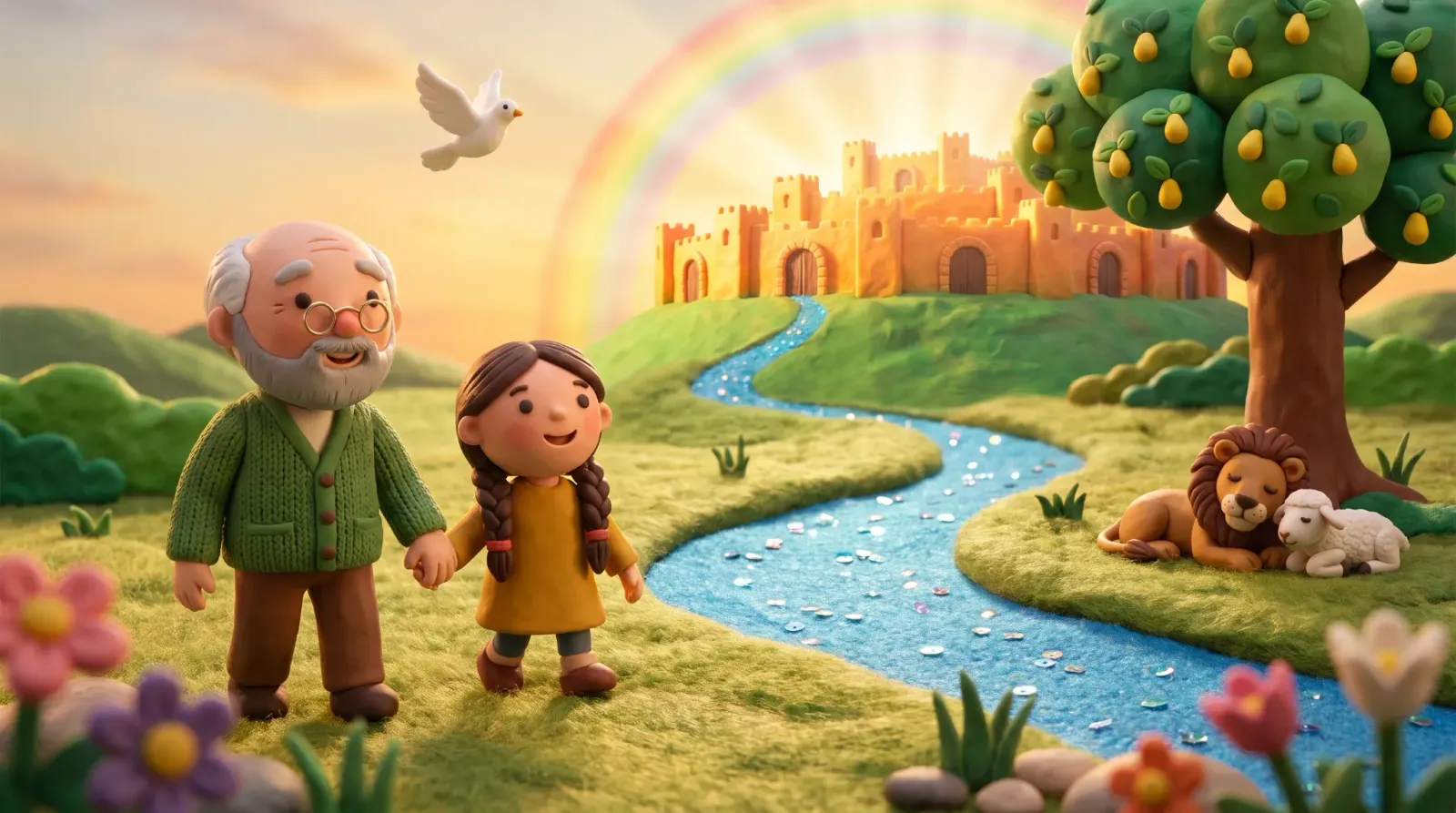 A grandfather and granddaughter walk toward a golden city, with a river and a fruit tree beside the path.
The order of the books and the order of time
Your table of contents groups the books by genre, so time order holds only in places. The history books and the Gospels mostly move forward. Job never names a date, and the Psalms were written across centuries; Psalm 137 looks back on the exile in Babylon. Paul’s letters, printed after Acts, are the earliest writings in the New Testament, according to Britannica, sent not long after Jesus’ death to deal with problems in local churches (Britannica).
Want to read in time order? Follow the narrative books and stop for the prophets where they fit. Ezekiel goes with 2 Kings 24, since he dates his first vision to the fifth year of King Jehoiachin’s exile (Ezekiel 1:2). Haggai and Zechariah go with Ezra 5, which names them both (Ezra 5:1).
Catholic and Protestant Bibles: 66 or 73 books
Catholic Bibles have 73 books. The New Testament matches the Protestant one, and the Old Testament adds Tobit, Judith, 1 and 2 Maccabees, Wisdom, Sirach and Baruch, along with longer versions of Esther and Daniel. Catholics call these the deuterocanonical books, and older Protestant printings that include them, like the 1611 King James Version, group them as the Apocrypha. The U.S. Conference of Catholic Bishops spreads them among the historical, wisdom and prophetic books, and Britannica notes that Catholic and Eastern Orthodox Old Testaments are somewhat larger. The 8 blocks above work for a Catholic Bible too, with a few books on different shelves.
Where to start reading the Bible
Mark is our pick for a first read. In chapter 1 alone, Jesus is baptized, calls four fishermen and heals a man with leprosy. Give the plan below 15 to 20 minutes a day for four weeks:
| Week | Read | What you’ll come away with |
|---|---|---|
| 1 | All of Mark (16 chapters, about 1 h 30 min) | Jesus’ ministry, from His baptism to the empty tomb |
| 2 | Genesis 1 to 3, 12, 22 and 37 to 45 | The garden, God’s promise to Abraham and Joseph’s rise in Egypt |
| 3 | Exodus 1 to 20 and Psalm 23 | Slavery, the escape through the sea, Sinai and a psalm to learn by heart |
| 4 | Acts 1 to 4, Philippians and Revelation 21 and 22 | The church’s first days, a letter from prison and the new creation |
Those four weeks take you from the garden to the new creation. From there, try Luke and Acts back to back. They’re two volumes by the same writer, addressed to the same Theophilus (Luke 1:3; Acts 1:1), and together they run from an angel’s visit to Zechariah to Paul in Rome.
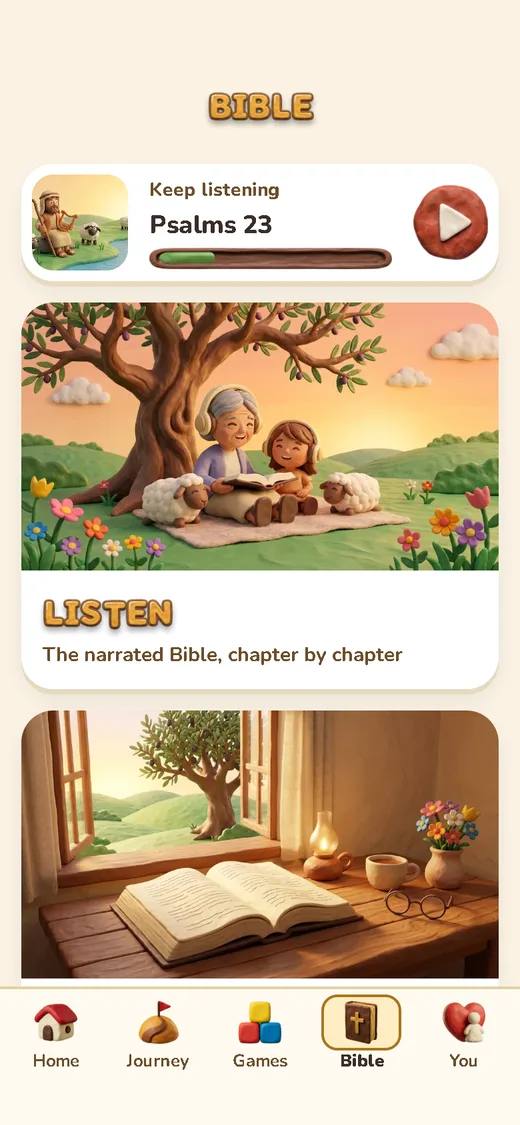 The Bible tab: “Keep listening” picks up at Psalms 23, and “Listen” opens the narrated chapters.
How to read each kind of book
- Stories (Genesis, Exodus, Gospels, Acts): keep track of who’s in each scene and where it happens. For Acts 13 to 28, a map of Paul’s journeys helps.
- Poetry (Psalms, Song of Songs): read it aloud and listen for the second line echoing the first.
- Laws (Leviticus, Deuteronomy): look for the reason, often a short line such as “I am the LORD your God” (Leviticus 19:3).
- Prophets: check the first verse for the date. Zephaniah 1:1 names King Josiah, and Haggai 1:1 gives the year, the month and the day.
- Letters: find the problem the writer is answering. In 1 Corinthians 1:11, Paul has heard about quarrels in the church.
- Revelation: watch for sevens: seven churches, seven seals, seven trumpets and seven bowls.
Reading with kids? Start with Bible stories for kids, ten short retellings from Creation to the Good Samaritan, and use how to teach the Bible to kids for a plan by age. A round of Bible trivia or one of our Bible games for families is a good way to drill the book order. And how to memorize the Bible on a long-term plan covers keeping whole passages in memory for years.
How we put this guide together. The site’s editorial team wrote it and checked it in October 2026. Every verse is quoted from the Berean Standard Bible, and we ran our own chapter and word counts on that same text. To turn words into hours, we used 158 words per minute, the pace of a Psalm 23 narration we timed. Temple dates, the dating of Paul’s letters and the Hebrew and Catholic book lists come from Britannica and the USCCB, linked where they appear. Where an idea is Carson’s, we say so.
Sources
- Carson, D. A. (2016). An Overview of the Whole Bible. Desiring God / The Gospel Coalition.
- Encyclopaedia Britannica. Bible.
- Encyclopaedia Britannica. Temple of Jerusalem.
- Encyclopaedia Britannica. New Testament.
- United States Conference of Catholic Bishops. Books of the Bible (New American Bible).
- Our own count of chapters and words in the text of the Berean Standard Bible, with a narration pace of 158 words per minute measured on a reading of Psalm 23.
Frequently asked questions
How many books are in the Bible, and what order are they in?
Protestant Bibles have 66 books, and Catholic Bibles have 73 because they add seven to the Old Testament. In the Protestant order, the 39-book Old Testament opens with the Pentateuch and moves through history, poetry and the prophets; the 27-book New Testament runs Gospels, Acts, letters and Revelation.
What's the Bible about in a nutshell?
It's one story in four acts. God makes a good world and puts people in it (Genesis 1 and 2). Sin enters in Genesis 3, and God spends most of the Bible rescuing His world, from Abraham's family all the way to Jesus' death and resurrection. In the last act, He makes heaven and earth new and moves in with His people. Creation, fall, redemption, new creation.
Are the books of the Bible in chronological order?
Partly. Paul's letters are one example: they're printed after the Gospels and Acts, and Britannica dates them earlier. In the Old Testament, the narrative runs forward from Genesis to 2 Kings, Chronicles retells it, and Esther's events under Xerxes (Esther 1:1) come before Nehemiah's trip under Artaxerxes (Nehemiah 2:1), which sits earlier in your Bible.
How long does it take to read or listen to the whole Bible?
Roughly 76.5 hours for the Berean Standard Bible. We counted 724,811 words and divided by 158 words per minute, the pace of a Psalm 23 narration we timed. That's about 58.3 hours for the Old Testament and 18.1 for the New, or about 13 minutes a day if you spread it over a year. A slower narrator or another translation will shift the total a bit.
Where should I start reading the Bible?
Mark. It's the shortest Gospel, about an hour and a half in audio, and by the end of chapter 1 Jesus has healed a fever and a man with leprosy. If you'd like to start in the Old Testament, Genesis 1 to 3 and 12 give you the opening of the story in four chapters.
What's the difference between the Catholic and Protestant Bible?
Catholic Bibles count 73 books and Protestant Bibles 66, and all seven extra books are in the Old Testament: Tobit, Judith, 1 and 2 Maccabees, Wisdom, Sirach and Baruch. Catholic editions also carry longer forms of Esther and Daniel. Catholics call these books deuterocanonical.
Keep reading
-
How to memorize the books of the Bible
How to memorize the 66 books of the Bible in order: small blocks, a 7-day plan, self-testing, tricks for look-alike names and a version for kids. Read article -
Bible characters: who they were and where
The main Bible characters in story order, from Adam to Paul, with the book and chapter for each, what they did, what they teach and a section on the women. Read article -
Fruit of the Spirit for kids: a family guide
Love, joy, peace and the rest of Galatians 5:22-23 in words kids understand, with family moments, games for busy evenings and a four-week verse plan. Read article