
How to memorize the books of the Bible
How to memorize the 66 books of the Bible in order: small blocks, a 7-day plan, self-testing, tricks for look-alike names and a version for kids.
 The Terra Sinai team 14 min read
In this article (13)
To memorize the books of the Bible in order, split the 66 names into 10 short blocks, learn one or two blocks a day for a week, and open each session by writing out from memory what you’ve learned so far before you look at the list. After that, review on days 10, 17, and 30. That covers the 39 books of the Old Testament and the 27 of the New.
This guide is about the names of the books and their order. If you want to memorize the actual text of a chapter or a whole book, head to how to memorize the Bible. And for a tour of what each section of the Bible contains, see the Bible from Genesis to Revelation.
Why 66 names in a row are hard to hold
If you’ve ever started reciting the books and lost the thread somewhere around Obadiah, short-term memory is the bottleneck. Psychologist George Miller argued in 1956 that its limit is counted in chunks, and that the workaround is to bundle items under one label you can recall. Nelson Cowan reviewed the evidence in 2001 and put the cap at about 4 chunks (3 to 5) when people can’t rehearse.
That’s why the table below comes in named blocks. Say “Law” and you’ve got five books in hand, and the 12- and 13-book blocks break down into groups of three or four.
| Block | Books, in order | Count | How to split it |
|---|---|---|---|
| Law (Pentateuch) | Genesis, Exodus, Leviticus, Numbers, Deuteronomy | 5 | all at once |
| History | Joshua, Judges, Ruth, 1 Samuel, 2 Samuel, 1 Kings, 2 Kings, 1 Chronicles, 2 Chronicles, Ezra, Nehemiah, Esther | 12 | 3 + three pairs + 3 |
| Poetry and Wisdom | Job, Psalms, Proverbs, Ecclesiastes, Song of Solomon | 5 | all at once |
| Major Prophets | Isaiah, Jeremiah, Lamentations, Ezekiel, Daniel | 5 | all at once |
| Minor Prophets | Hosea, Joel, Amos, Obadiah, Jonah, Micah, Nahum, Habakkuk, Zephaniah, Haggai, Zechariah, Malachi | 12 | three groups of 4 |
| Gospels | Matthew, Mark, Luke, John | 4 | all at once |
| Acts | Acts | 1 | on its own |
| Paul’s letters | Romans, 1 Corinthians, 2 Corinthians, Galatians, Ephesians, Philippians, Colossians, 1 Thessalonians, 2 Thessalonians, 1 Timothy, 2 Timothy, Titus, Philemon | 13 | 9 to churches + 4 to people |
| General letters | Hebrews, James, 1 Peter, 2 Peter, 1 John, 2 John, 3 John, Jude | 8 | 4 + 4 |
| Revelation | Revelation | 1 | on its own |
The names come from the Berean Standard Bible, the translation in our app. Many other translations call book 22 “Song of Songs.”
A few patterns make the list friendlier. There are five books of Law, five of Poetry, and five Major Prophets. Paul wrote nine letters to churches (Romans through 2 Thessalonians) and four to individuals (1 Timothy through Philemon). Adding up the blocks, the Old Testament comes to 17 + 5 + 17 and the New to 4 + 1 + 9 + 4 + 9.
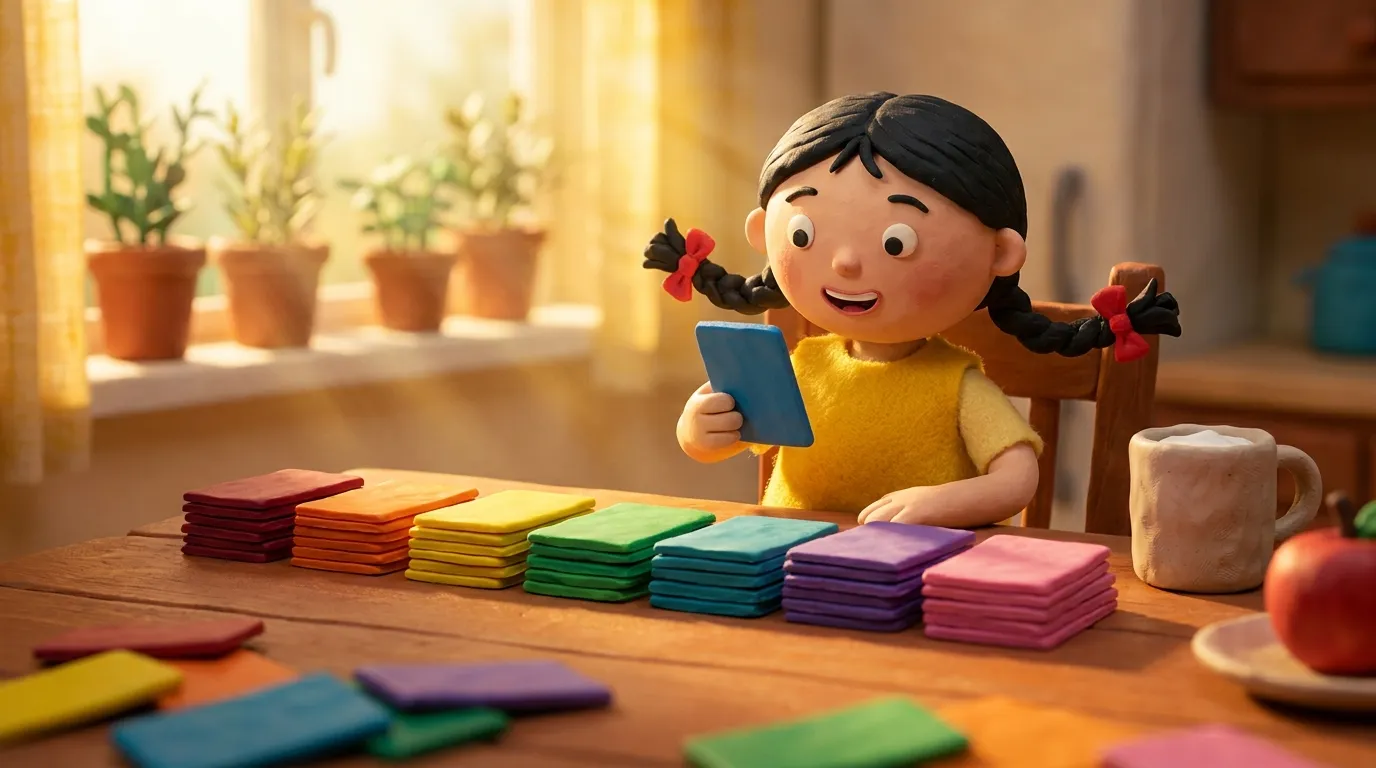 Lia sorts the book cards into piles, one color per block.
You’ll sometimes see Hebrews filed under Paul, since early church tradition credited the letter to him; few scholars hold that view today. Either way, the order on the page doesn’t change: Philemon, then Hebrews, then James.
First, decide which list you’re learning
The 66-book list belongs to Protestant Bibles. Catholic Bibles have 73 books, and the Hebrew Bible has 24 in a different order. Pick your list before day one, because switching halfway scrambles the blocks. Near the end of this guide you’ll find where the Catholic list adds books and how the Hebrew Bible is arranged.
It’s also worth opening the table of contents in the Bible you carry to church. Whatever name is printed there, whether “Song of Solomon” or “Song of Songs,” is the one to learn, since that’s what you’ll be flipping to on Sunday.
The 7-day plan
Plan on 10 to 15 minutes a day (our estimate for teens and adults). Each day adds new blocks and opens with a from-memory check on everything before.
| Day | New today | From-memory check before you start |
|---|---|---|
| 1 | Law (5) + Joshua, Judges, Ruth | — |
| 2 | 1 and 2 Samuel, 1 and 2 Kings, 1 and 2 Chronicles + Ezra, Nehemiah, Esther | day 1 |
| 3 | Poetry (5) + Major Prophets (5) | days 1 and 2 |
| 4 | Minor Prophets, in three groups of 4 | Genesis through Daniel |
| 5 | Gospels (4), Acts, and Paul’s 9 letters to churches | the whole Old Testament |
| 6 | The 4 letters to people, the 8 general letters, and Revelation | Matthew through 2 Thessalonians |
| 7 | Nothing new | all 66 written out start to finish; then check and mark mistakes |
Short on time? Split each day of the plan in two: that’s 12 days of new blocks, plus 2 days to write out the whole list from memory.
What a 10-minute session looks like
Minutes 1 and 2: grab a blank sheet and write down everything you remember from earlier days, no peeking. Minute 3: open the list and mark, in a different color, whatever you missed or put in the wrong spot. Minutes 4 through 8: read the new block out loud, cover it, and say it back until you get it right twice in a row. Minutes 9 and 10: say the new block from memory together with the one before it. The seams between blocks, like Esther to Job or Malachi to Matthew, are where most people stall.
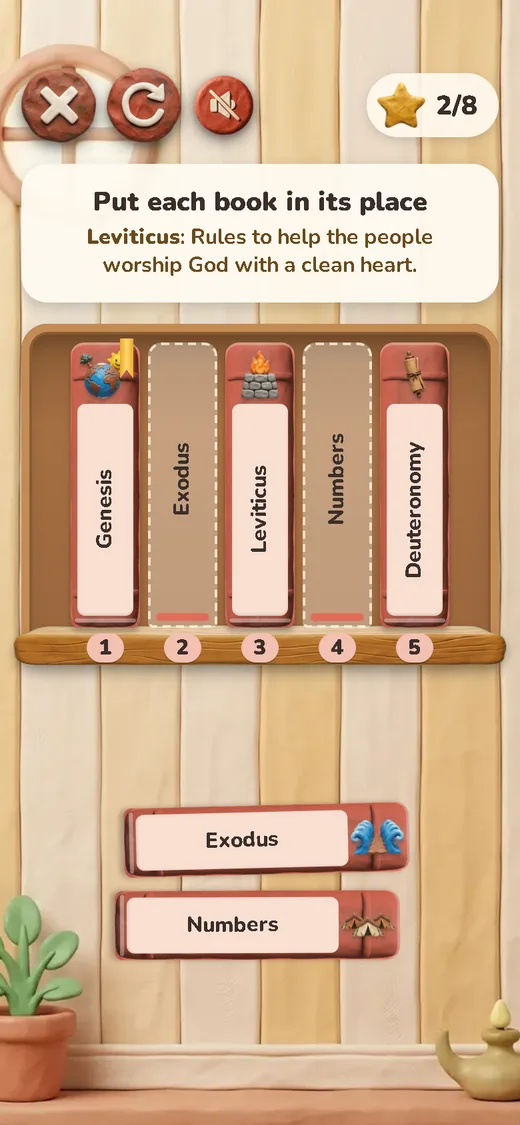 The first shelf in the game: Exodus and Numbers still need a spot.
Our app has a game built for exactly this list, The 66 Bookshelf. The books lie flat in a stack, and you stand each one up in its slot on the shelf. Once it’s in place, a short line tells you what the book is about. Every group has its own color. Early on, only a few books are missing, their neighbors are already in place, and each empty slot shows the name. As the levels climb, the hints fade (first the name, then the first letter, then just the number), whole shelves open up, and quick rounds ask “which book comes after?” and “which comes before?” Put a book in the wrong slot and it slides back to the stack while the game shows you where it belongs. Get a book right on the first try three times and it joins “My bookshelf.”
Test yourself before you look
The key move in every session is trying to recall before you read. Henry Roediger and Jeffrey Karpicke measured this in 2006 with college students who studied short passages and were tested a week later. In Experiment 1, students who had taken a recall test remembered 56% of the ideas, and students who had reread remembered 42%. In Experiment 2, the group that studied once and tested three times recalled 61%, and the group that studied four times recalled 40%. Keep in mind the students were learning prose passages, so those percentages are about prose. What carries over to the book list is the routine: blank page first, open list second.
You can quiz yourself almost anywhere. While the coffee brews, run the Minor Prophets in your head, and on the drive to work, say Acts through Philemon out loud. Jot any name that trips you up on a sticky note, and work through that note first thing the next morning.
 On the couch at night, Dad holds up a card and Teo calls out the book that comes next.
When to review
After day 7, review on days 10, 17, and 30, always starting with the blank page. Those dates are our suggestion, built on a pattern that’s been measured: in a meta-analysis of 317 experiments from 184 articles, Nicholas Cepeda and colleagues (2006) found that the best gap between study sessions grows with how long you want to remember. If you want the list for months, your reviews can keep spreading out.
If a whole block falls apart during a review, study just that block two days in a row, then pick the schedule back up.
Use one song, start to finish
A song helps when the melody repeats. According to the abstract of Wallace’s 1994 study, text heard as a song was recalled better than the same text spoken when it had three verses set to the same easy-to-learn melody. With a single verse, or with a different melody for each verse, the result flipped. The study used song lyrics, so it says nothing direct about lists of names. The practical takeaway for the books of the Bible is to pick one song and stay with it.
 Grandpa plays the books song while Lia and Teo clap along.
YouTube and the music apps are full of books-of-the-Bible songs. Before you teach one, sit down with the list and make sure the lyrics name all 66 books (plenty stop at Malachi), follow your Bible’s order, and use the same names as your translation. If your favorite only covers the Old Testament, find a second one for the New, and sing each one all the way through.
The memory palace, with 10 stops
The memory palace, also called the method of loci, means parking each item in a place you know well, like the rooms of your house, always walked in the same order. In a 2003 study of world memory champions, Eleanor Maguire and colleagues found people of ordinary intelligence with no structural brain differences who relied on a spatial learning strategy. In 2017, Martin Dresler and colleagues trained volunteers in the method for six weeks; their memory improved, and the gain still showed four months later (Neuron, 2017).
Ten stops cover the whole list, one per block, and the easiest route is one you already drive every week. Take the trip from your driveway to church. The mailbox gets the Law. The stop sign at the corner gets the History books, the big oak in your neighbor’s yard gets Poetry, the school crosswalk gets the Major Prophets, and the gas station gets the Minor Prophets. Keep going until you pull into the church parking lot, where Revelation is waiting.
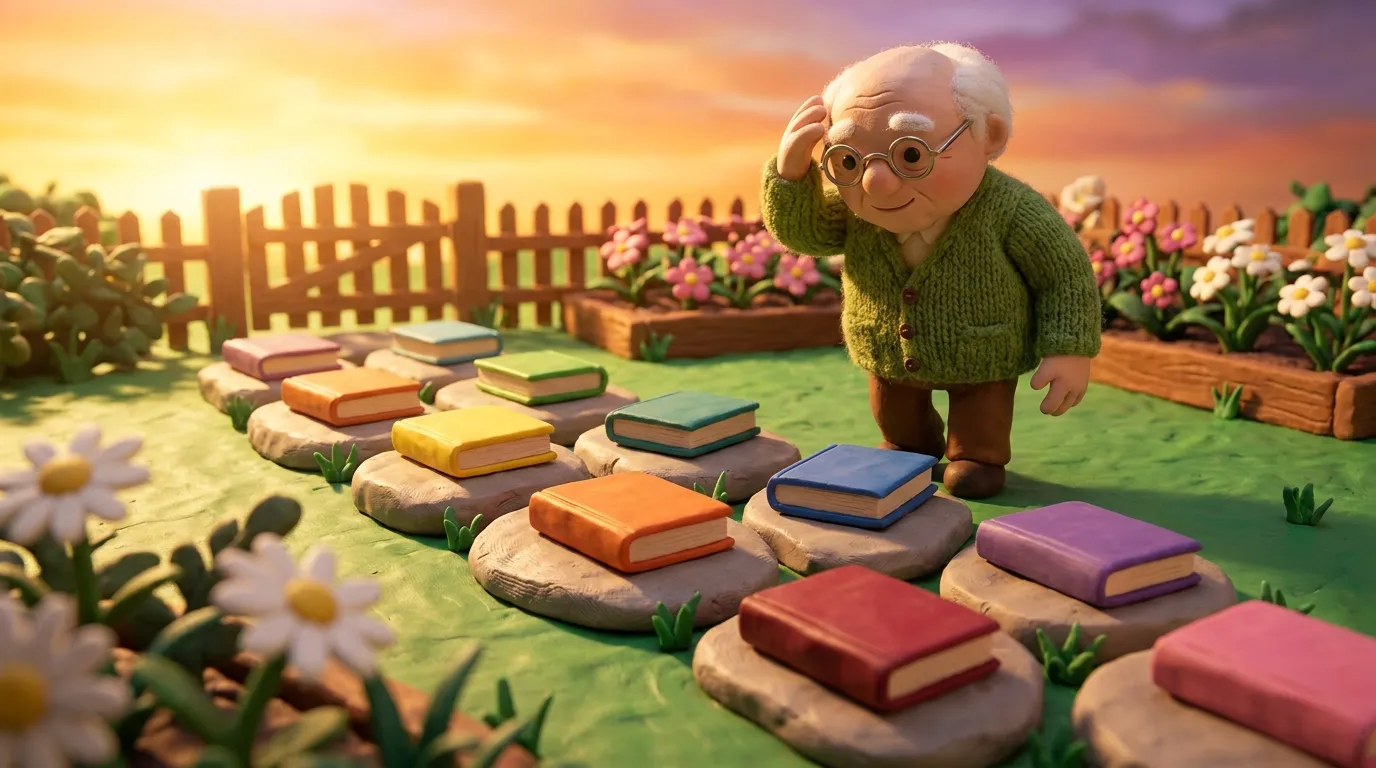 Grandpa walks the garden path and recalls the block waiting on each stone.
One stop, up close
The gas station on that drive has three pumps, which is perfect for the 12 Minor Prophets: four books per pump. Hosea, Joel, Amos, and Obadiah wait at pump one. Jonah leads at pump two, soaking wet and still smelling like fish, with Micah, Nahum, and Habakkuk behind him. Pump three has Zephaniah, Haggai, Zechariah, and Malachi. Malachi closes the Old Testament, so when you pull back onto the road, the next stop belongs to the Gospels.
Tricks for the look-alike names
Most mix-ups happen between names that sound alike or sit close together. These tricks are ours, and each one leans on where the book sits in the list.
| Names | Why they get mixed up | Trick |
|---|---|---|
| Philippians and Philemon | same opening sound | Philippians sits inside Galatians, Ephesians, Philippians, Colossians (G-E-P-C); Philemon is the one-chapter letter that closes Paul’s set, right after Titus |
| Joshua and Judges | two J books back to back | Joshua takes the people into the land; Judges opens “after the death of Joshua” (Judges 1:1) |
| John and 1, 2, 3 John | same name in two places | the Gospel closes the four Gospels; the three letters sit near the end, between 2 Peter and Jude |
| Job, James, and Jude | short J names | Job opens Poetry; James comes right after Hebrews; Jude is the last letter before Revelation |
| Corinthians, Thessalonians, Timothy | three “1 and 2” pairs | they run in alphabetical order: Co, Th, Ti |
| Ezra, Nehemiah, Esther | the end of History | two builders (the temple, then the walls) and a queen |
| Obadiah and Jonah | the border between groups of 4 | Obadiah ends the first group of Minor Prophets; Jonah starts the second |
 Teo plays with his book train, one car after another.
To drill these, play “what comes next?” One person names a book and the other names the one after it. Start with the names in the table, then pull books at random from anywhere in the list.
Acronyms: what the research shows and where to use one
The first letters of the 66 books repeat too much to make one useful acronym. Counting the BSB names, 12 of the 66 start with J: Joshua, Judges, Job, Jeremiah, Joel, Jonah, John, James, the three letters of John, and Jude. Drop the numbers and you’re left with 56 distinct names. A long string full of J’s can’t tell you which book goes where.
Research on first-letter tricks is mixed. Kibler and Blick (1972) taught a list of 19 nouns: there was no difference in immediate recall, and people handed a ready-made scheme remembered more than people who made up their own, at 1 day, 1 week, and 4 weeks (Psychological Reports). Carlson, Zimmer, and Glover (1981) found no effect of first-letter mnemonics on immediate or delayed recall, according to the paper’s abstract (Journal of General Psychology).
Save acronyms for one short, tricky stretch. G-E-P-C, for Galatians, Ephesians, Philippians, and Colossians, works well because those are four letters in a row of similar length.
Teaching kids, by age
These age targets are our suggestions for home or Sunday school:
- Ages 4 to 6: the Law and the Gospels, sung and pointed out on colored cards.
- Ages 7 to 9: the Old Testament, one block a week, with cards they line up on the floor themselves.
- Ages 10 to 12: the whole New Testament and the Minor Prophets in groups of four, with beat-the-clock challenges.
- Teens and adults: all 66 with the 7-day plan, plus the memory palace if they like it.
- Grandparents, or anyone who wants big print: a large-print copy of the list, one block a week, reviewed out loud.
Teaching God’s words at home is right there in the Law:
And you shall teach them diligently to your children and speak of them when you sit at home and when you walk along the road, when you lie down and when you get up.
(Deuteronomy 6:7, BSB)
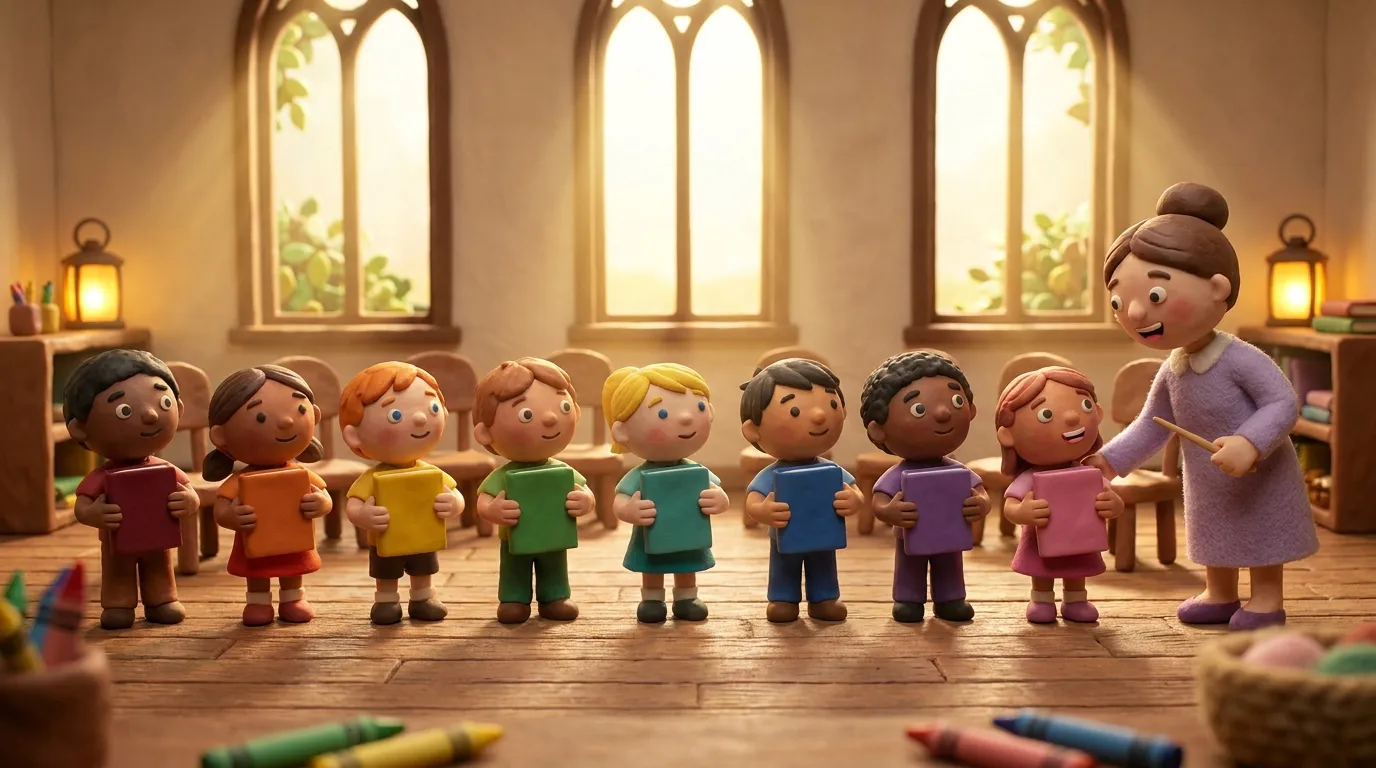 In Sunday school, each child holds one book and the teacher checks the line.
A 10-minute routine for the table or the classroom
Make one card per book in the block, all in the same color, and shuffle the deck. Kick things off by singing the block together for a couple of minutes. Then hand the kids the deck and let them build the line on the floor while you keep time, about three minutes. Next, have everyone close their eyes while you slip two or three cards out of the line, and ask which books went missing. Wrap up with a lap around the circle: each kid names a book and the one after it, and the group cheers every right answer. For more variety, the Bible memory game and Bible trivia come with ready-made cards and questions, and Sunday school games has more ideas for a group.
If you use a Catholic Bible or the Hebrew Bible
The Catholic Bible has 73 books, according to the U.S. Conference of Catholic Bishops (USCCB): 46 in the Old Testament and the same 27 in the New. Tobit and Judith go between Nehemiah and Esther; 1 and 2 Maccabees between Esther and Job; Wisdom and Sirach between the Song of Songs and Isaiah; and Baruch between Lamentations and Ezekiel. Esther and Daniel also carry extra passages, inside those same two books.
The same blocks still work: History grows to 16 (four groups of four), Poetry and Wisdom to 7, and the Major Prophets to 6.
 Parchment scrolls, a lit clay lamp, and a red-covered book at sunset.
The Hebrew Bible, or Tanakh, holds the same text as the Protestant Old Testament in 24 books and three parts, according to Encyclopaedia Britannica: the Torah (Genesis through Deuteronomy), the Prophets, and the Writings. Samuel, Kings, and Chronicles count as one book each, Ezra and Nehemiah are one, and the 12 Minor Prophets make up a single book, “the Twelve.” Ruth, Esther, Daniel, and Lamentations sit among the Writings, and the list ends with Chronicles. Jesus names the Law of Moses, the Prophets, and the Psalms together:
Jesus said to them, “These are the words I spoke to you while I was still with you: Everything must be fulfilled that is written about Me in the Law of Moses, the Prophets, and the Psalms.”
(Luke 24:44, BSB)
What usually stalls the plan
Plenty of people can say every block on its own and then freeze at a seam: Esther into Job, Malachi into Matthew. Give those borders a minute of every session with a round of “what comes next?”
Rereading the list won’t show you which names are missing, so start every session with the blank page. That’s the step behind the 56% and 61% in Roediger and Karpicke’s experiments.
Pick one translation, one list, and one song on day one, and keep them. If your church says “Song of Songs” and your song says “Song of Solomon,” choose one name and stick with it.
And don’t try to cram it all into one evening. Spaced reviews keep the names from slipping. The check-ins on days 10, 17, and 30 take a few minutes each. Once the order feels solid, move on to the words themselves with how to memorize Bible verses, which walks through the technique one verse at a time.
How this guide was made. Written by the site’s editorial team and reviewed in October 2026. We built the list and the counts ourselves from the Berean Standard Bible names and checked them against the standard Protestant order. The 7-day plan, review dates, tricks, and age targets are our suggestions, grounded in the memory studies listed below. Scripture quotations are from the Berean Standard Bible.
Sources
- G. A. Miller (1956), The magical number seven, plus or minus two, Psychological Review (grouping items and naming the group)
- N. Cowan (2001), The magical number 4 in short-term memory, Behavioral and Brain Sciences (about 4 chunks)
- H. L. Roediger and J. D. Karpicke (2006), Test-enhanced learning, Psychological Science (Experiments 1 and 2)
- N. J. Cepeda and colleagues (2006), Distributed practice in verbal recall tasks, Psychological Bulletin (meta-analysis of spacing)
- W. T. Wallace (1994), Memory for music: effect of melody on recall of text, Journal of Experimental Psychology: Learning, Memory, and Cognition (abstract)
- E. A. Maguire and colleagues (2003), Routes to remembering: the brains behind superior memory (memory champions)
- M. Dresler and colleagues (2017), Mnemonic training reshapes brain networks to support superior memory, Neuron (six weeks of method-of-loci training)
- USCCB, Books of the Bible (Catholic order, 73 books)
- Encyclopaedia Britannica, Tanakh (the three parts of the Hebrew Bible)
Frequently asked questions
How many books are in the Bible?
Protestant Bibles have 66 books: 39 in the Old Testament and 27 in the New Testament. Catholic Bibles have 73, because they add seven books to the Old Testament (Tobit, Judith, 1 and 2 Maccabees, Wisdom, Sirach, and Baruch). The Hebrew Bible holds the same text as the Protestant Old Testament in 24 books, in an order that ends with Chronicles.
What is the fastest way to memorize the books of the Bible in order?
Split the list into named blocks (Law, History, Poetry, Prophets, Gospels, Letters), learn one or two blocks a day, and start every session by writing what you already know from memory before you look. With 10 to 15 minutes a day, the 7-day plan in this article reaches all 66 on day seven. Review on days 10, 17, and 30 so the list lasts.
Is there a song to learn the books of the Bible?
There are many. Pick one that names all 66 books in the order your Bible uses, and check the lyrics against the list before you teach it, since a lot of kids' songs cover only the Old or only the New Testament. Then stick with that one melody all the way through.
How do you teach kids the books of the Bible?
Start with the short blocks they already know: the five books of the Law and the four Gospels. Give each block its own card color, sing the same song every time, and play "what comes next?" A 4- or 5-year-old who knows those two blocks is doing great.
How long does it take to memorize the 66 books?
With 10 to 15 minutes a day, the plan here gets you to the full list written from memory in a week. For young kids, we suggest one block a week. Those times are our estimate, and they shift with age and with how familiar the names already are.
Keep reading
-
Fruit of the Spirit for kids: a family guide
Love, joy, peace and the rest of Galatians 5:22-23 in words kids understand, with family moments, games for busy evenings and a four-week verse plan. Read article -
Bible activities for kids: 15 easy ideas
15 Bible activities for kids to do at home with everyday supplies: crafts, puppets, a recipe, a treasure hunt, music and painting, with ages and steps. Read article -
Bible coloring pages: 10 printable scenes
Ten printable Bible coloring pages for kids, from Creation to the lost sheep, each with a short story and a verse, plus tips by age and for Sunday school. Read article