
Bible characters: who they were and where
The main Bible characters in story order, from Adam to Paul, with the book and chapter for each, what they did, what they teach and a section on the women.
 The Terra Sinai team 22 min read
In this article (12)
Samson or Samuel? Elijah or Elisha? Bible names blur together fast, so this guide lines up the main Bible characters in story order, from Adam in Genesis to Paul in Acts. Each person comes with a book and chapter, what they did and a one-line lesson, and the women of the Bible get their own section near the end.
Every quote comes from the Berean Standard Bible, and we checked each reference there. Use the table below for a quick lookup, then jump to the era you need.
Table: 30 Bible characters in story order
| Character | Where to find them | Who they were | What they teach |
|---|---|---|---|
| Adam | Genesis 2-3 | The first man, formed from dust | Life is a gift from God |
| Eve | Genesis 2-3 | The first woman, “mother of all the living” | God comes looking for people who’ve failed |
| Noah | Genesis 6-9 | Built the ark and saved his family | Obey God when no one else does |
| Abraham | Genesis 12-25 | Left home without knowing where he was going | Trust a promise you can’t see yet |
| Sarah | Genesis 18, 21 | Abraham’s wife, Isaac’s mother in old age | Nothing is too hard for God |
| Isaac | Genesis 21-27 | The promised son | God provides on time |
| Jacob | Genesis 25-35 | Abraham’s grandson, renamed Israel | God keeps working with flawed people |
| Joseph | Genesis 37-50 | Sold by his brothers, ruled in Egypt | Forgiveness and God’s hand in hard times |
| Moses | Exodus 2 to Deuteronomy 34 | Led Israel out of Egypt, received the Law | God equips people who feel unqualified |
| Aaron | Exodus 4, 28 | Moses’ brother, first high priest | Stand beside someone with a hard job |
| Miriam | Exodus 15 | Prophetess, sister of Aaron and Moses | Celebrate what God has done |
| Joshua | Joshua 1, 6 | Led Israel into the promised land | Courage comes from God’s presence |
| Deborah | Judges 4-5 | Prophetess and judge of Israel | Lead with wisdom and faith |
| Gideon | Judges 6-7 | Judge who won with 300 men | God uses the small and the weak |
| Samson | Judges 13-16 | Nazirite judge with great strength | Strength is God’s gift |
| Ruth | Ruth 1-4 | Loyal Moabite widow, David’s great-grandmother | Loyalty and care for family |
| Samuel | 1 Samuel 1-16 | Prophet who anointed Israel’s first two kings | Listen when God speaks |
| Saul | 1 Samuel 9-31 | Israel’s first king | Obey God all the way |
| David | 1 Samuel 16 to 1 Kings 2 | Shepherd, musician and king | Turn back to God after you fall |
| Solomon | 1 Kings 1-11 | Wise king who built the temple | Ask God for wisdom |
| Elijah | 1 Kings 17 to 2 Kings 2 | Prophet of Mount Carmel | God also speaks in a quiet voice |
| Isaiah | Isaiah 6, 9 | Prophet who foretold the Messiah | Answer “Here am I” |
| Jeremiah | Jeremiah 1 | Prophet called when young | Being young doesn’t rule you out |
| Daniel | Daniel 1, 6 | Exile in Babylon, faithful in the lions’ den | Stay faithful far from home |
| Jonah | Jonah 1-4 | Prophet who ran and was swallowed by a fish | God’s mercy reaches everyone |
| Esther | Esther 2-9 | Queen who saved her people | Speak up at the right moment |
| Mary | Luke 1-2 | The mother of Jesus | Say yes to God |
| Jesus | The four Gospels | The Son of God, center of the Bible | Love, forgiveness and new life |
| Peter | Gospels and Acts 1-15 | Fisherman, apostle, church leader | God restores people who fail |
| Paul | Acts 9-28 and his letters | Persecuted the church, then God called him | Grace reaches the farthest away |
The patriarchs: Adam to Joseph
Genesis 1-11 covers creation, the flood and the tower of Babel. Chapter 12 opens the story of the patriarchs, Israel’s founding fathers, and the book stays with them to the end: Abraham, Isaac, Jacob and Jacob’s twelve sons, Joseph among them.
Adam (Genesis 2-3) was formed “from the dust of the ground,” and God breathed the breath of life into his nostrils (Genesis 2:7). After he disobeyed in the garden, God went looking for him and called out, “Where are you?” (Genesis 3:9).
Noah (Genesis 6-9) was “a righteous man, blameless in his generation,” and he “walked with God” (Genesis 6:9). He built the ark, brought his family and the animals inside, and afterward saw the rainbow in the clouds as the sign of God’s covenant with the earth (Genesis 9:13). For a kid-friendly retelling, see Noah’s ark story for kids.
Abraham (Genesis 12-25) was still called Abram when the LORD told him, “Leave your country, your kindred, and your father’s household” (Genesis 12:1). He was seventy-five when he left Haran (Genesis 12:4). One night God took him outside the tent:
And the LORD took him outside and said, “Now look to the heavens and count the stars, if you are able.” Then He told him, “So shall your offspring be.”
(Genesis 15:5, Berean Standard Bible)
Genesis 15:6 adds that “Abram believed the LORD, and it was credited to him as righteousness.” Two chapters later, God renamed him Abraham, “a father of many nations” (Genesis 17:5).
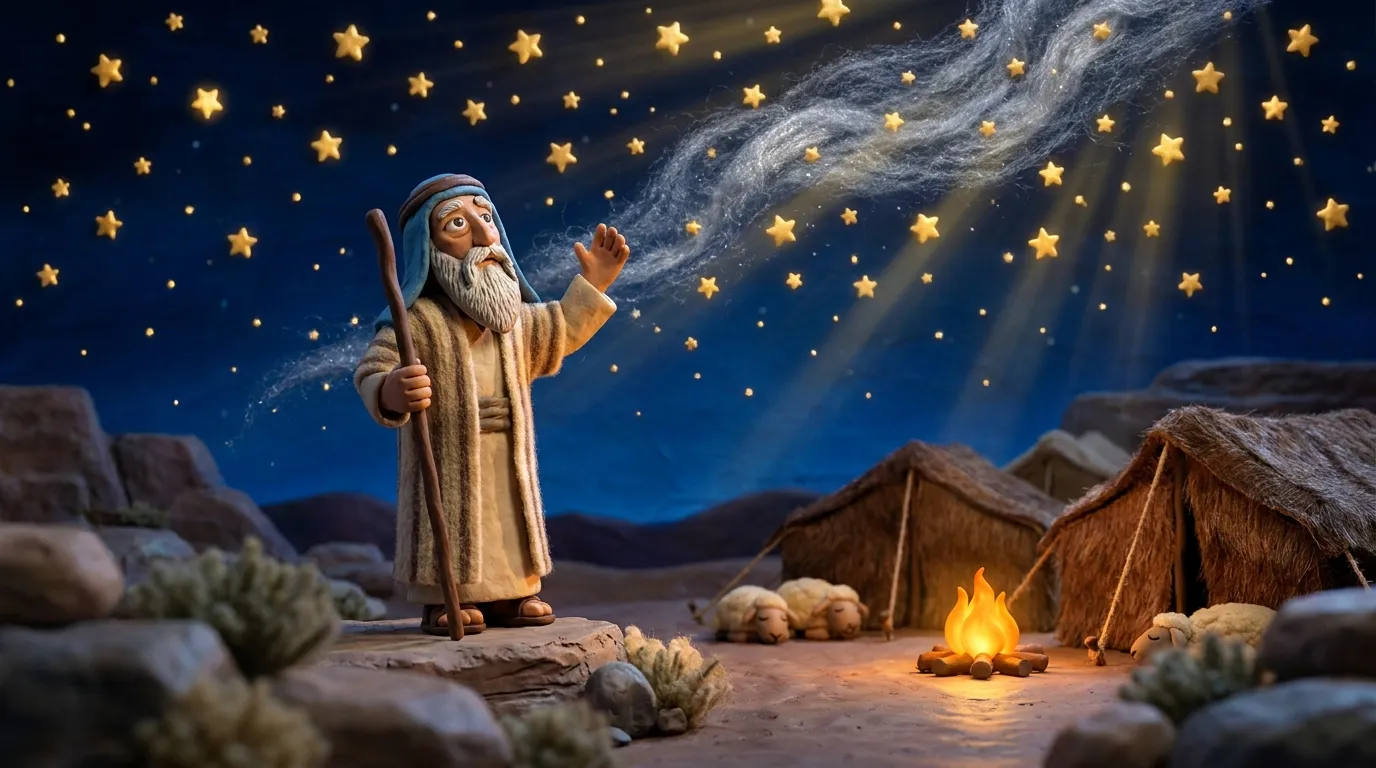 Abraham reaches toward a sky too full of stars to count.
Isaac (Genesis 21-27) was born when his father Abraham was a hundred years old (Genesis 21:5). On the way up the mountain in the land of Moriah, the boy noticed the fire and the wood and asked where the lamb was, and Abraham answered, “God Himself will provide the lamb” (Genesis 22:7-8). Abraham saw a ram caught by its horns in a thicket and offered it as a burnt offering (Genesis 22:13). Years later, Isaac was out in the field one evening to meditate when he looked up and saw camels approaching, bringing Rebekah (Genesis 24:63-64). He married her, and the text says simply that “Isaac loved her” (Genesis 24:67).
Jacob (Genesis 25-35) got his name at birth, when he came out grasping his twin brother Esau’s heel (Genesis 25:26). He tricked his father, ran for his life, and on the road dreamed of a ladder reaching up to heaven with God’s angels going up and down it (Genesis 28:12). For Rachel he worked seven years, “yet it seemed but a few days because of his love for her” (Genesis 29:20). On the way home, he wrestled a man until daybreak and held on: “I will not let you go unless you bless me” (Genesis 32:26). There he received the name Israel (Genesis 32:28), and his twelve sons are the fathers of the twelve tribes (Genesis 49:28).
Joseph (Genesis 37-50) was thirty years old when he entered the service of Pharaoh (Genesis 41:46), and by then he’d already been a slave and a prisoner. It started at home, where Jacob loved him most and made him “a robe of many colors” (Genesis 37:3). His jealous brothers sold him to passing traders for twenty shekels of silver (Genesis 37:28). In Egypt, Pharaoh slipped his own signet ring onto Joseph’s finger and put him over all the land (Genesis 41:41-42). When the brothers came to buy grain, Joseph told them who he was and forgave them: “As for you, what you intended against me for evil, God intended for good” (Genesis 50:20).
Moses and the exodus
The exodus is Israel’s escape from slavery in Egypt, told from Exodus to Deuteronomy. Moses leads it, with his brother Aaron and sister Miriam close by.
Moses (Exodus 2 to Deuteronomy 34) started life in a papyrus basket coated with tar and pitch, set among the reeds of the Nile while his sister watched from a distance (Exodus 2:3-4). Pharaoh’s daughter found him and named him, saying, “I drew him out of the water” (Exodus 2:10). Years later, God spoke to him from a bush that was ablaze and not consumed (Exodus 3:2) and told him, “Take off your sandals, for the place where you are standing is holy ground” (Exodus 3:5). Moses protested that he was “slow of speech and tongue” (Exodus 4:10), and he went anyway. At the sea, the LORD drove the water back all night with a strong east wind (Exodus 14:21), and on Mount Sinai Moses received the Ten Commandments (Exodus 20), explained one by one in the Ten Commandments for kids.
 A dry path opens through the sea in front of Moses.
Aaron (Exodus 4, 28) was the brother God described as one who “can speak well” (Exodus 4:14), and he went out to meet Moses at the mountain of God and kissed him (Exodus 4:27). During the battle against Amalek, when Moses’ hands grew heavy, Aaron and Hur held them up, one on each side, until the sun went down (Exodus 17:12). Later he and his sons were set apart as priests (Exodus 28:1).
Joshua (book of Joshua) took over after Moses. God asked him, “Have I not commanded you to be strong and courageous? Do not be afraid; do not be discouraged, for the LORD your God is with you wherever you go” (Joshua 1:9). At Jericho the rams’ horns sounded, the people gave a great shout, and the wall collapsed (Joshua 6:20).
The judges: Gideon, Samson and Samuel
“In those days there was no king in Israel,” the book of Judges says (Judges 21:25). Between Joshua’s death and Saul, God raised up judges to rescue the tribes from their enemies. Deborah was one of them, and Ruth’s story is set “in the days when the judges ruled” (Ruth 1:1); you’ll find both women in their own section.
Gideon (Judges 6-7) was threshing wheat in a winepress to hide it from the Midianites (Judges 6:11) when the angel greeted him as a “mighty man of valor” (Judges 6:12). Gideon answered that his clan was the weakest in Manasseh and he was the youngest in his father’s house (Judges 6:15). Then he asked God for a sign with a wool fleece on the threshing floor: one morning he wrung “a bowlful of water” out of the fleece while the ground around it was dry, and the next night only the fleece stayed dry (Judges 6:37-40). God cut his army down to 300 men (Judges 7:7), and they attacked by night with horns, jars and torches (Judges 7:20).
Samson (Judges 13-16) was worth eleven hundred shekels of silver from each Philistine lord, the price they offered Delilah to find out the source of his great strength (Judges 16:5). The answer went back to before he was born: he was a Nazirite, and no razor was to touch his head (Judges 13:5). Delilah kept at him until he told her, and once his head was shaved, his strength left him (Judges 16:17-19). As a prisoner, he asked God to strengthen him “just once more” (Judges 16:28).
Samuel (1 Samuel 1-16) was the son his mother Hannah prayed for (1 Samuel 1:20). As a boy, he heard his name called in the night, and he answered the way his teacher Eli had told him to:
Then the LORD came and stood there, calling as before, “Samuel! Samuel!” And Samuel answered, “Speak, for Your servant is listening.”
(1 Samuel 3:10, Berean Standard Bible)
As an adult, Samuel anointed Saul (1 Samuel 10:1) and later David (1 Samuel 16:13).
The kings: Saul, David and Solomon
For three reigns, all twelve tribes shared one king. Britannica dates this united monarchy to about 1020-922 BC, and after Solomon died, the northern tribes broke away and crowned their own king (1 Kings 12).
Saul (1 Samuel 9-31) was “a head taller than any of the people” (1 Samuel 9:2). On the day the tribes gathered to present their first king, the LORD had to tell them where he was: “he has hidden himself among the baggage” (1 Samuel 10:22). Saul reigned, but he turned away from following God and didn’t carry out his instructions (1 Samuel 15:11), and the throne went to another family.
David (1 Samuel 16 to 1 Kings 2) was the youngest of Jesse’s sons and was out tending the sheep, so Samuel refused to sit down to eat until the boy was brought in (1 Samuel 16:11). He anointed David in front of his brothers (1 Samuel 16:13). David played the harp whenever Saul was troubled (1 Samuel 16:23), and against Goliath he chose “five smooth stones from the brook” for his sling (1 Samuel 17:40), a story we tell scene by scene in David and Goliath for kids. He was thirty when he began to reign, and he reigned forty years (2 Samuel 5:4). After his sin with Bathsheba, the prophet Nathan confronted him, and David said, “I have sinned against the LORD” (2 Samuel 12:13). His last words call him “the sweet psalmist of Israel” (2 Samuel 23:1).
 David plays his harp for the flock on a hillside.
Solomon (1 Kings 1-11) was so famous for his wisdom that the queen of Sheba came to test him with difficult questions (1 Kings 10:1). Early in his reign he’d asked God for “an understanding heart to judge Your people” (1 Kings 3:9), and the same chapter has his ruling on two women who both claimed one baby (1 Kings 3:16-27). He also built the temple in Jerusalem (1 Kings 6:1).
Prophets, exile and return
Cyrus of Persia let the exiles go home around 538 BC, according to Britannica, about half a century after Babylon took Jerusalem (around 587 BC) and carried many people from Judah away. The prophets in this section spoke for God across those years, to kings and ordinary people alike.
Elijah (1 Kings 17 to 2 Kings 2) once lived on bread and meat that ravens brought him by a brook (1 Kings 17:6). On Mount Carmel, fire from the LORD burned up the sacrifice (1 Kings 18:38). Soon after, Elijah was afraid and ran for his life (1 Kings 19:3), and in the wilderness he heard God in “a still, small voice” (1 Kings 19:12). At the end, a chariot of fire came between him and Elisha, and Elijah was taken up to heaven in a whirlwind (2 Kings 2:11).
Elisha (2 Kings 2-13) asked to inherit “a double portion” of Elijah’s spirit (2 Kings 2:9), and when Elijah was gone, he struck the Jordan with his teacher’s cloak and the water parted (2 Kings 2:13-14). Naaman, commander of the army of Aram, came to him with leprosy, and Elisha sent a messenger telling him to wash seven times in the Jordan; Naaman’s flesh was restored “like that of a little child” (2 Kings 5:10, 5:14). Once, with an enemy army around the city, Elisha prayed for his frightened servant’s eyes to be opened, and the young man saw the hills full of horses and chariots of fire (2 Kings 6:15-17).
Isaiah (book of Isaiah) heard the Lord ask, “Whom shall I send?” and answered, “Here am I. Send me!” (Isaiah 6:8). He wrote the prophecy “For unto us a child is born, unto us a son is given” (Isaiah 9:6).
Jeremiah (book of Jeremiah) told God, “I surely do not know how to speak, for I am only a child!” (Jeremiah 1:6). God’s answer was that he had known Jeremiah before forming him in the womb (Jeremiah 1:5).
Jonah (book of Jonah) paid his fare and boarded a ship for Tarshish to get away from God (Jonah 1:3). When a violent storm hit, the sailors cried out to their gods while Jonah lay in a deep sleep below deck, until the captain woke him (Jonah 1:5-6). A great fish swallowed him, and he spent three days and three nights inside it (Jonah 1:17). He preached in Nineveh, the whole city repented (Jonah 3:5), and Jonah was angry, because he knew God was “gracious and compassionate” (Jonah 4:1-2). God gave him a vine for shade, sent a worm to wither it the next morning, and used that plant to ask him about a city of more than 120,000 people (Jonah 4:6-11).
Daniel (book of Daniel) was a young man from Judah when Nebuchadnezzar took him to Babylon (Daniel 1:1-6), and right away he resolved not to defile himself with the king’s food (Daniel 1:8). Decades later, under a new king, officials pushed through a 30-day decree against petitioning any god or man except the king (Daniel 6:7). Daniel went home and prayed three times a day at windows open toward Jerusalem, “just as he had done before” (Daniel 6:10). After a night in the lions’ den, he told the king, “My God sent His angel and shut the mouths of the lions” (Daniel 6:22), and when they lifted him out, “no wounds whatsoever were found on him” (Daniel 6:23).
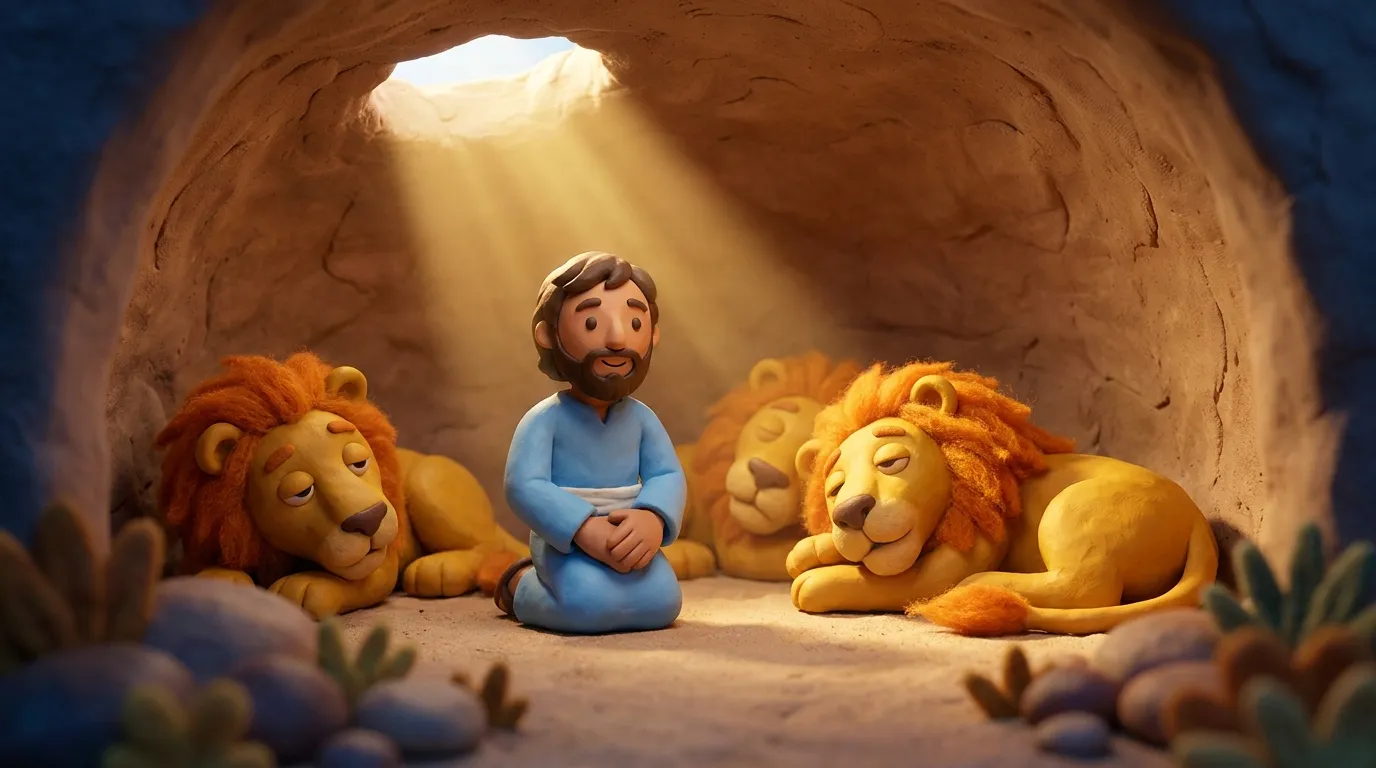 Sleepy lions lie around Daniel as he prays.
Nehemiah (book of Nehemiah) was cupbearer to the king of Persia (Nehemiah 1:11) when he got permission to go home and rebuild Jerusalem (Nehemiah 2:5). Enemies were furious that the gaps were closing (Nehemiah 4:7), so every builder worked with a sword strapped at his side (Nehemiah 4:18). The wall went up in fifty-two days (Nehemiah 6:15).
Jesus and his disciples
Matthew, Mark, Luke and John tell the life of Jesus. Britannica places his birth around 6-4 BC and his death around AD 30.
John the Baptist (Matthew 3, John 1) wore a garment of camel’s hair with a leather belt and lived on locusts and wild honey (Matthew 3:4). When Jesus came to the Jordan to be baptized, John tried to stop him: “I need to be baptized by You, and do You come to me?” (Matthew 3:13-14). He pointed to Jesus as “the Lamb of God, who takes away the sin of the world” (John 1:29), and when his own disciples told him everyone was going to Jesus, he said, “He must increase; I must decrease” (John 3:26-30).
Jesus (the four Gospels) was born in Bethlehem and laid in a manger because there was no room for them in the inn (Luke 2:7). He taught the crowds, including in the Sermon on the Mount (Matthew 5-7), healed the sick and called Lazarus out of the tomb (John 11:43). He was crucified (Luke 23:33), and on the third day the women heard at the empty tomb, “He is not here; He has risen!” (Luke 24:6).
Peter (the Gospels and Acts) was a fisherman named Simon when Jesus said, “Come, follow Me,” and promised, “I will make you fishers of men” (Matthew 4:19). One morning, after a whole night of empty nets, Jesus told him to put out into deep water and try again:
“Master,” Simon replied, “we have worked hard all night without catching anything. But because You say so, I will let down the nets.”
(Luke 5:5, Berean Standard Bible)
The catch was so big the nets began to tear (Luke 5:6). Peter walked on the water (Matthew 14:29) and declared, “You are the Christ, the Son of the living God” (Matthew 16:16). On the night of Jesus’ arrest he denied him three times (Luke 22:61). After the resurrection, Jesus asked him three times, “Do you love Me?” and gave him his job back: feeding his sheep (John 21:17).
 Peter hauls in a net so full it’s starting to tear.
John (Gospel of John) is traditionally identified as “the one whom Jesus loved” (John 13:23). From the cross, Jesus put his mother in John’s care (John 19:26), and the Gospel says this disciple is the one who wrote it down (John 21:24).
Thomas (John 14, 20) asked Jesus a question many readers share: “Lord,” said Thomas, “we do not know where You are going, so how can we know the way?” (John 14:5). After the resurrection, he said he wouldn’t believe unless he touched the nail marks (John 20:25). Eight days later, Jesus told him, “Put your finger here and look at My hands” (John 20:27), and Thomas answered, “My Lord and my God!” (John 20:28).
“Today salvation has come to this house,” Jesus said at the home of Zacchaeus (Luke 19:9), a rich chief tax collector in Jericho (Luke 19:2). Zacchaeus was too short to see over the crowd, so he’d climbed a sycamore tree, and Jesus looked up and called him down by name (Luke 19:4-5). Before the day was over, he promised to give half his possessions to the poor and pay back four times over anyone he’d cheated (Luke 19:8).
The early church
The book of Acts follows the apostles as the message about Jesus spreads from Jerusalem “to the ends of the earth” (Acts 1:8).
Peter steps up as a leader. On the day of Pentecost he preached to the crowd in Jerusalem (Acts 2:14), and about three thousand people were baptized that day (Acts 2:41).
Stephen (Acts 6-7) was one of the men picked to run the daily food distribution for widows (Acts 6:1-5). When he was stoned, the witnesses laid their garments at the feet of a young man named Saul (Acts 7:58), the same Saul you’ll meet in the next paragraph. Stephen fell on his knees and cried out, “Lord, do not hold this sin against them” (Acts 7:60).
Paul (Acts 9-28 and his letters) was still called Saul, and still hunting down Christians, when a light from heaven flashed around him near Damascus. He fell to the ground and heard, “Saul, Saul, why do you persecute Me?” (Acts 9:3-4). For three days he couldn’t see (Acts 9:9), until a disciple named Ananias laid his hands on him and “something like scales” fell from his eyes (Acts 9:17-18). The Lord had already called him “My chosen instrument to carry My name before the Gentiles” (Acts 9:15). When a plot to kill him was uncovered, his disciples lowered him in a basket through a window in the city wall (Acts 9:23-25). He went on to travel from city to city and write letters to the churches, and near the end he wrote, “I have fought the good fight, I have finished the race, I have kept the faith” (2 Timothy 4:7).
Women of the Bible
Two books of the Bible, Ruth and Esther, carry women’s names, and women move the story at many key moments, from Miriam’s song by the sea to the empty tomb. The best known are listed below in story order, each with her chapter.
Eve (Genesis 2-3) was named by Adam “because she would be the mother of all the living” (Genesis 3:20).
Sarah (Genesis 18, 21) was listening at the entrance to the tent when the LORD promised Abraham a son, and she laughed to herself at the idea at her age (Genesis 18:10-12). The answer came as a question: “Is anything too difficult for the LORD?” (Genesis 18:14). Isaac was born at the very time God had promised (Genesis 21:2), and Sarah said, “God has made me laugh, and everyone who hears of this will laugh with me” (Genesis 21:6).
Miriam (Exodus 15), the prophetess and Aaron’s sister, picked up a tambourine after Israel crossed the sea, and all the women followed her, dancing and singing to the LORD (Exodus 15:20-21).
Deborah (Judges 4-5) was a prophetess who judged Israel. She sat under the Palm of Deborah, and the Israelites came up to her to settle their disputes (Judges 4:4-5). After the victory, she and Barak sang the song in Judges 5.
Ruth (book of Ruth) was a widow from Moab. When her mother-in-law Naomi headed home to Bethlehem, Ruth refused to leave her: “For wherever you go, I will go, and wherever you live, I will live; your people will be my people, and your God will be my God” (Ruth 1:16). They reached Bethlehem at the beginning of the barley harvest (Ruth 1:22). Ruth went out to glean, and she happened to end up in the field of Boaz, a relative of the family (Ruth 2:3). The two married, and their son Obed was the grandfather of King David (Ruth 4:17).
 Ruth gleans barley behind the harvesters.
Hannah (1 Samuel 1-2) prayed at the house of the LORD with her lips moving and no sound coming out, and the priest Eli thought she was drunk (1 Samuel 1:13). She had no children and had vowed that a son would be dedicated to the LORD all the days of his life (1 Samuel 1:11). She named the baby Samuel, “Because I have asked for him from the LORD” (1 Samuel 1:20), and her prayer of thanks begins, “My heart rejoices in the LORD” (1 Samuel 2:1). Every year she made him a little robe and brought it when she came for the annual sacrifice (1 Samuel 2:19).
Esther (book of Esther), a Jewish woman, was made queen of Persia (Esther 2:17). When a decree threatened her people, her cousin Mordecai sent her this message:
For if you remain silent at this time, relief and deliverance for the Jews will arise from another place, but you and your father’s house will perish. And who knows if perhaps you have come to the kingdom for such a time as this?
(Esther 4:14, Berean Standard Bible)
Esther asked the Jews of Susa to fast for her for three days (Esther 4:16), then went to King Xerxes without being summoned. He held out the gold scepter to her (Esther 5:2), and her people were saved.
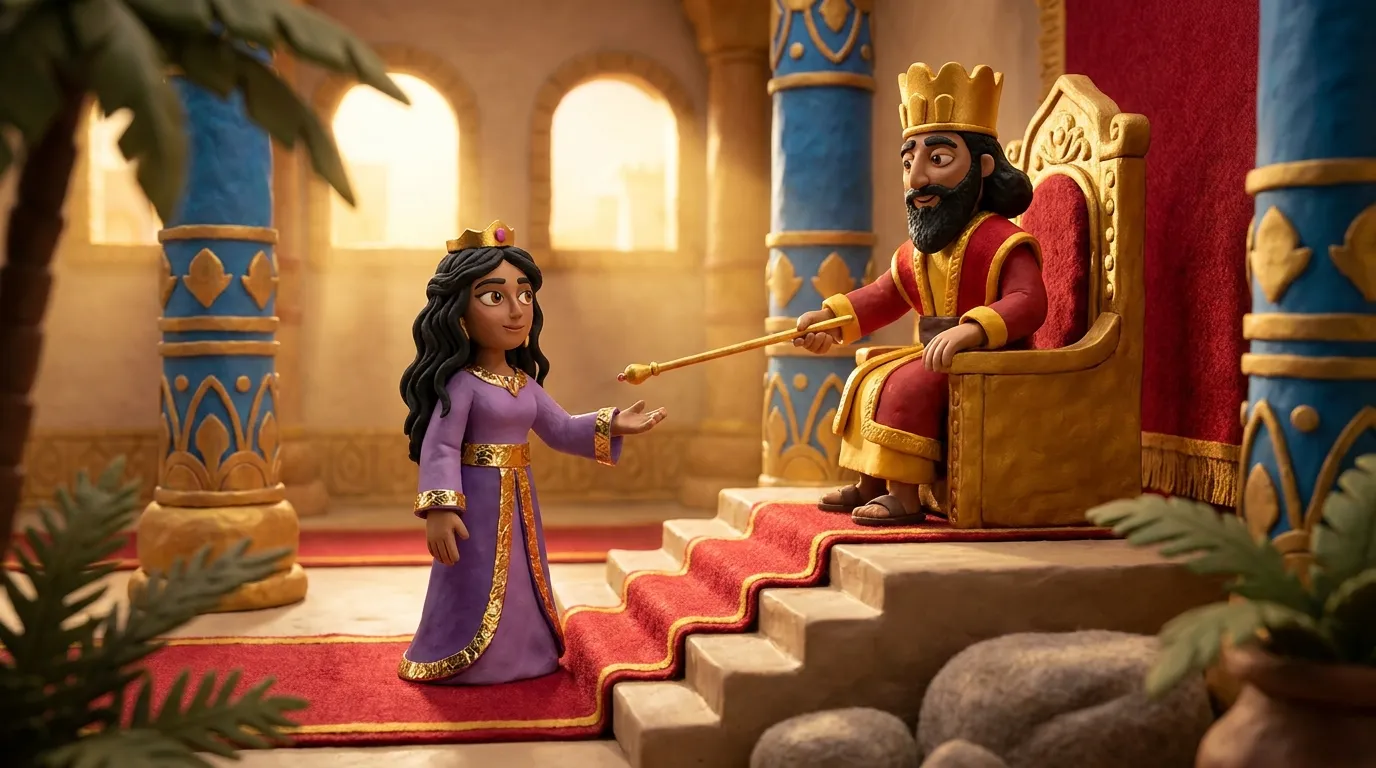 King Xerxes holds out the gold scepter to Esther.
Mary (Luke 1-2, John 2 and 19, Acts 1), the mother of Jesus, was at a wedding in Cana when the wine ran out. She told Jesus, then said to the servants, “Do whatever He tells you” (John 2:1-5). Years earlier she had answered the angel, “I am the Lord’s servant,” and added, “May it happen to me according to your word” (Luke 1:38). She stood near the cross (John 19:25) and prayed with the disciples after Jesus returned to heaven (Acts 1:14).
Martha and Mary of Bethany (Luke 10, John 11-12) were Lazarus’s sisters. On one visit Mary sat at Jesus’ feet listening to him, and when Martha asked for help with the preparations, Jesus said Mary had “chosen the good portion” (Luke 10:39-42). When Lazarus got sick, the sisters sent word to Jesus (John 11:3), and Martha told him, “I believe that You are the Christ, the Son of God” (John 11:27). At a dinner in their house, Martha served, and Mary anointed Jesus’ feet with about a pint of pure nard until the whole house was filled with the fragrance (John 12:2-3).
Mary Magdalene (Luke 8, John 20) stayed by the cross (John 19:25) and was the first to see Jesus after he rose. He called her by name (John 20:16), and she ran to tell the disciples (John 20:18).
Lydia (Acts 16) was a dealer in purple cloth from Thyatira who heard Paul preach in Philippi (Acts 16:12-14). She was baptized with her household and insisted that the missionaries stay at her house (Acts 16:15).
Priscilla (Acts 18) and her husband Aquila were tentmakers who took Paul in and worked alongside him (Acts 18:2-3). Years later Paul wrote that the couple had risked their lives for him (Romans 16:3-4; he calls her Prisca there). In Ephesus, the two of them took a gifted preacher named Apollos aside and explained the way of God to him more accurately (Acts 18:24-26).
Dorcas, also called Tabitha (Acts 9), was a disciple in Joppa who “was always occupied with works of kindness and charity” (Acts 9:36). When she died, the widows stood around Peter in the upper room, weeping and showing him the tunics and other clothing she had made (Acts 9:39). Peter sent them all out, knelt down and prayed, and said, “Tabitha, get up!” She opened her eyes and sat up (Acts 9:40).
Learning the names as a family
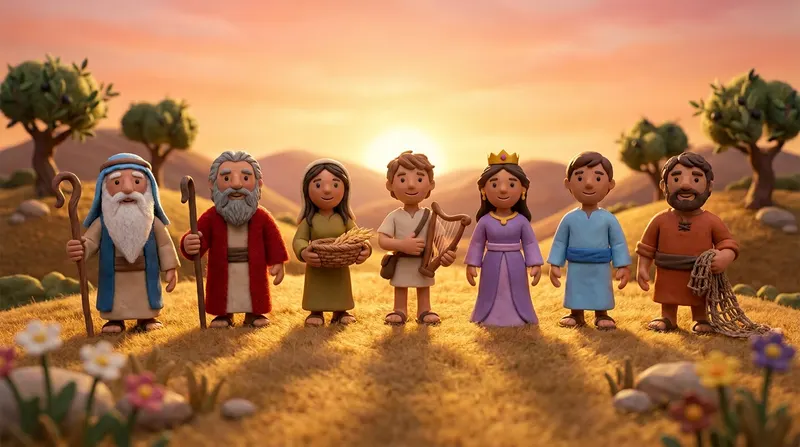
At home, give each person one object a child can draw: stars for Abraham, a staff for Moses, barley for Ruth, a harp for David, lions for Daniel, a net for Peter. Tape the drawings to the fridge and see who can name the owner of each one. For where each book sits in the Bible, the Bible from Genesis to Revelation maps the order of the books against the order of events, and Bible stories for kids retells these lives for little ones.
On a car ride, try riddles in first person: “I wore a robe of many colors, and my brothers sold me. Who am I?” Whoever gets it first gives the next clue. If you’d rather have cards in hand, there’s a printable set in the Who am I Bible game.
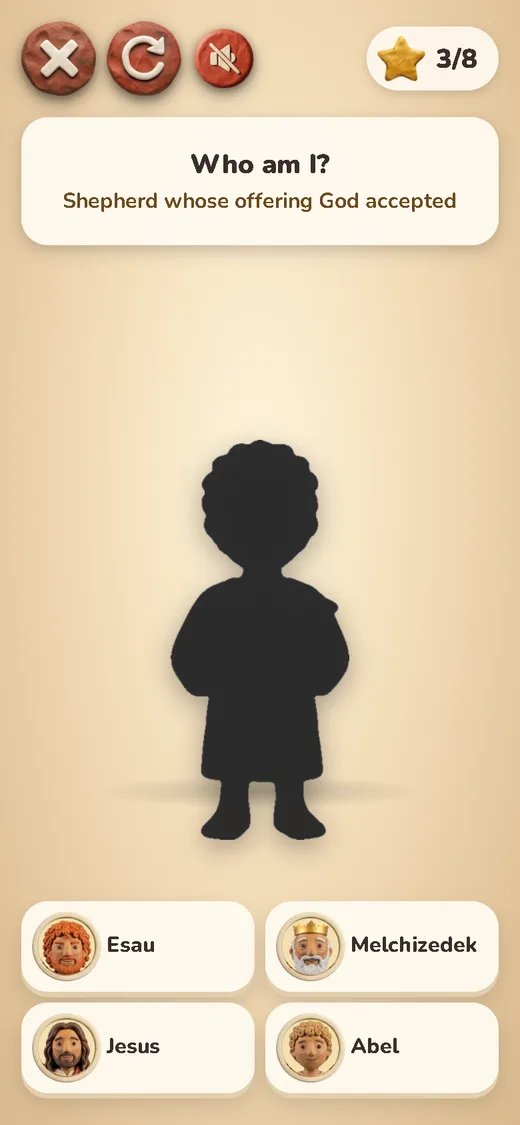 In Who am I?, the clue sits above the character’s silhouette.
Kids who like guessing games can try Who am I? in our app. In the silhouette rounds, players see a dark figure and a one-line clue, then tap the face they think fits; a wrong tap brings a new clue, and a right one fills the silhouette with color. In the screenshot, “Shepherd whose offering God accepted” points to Abel, whose offering the LORD looked on with favor (Genesis 4:4).
How this guide was made. Our editorial team wrote this guide and last reviewed it in October 2026. Every reference was checked against the Berean Standard Bible, and every quote is copied from it. The three approximate dates (the united kingdom, the exile and the life of Jesus) come from Encyclopaedia Britannica. The one-line lessons are our own reading of the chapters listed.
Sources
- Encyclopaedia Britannica, Israel (Biblical Kingdom) (united monarchy dated to about 1020-922 BC)
- Encyclopaedia Britannica, Babylonian Captivity (conquest of Judah in 598/7 and 587/6 BC, end of the exile in 538 BC)
- Encyclopaedia Britannica, Jesus (born around 6-4 BC, died around AD 30)
- Berean Standard Bible, text from bible.helloao.org (Genesis 15 and the other chapters quoted)
Frequently asked questions
Who are the most important characters in the Bible?
If you only learn a handful, start with Abraham, who receives God's promise; Moses, who leads Israel out of Egypt; and David, the shepherd God made king. Ruth, Esther and Mary, the mother of Jesus, are the best-known women. Elijah, Isaiah and Daniel stand out among the prophets, Peter and Paul lead the church in Acts, and at the center of the whole Bible is Jesus.
How many people are named in the Bible?
Nobody has settled on one number. Noah's wife and Pharaoh's daughter never get names, while one name can belong to several people (two of the twelve apostles are called James, Matthew 10:2-3), so every total depends on how the counter handles those cases. For following the big story, the 30 people in this guide's table cover the essentials.
What is the order of the main Bible characters?
In story order: Adam and Eve, Noah, the patriarchs (Abraham, Isaac, Jacob and Joseph), Moses and Joshua, the judges (Deborah, Gideon, Samson and Samuel), the kings (Saul, David and Solomon), the prophets and the exile (Elijah, Isaiah, Jeremiah, Daniel, Esther and Nehemiah), Jesus and his disciples, and the early church (Peter, Stephen and Paul). The books of the Bible aren't always arranged in that same timeline.
Who are the most famous women in the Bible?
Eve, Sarah, Miriam, Deborah, Ruth, Hannah, Esther, Mary the mother of Jesus, Martha and Mary of Bethany, Mary Magdalene, Lydia, Priscilla and Dorcas. The women's section of this guide gives the chapter for each one and what her story teaches.
Who is the first character in the Bible?
Adam is the first human being. Genesis 2:7 says God formed him from the dust of the ground and breathed the breath of life into his nostrils. Eve gets her name in Genesis 3:20.
Keep reading
-
How to memorize Bible verses: a 7-day method
How to memorize a Bible verse: break it into chunks, test yourself, use first letters and review on spaced days. A 7-day plan with Joshua 1:9. Read article -

How to memorize the Bible: chapters and books
A plan to memorize whole chapters and books of the Bible: where to start, minutes a day, a 12-week table and review boxes that keep Scripture for years. Read article -

Fruit of the Spirit for kids: a family guide
Love, joy, peace and the rest of Galatians 5:22-23 in words kids understand, with family moments, games for busy evenings and a four-week verse plan. Read article