
Bible stories for kids: 10 to read aloud
Ten short Bible stories for kids ages 2 to 7, written to read aloud in 4 to 10 minutes, with suggested ages, questions to talk about and a bedtime routine.
 The Terra Sinai team 16 min read
Download the printable storybooks
Three Bible stories as PDFs: a cover with your child's name, one scene per page with its verse, and a last page to draw on. Laid out on A4; on US Letter, choose "Fit to page".
-
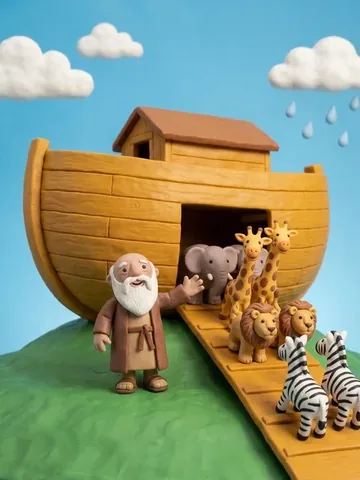
Noah Builds the Ark
Genesis 6–7 PDF · 9 pages
Download PDF Noah Builds the Ark -
David and the Giant
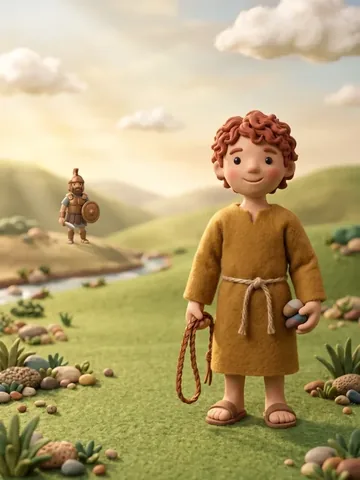
1 Samuel 17 PDF · 10 pages
Download PDF David and the Giant -
Jonah and the Big Fish
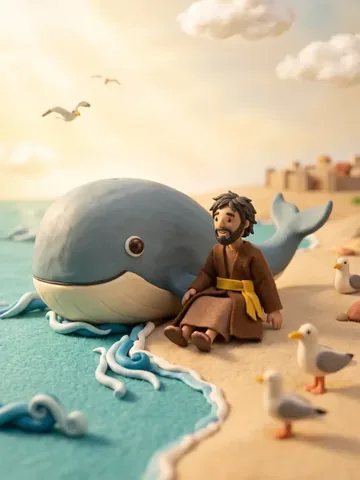
Jonah 1–4 PDF · 10 pages
Download PDF Jonah and the Big Fish
In this article (8)
Ten Bible stories, Creation through the Good Samaritan, make a good starter set for kids between 2 and 7. Each one comes with an age, the passage, a read-aloud retelling, a one-line lesson and a question to talk about afterward. The gentlest ones, Creation and the first Christmas, work from age 2, and Joseph’s story, with its prison and famine, is one we’d save for about 6.
Does your child go to Sunday school? Ask what they remember about a story before you tell it, and you’ll hear which details stuck. It also helps to read the chapter yourself the night before, so you’re ready for questions and know which parts you’re leaving for later. Our guide on how to teach the Bible to kids picks up where this list stops, with a plan for each age.
Quick-reference chart
Treat the ages as a starting point. A sensitive 6-year-old may still want to wait on the lions’ den, so adjust as you go.
| Story | Where to find it | Age | One-line lesson |
|---|---|---|---|
| Creation | Genesis 1:1 to 2:3 | 2 and up | God made light, land, animals and people, and called it all good |
| Noah’s ark | Genesis 6 to 9 | 3 and up | God keeps His promises, and the rainbow is the sign |
| Abraham and the stars | Genesis 12, 15 and 21 | 4 and up | Abraham trusted God’s promise, and Isaac was born |
| Joseph and the colorful coat | Genesis 37 to 50 | 6 and up | God was with Joseph in the pit, the prison and the palace |
| Moses and the sea | Exodus 14 | 5 and up | The LORD fought for His people at the sea |
| David and Goliath | 1 Samuel 17 | 5 and up | David trusted the LORD to win the battle |
| Daniel and the lions | Daniel 6 | 4 and up | Daniel prayed as usual, and God shut the lions’ mouths |
| Jonah and the big fish | Jonah 1 to 4 | 4 and up | God cared about Nineveh and gave the city a chance to turn around |
| The birth of Jesus | Luke 2:1-20 | 2 and up | God’s Son was born in Bethlehem, and shepherds were His first visitors |
| The Good Samaritan | Luke 10:25-37 | 5 and up | The one who stopped to help was the true neighbor |
How to tell a Bible story out loud
The CDC notes that by age 5, many children can pay attention for 5 to 10 minutes during activities like story time. So we aim for 7 to 10 minutes at ages 5 to 7 and 4 to 6 minutes for younger kids, and Joseph’s long story is split over two nights.
A quick read of the chapter after dinner is all the prep you need. Pick the two or three scenes you’ll tell, and leave the rest for another night.
With 2- and 3-year-olds, the American Academy of Pediatrics (AAP) suggests repeating an important word your child says and waiting for them to add to it. With 5-year-olds, stop right before the stone leaves David’s sling and ask the CDC’s question: “What do you think will happen next?”
Give two or three characters a voice of their own, like a sailor yelling over the storm, Pharaoh barking orders or a shepherd calling to his sheep. Before long, your child may start doing the voices with you.
Short Bible stories for kids, one by one
1. The creation of the world
Passage: Genesis 1:1 to 2:3; ages 2 and up
Tell it like this: before anything else, there was only dark water. God said, “Let there be light!” and light came; He called it day. Day after day He kept speaking. A sky stretched over the water. The seas pulled back, and dry land came up, green with grass and fruit trees. The sun, the moon and the stars took their places. Fish filled the sea, and birds filled the air. Then cows, lions and creeping bugs walked the land, and last of all God made a man and a woman in His own image. He looked at everything He’d made, and it was very good. On the seventh day, He rested.
And God looked upon all that He had made, and indeed, it was very good.
(Genesis 1:31, Berean Standard Bible)
The lesson: God made light, land, animals and people, and called it all good. Ask: “Which day would you have wanted to watch?” With toddlers, make the animal sounds for day six together: moo, roar, and a tiny buzz for the bugs.
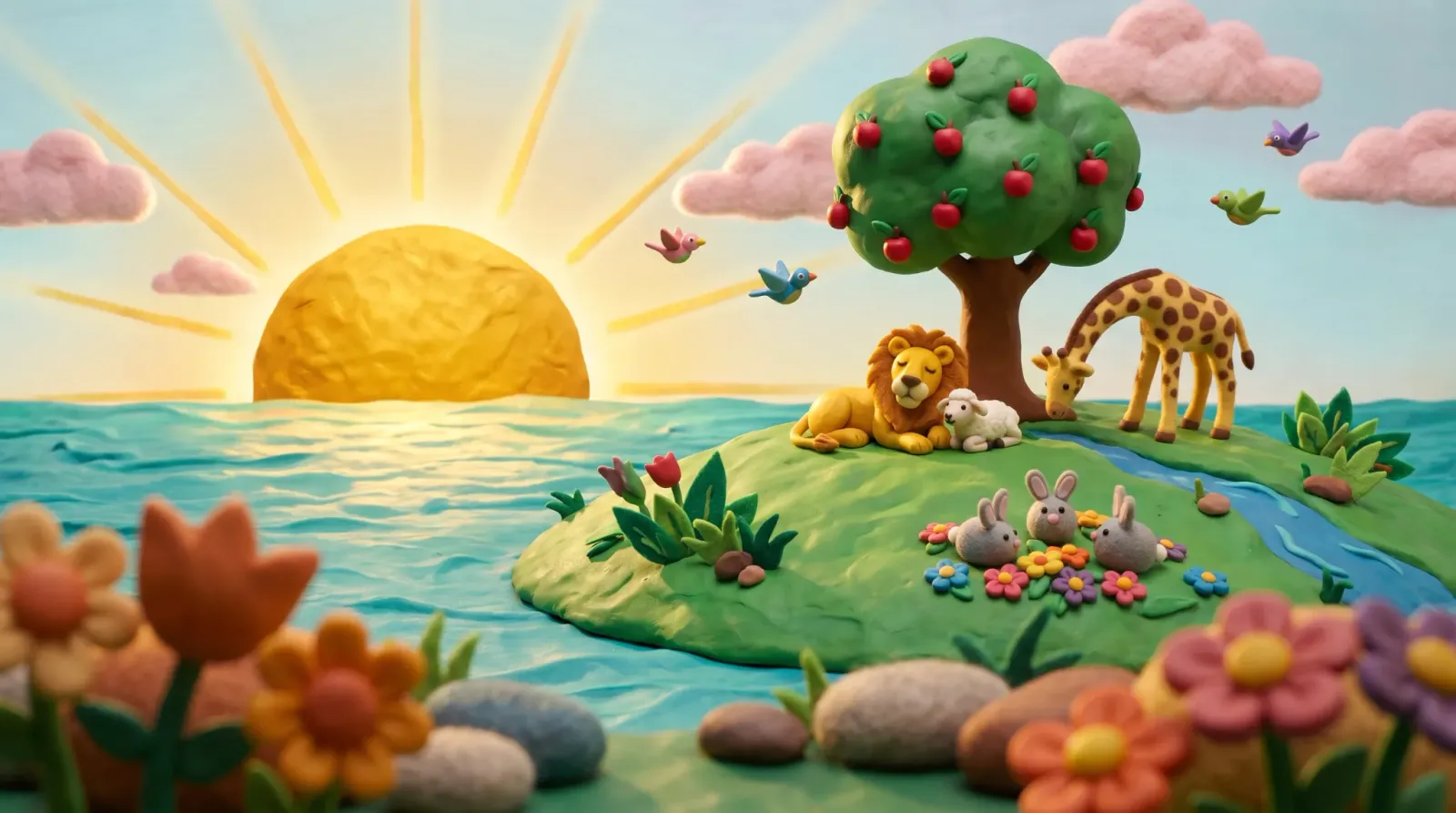 Sunrise over a clay island, where a lion rests beside a lamb.
2. Noah’s ark
Passage: Genesis 6 to 9; ages 3 and up
Tell it like this: the earth had filled up with violence, and God told Noah to build an ark, a wooden boat about 450 feet long (Genesis 6:13-15). Noah did everything God told him. Into the ark went Noah, his wife, their three sons and their sons’ wives, along with pairs of every kind of animal. Then the rain came, forty days and forty nights of it, and the ark rose and floated on the water. Months later, Noah opened a window and sent out a dove. The first time, it found nowhere to land and flew back. A week later it returned with a fresh olive leaf in its beak. When the ground was dry, everyone came out, and God set a rainbow in the clouds as the sign of His promise.
I have set My rainbow in the clouds, and it will be a sign of the covenant between Me and the earth.
(Genesis 9:13, Berean Standard Bible)
The lesson: God keeps His promises, and the rainbow is the sign. Ask: “What sounds do you think the ark made at night?” On a sunny afternoon, stand with your back to the sun and spray the garden hose into a fine mist until a small rainbow shows up, then ask your child what God promised Noah. If they ask about the people outside the ark, Genesis 6:11 gives a short, true answer: the earth was full of violence.
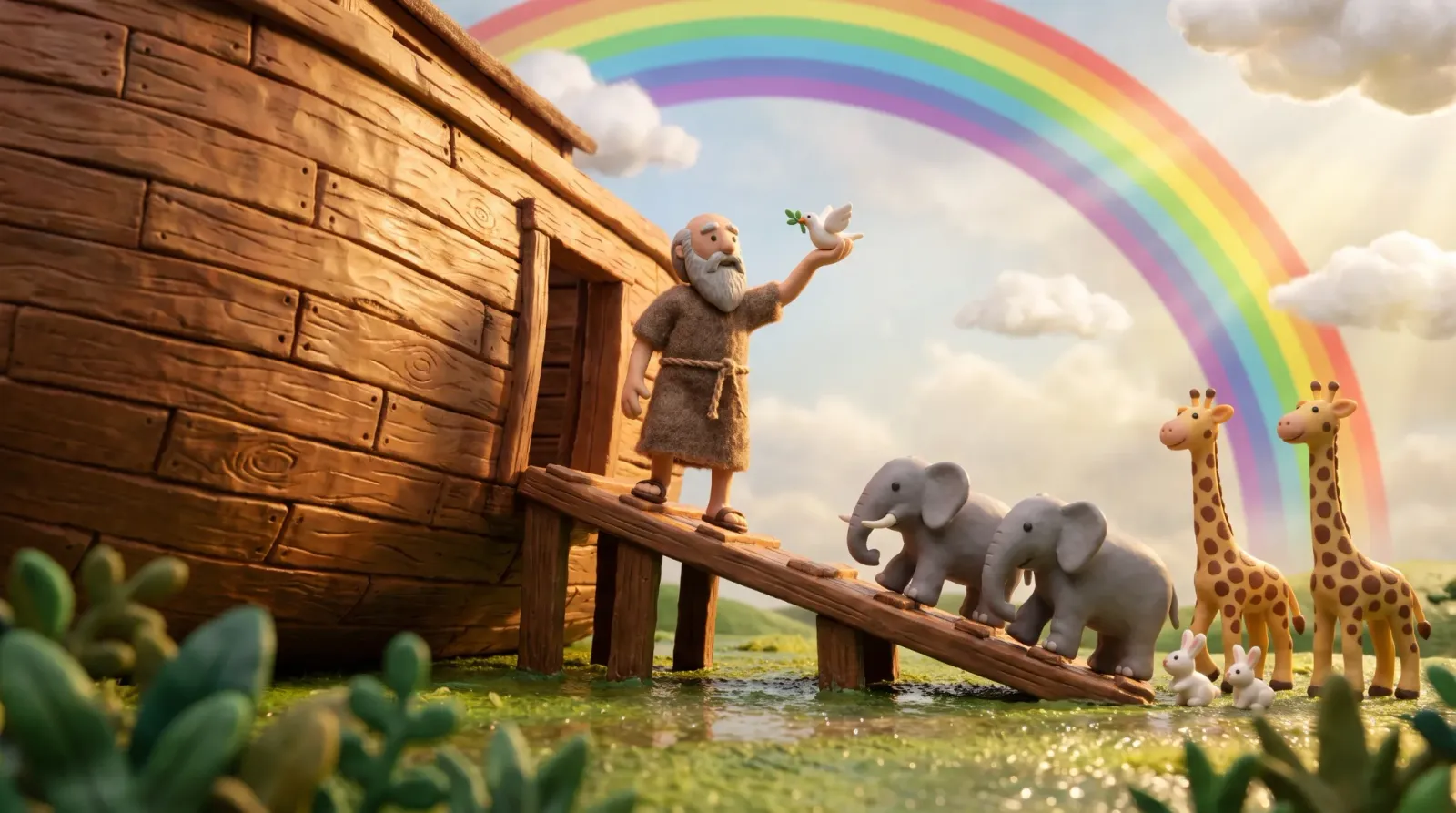 Elephants and giraffes step onto the grass under a rainbow.
3. Abraham and the stars
Passage: Genesis 12:1-3, 15:5 and 21:1-6; ages 4 and up
Tell it like this: God told Abraham to leave Haran for a land He would show him, and Abraham went. He took Sarah, his nephew Lot, their servants, the tents and all the flocks. Years went by in the new land, and still there was no baby, though God had promised Abraham a family. One night God brought him outside the tent. “Look up at the sky,” God said. “Count the stars, if you are able. Your family will be like that.” Abraham believed Him. When Abraham was 100 years old, Isaac was born, and Sarah laughed for joy.
The lesson: Abraham trusted God’s promise, and Isaac was born. Ask: “What’s something you had to wait a long time for?” Turn off the lights and let your child “make stars” on the ceiling with a flashlight while you tell the night scene.
4. Joseph and the colorful coat
Passage: Genesis 37 to 50; ages 6 and up
Tell it like this: Joseph’s brothers noticed the coat first: a robe of many colors, a gift from their father, Jacob, who loved Joseph more than his other sons (Genesis 37:3). Then Joseph told them a dream in which their bundles of grain bowed down to his, and they hated him even more. One day out in the fields they threw him into an empty pit and then sold him to traders headed for Egypt. There, Potiphar’s wife lied about him, and Joseph landed in prison, but the LORD was with him (Genesis 39:21). Years later, Pharaoh dreamed of seven fat cows and seven skinny ones, and Joseph explained the dream: seven good harvests, then seven years of famine. Pharaoh put Joseph in charge of storing grain. When the famine reached Canaan, his brothers came to Egypt to buy food, and Joseph knew them at once (Genesis 42:7). At last he told them, “I am Joseph, your brother,” and wept as he hugged them.
As for you, what you intended against me for evil, God intended for good, in order to accomplish a day like this—to preserve the lives of many people.
(Genesis 50:20, Berean Standard Bible)
The lesson: God was with Joseph in the pit, the prison and the palace. Ask: “Joseph cried when he saw his brothers. What do you think he was feeling?” The story runs from Genesis 37 to 50, so tell it as a two-night serial, and at the end of night one let your child guess what the brothers will do when they meet Joseph again.
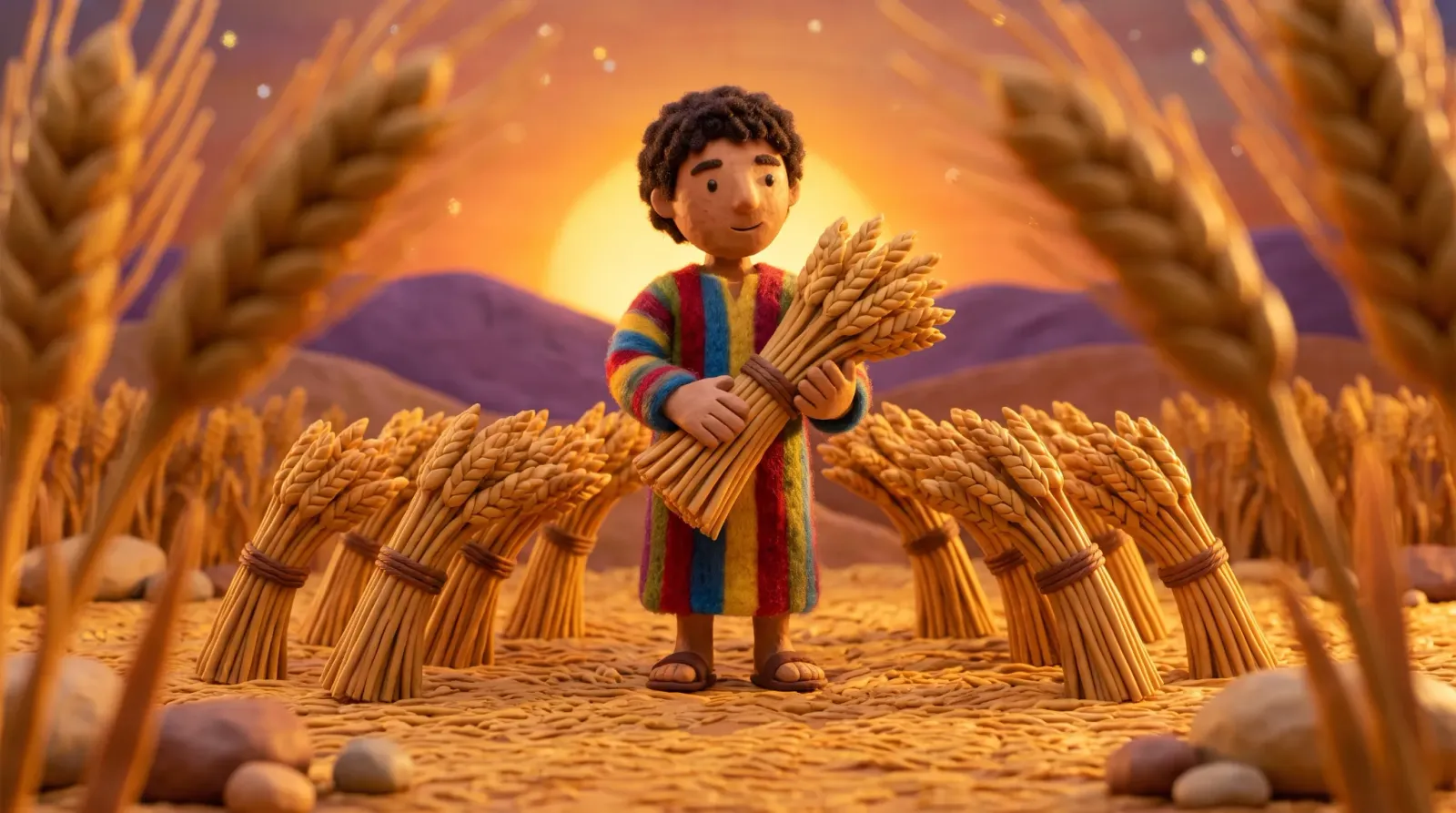 Joseph’s dream in clay, in a field of golden wheat.
5. Moses and the sea
Passage: Exodus 14; ages 5 and up
Tell it like this: Pharaoh finally let God’s people leave Egypt, and Moses led them out to camp beside the sea. Then Pharaoh changed his mind and sent his chariots after them, hundreds of them. The people were terrified. “Don’t be afraid,” Moses told them. “The LORD will fight for you.” God told Moses to stretch out his staff over the water, and all night a strong east wind drove the sea back. The whole crowd, with their flocks and herds, walked through on dry ground, with a wall of water on each side.
(…) and the Israelites went through the sea on dry ground, with walls of water on their right and on their left.
(Exodus 14:22, Berean Standard Bible)
The lesson: The LORD fought for His people at the sea. Ask: “What would you have packed to leave Egypt?” Blow across a bowl of water with your child and watch the ripples, then talk about how strong the wind in Exodus 14 must have been.
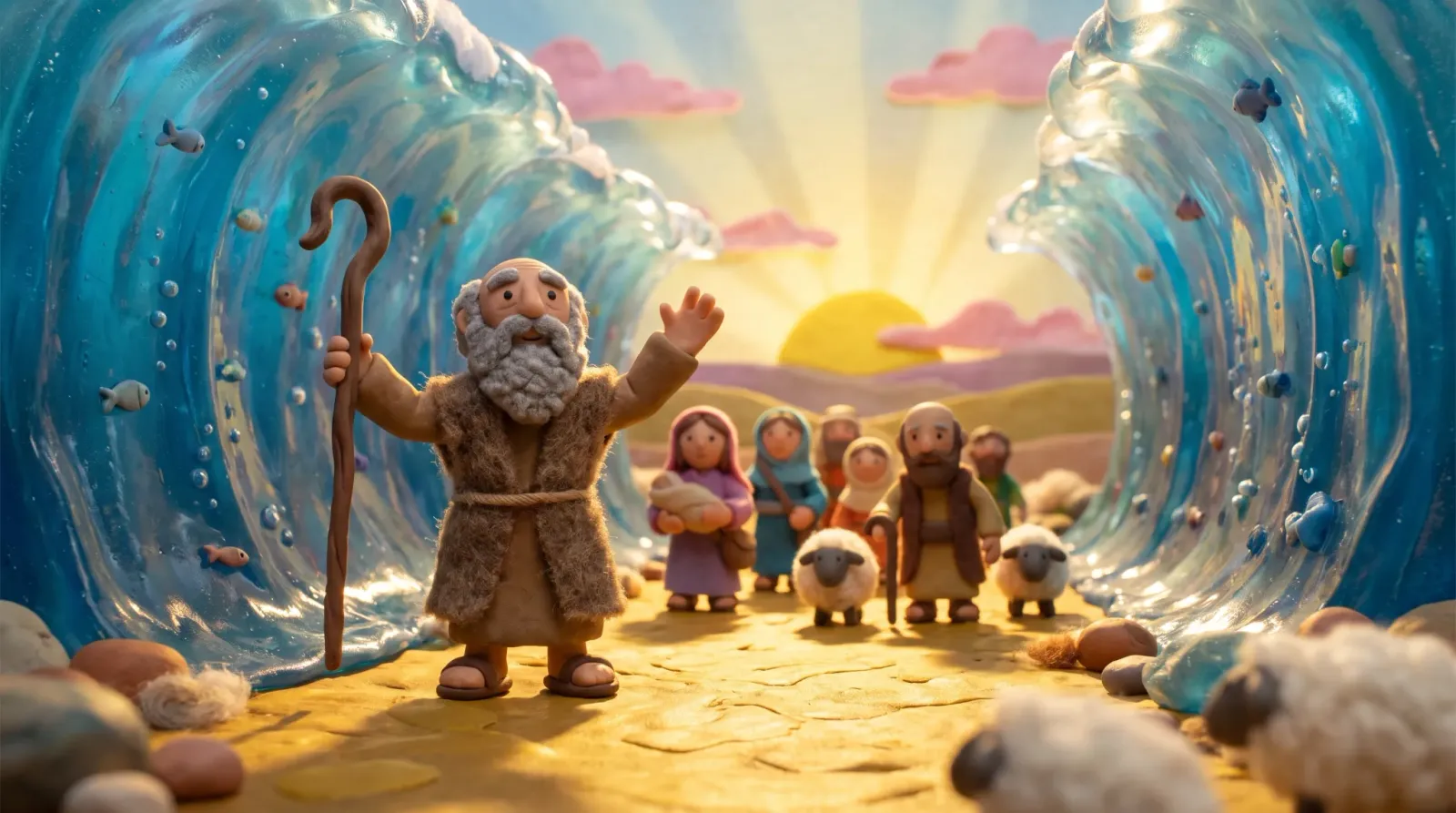 Moses raises both arms as the first families start across.
6. David and Goliath
Passage: 1 Samuel 17; ages 5 and up
Tell it like this: for forty days, a Philistine giant named Goliath came out every morning and every evening and dared Israel’s army to send someone to fight him. Nobody went. Then young David showed up with food from home: roasted grain and bread for his brothers, and cheese for their commander. When he heard Goliath mocking God’s people, David told King Saul he’d go. He’d already fought off a lion and a bear to protect his sheep, he said. Saul gave him his own armor, but David wasn’t used to it, so he took it off. He picked five smooth stones from the stream, dropped them in his shepherd’s bag and walked out with his sling. “I come against you in the name of the LORD,” he told Goliath. David swung, the stone flew, and the giant fell face down.
But David said to the Philistine, “You come against me with sword and spear and javelin, but I come against you in the name of the LORD of Hosts, the God of the armies of Israel, whom you have defied (…)
(1 Samuel 17:45, Berean Standard Bible)
The lesson: David trusted the LORD to win the battle. Ask: “Why do you think David picked five stones?” Stop at the moment Goliath falls; the battle scenes after that can wait for an older reader. For the full story, see David and Goliath for kids.
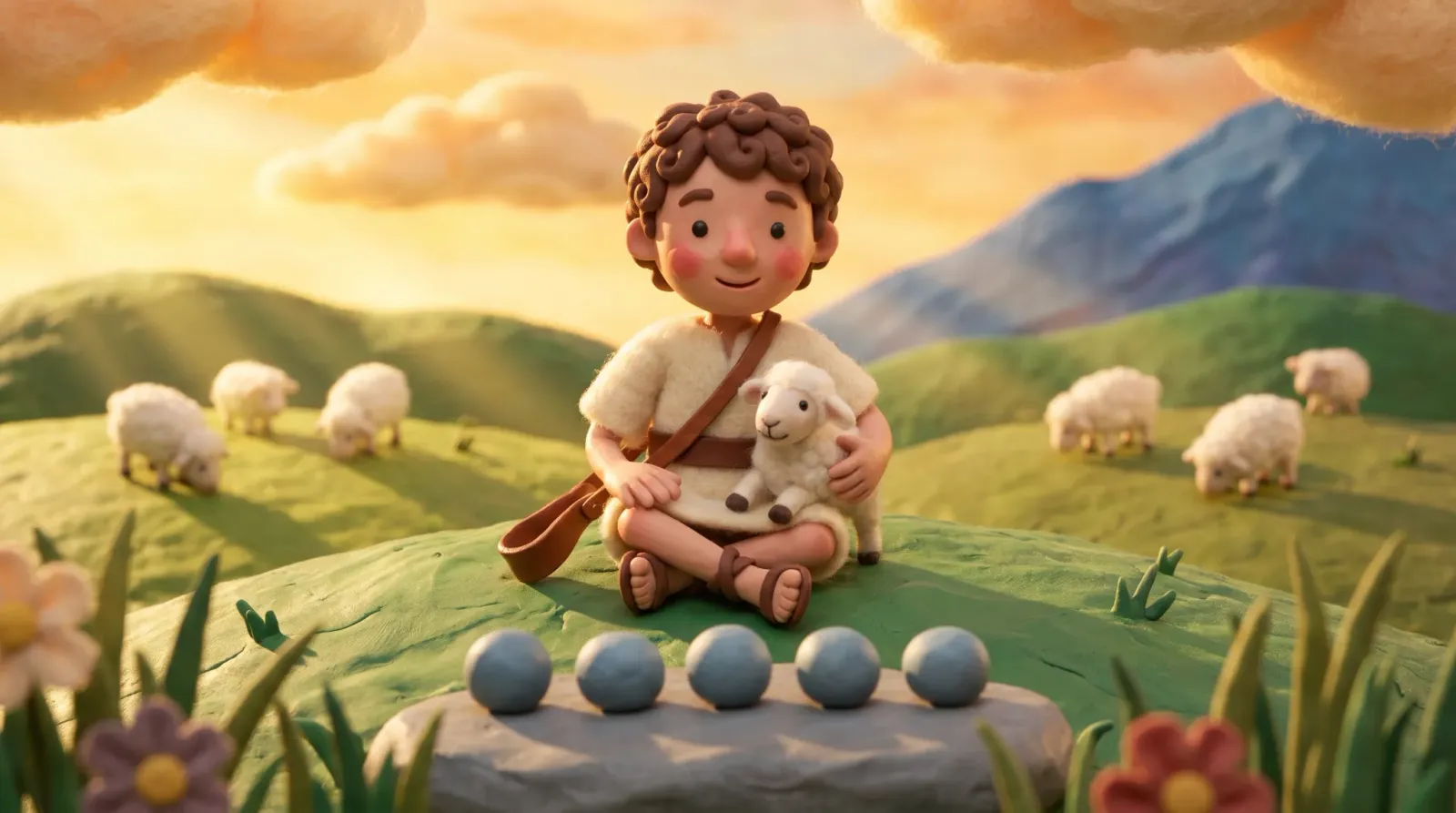 Before the battle: David the shepherd, with the five stones he’ll take to the valley.
7. Daniel and the lions
Passage: Daniel 6; ages 4 and up
Tell it like this: the other officials in King Darius’s court were jealous of Daniel, because the king planned to put him over the whole kingdom. They couldn’t find anything wrong with his work, so they went after his prayers. They talked the king into signing a law: for thirty days, anyone who prayed to any god or man except the king would be thrown into the lions’ den. Daniel went home, opened his upstairs windows toward Jerusalem and knelt to pray, three times a day, as he always had. The officials reported him. The king was upset, but his own law couldn’t be changed, so Daniel went into the den, and a stone was set over the opening. The king couldn’t eat or sleep. At dawn he hurried to the den and called out, “Daniel, has your God been able to save you?”
My God sent His angel and shut the mouths of the lions. They have not hurt me (…)
(Daniel 6:22, Berean Standard Bible)
The lesson: Daniel prayed as usual, and God shut the lions’ mouths. Ask: “What would you say to God if you were Daniel, praying by that window?” Make your last picture the king, so glad that he orders Daniel lifted out of the den right away (Daniel 6:23).
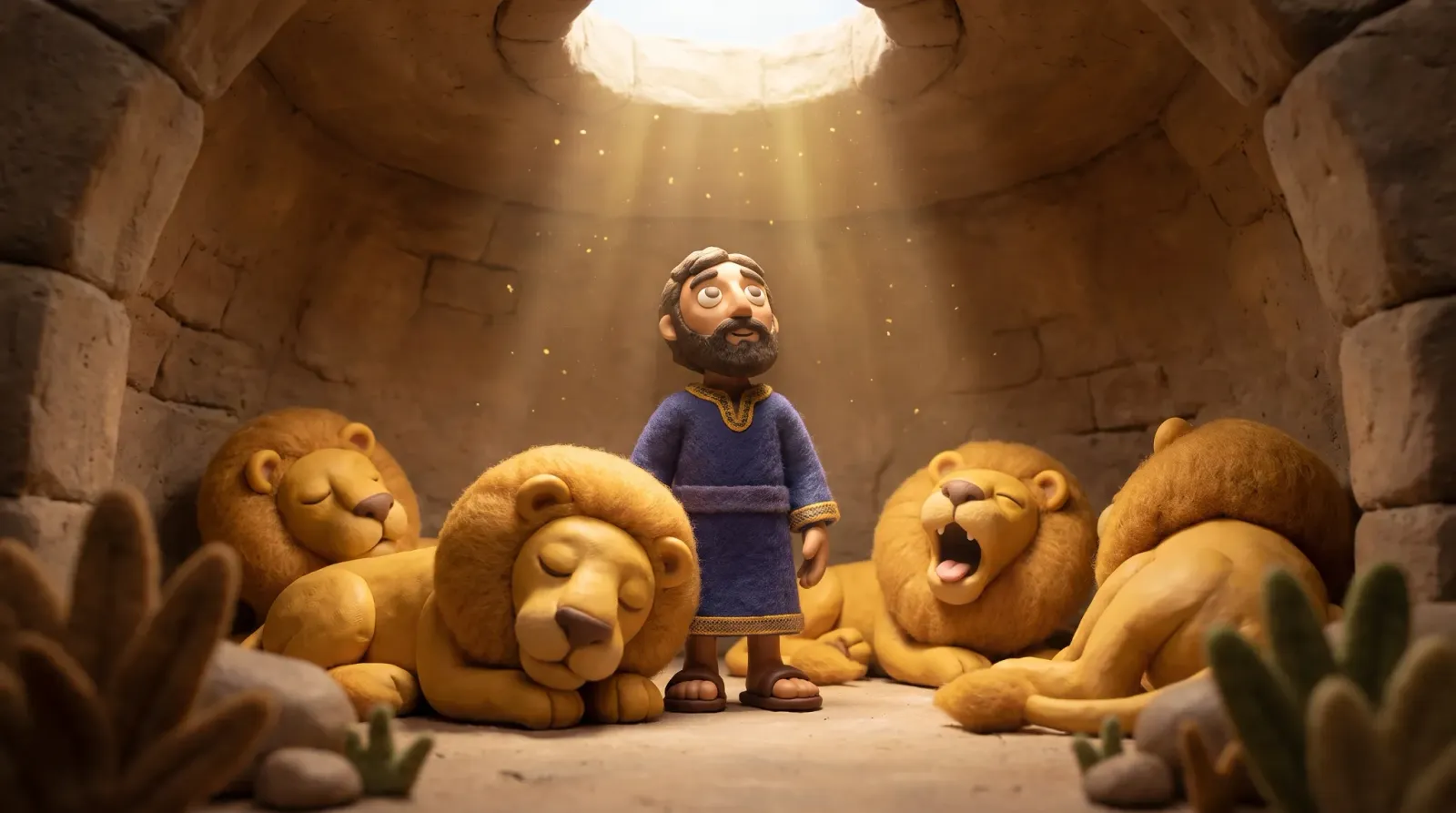 Morning light reaches the den, where the lions never touched Daniel.
8. Jonah and the big fish
Passage: Jonah 1 to 4; ages 4 and up
Tell it like this: God told Jonah to go to the big city of Nineveh and warn the people about their wickedness. Jonah ran. He found a ship at Joppa sailing for Tarshish, far in the other direction, paid the fare and went below deck to sleep. Out at sea, God sent a storm so wild that the sailors threw the cargo overboard. When they woke Jonah, he knew the storm was his fault and told them to throw him into the sea. The moment they did, the water went calm. A huge fish, sent by God, swallowed him, and for three days and nights Jonah prayed inside it. Then the fish spit him out on dry land. This time Jonah went to Nineveh, and the whole city, from the king down, turned from its evil ways. God saw it and spared the city.
The lesson: God cared about Nineveh and gave the city a chance to turn around. Ask: “Why do you think Jonah ran away?” For the swallow, wrap your arms around your child like a giant fish. Older kids can hear how the book ends, with God’s question to Jonah about caring for the more than 120,000 people of Nineveh (Jonah 4:11).
9. The birth of Jesus
Passage: Luke 2:1-20 (the wise men from the East are in Matthew 2:1-12); ages 2 and up
Tell it like this: Caesar Augustus wanted to count everyone in his empire, so each person had to go to his own town to register. Joseph came from the family line of King David, so he went from Nazareth to David’s town, Bethlehem, and Mary went with him, though she was expecting a baby soon. While they were there, Jesus was born. Mary wrapped Him in cloths and laid Him in a manger, a feeding trough for animals, because there was no room for them at the inn. Out in the fields that night, shepherds were watching their sheep when an angel appeared and the glory of the Lord shone around them. “Don’t be afraid,” the angel said. “I bring you good news of great joy.” Then the sky filled with angels praising God, and the shepherds hurried into Bethlehem and found the baby, just as they’d been told.
Today in the city of David a Savior has been born to you. He is Christ the Lord! And this will be a sign to you: You will find a baby wrapped in swaddling cloths and lying in a manger.
(Luke 2:11-12, Berean Standard Bible)
The lesson: God’s Son was born in Bethlehem, and shepherds were His first visitors. Ask: “If you were one of the shepherds, who would you run to tell first?” If your church puts on a Christmas pageant, tell the story the week before and let your child pick which part they’d want to play, shepherd, angel or sheep. With little ones, a stuffed lamb and a doll wrapped in a dish towel are all the props you need.
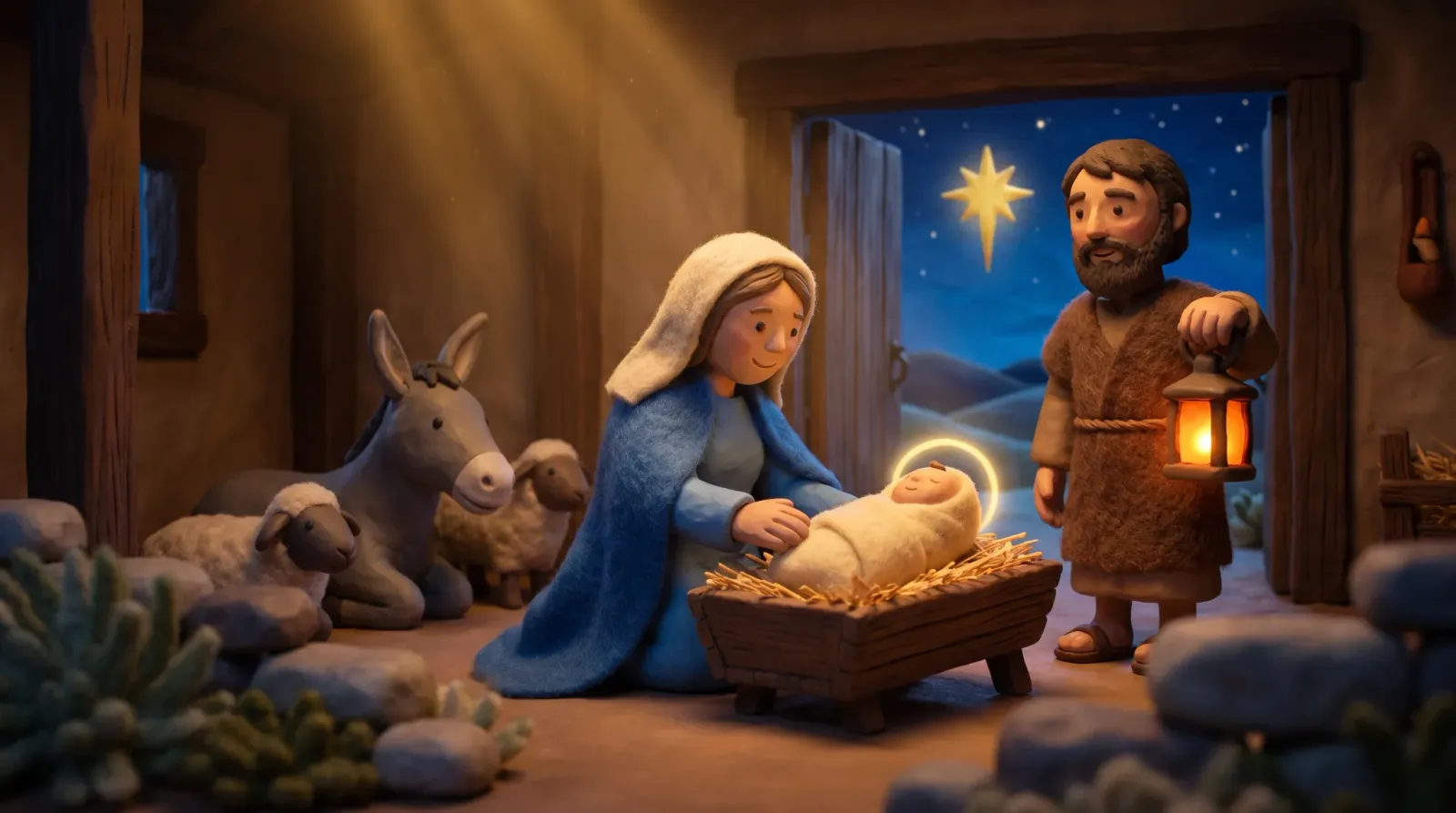 A clay manger scene, the way the shepherds might have found it.
10. The Good Samaritan
Passage: Luke 10:25-37; ages 5 and up
Tell it like this: an expert in the law wanted to know who counted as his neighbor, so Jesus told him a story. A man walking the road from Jerusalem down to Jericho was attacked by robbers and left half dead. A priest came by, saw him and kept to the far side of the road. So did a Levite. Then a Samaritan traveler came along, and he stopped. He poured oil and wine on the man’s wounds and bandaged them, lifted him onto his own animal and brought him to an inn. The next day he paid the innkeeper two silver coins and promised to cover anything more on his way back. “Which of the three was a neighbor to the man?” Jesus asked. The expert answered, “The one who showed him mercy.”
Then Jesus told him, “Go and do likewise.”
(Luke 10:37, Berean Standard Bible)
The lesson: the one who stopped to help was the true neighbor. Ask: “What did the Samaritan do first when he stopped?” Older kids may wonder why Jesus made a Samaritan the hero. Just one chapter earlier, a Samaritan village had refused to welcome Jesus (Luke 9:52-53), so His listeners wouldn’t have expected one to be the good guy. For more stories Jesus told, see parables of Jesus for kids.
Bedtime Bible stories for kids
For lights-out, we reach for Creation, Abraham, Noah or the first Christmas, since each one closes on a quiet picture.
Here’s an evening that fits the CDC and AAP advice. An hour or two before bed, the tablet goes on the kitchen charger, since the CDC suggests no screens in that stretch. Then come bath, PJs and teeth, and 10 to 20 minutes of books with the TV off, the AAP’s suggestion, which is where the Bible story fits. Keep the pillow fights for the afternoon; the AAP warns that rough play right before bed can leave a child too wound up to sleep. For the whole day, the CDC puts a 5-year-old’s sleep at 10 to 13 hours, naps included.
Printable Bible storybooks
If you’d rather use paper, three stories from this list are printable PDF storybooks. Each one has a cover with a line for your child’s name, a page for each scene with a big illustration and the Bible text with its reference, and a last page with what the story teaches and a box where your child can draw a favorite part. They’re laid out on A4, so on US Letter paper choose “Fit to page” when you print.
Print in color if you can, and staple the pages along the side. The text comes in short sentences, each with its verse reference, so you can check it against your own Bible.
Picture books for telling Bible stories
Our app, Terra Sinai, has a shelf of clay-illustrated picture books, such as God Makes the World and The Rainbow Promise, with short lines of Scripture on every page. It’s a daytime pick, for after school or a long drive, which keeps screens out of the hour or two before bed, as the CDC suggests, and leaves a paper picture book for the nightstand.
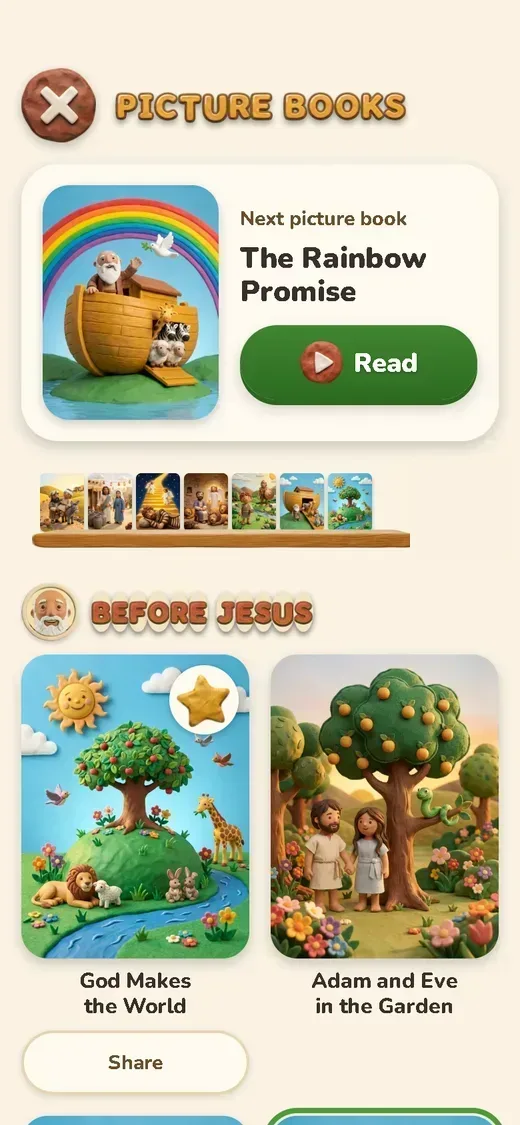 Top of the shelf: The Rainbow Promise, with the ark and a dove under a rainbow.
The big orange arrow in the bottom corner turns the page, so your child can run the page-turning. Each page puts a few lines of Scripture in large type above the reference, which makes it easy to find the whole passage in your own Bible later.
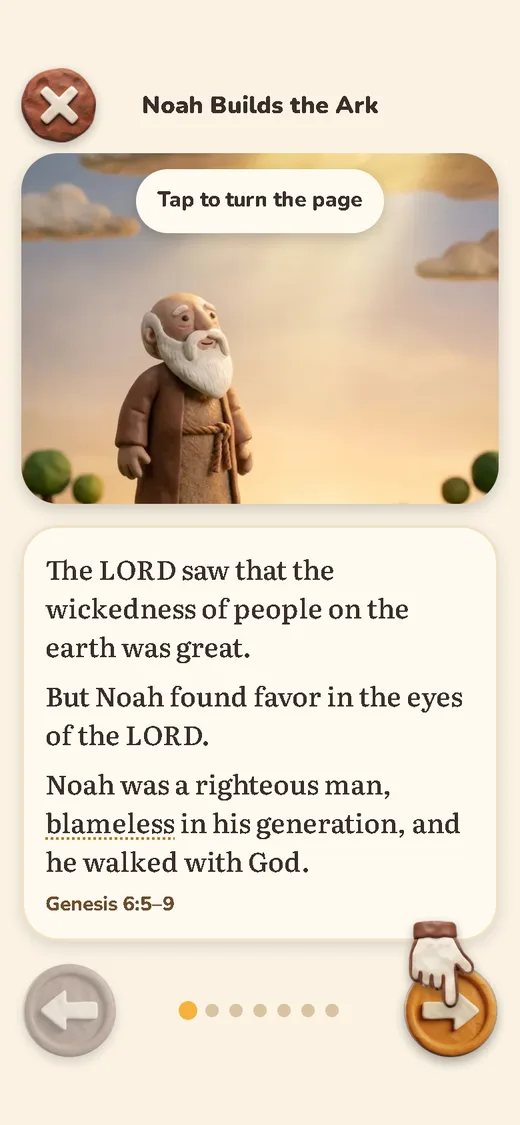 Page one of Noah Builds the Ark, with the tap-to-turn tip above Noah.
Save our Bible games for families for a weekend afternoon. On school days, the audio Bible for families works on the drive, and Bible verses for kids gives you a short verse to learn together, sorted by theme.
How we made this guide. The site’s editorial team wrote the retellings from the chapters themselves and checked everything in October 2026. Verses come from the Berean Standard Bible. The ages and minute counts are our own suggestions; the notes on attention, sleep and reading aloud come from the CDC and AAP pages listed below. If something about your child’s sleep or development worries you, ask your pediatrician.
Sources
- CDC, Milestones by 5 Years (updated May 2026)
- American Academy of Pediatrics, How to Share Books with Children 2 and 3 Years Old, HealthyChildren.org (2021)
- American Academy of Pediatrics, Toddler Won’t Go to Sleep? 7 Tips to Help End Bedtime Battles, HealthyChildren.org (updated October 2026)
Frequently asked questions
Which Bible stories should I tell young children?
Start with Creation and the baby in the manger, both fine from age 2. Around 3 or 4, add Noah's ark, Abraham and the stars, Daniel and the lions and Jonah. Save Joseph and David and Goliath for 5 or 6, when a child can handle a longer story with a tense moment in it.
Which Bible stories work for bedtime?
Any of the four with a quiet ending: Creation, Abraham and the stars, Noah's ark (end with the rainbow) or the first Christmas. Daniel and Jonah are daytime stories for a worried child, since lions and a storm can stick around after lights-out.
How do I tell David and Goliath or the flood without scaring my child?
Tell the flood from inside the ark, with Noah's family and the animals safe and dry, and stop David's story when Goliath falls. If your child presses for more, Genesis 6:11 has a one-line answer about the flood: the earth was full of violence. The battle in 1 Samuel 17 can wait until they read it themselves.
How long should a Bible story for kids last?
Short enough to finish before attention runs out. By age 5, the CDC says, many kids can stay with an activity like story time for 5 to 10 minutes. We aim for 4 to 6 minutes with 2- to 4-year-olds and 7 to 10 with 5- to 7-year-olds, and we split long ones, like Joseph's fourteen chapters, across two nights.
Is it okay to tell the same story every night?
Go for it. The American Academy of Pediatrics notes that 2-year-olds love sharing the same book over and over.
Keep reading
-
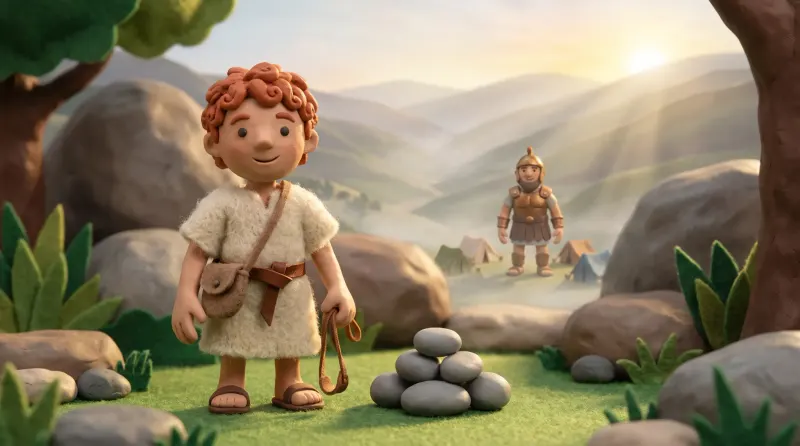
David and Goliath Bible story for kids
The David and Goliath Bible story for kids, told in short read-aloud scenes with no graphic violence, plus family questions and a five-stone activity. Read article -
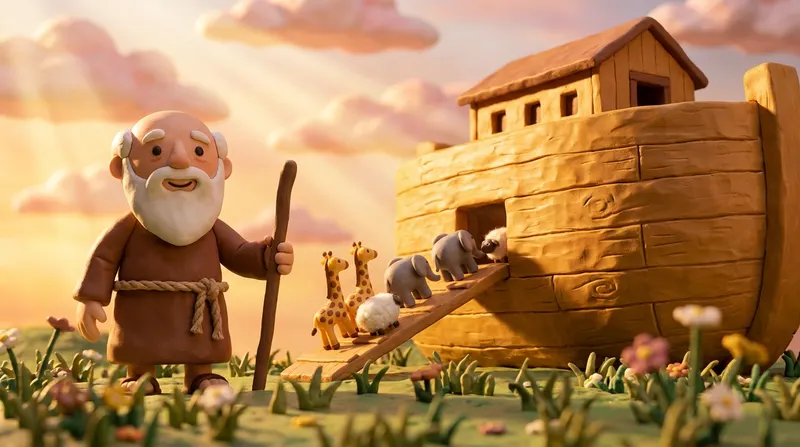
Noah's ark story for kids, scene by scene
Noah's ark for kids in read-aloud scenes from Genesis 6-9, every number checked in the text, questions by age, crafts and how to tell the flood gently. Read article -
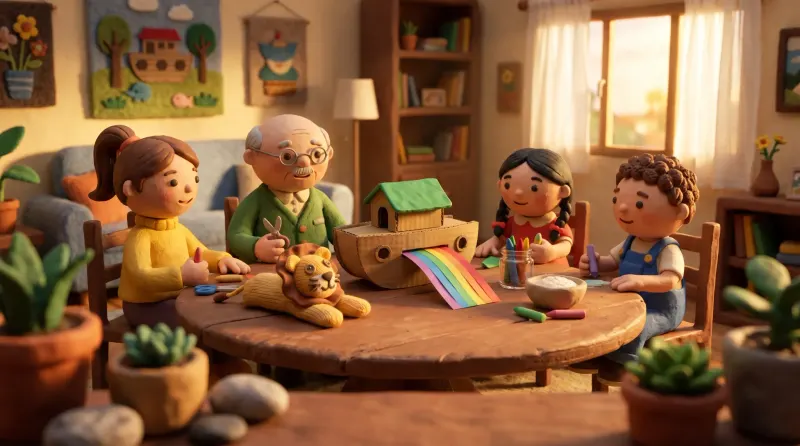
Bible activities for kids: 15 easy ideas
15 Bible activities for kids to do at home with everyday supplies: crafts, puppets, a recipe, a treasure hunt, music and painting, with ages and steps. Read article