
Parables of Jesus for kids: 8 stories to tell
Parables of Jesus for kids: the sower, the lost sheep, the prodigal son and more, each with the Bible passage, a short retelling and a question to ask.
 The Terra Sinai team 14 min read
In this article (15)
Parables of Jesus for kids are easy to tell at bedtime, because Jesus built them out of pictures a preschooler can see with their eyes closed: a seed in the dirt, a sheep that wandered off, a house still standing after a storm. We picked eight. For each one you’ll get a read-aloud retelling, the lesson in a line, a question for the dinner table and the passage to look up.
You can read the retellings straight off the page, since they’re written in short sentences. Still, skim the passage in your own Bible first. Kids have a way of asking about the one detail a retelling skips. For more Bible stories sorted by age, see Bible stories for kids.
What is a parable?
When Jesus wanted people to understand what God is like, He often told a story about something they handled every day: seed, sheep, coins, a field, a house. That’s a parable, a short everyday story set next to a truth about God so the familiar picture explains the less familiar one. Britannica traces the word to the Greek parabolē, “placing side by side” or “to compare.”
Your kids have everyday scenes that line up with these stories too. They’ve watched the tide flatten a sandcastle, counted heads after hide-and-seek to make sure nobody’s still in the closet, and dug through the couch cushions for a missing remote.
These eight are short enough to tell in one sitting, and each one ends in a way a young child can follow. There are plenty more in the Gospels for later.
The parables at a glance
Ages are our own suggestions, and you know your child’s pace.
| Parable | Where to find it | Age | One-line lesson |
|---|---|---|---|
| The sower | Matthew 13:1-9 and 18-23 | 4 and up | God’s word grows in someone who listens with an open heart |
| The mustard seed | Matthew 13:31-32 | 3 and up | What God starts small can grow very big |
| The wise and foolish builders | Matthew 7:24-27 | 3 and up | Whoever hears Jesus and does what He says has a steady life |
| The lost sheep | Luke 15:1-7 | 3 and up | God looks for each person, and each one matters |
| The lost coin | Luke 15:8-10 | 4 and up | God is glad when someone comes back to Him |
| The prodigal son | Luke 15:11-32 | 5 and up | God is always ready to welcome home anyone who comes back |
| The good Samaritan | Luke 10:25-37 | 5 and up | Being a neighbor means helping whoever needs it |
| The hidden treasure | Matthew 13:44-46 | 6 and up | The kingdom of heaven is a treasure worth everything we have |
1. The sower
Passage: Matthew 13:1-9, with Jesus’ explanation in 13:18-23 (also in Luke 8:4-15).
Tell it like this: a farmer went out to plant, swinging his arm and scattering seed across the field. A few seeds bounced onto the packed-down path, and birds swooped in and gobbled them up. Some landed where rock sat just under a thin layer of dirt. Those sprouted in a hurry, then wilted the first hot day, since their roots had nowhere to go. Some dropped into a thorny patch, and the thorns crowded them out. The rest fell into good soil and came up strong, with a harvest of a hundred, sixty or thirty times what was planted. Later, when His disciples asked what the story meant, Jesus told them the seed stands for God’s word, and the different kinds of ground are the different ways people hear it.
Still other seed fell on good soil and produced a crop—a hundredfold, sixtyfold, or thirtyfold.
(Matthew 13:8, Berean Standard Bible)
The lesson, in one sentence: God’s word grows in someone who listens with an open heart.
Try this: set out four paper cups. Fill one with packed dirt from the yard for the path, one with gravel and a sprinkle of soil, one with soil and a few twigs poked in for thorns, and one with potting soil. Drop two dry beans in each, water them all the same and line them up on a sunny windowsill. Over the next week, ask, “Which cup looks like a heart that’s really listening? What helps it grow?”
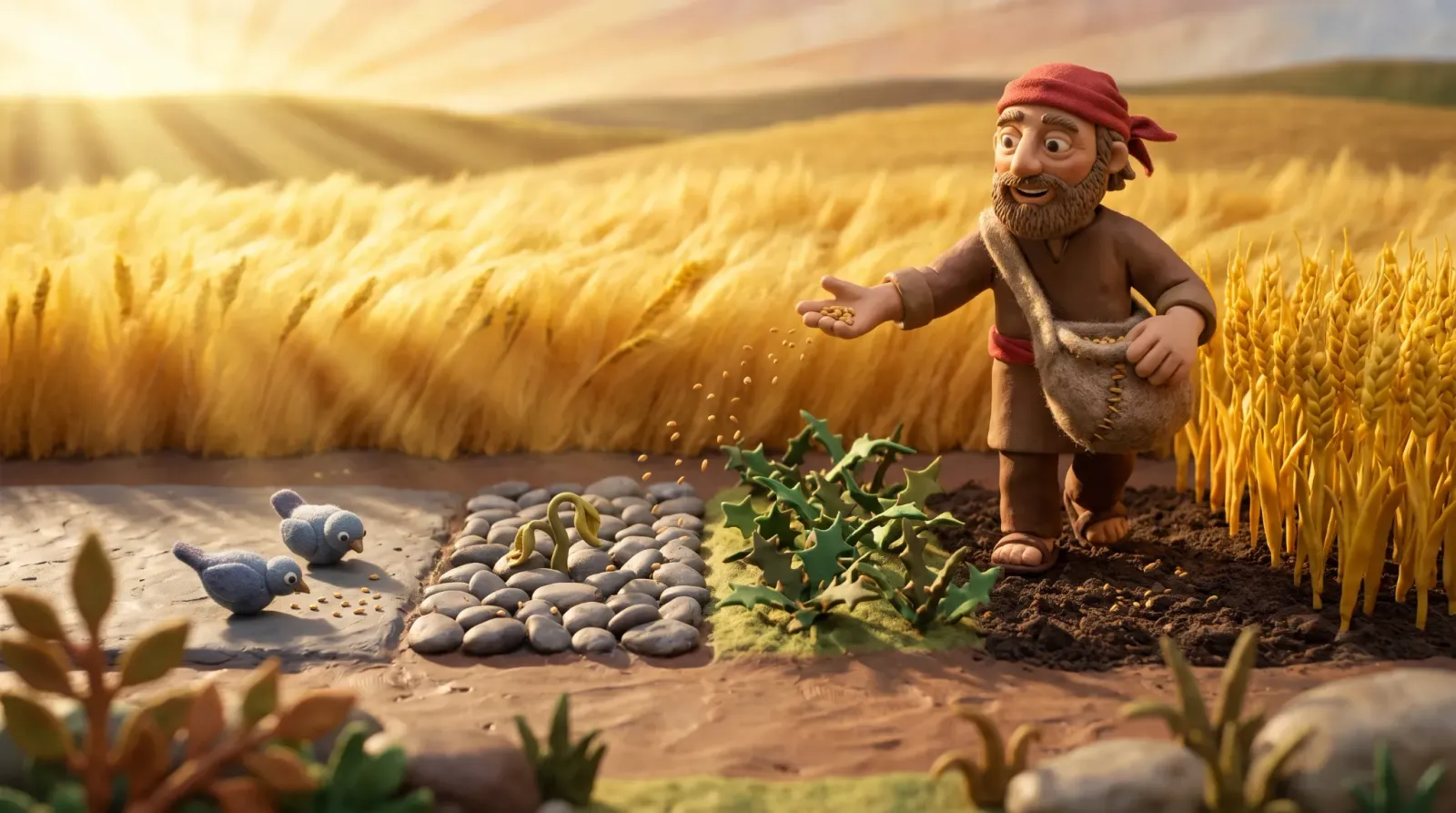 Joel scatters seed at sunrise, with tall wheat already growing in the dark soil.
2. The mustard seed
Passage: Matthew 13:31-32 (also in Mark 4:30-32 and Luke 13:18-19).
Tell it like this: Jesus said the kingdom of heaven is like a mustard seed. Pinch your finger and thumb together until there’s almost no gap; a mustard seed would fit in that sliver. A man planted one of those specks in his field. The shoot that came up kept climbing, week after week, until it stood taller than every other plant in the garden, as big as a small tree. Birds flew in and built their nests in its branches.
Although it is the smallest of all seeds, yet it grows into the largest of garden plants and becomes a tree, so that the birds of the air come and nest in its branches.
(Matthew 13:32, Berean Standard Bible)
The lesson, in one sentence: what God starts small can grow very big.
To talk about: if your spice rack has mustard seed or poppy seed, tip a single seed into your child’s palm and let them study it for a moment. Then ask, “Who could use a small kindness from you this week? What would it be?”
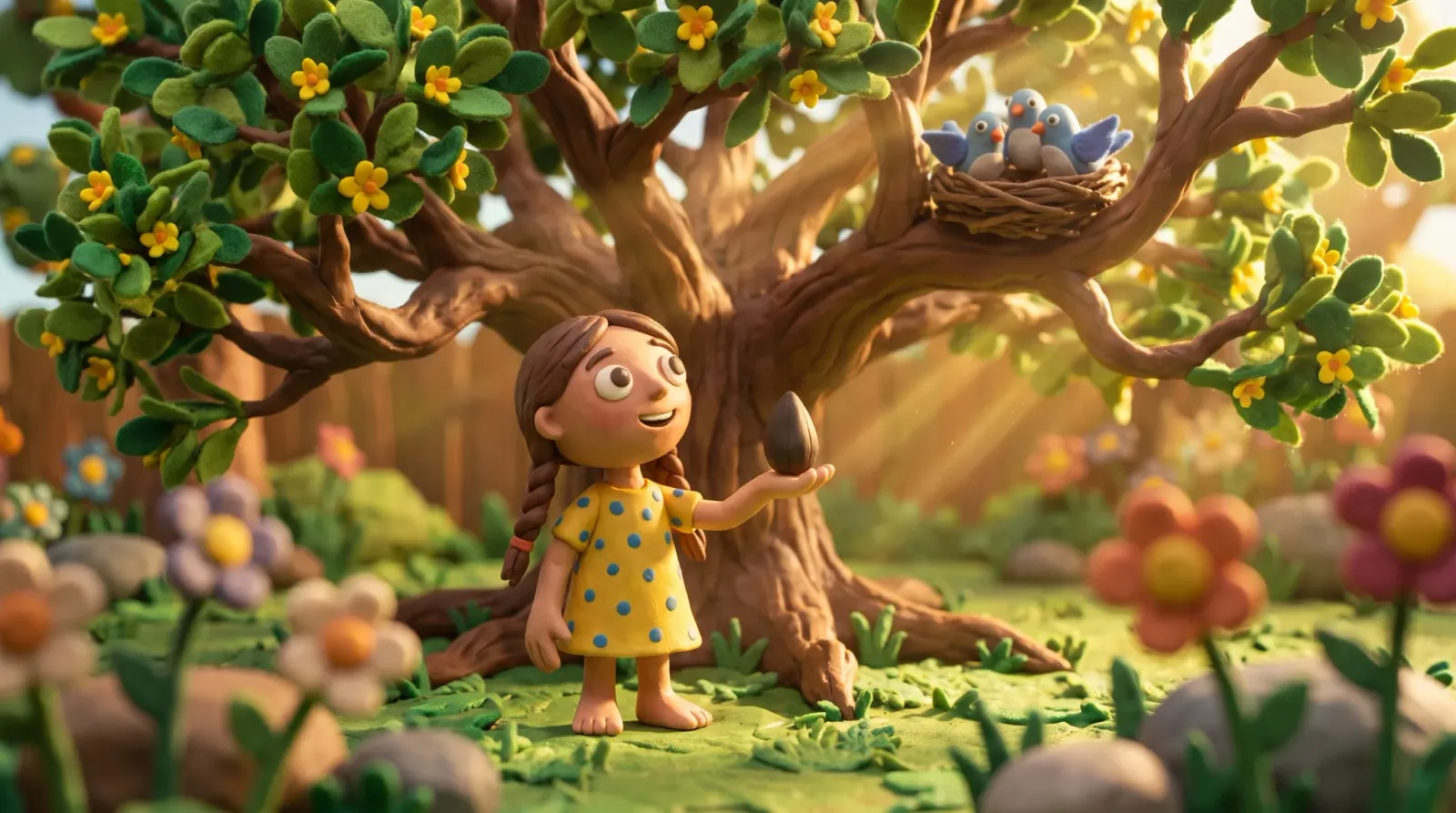 A tiny clay seed, and beside it the tree where birds build their nest.
3. The wise and foolish builders
Passage: Matthew 7:24-27 (also in Luke 6:47-49).
Tell it like this: two men each needed a house. The wise one went looking for solid rock and built right on top of it. (Luke adds that he dug down deep to reach it.) The other man put his house on the sand. One day the sky opened up. Rain poured down, the streams spilled over and the wind hammered at the walls. When the storm passed, only the house on the rock was still standing; the other had come down with a crash. Jesus said anyone who hears His words and puts them into practice is like that wise man.
Therefore everyone who hears these words of Mine and acts on them is like a wise man who built his house on the rock.
(Matthew 7:24, Berean Standard Bible)
The lesson, in one sentence: whoever hears Jesus and does what He says has a steady life, even when a storm comes.
Try this: at the kitchen sink, build a little house of wet sand on one plate and a Lego house on an upside-down mug in another. Pour a cup of water over each and watch what happens. Then ask, “What kinds of storms do kids go through? What helps you hold steady when one hits?”
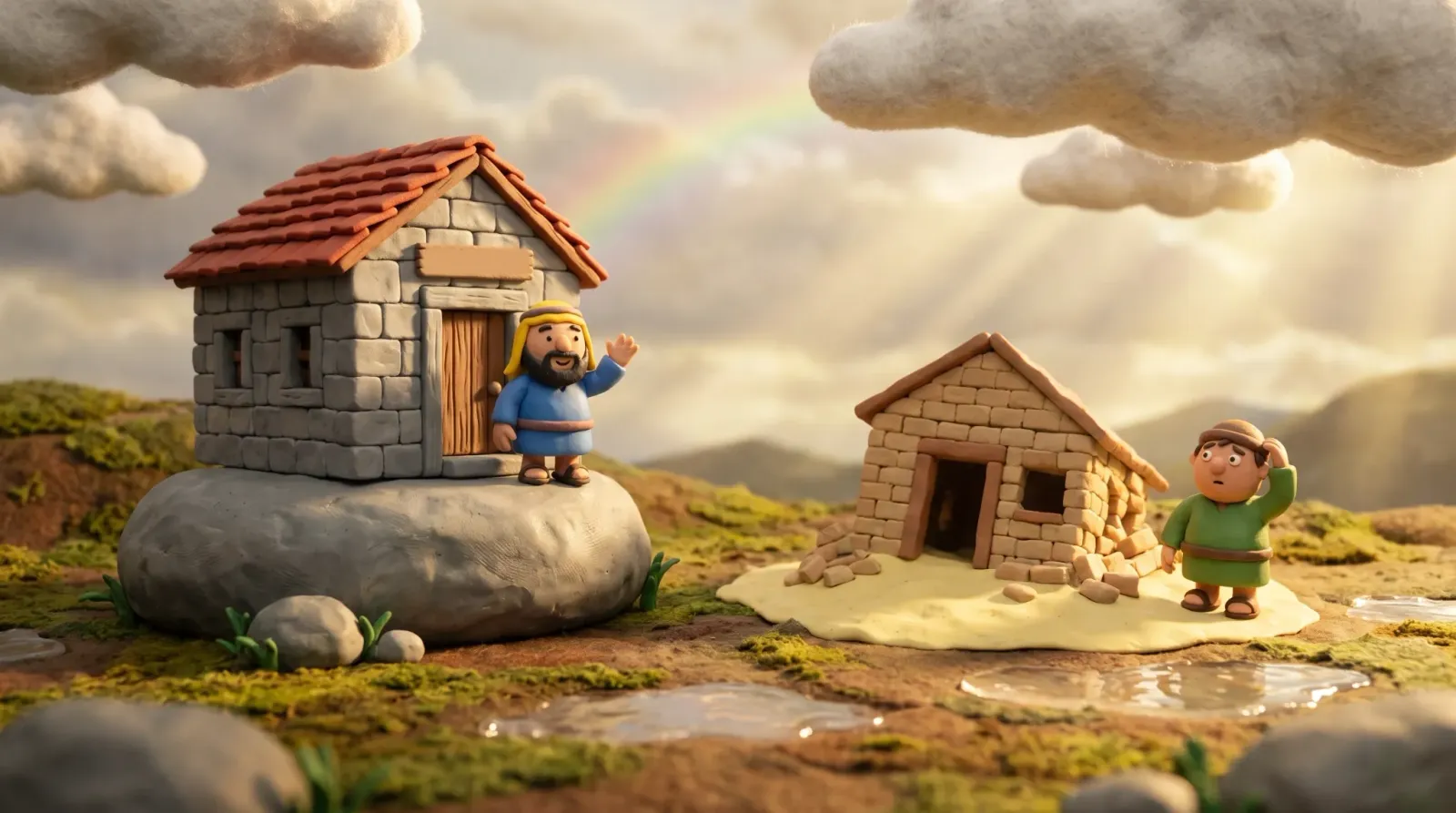 After the rain, Asa smiles in front of his stone house, still standing on the rock.
4. The lost sheep
Passage: Luke 15:1-7 (also in Matthew 18:12-14).
Tell it like this: a shepherd had a hundred sheep, and one of them wandered off. He left the other ninety-nine grazing in the open pasture and went after the lost one, searching the hills until he found it. He hoisted it onto his shoulders and carried it all the way home, happy the whole time. Once he got there, he called his friends and neighbors over: “Celebrate with me! I found my lost sheep!” Jesus said heaven throws that kind of party over one person who turns back to God.
And when he finds it, he joyfully puts it on his shoulders, comes home, and calls together his friends and neighbors to tell them, ‘Rejoice with me, for I have found my lost sheep!’
(Luke 15:5-6, Berean Standard Bible)
The lesson, in one sentence: God looks for each person, and each one matters to Him.
To talk about: “Have you ever looked up at Target or a Little League game and couldn’t find Mom or Dad?” Most kids have a story like that and want to tell every minute of it, so let them. Then ask, “Who do you think was looking harder, you or the grown-up?” That question usually gets them to the shepherd without your help.
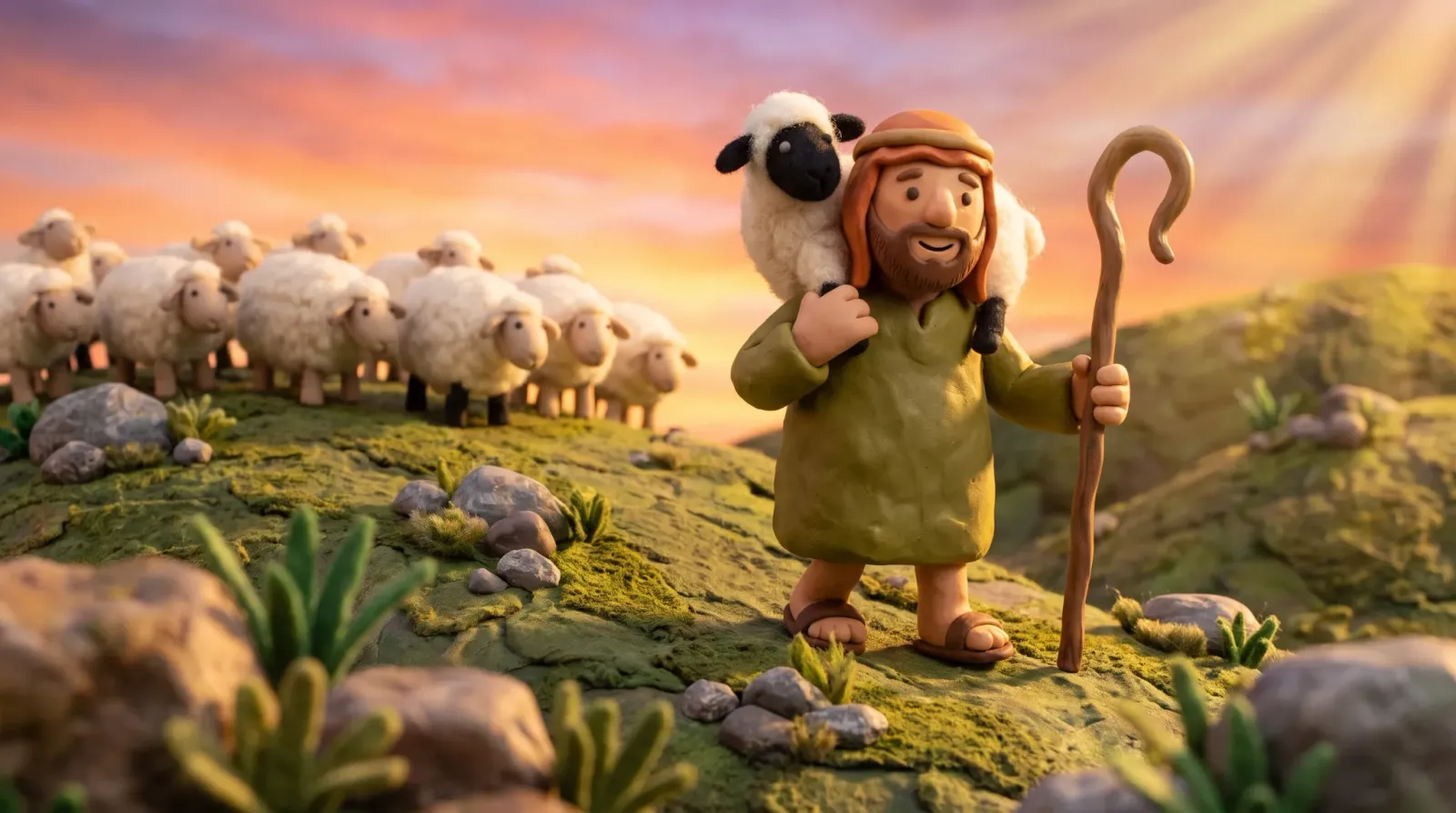 Tobias heads down the hill at sunset with the lamb across his shoulders.
5. The lost coin
Passage: Luke 15:8-10.
Tell it like this: a woman had ten silver coins, and one day she could only find nine. She lit a lamp, got out her broom and swept every inch of the house: under the table, along the walls, behind the water jar. Then something glinted in the dust. There it was! She hurried to tell her friends and neighbors, “Celebrate with me! I found my coin!” Jesus said there’s that same kind of joy in the presence of God’s angels over one person who repents.
The lesson, in one sentence: God is glad when someone comes back to Him.
Try this: cut ten “coins” out of yellow paper and let your child count them. While they’re not looking, slip one under a couch cushion. When they count again and come up with nine, turn the lights down and hand over a flashlight. Cheer like the woman’s neighbors when it turns up, then ask, “What’s something you lost that you were really glad to find?”
6. The prodigal son
Passage: Luke 15:11-32. “Prodigal” means wasteful, and plenty of people call this the parable of the lost son.
Tell it like this: a man had two sons. The younger one asked his father for his share of the family estate, packed up everything and moved to a country far away, where he blew it all on wild living. Then a famine hit. The only job he could find was feeding someone’s pigs, and he was so hungry the pig food looked good. That’s when he came to his senses: “My dad’s hired workers have plenty to eat. I’ll go home, tell him I’ve sinned, and ask to work for him.” He was still far down the road when his father spotted him. His father ran to him, threw his arms around him and kissed him, then called for the best robe, a ring, sandals and a feast. On his way in from the fields, the older brother heard the music and got so angry he wouldn’t go inside. So the father went out to him too: “Your brother was lost, and now he’s found.”
So he got up and went to his father. But while he was still in the distance, his father saw him and was filled with compassion. He ran to his son, embraced him, and kissed him.
(Luke 15:20, Berean Standard Bible)
The lesson, in one sentence: God is always ready to welcome home anyone who comes back.
To talk about: for preschoolers, the hug and the party are the whole story. Stop there and ask, “What did the dad do when he saw his son coming?” Hold verses 25-32 for a kid who’s old enough to complain that a sibling got extra screen time. After you read the older brother’s part, ask whose side they’re on, and why.
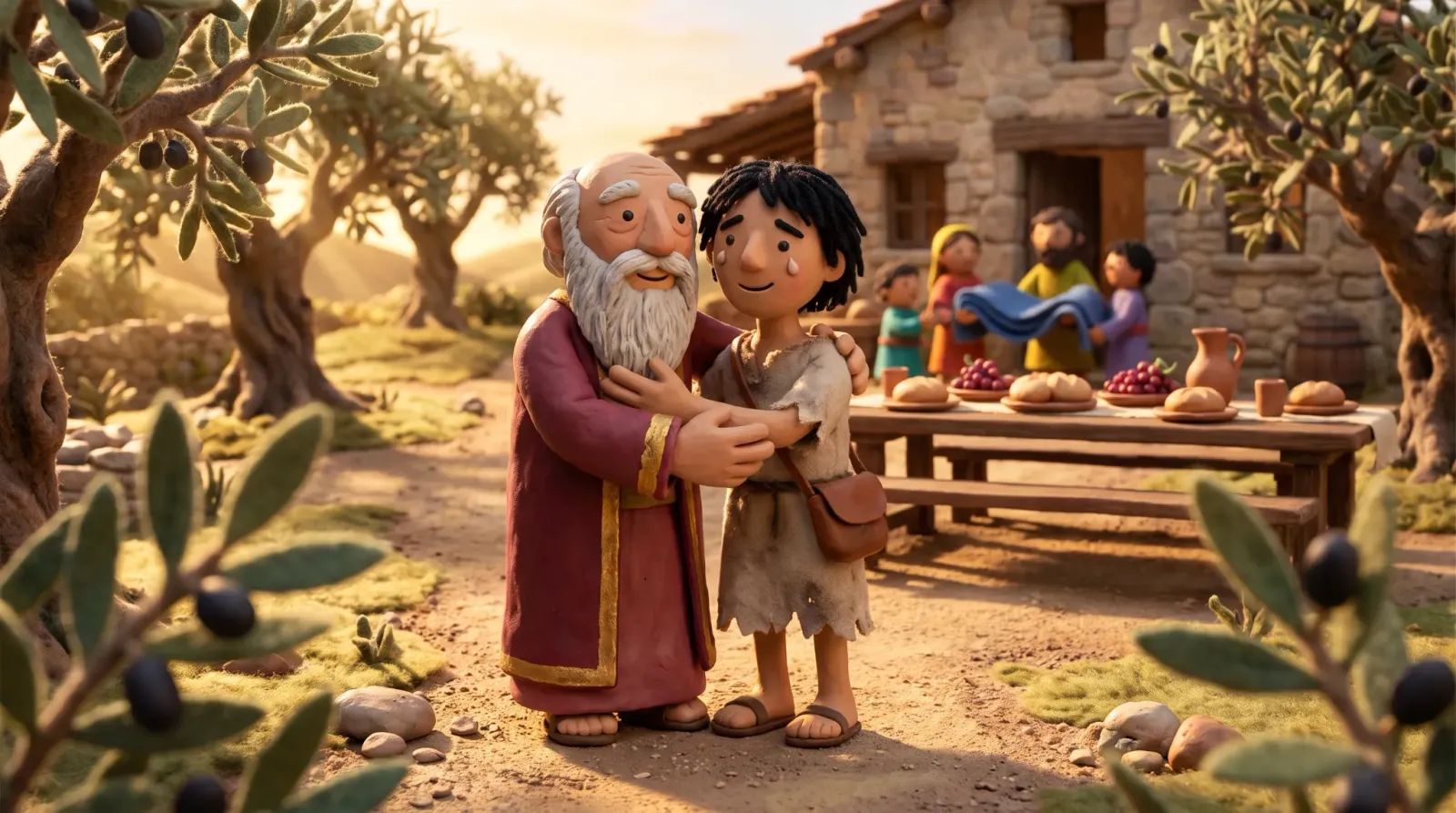 Jacob runs down the road to hug Samuel, and the party table is already set.
7. The good Samaritan
Passage: Luke 10:25-37.
Tell it like this: an expert in the law asked Jesus, “And who is my neighbor?” Jesus answered with a story. A man was walking the road from Jerusalem down to Jericho when robbers jumped him. They took his clothes, beat him and left him half dead. A priest came along, saw him and crossed to the other side of the road. A Levite did the same. Then a Samaritan on a journey reached the spot, and his heart went out to the man. He poured oil and wine on the wounds, bandaged them, lifted the man onto his own animal and took him to an inn. The next day he handed the innkeeper two silver coins and said, “Look after him. If it costs more, I’ll pay you when I come back.” Jesus asked which of the three had been a neighbor. “The one who showed him mercy,” the expert said, and Jesus told him, “Go and do likewise.”
He went to him and bandaged his wounds, pouring on oil and wine. Then he put him on his own animal, brought him to an inn, and took care of him.
(Luke 10:34, Berean Standard Bible)
The lesson, in one sentence: being a neighbor means helping whoever needs it.
To talk about: older kids get more out of this one with the backstory. Jews and Samaritans didn’t associate (John 4:9 says so outright), and many of Jesus’ listeners saw Samaritans as outsiders, so a Samaritan hero would have surprised a lot of people in that crowd. Ask your child who “the Samaritan” might be in their world: the new kid, the neighbor nobody talks to, the team you always play against. Then ask, “What could you do for someone like that this week?”
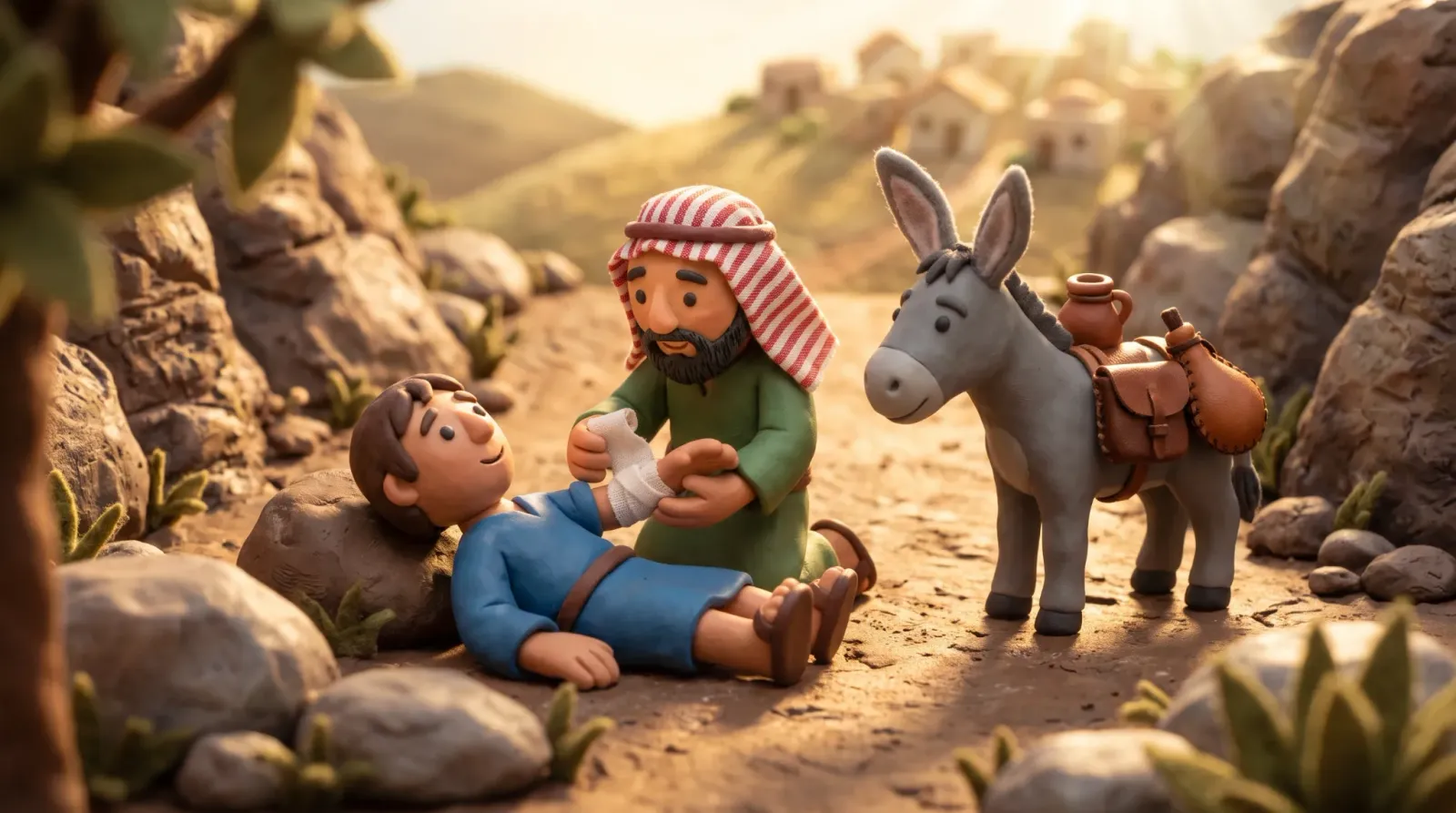 Ezra kneels on the road to bandage the traveler, with the donkey ready to carry him to the inn.
8. The hidden treasure
Passage: Matthew 13:44-46 (the hidden treasure and the pearl of great value).
Tell it like this: a man was working someone else’s field when he came across treasure hidden in the ground. He covered it right back up, went off overjoyed and sold everything he owned so he could buy that field. Jesus followed it with a second story, about a merchant on the lookout for fine pearls. When the merchant found one of great value, he did the same thing: sold all he had and bought it. With both stories, Jesus was showing that the kingdom of heaven is worth everything we have.
The kingdom of heaven is like treasure hidden in a field. When a man found it, he hid it again, and in his joy he went and sold all he had and bought that field.
(Matthew 13:44, Berean Standard Bible)
The lesson, in one sentence: the kingdom of heaven is a treasure worth everything we have.
To talk about: ask your child, “If you could keep only one thing in your room, what would it be?” Let them explain; the reasons are usually the best part. Then go back to the verse and point out that the man in the story sold everything he had to get that field. Ask, “What do you think made the treasure worth that much to him?”
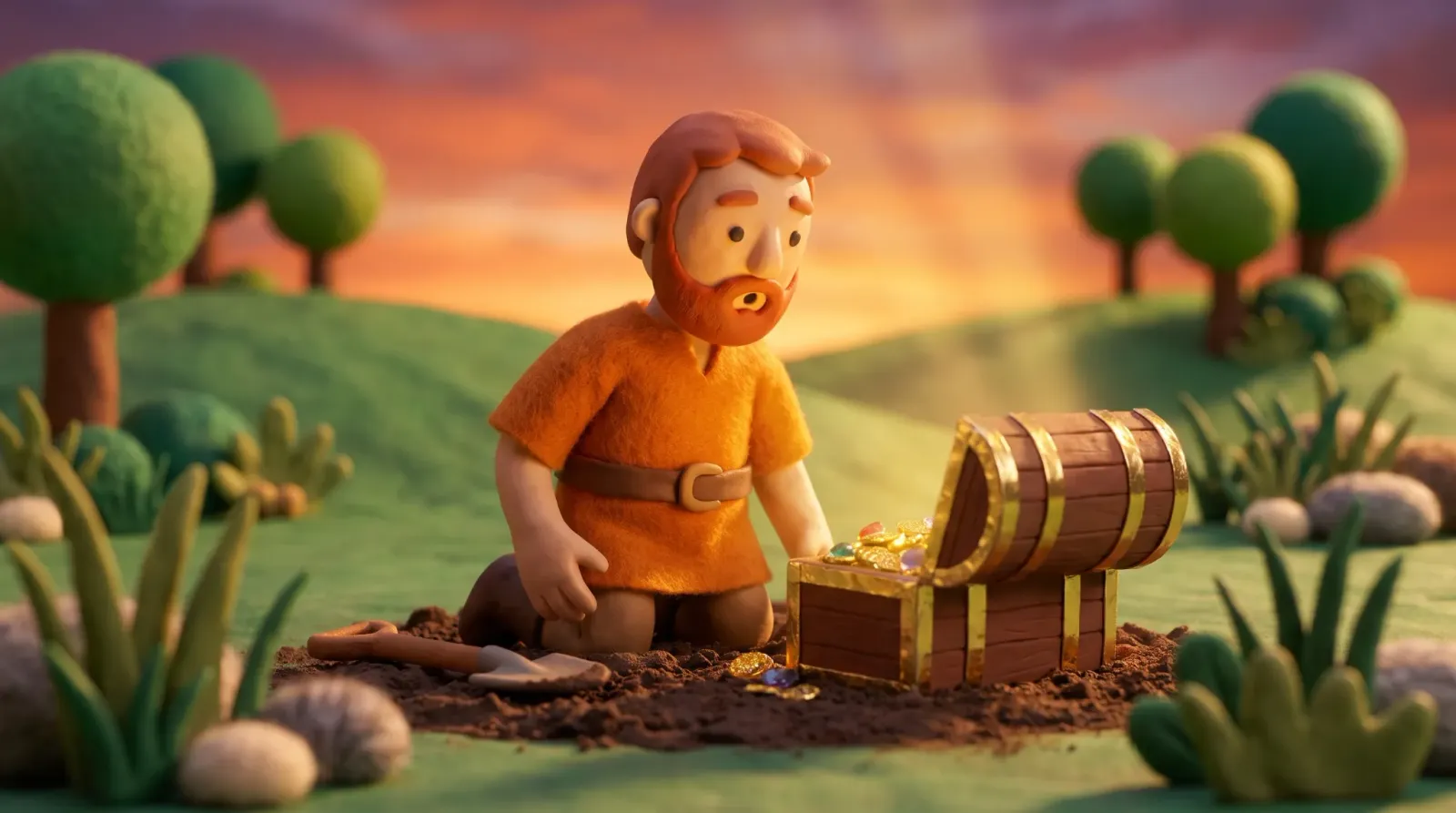 Caleb opens the chest he found in the field, with the gold of the evening light on his face.
How to tell a parable to kids
Pick your closing question before you start, and tell the story so it builds toward that moment. A quick read of the passage in the afternoon keeps the scenes in order, so at bedtime you can tell it from memory and keep your eyes on your child. Give the main characters their own voices, like a grumbly older brother or a younger son practicing his apology on the long walk home.
Once you’ve asked, stop talking. The AAP’s tips for reading with 2- and 3-year-olds include repeating an important word your child says and waiting for them to add more. Count to five in your head before you say anything else.
Five-year-olds are ready to switch roles: “Now you tell me what happened.” Telling a story with at least two events and answering simple questions about one are both on the CDC’s list of milestones by age 5.
Four to six minutes is plenty for a preschooler, and a grade-schooler can go about ten. Bring back the favorites, too; kids often ask something new the second time through. For crafts and games tied to each parable, see Bible activities for kids.
Which parable for which age
| Age | Good choices | Why |
|---|---|---|
| 3 and 4 | The builders, the lost sheep, the mustard seed | Motions, animals and one clear picture, and they end well |
| 5 and 6 | The sower, the lost coin, the good Samaritan, the prodigal son | They have a beginning, middle and end, and kids can answer questions about them |
| 7 and up | The hidden treasure, the prodigal son with the older brother | They open up talks about choices, values and forgiveness |
Listening and reading together
When your voice gives out, or you’re stuck in the school pickup line, the Bible tab in our app, Terra Sinai, can take a turn. It reads Scripture aloud chapter by chapter in a synthetic voice, with speed and Timer controls and buttons that skip back or ahead 15 seconds. Open Matthew 7, Matthew 13, Luke 10 or Luke 15 for the parables in this guide. Listening needs an internet connection.
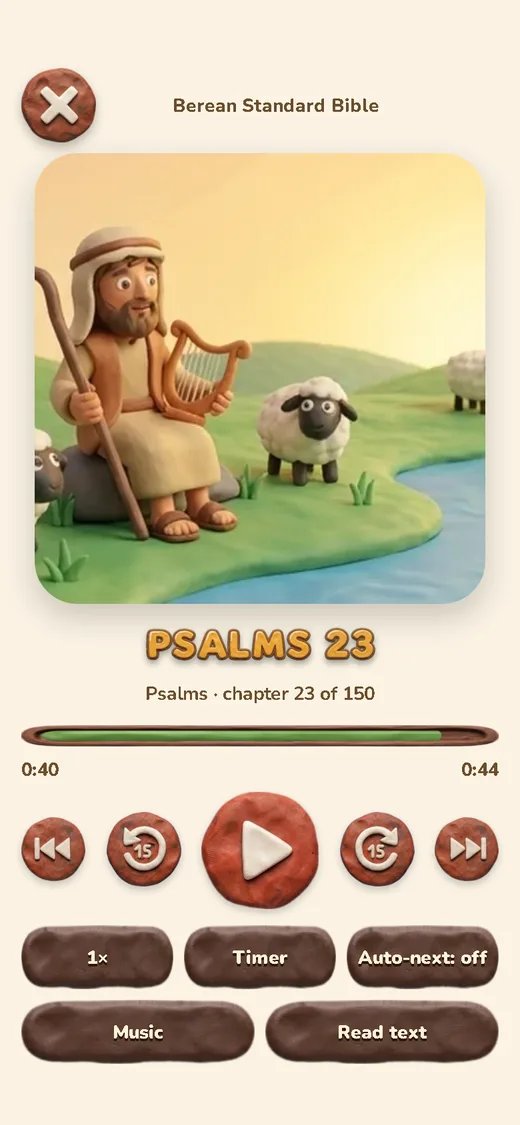 The Bible audio player.
Picture-book kids can also flip through the illustrated Bible storybooks, which keep the text short.
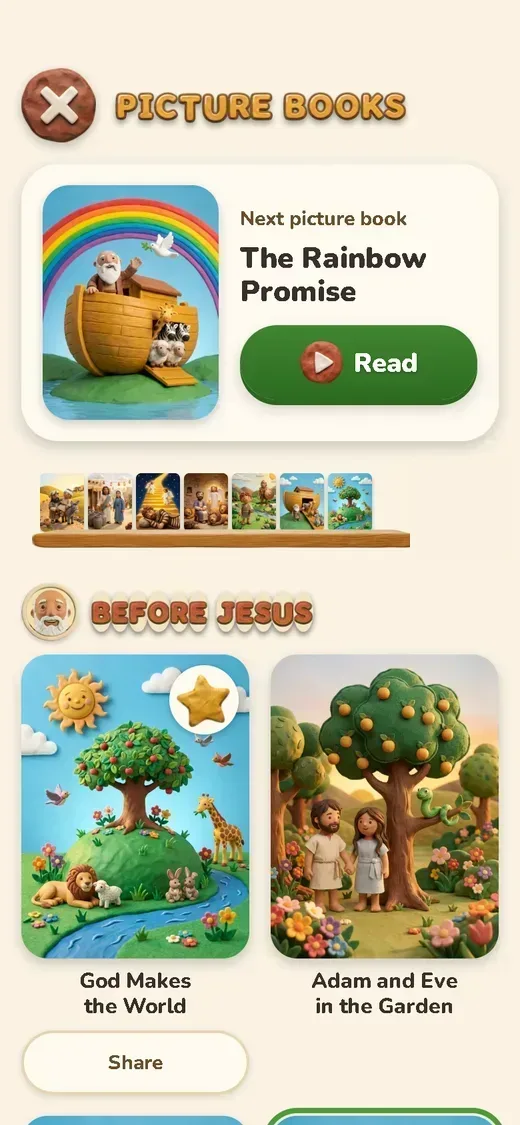 The shelf of illustrated picture books.
Where to next? Bible verses for kids pairs a verse with each story. If you want a bigger plan, start with how to teach the Bible to kids. The audio Bible for families covers listening together, and Bible games for families has ways to play with the stories afterward.
How this guide was made. Our editorial team wrote this guide and reviewed it in October 2026. Every verse quoted comes from the Berean Standard Bible, and we wrote the kid-friendly retellings ourselves, working from each chapter. Encyclopaedia Britannica supplied the origin of the word “parable,” and the CDC and the AAP supplied the milestones and read-aloud tips. The ages are our suggestions. If something about your child’s development worries you, ask your pediatrician.
Sources
- Encyclopaedia Britannica, Parable (definition and Greek origin of the word)
- CDC, Milestones by 5 Years (updated May 16, 2026)
- American Academy of Pediatrics, How to Share Books with Children 2 and 3 Years Old, HealthyChildren.org (2021)
Frequently asked questions
What is a parable, in simple words for a child?
Jesus would take something everyone knew, like a seed, a sheep or a coin, and set it next to a truth about God. That's built into the word: the Greek parabolē means "placing side by side" or "to compare." Your preschooler only needs the short version: "Jesus told stories to help us understand God."
Which parables of Jesus are good for kids?
A good parable for a young child has one clear picture and only a couple of characters. The lost sheep, the mustard seed and the wise and foolish builders all pass that test for 3-year-olds. The age table in this guide covers all eight, from the sower to the hidden treasure.
What age can kids understand parables?
Three- and four-year-olds already enjoy the characters and the action. By 5, the CDC says, many kids can tell a story with at least two events and answer simple questions about one, so that's a good age for real back-and-forth. The deeper meaning keeps opening up for years, and returning to the same parable is part of how that happens.
How do I explain a parable to a young child?
Pick the question you'll ask at the end, something like "How do you think the shepherd felt when he found his sheep?", and tell the story with that moment in mind. Keep the sentences short and the lesson to one line. After you ask, wait. A lot of kids answer with a story of their own, and you can follow it wherever it goes.
Where are the parables in the Bible?
Matthew and Luke have most of them. Luke 15 is the chapter to bookmark, with the lost sheep, the lost coin and the prodigal son one after another, and the good Samaritan is in Luke 10. Matthew 13 has the sower, the mustard seed and the hidden treasure, and Matthew 7 has the wise and foolish builders. Mark tells several too, including the sower in Mark 4.
Keep reading
-
Bible stories for kids: 10 to read aloud
Ten short Bible stories for kids ages 2 to 7, written to read aloud in 4 to 10 minutes, with suggested ages, questions to talk about and a bedtime routine. Read article -
David and Goliath Bible story for kids
The David and Goliath Bible story for kids, told in short read-aloud scenes with no graphic violence, plus family questions and a five-stone activity. Read article -

Fruit of the Spirit for kids: a family guide
Love, joy, peace and the rest of Galatians 5:22-23 in words kids understand, with family moments, games for busy evenings and a four-week verse plan. Read article