
David and Goliath Bible story for kids
The David and Goliath Bible story for kids, told in short read-aloud scenes with no graphic violence, plus family questions and a five-stone activity.
 The Terra Sinai team 11 min read
In this article (13)
In 1 Samuel 17, a shepherd boy, the youngest of eight brothers, walks into a valley where a whole army is afraid of one giant, and he brings Goliath down with a sling and a single stone, trusting God. This guide tells it in short read-aloud scenes, then covers what it teaches, questions to ask your kids and a ten-minute stone-painting activity.
If you grew up with this one on a Sunday school flannelgraph, you already know the shape of it. The retellings here are paced for a preschooler: each scene is short, comes with a hand motion, and skips the gory bits at the end of the chapter. Want a bigger bundle of stories, with ages for each? Try Bible stories for kids.
The story at a glance
| Scene | Where to find it | A move to do together |
|---|---|---|
| 1. The shepherd | 1 Samuel 16:11 and 17:15 | Rock a pretend lamb in your arms |
| 2. An errand for Dad | 1 Samuel 17:17-20 | Carry a pretend basket |
| 3. A giant nobody will fight | 1 Samuel 17:4-11 | Look way up and open your eyes wide |
| 4. Too big to walk in | 1 Samuel 17:38-39 | Walk slowly like you’re wearing something heavy, then drop it all |
| 5. Five smooth stones | 1 Samuel 17:40 | Count five pebbles in your palm |
| 6. The sling | 1 Samuel 17:48-50 | Swing your arm in a circle, holding nothing |
Scene 1: the shepherd
Tell it like this: out near Bethlehem, Jesse’s youngest son was watching the family’s sheep. His name was David. Eliab, Abinadab and Shammah, the three oldest of his seven big brothers, had gone off with King Saul’s army, so the sheep were David’s job. Sometimes a lion or a bear showed up and carried off a lamb. Every time, David went after it and got that lamb back.
Here’s a chance for sound effects. Let your child do the lion’s roar and the bear’s growl, and you do David’s “Hey! Give that back!” (David tells this part to Saul in verses 34 and 35.)
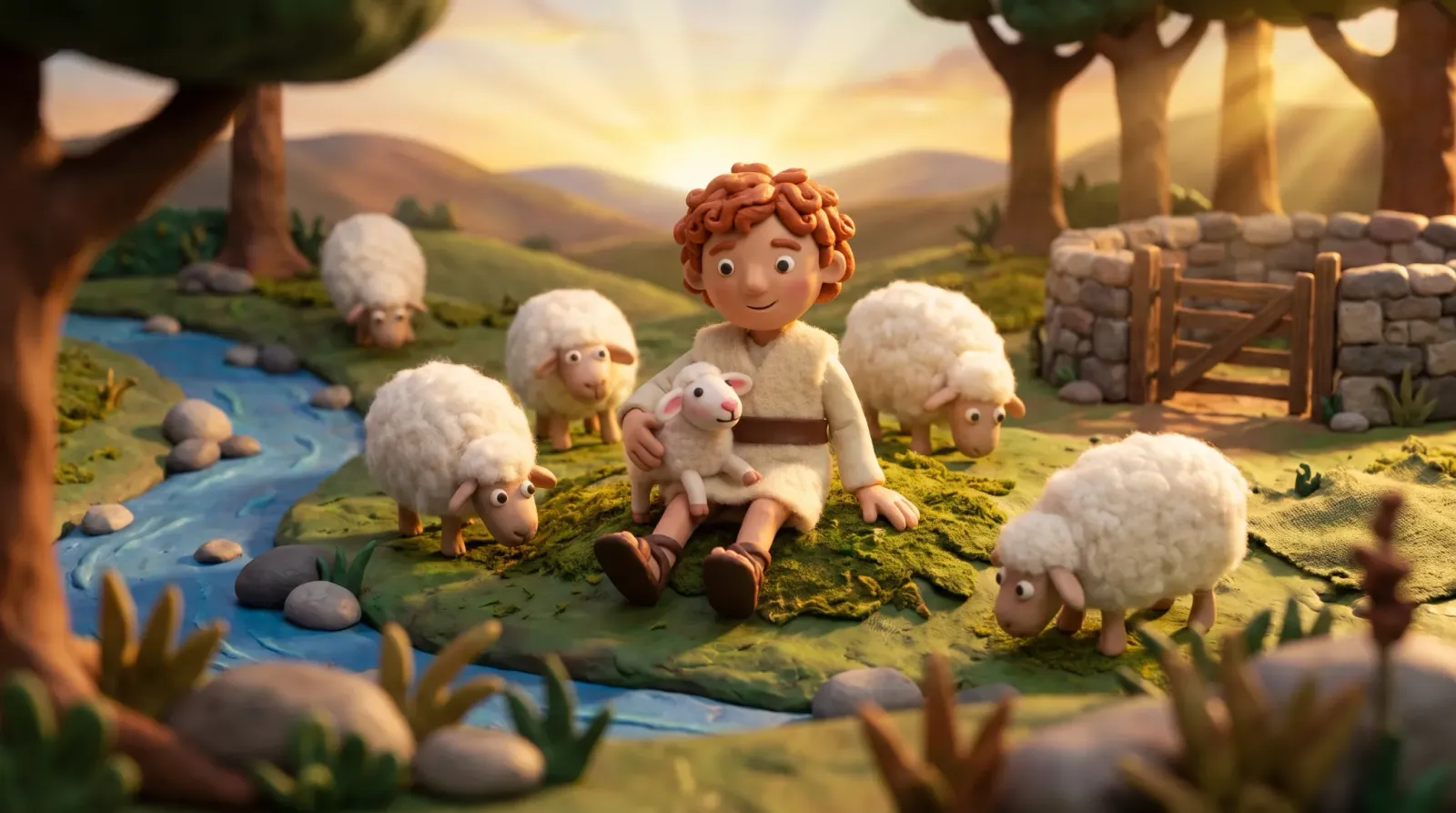 Out in the fields near Bethlehem, a lamb gets a cuddle.
Scene 2: an errand for Dad
Tell it like this: Jesse wanted to know how his three oldest boys were doing at the battle, so he gave David a job. Roasted grain and ten loaves of bread were for the brothers, and ten portions of cheese were for their commander. David was up early the next morning. He left the flock with a keeper, loaded up and set off. He got to camp just as the army was marching out to its position, everybody shouting the battle cry. David left his things with the quartermaster, the soldier who watched the supplies, and ran to the battle line to find his brothers.
Take also these ten portions of cheese to the commander of their unit. Check on the welfare of your brothers and bring back an assurance from them.
(1 Samuel 17:18, Berean Standard Bible)
Pause here and ask your child what they’d pack for a big brother who’s far from home. Jesse’s list was grain, bread and cheese.
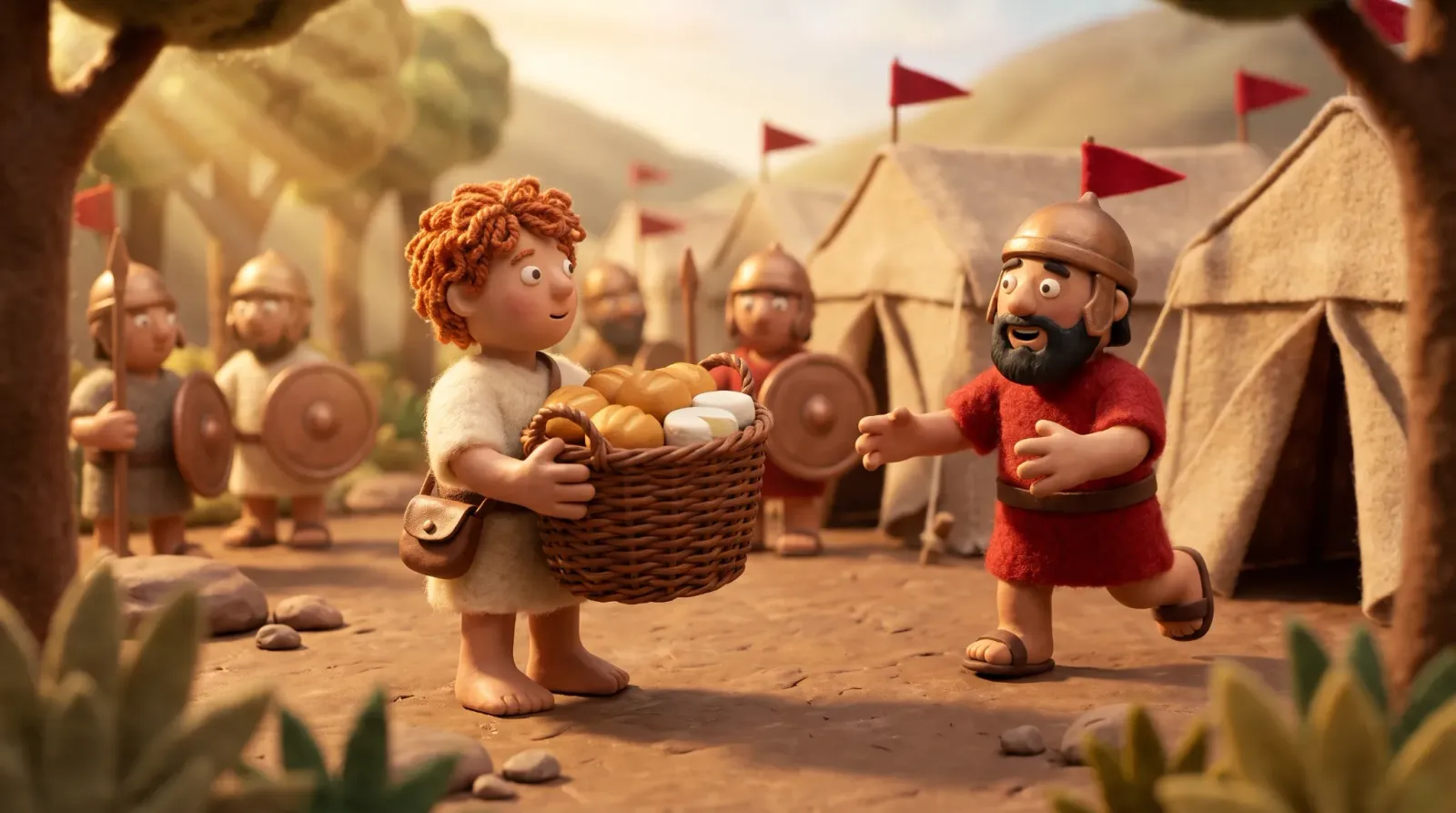 Bread and cheese, delivered: David reaches his brothers’ camp.
Scene 3: a giant nobody will fight
Tell it like this: for forty days, every morning and every evening, Goliath came out. He was the Philistines’ champion, a giant in a bronze helmet and a bronze coat of armor, and the shaft of his spear was as thick as a weaver’s beam. The two armies were camped on two hills with the Valley of Elah between them, and Goliath stood there and shouted across: “Choose one of your men and have him come down against me.” Saul and all his soldiers heard it and were terribly afraid.
For forty days the Philistine came forward every morning and evening to take his stand.
(1 Samuel 17:16, Berean Standard Bible)
Picture David catching up with his brothers when the shouting starts again. Every soldier near him takes off running (verse 24), and David starts asking questions. What will the king do for whoever beats this Philistine, who is defying the armies of the living God? Eliab hears him and snaps, “And with whom did you leave those few sheep in the wilderness?” David moves on to another soldier with the same question, and before long King Saul sends for him.
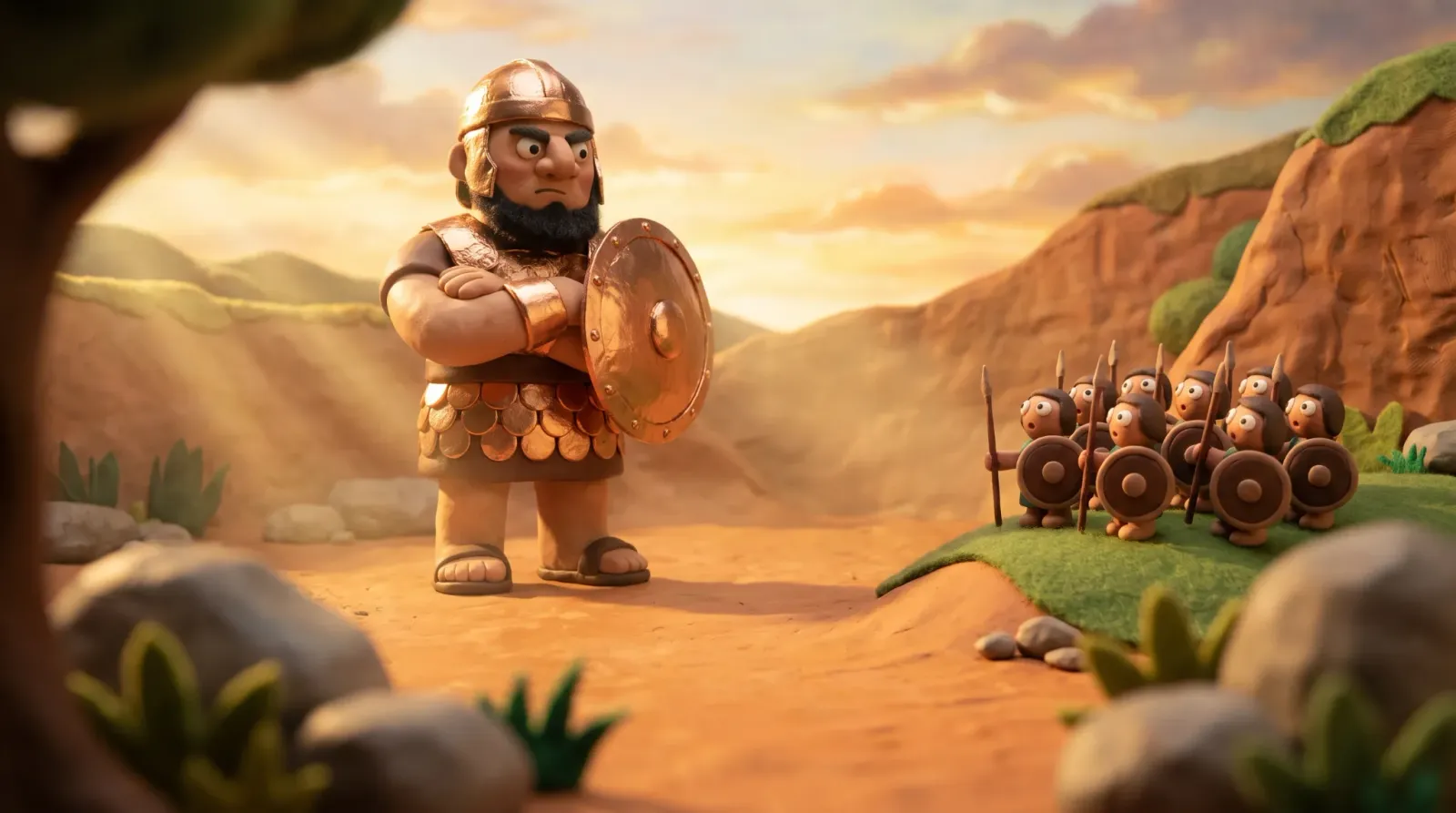 Goliath takes his stand while Israel’s army watches from the hill.
Scene 4: too big to walk in
Tell it like this: “Let no one lose heart because of that giant,” David told King Saul. “I’ll go and fight him.” Saul said no. David was just a boy, and Goliath had been a warrior since his own youth (verse 33). David had an answer ready. Out in the fields, he’d gone after a lion and a bear and rescued a lamb from their mouths. Then he said this:
The LORD, who delivered me from the claws of the lion and the bear, will deliver me from the hand of this Philistine.
(1 Samuel 17:37, Berean Standard Bible)
Saul gave in. “Go,” he said, “and may the LORD be with you.” Then the king dressed David in his own tunic, a bronze helmet and armor, and David strapped a sword over it all. He tried a few steps and stopped. “I can’t walk in these,” he told Saul. “I’m not used to them.” Off it all came.
Act it out. Zip your child into the biggest winter coat in the house, add a pair of rain boots, and let them try to march to the kitchen. When they give up, they get to shout David’s line: “I can’t walk in these!”
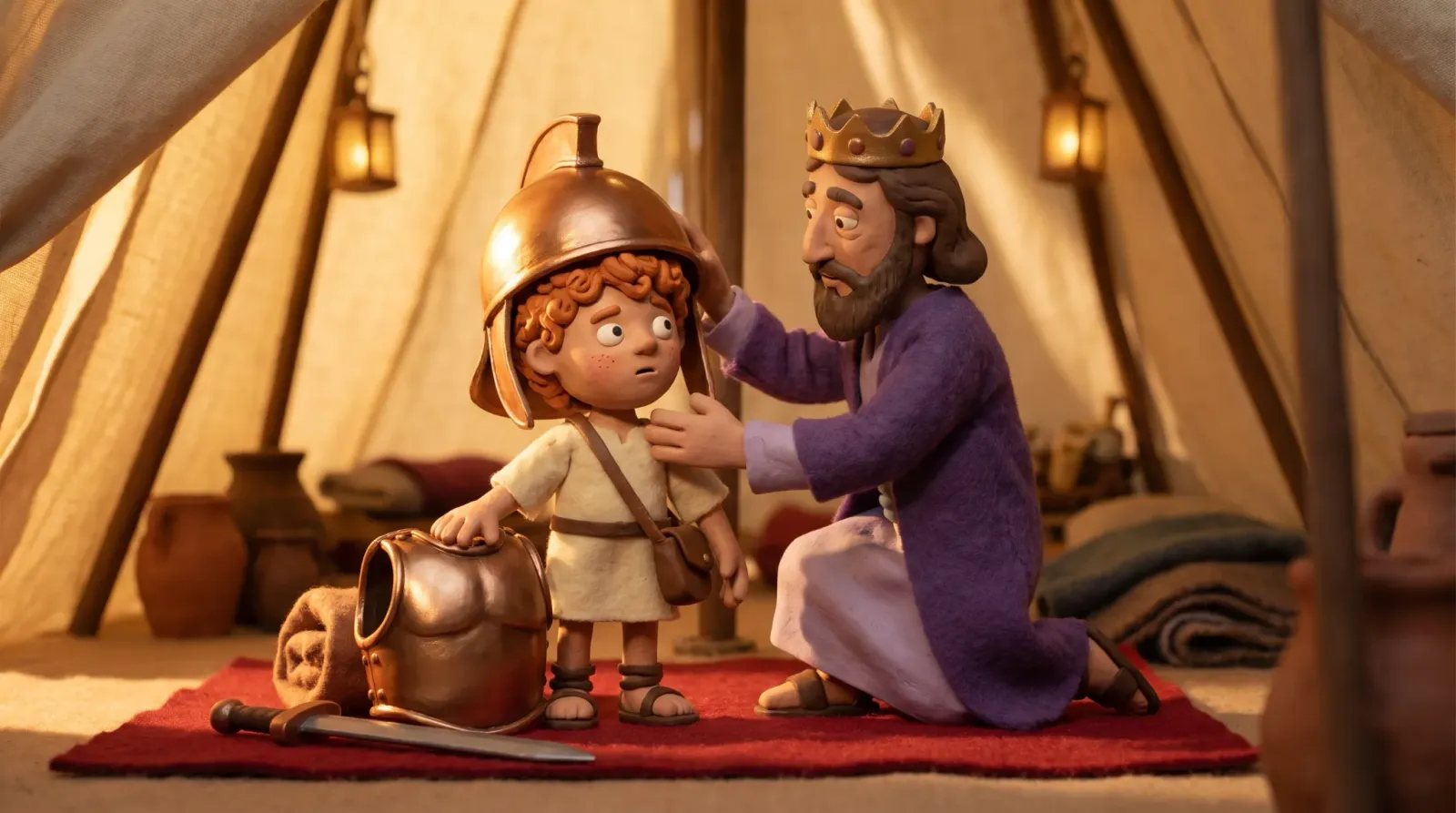 Saul’s helmet keeps sliding over David’s eyes.
Scene 5: five smooth stones
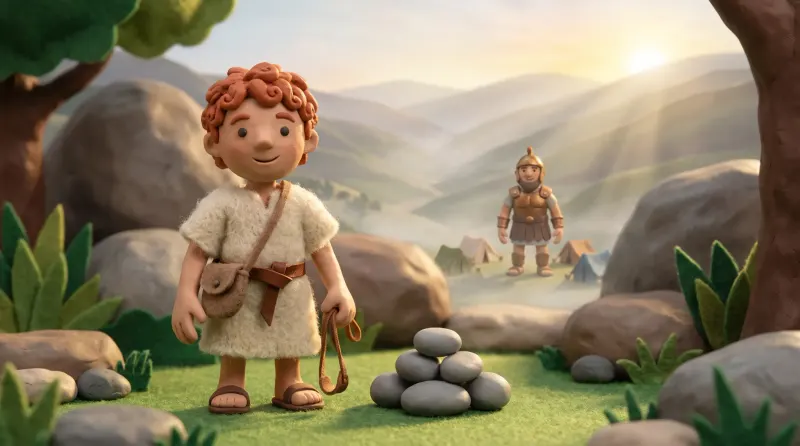
Tell it like this: David picked up his staff and went down to the brook. Have your child count along as he chooses: one, two, three, four, five smooth stones, all into his shepherd’s bag. Then, sling in hand, David walked out toward the Philistine.
And David took his staff in his hand, selected five smooth stones from the brook, and put them in the pouch of his shepherd’s bag. And with his sling in hand, he approached the Philistine.
(1 Samuel 17:40, Berean Standard Bible)
Judges 20:16 shows how accurate slingers could be: it mentions 700 select left-handers, “each of whom could sling a stone at a hair without missing.”
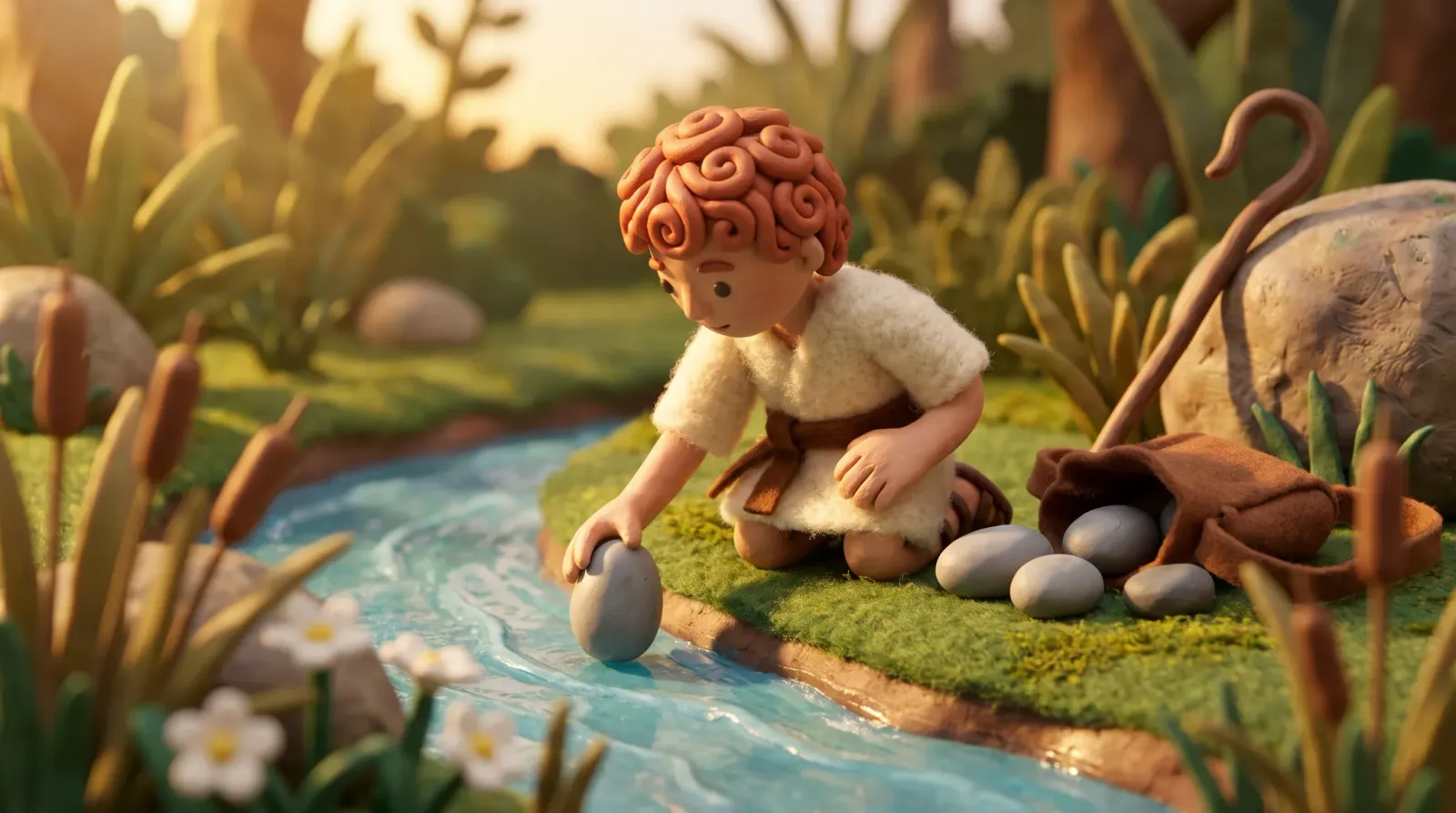 Picking smooth stones at the edge of the brook.
Scene 6: the sling
Tell it like this: the giant and his shield bearer came closer and closer. When Goliath got a good look at David, he looked down on him. A boy, coming at him with sticks? David called back that he came in the name of the LORD, the God of Israel’s armies. Then Goliath started forward, and David ran toward him. His hand went into the bag and came out with a stone. One swing of the sling, and the stone hit Goliath in the forehead. Down went the giant, face-first. The Philistines saw their hero fall and ran, and Israel was safe.
But David said to the Philistine, “You come against me with sword and spear and javelin, but I come against you in the name of the LORD of Hosts, the God of the armies of Israel, whom you have defied.”
(1 Samuel 17:45, Berean Standard Bible)
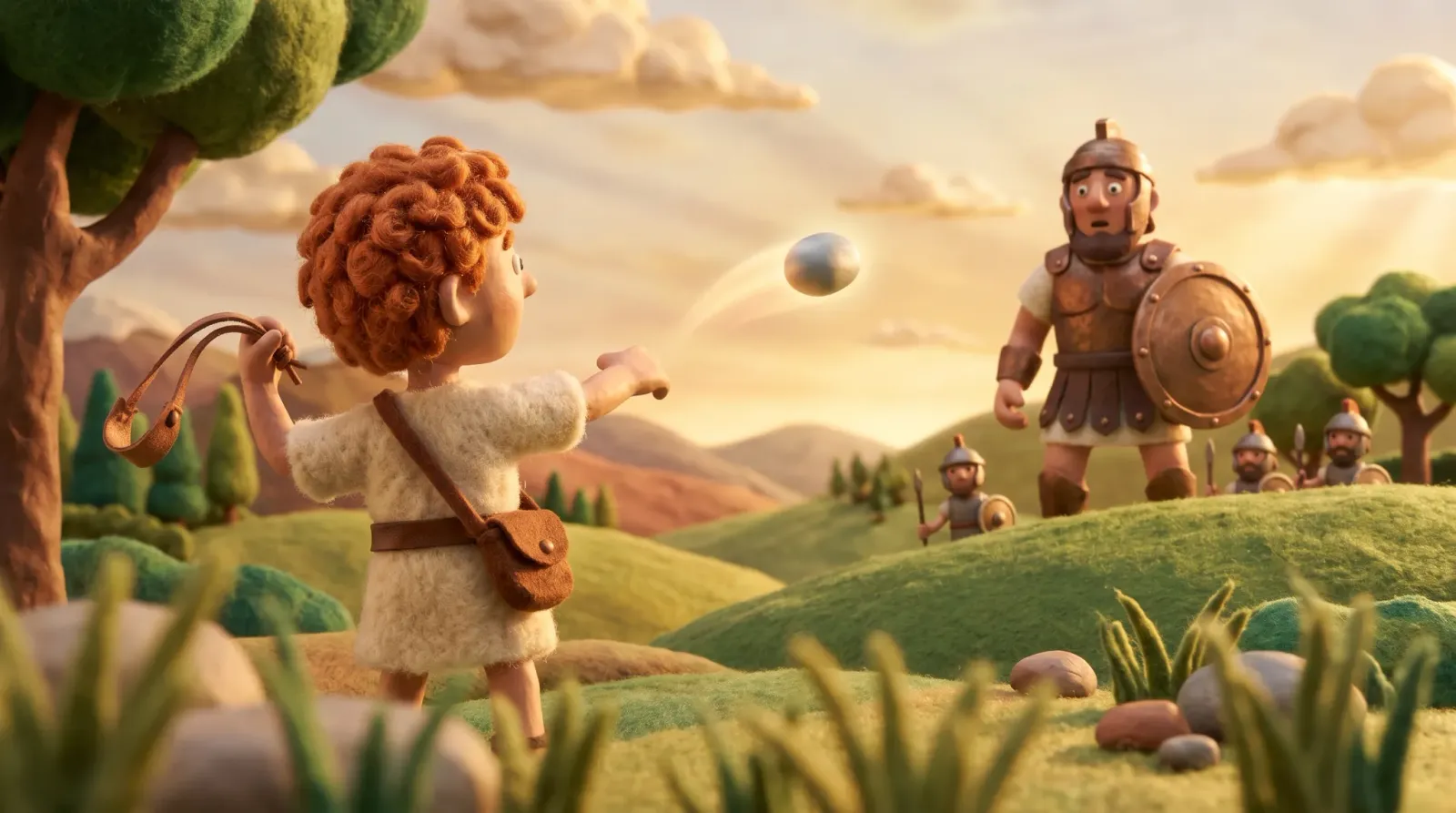 One swing, and a stone sails across the valley.
How to tell it without scaring your child
Verses 51 to 54 are the rough part of the chapter, with the chase and the plundered Philistine camp. You can skip them with little ones and finish at Scene 6, when Goliath goes down and his army runs. Older kids sometimes ask about Goliath straight out. Tell them he died in the battle, then steer back to what David said in verse 45.
The CDC’s milestone checklist for 5-year-olds says kids this age pay attention for 5 to 10 minutes during activities like story time. With a kid that age, try two scenes a night for three nights, and on the fourth night read verse 45 together.
Keep your child in the story while you read. The CDC suggests asking, “What do you think will happen next?” and the American Academy of Pediatrics (AAP) recommends echoing an important word your child just said, then waiting for them to add to it. Try it after Goliath’s first shout in Scene 3. Stop, look up from the page and ask, “What do you think David’s going to do?”
What the story teaches
In one day, David gets brushed off by his big brother Eliab, who snaps at him about the sheep he left behind, and by King Saul, who tells him he’s just a boy. Any kid who’s ever heard “you’re too little for that” will recognize this part. Ask yours when someone last said that to them, and what they did next.
What’s your kid already good at? Building block towers, making a little sister laugh, kicking a soccer ball? Ask them, then point out that David left Saul’s armor behind because he couldn’t walk in it, and went out with the staff and sling he used every day.
Before David ever picked up a stone, he went back over his own story. Out in the fields, the LORD had kept him safe from a lion and a bear, and in verse 37 he counts on that same help against Goliath. At bedtime, ask your child, “Who helped you the last time you were scared?” Then tell them about a time God helped you.
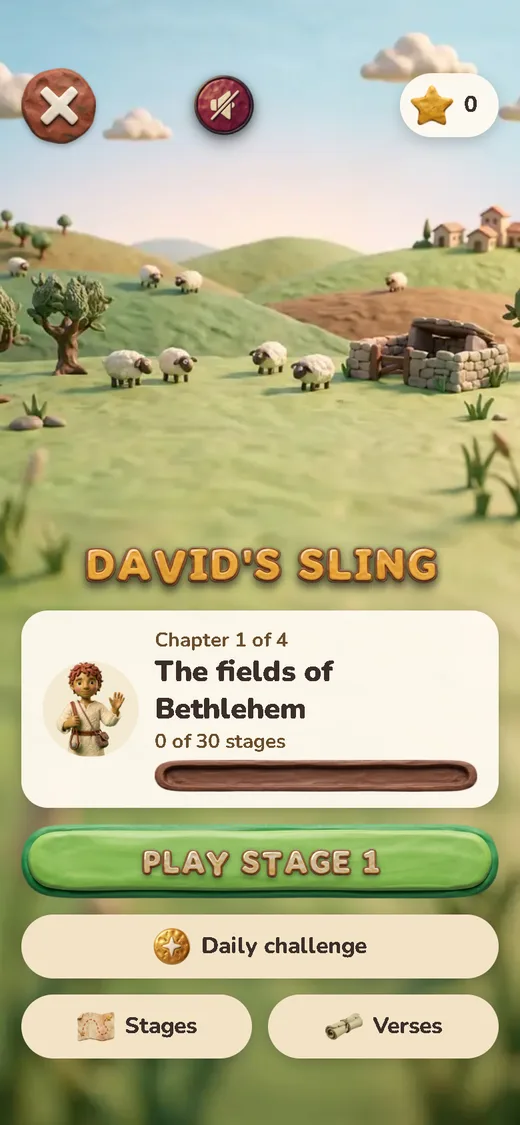 The opening screen of David’s Sling.
For a rainy afternoon after you’ve read the story, our app has a game called David’s Sling, set in the fields of Bethlehem and the Valley of Elah, with short stages a young kid can finish. More ways to play together are in Bible games for families.
Questions to talk about as a family
Pick just one of these and ask it somewhere low-key, like the car, the bathtub or the dark after lights-out. Any answer your child gives is a good one.
- “If you had to face Goliath, what would you bring?” Let them name something of their own first (a stuffed animal, Grandpa, a favorite song). Then talk about what David brought and why Saul’s armor stayed behind.
- “Why do you think all the soldiers ran away?” Verse 24 says they fled from Goliath in great fear. Talk about what being scared feels like in your body, and what helps your child calm down.
- “Is anything making you nervous this week?” It could be a dentist visit, a new classroom, a dark hallway or the neighbor’s barking dog. If they come up empty, offer a small one from your own week, like a work meeting you’re dreading, then pick one of the courage stones from the activity below for that worry.
Want a short verse to tape to the fridge after this talk? Pick one from Bible verses for kids. And if you’re planning more nights like this one, how to teach the Bible to kids breaks it down by age.
Activity: five courage stones
Grab five smooth stones, washable paint or nontoxic paint markers, and a small drawstring bag. The whole thing takes about ten minutes, plus drying time.
Got a baby or toddler at home? Swap in stones about the size of an egg, or wooden discs too big to fit in a mouth, and sit with your kids for the whole craft. The U.S. Consumer Product Safety Commission bans small parts in toys meant for children under 3 because they can cause choking.
Find and scrub. Hunt for five smooth stones in the backyard, a park path or a creek bank, then scrub them in the sink and pat them dry with a towel.
Paint. One simple picture per stone, no letters: a rainbow, a paw print, a smiley face, a cloud, a soccer ball. While the paint dries, point to each stone and ask, “Who does this one remind you of?” Maybe it’s the coach who stayed late after practice, or the friend who shared a snack at lunch.
Bag them. Once they’re dry, the stones go in the bag. Before a first swim lesson or a new babysitter, let your child pick one, tell you who it stands for and squeeze it tight while the two of you say verse 37.
Where should the bag live? The nightstand works, or a hook by the door so it can ride along in a backpack on a big day. Just pick a spot a crawling baby can’t get to. There are more crafts in this spirit in Bible activities for kids.
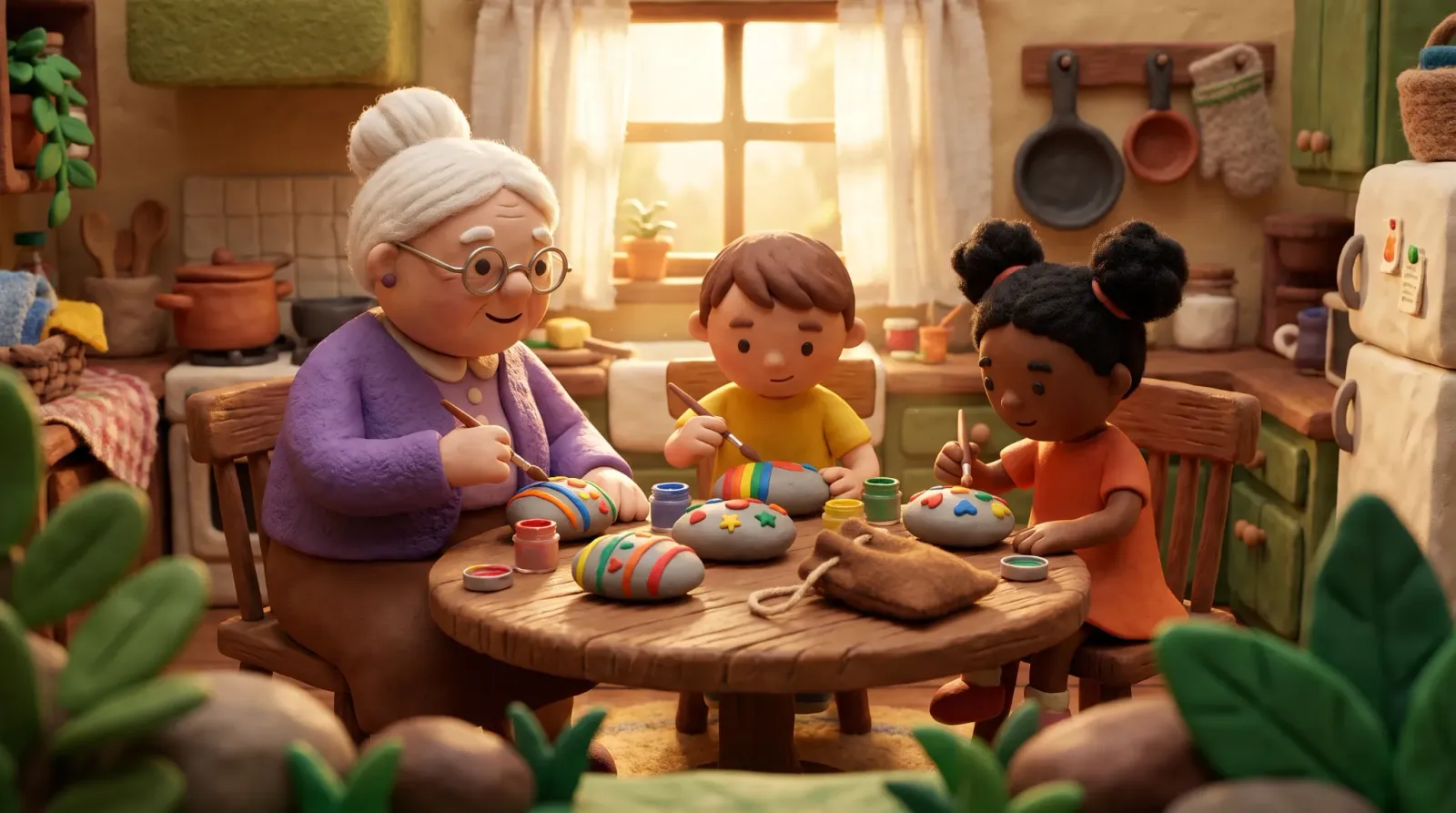 A grandma and two kids painting courage stones at the wooden table.
How this guide was made. Ages, scene breaks and the stone activity are our own suggestions, written by our editorial team from 1 Samuel 17 and last reviewed in October 2026. Every Bible quote comes from the Berean Standard Bible. We followed the CPSC on small parts, and the CDC and the American Academy of Pediatrics on attention span and reading aloud. Questions about your child’s development? Ask your pediatrician.
Sources
- CDC, Milestones by 5 Years (attention span of 5 to 10 minutes and questions after a story)
- CDC, Milestones by 4 Years (reading together and asking “What do you think will happen next?”)
- American Academy of Pediatrics, How to Share Books with Children 2 and 3 Years Old, HealthyChildren.org (2021)
- U.S. Consumer Product Safety Commission, Small Parts Ban and Choking Hazard Labeling (small parts and choking risk for kids under 3)
- Berean Standard Bible, 1 Samuel 17 and Judges 20:16, text from bible.helloao.org
Frequently asked questions
What is the David and Goliath story for kids?
A shepherd boy named David knocks down a giant with one stone from his sling. Here's how he gets there, in 1 Samuel 17: Jesse sends his youngest son to the army camp with food for his brothers, and David hears Goliath, the Philistine champion, daring Israel to send out a fighter. Saul's soldiers are terrified. David volunteers, trusting the LORD, sets King Saul's armor aside and goes out with five smooth stones from a brook. Once the giant falls, the Philistines run.
Where is the story of David and Goliath in the Bible?
Short on time? Read verse 45, David's answer to Goliath, and then verses 34 to 37 about the lion and the bear. The full story runs from verse 12 to verse 51 of 1 Samuel 17, a chapter with 58 verses.
How old was David when he fought Goliath?
The Bible never says. Saul tells him, "You are just a boy" (verse 33), Goliath despises him "because he was just a boy, ruddy and handsome" (verse 42), and he's still the one watching his father's sheep. Picturing him as a young teenager fits those clues.
Why did David pick five stones?
Verse 40 says David "selected five smooth stones from the brook, and put them in the pouch of his shepherd’s bag," and it doesn't say why five. That makes it a fun one to toss back to your child: "Why do you think he grabbed five?"
What does David and Goliath teach kids?
David gets ready for Goliath by looking back at the lion and the bear (verse 37), and he goes out with the sling he already used with the sheep, even after his big brother and the king brush him off. Tie it to something on your child's calendar, like Saturday's haircut or a first morning at a new preschool, and remind them that God helped David and helps them too.
Keep reading
-
Bible stories for kids: 10 to read aloud
Ten short Bible stories for kids ages 2 to 7, written to read aloud in 4 to 10 minutes, with suggested ages, questions to talk about and a bedtime routine. Read article -
Noah's ark story for kids, scene by scene
Noah's ark for kids in read-aloud scenes from Genesis 6-9, every number checked in the text, questions by age, crafts and how to tell the flood gently. Read article -
Parables of Jesus for kids: 8 stories to tell
Parables of Jesus for kids: the sower, the lost sheep, the prodigal son and more, each with the Bible passage, a short retelling and a question to ask. Read article