
Prayers for kids: short prayers to learn
Short, easy prayers for kids: morning, mealtime, school, family, scary moments, thankfulness and bedtime, plus the Lord's Prayer and teaching tips.
 The Terra Sinai team 10 min read
In this article (12)
A sentence or two in your child’s everyday words, with an “Amen” at the end, makes a complete prayer for a young kid. This page has short read-aloud prayers for waking up, meals, school drop-off, family, scary nights, saying thanks and bedtime, plus a newer ending for “Now I lay me down to sleep” and the Lord’s Prayer from Matthew 6:9-13.
Maybe you grew up saying “God is great, God is good” at the dinner table or “Now I lay me down to sleep” at bedtime. Keep those. The prayers below are new ones from our team, short enough to sit next to those classics on the fridge. Got a kid who likes to say “Dear Jesus,” or one who wants to pray for the class hamster? Go for it. For faith at home beyond prayer time, see how to teach the Bible to kids.
A prayer for waking up
Our prayer, to read aloud:
Good morning, God! Thank You for the night and for this new day. Stay with me today, in everything I do. Amen.
Try it at the bathroom sink, somewhere between the toothbrush and the hairbrush. Kids who can’t read yet can learn it by echo: you say a few words, and they say them back. An older brother or sister can take over and lead it for the little ones.
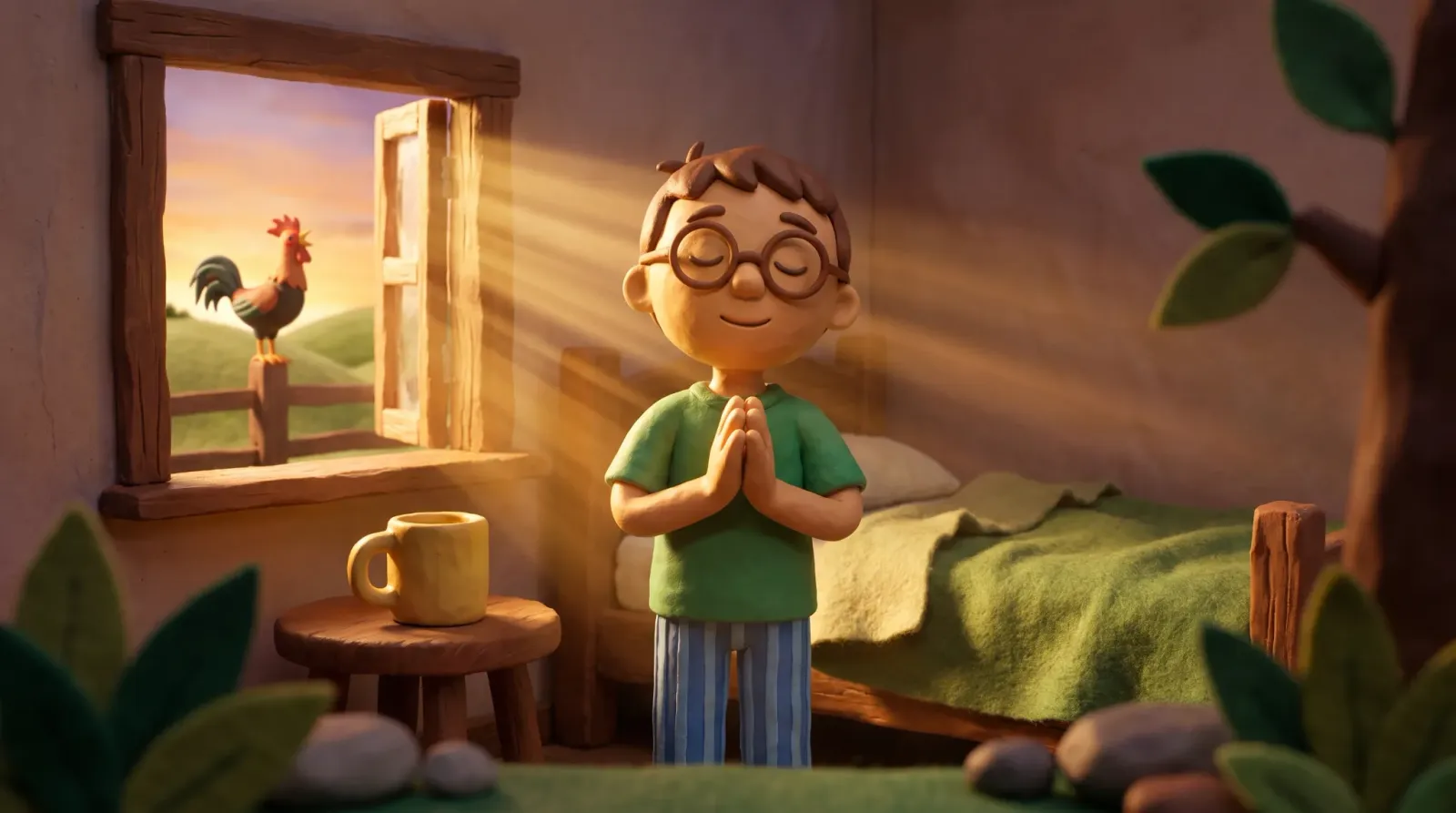 Sunrise, an open window and a quick good morning to God.
A prayer before eating
Our prayer, to read aloud:
Dear God, thank You for our food and for the hands that made it. Bless our table and our home. Amen.
If your family already says “God is great, God is good, and we thank Him for our food,” keep it, and alternate the two. Some nights, hand your child the bread basket or the pizza box and let them say the prayer over it. For a toddler, the first sentence alone is plenty.
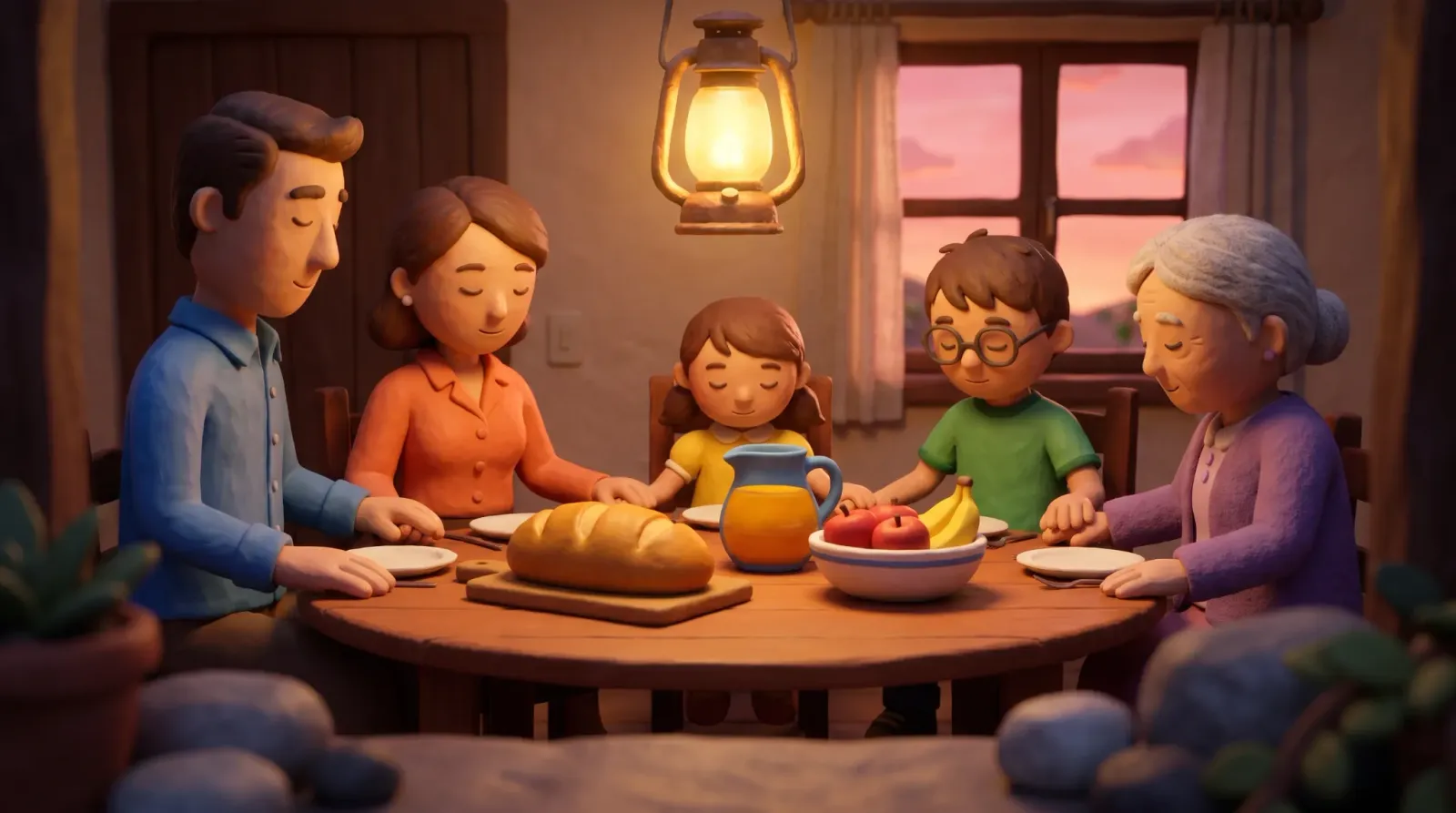 Bowed heads around the table before anyone eats.
A prayer for school
Our prayer, to read aloud:
God, today I’m going to school. Help me pay attention, be kind to my classmates, and be brave when I make a mistake. Amen.
The car line is a perfect spot for this one. You’ve got maybe thirty seconds before the door opens, so say it together at a red light or while you wait your turn, and finish with a fist bump. If they ride the bus, say it at the bus stop. Some kids like a secret signal to carry into the classroom, like three quick hand squeezes that mean “God is with me.”
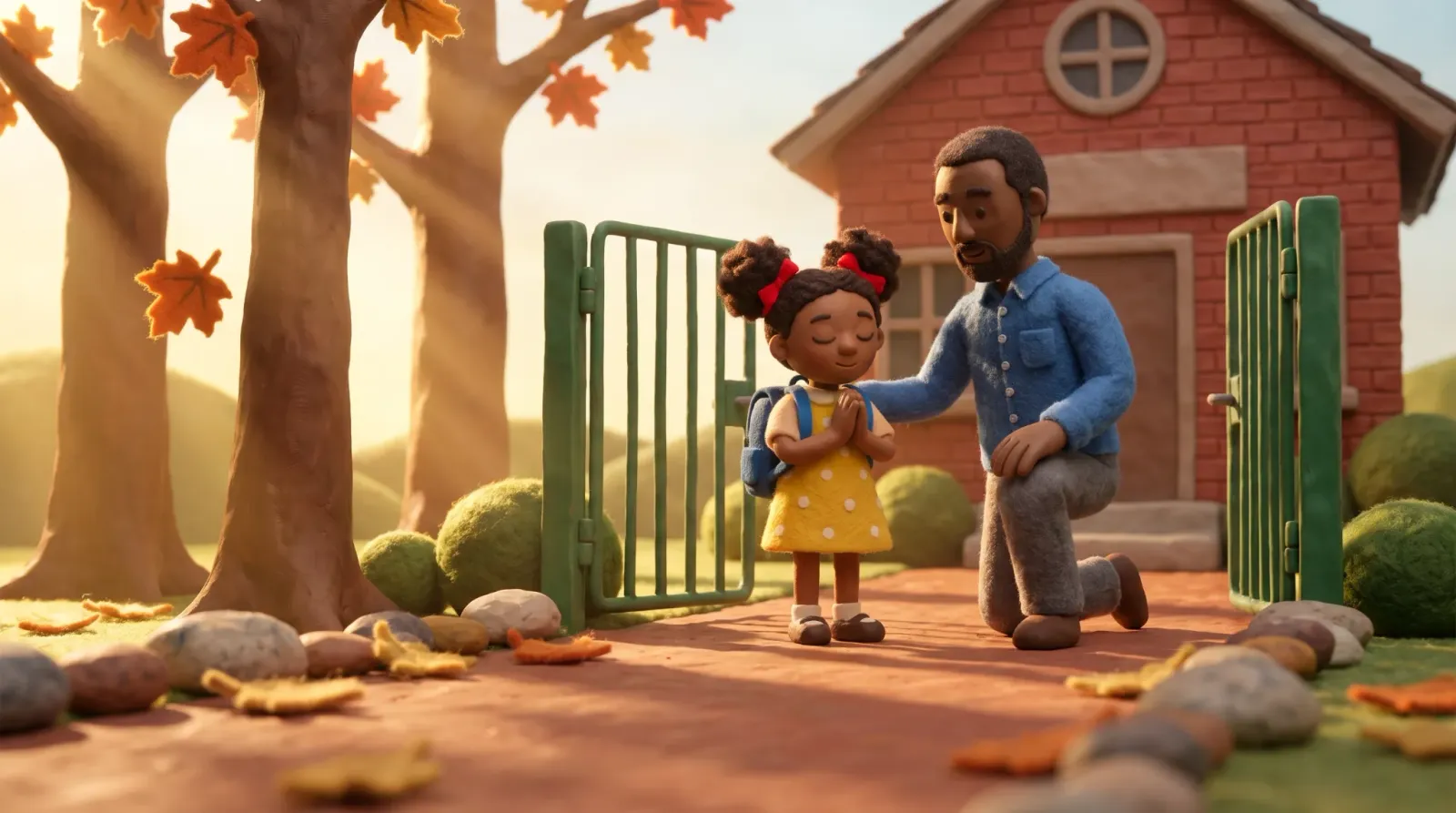 Backpack on, eyes closed, ready for the school day.
A prayer for family
Our prayer, to read aloud:
God, take care of Dad, Mom, my grandparents and everyone who lives with me. Give each one health and peace. Amen.
Hand the list over to your child. Start them off with “God, take care of…” and see who comes next. It might be the school crossing guard, the new baby next door or a friend from church who’s been sick. Right before lights out, you can say this blessing from Numbers over them:
‘May the LORD bless you and keep you; may the LORD cause His face to shine upon you and be gracious to you; may the LORD lift up His countenance toward you and give you peace.’
(Numbers 6:24-26, Berean Standard Bible)
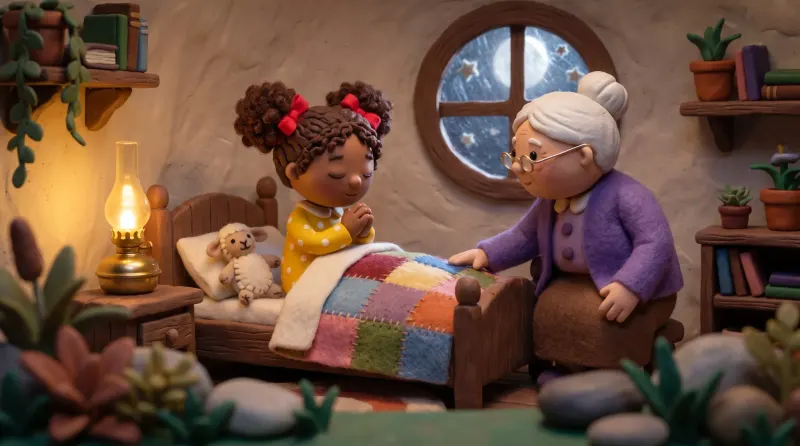
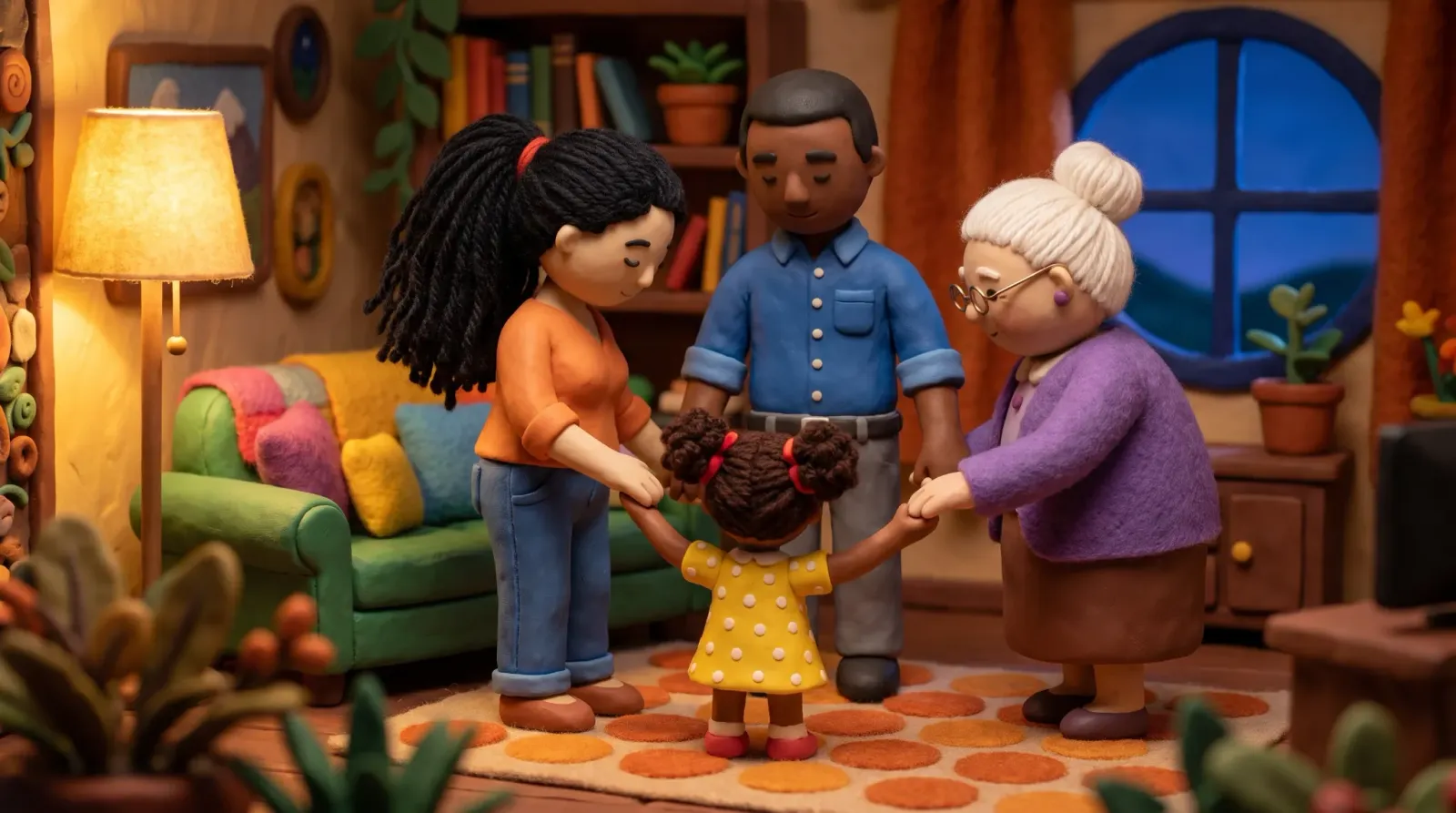 Heads bowed under a warm lamp, the whole family prays together.
A prayer for when your child is scared
Our prayer, to read aloud:
God, I’m scared. You’re here with me and You take care of me. Stay close to me right now. Amen.
A closet door that won’t stay shut, a siren at 2 a.m., a shadow on the ceiling shaped like a claw. Sit on the edge of the bed and pray it with them; your child can jump in on “Stay close to me.” Older kids might like this verse taped inside the closet door:
Cast all your anxiety on Him, because He cares for you.
(1 Peter 5:7, Berean Standard Bible)
A favorite stuffed animal, a special blanket, a night-light, a door left cracked: the AAP’s bedtime tips for toddlers and older kids include comfort like this. For babies under 1, the AAP’s safe-sleep rules call for a crib with a fitted sheet and nothing else, so no blankets, pillows or stuffed animals. With a preschooler, you can tape a drawing of praying hands to the bedpost, as a reminder that they can pray and then come get you.
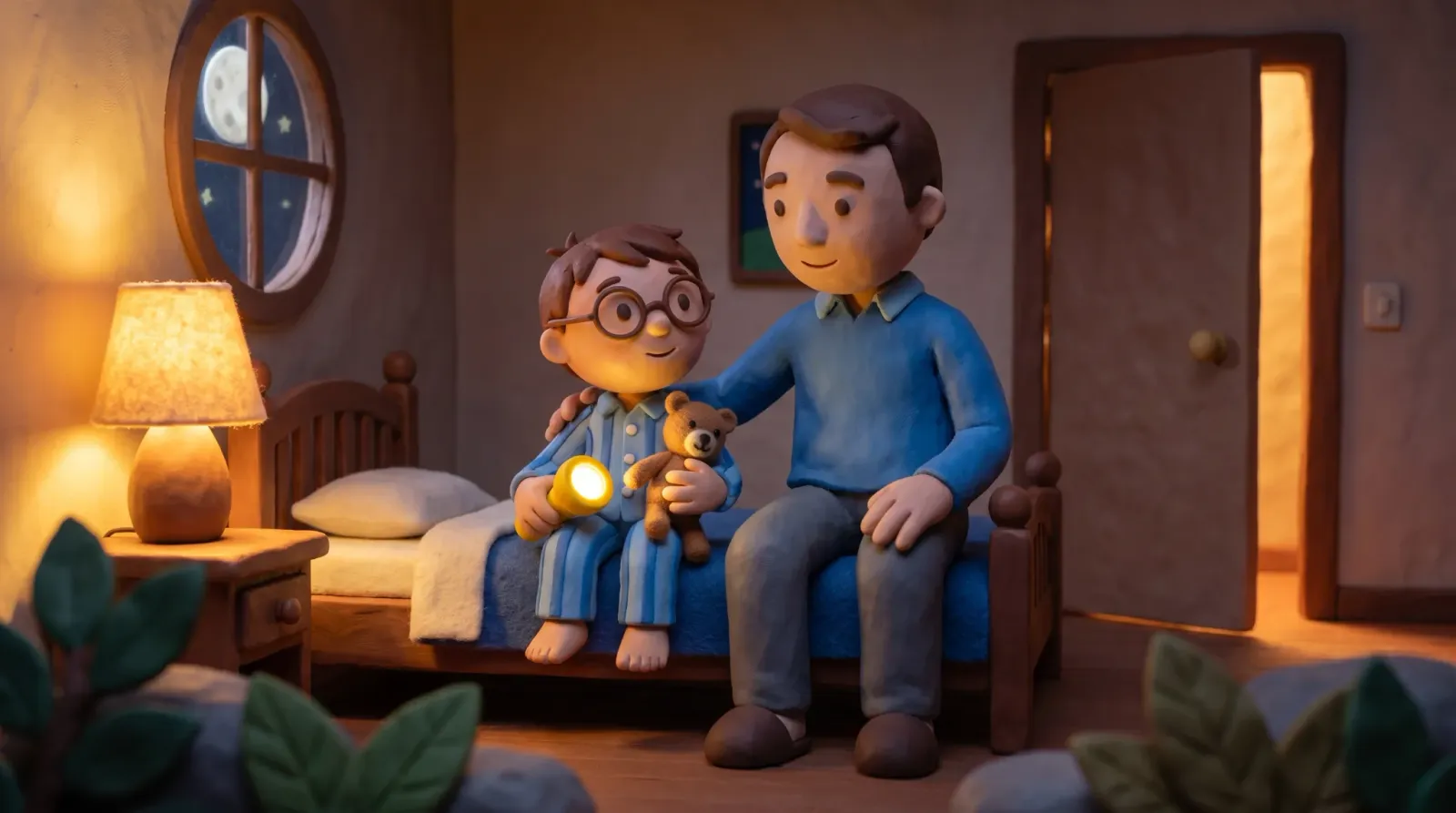 Bad dream? Dad’s hug comes first, then the prayer.
A prayer of thanks
Our prayer, to read aloud:
Thank You, God, for the sun, for my friends, for my home, and for today. Amen.
A thank-you jar on the kitchen counter makes it a habit. Each night, your child drops in a slip with one specific thing, like the spelling test they finally passed or the firefly they caught after dinner, and you read them all on Sunday night. Paul put it this way in his letter to the church in Thessalonica:
Give thanks in every circumstance, for this is God’s will for you in Christ Jesus.
(1 Thessalonians 5:18, Berean Standard Bible)
Save the slips. If your family goes around the table at Thanksgiving to say what you’re thankful for, your child can pull a few favorites from the jar.
 Sunflowers, a butterfly and a lot to be thankful for.
A prayer for bedtime
Our prayer, to read aloud:
God, thank You for today. Forgive what I did wrong. Take care of my family and me tonight, and give me a peaceful sleep. Amen.
The AAP recommends a short bedtime routine that runs the same way every night, such as brushing teeth, reading a book and getting into bed. Try making the prayer the very last step, after you’ve tucked the blanket in and before you hit the switch. A 5- or 6-year-old might like reading it from a card taped to the headboard, and a younger child can say just the “Amen.”
You may also know “Now I lay me down to sleep, I pray the Lord my soul to keep.” The traditional version goes on with a line about dying before you wake, which can worry a young child. Some families use a newer ending, “Guide me safely through the night, and wake me with the morning light.” For a verse to close the day:
I will lie down and sleep in peace, for You alone, O LORD, make me dwell in safety.
(Psalm 4:8, Berean Standard Bible)
For stories that go well with bedtime, see Bible stories for kids. If your child likes to hear Scripture while falling asleep, check out our guide to the audio Bible.
The Lord’s Prayer for kids
A child who asks “How do I pray?” is asking what one of Jesus’ disciples asked Him: “Lord, teach us to pray” (Luke 11:1, Berean Standard Bible). Jesus answered with the Lord’s Prayer. Luke gives a shorter version in verses 2 to 4, and Matthew has the longer one, here in the BSB:
So then, this is how you should pray: ‘Our Father in heaven, hallowed be Your name.
Your kingdom come, Your will be done, on earth as it is in heaven.
Give us this day our daily bread.
And forgive us our debts, as we also have forgiven our debtors.
And lead us not into temptation, but deliver us from the evil one.’
(Matthew 6:9-13, Berean Standard Bible)
Many churches also add a closing line: “For Yours is the kingdom and the power and the glory forever. Amen.” Your church may say “trespasses,” “debts” or “sins,” and a few use “save us from the time of trial.” Check the words in your bulletin or worship guide and teach those at home.
Here’s each line next to what it means in words a preschooler can follow. Learn one row a week, and stick a copy on the fridge if that helps.
| The line | In kid words |
|---|---|
| Our Father in heaven | God is our Father, and He’s listening right now |
| Hallowed be Your name | God’s name is holy, so we use it carefully |
| Your kingdom come | We want everyone to know God is King |
| Your will be done | Let what God wants happen here, the way it does in heaven |
| Give us this day our daily bread | Please give us what we need today, like food and a safe home |
| Forgive us our debts, as we also have forgiven… | Forgive me when I mess up, and help me forgive others too |
| Lead us not into temptation, but deliver us from the evil one | Help me say no to wrong things, and keep me safe from evil |
Once it’s memorized, let your child lead it for the whole family at dinner one night a week.
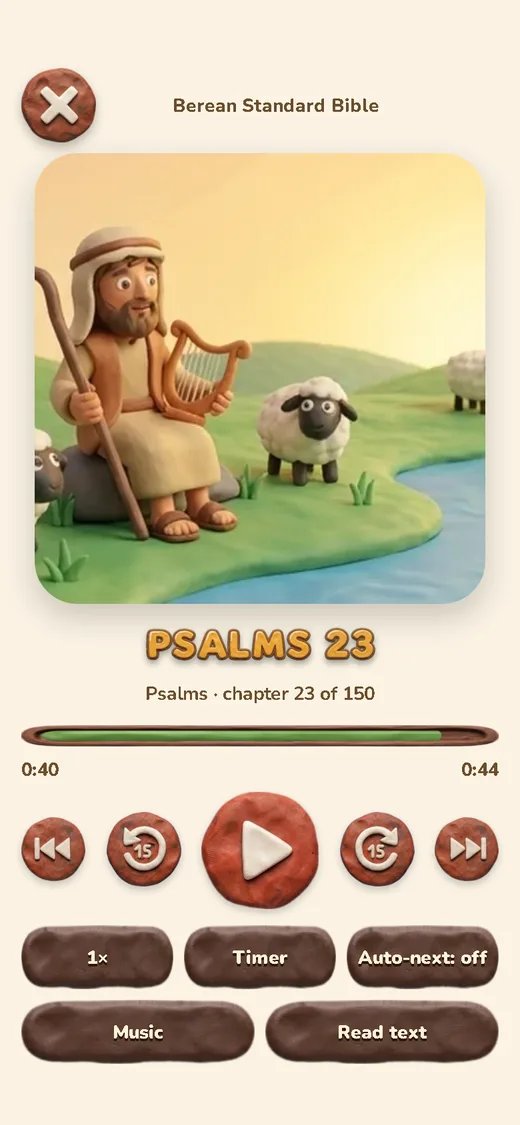 Psalm 23 in audio, ready to play at lights-out.
How to teach a child to pray in their own words
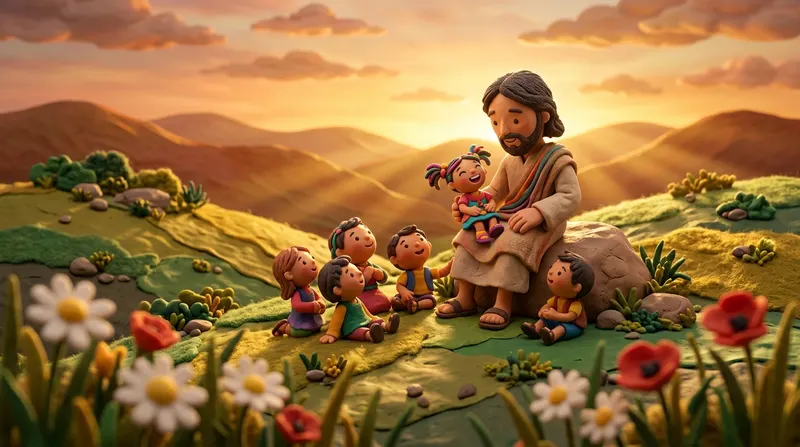
“Let the little children come to Me, and do not hinder them! For the kingdom of heaven belongs to such as these,” Jesus said (Matthew 19:14, Berean Standard Bible). Your child can talk to God about the same things they tell you: the loose tooth, the lost library book, the class hamster.
Ask two questions on the drive home or at bath time: “What was fun today?” and “What was hard?” The CDC’s checklist says that around age 4, many kids can string several words into a sentence and tell you at least one thing that happened during the day. Their answers fill in these sentence starters:
- Thank You for… Something good: “Thank You that I got to be line leader.”
- I’m sorry for… Something they’d take back: “I’m sorry I wouldn’t share the swings.”
- Help me with… Something coming up: “Help me at my swim lesson Saturday.”
- Please take care of… A person or a pet: “Please take care of Biscuit at the vet.”
Write the starters on index cards and let your child draw one card a night, so there’s only one sentence to finish. If a card stumps them, they can trade it for another. A shoebox by the bed keeps the cards easy to find.
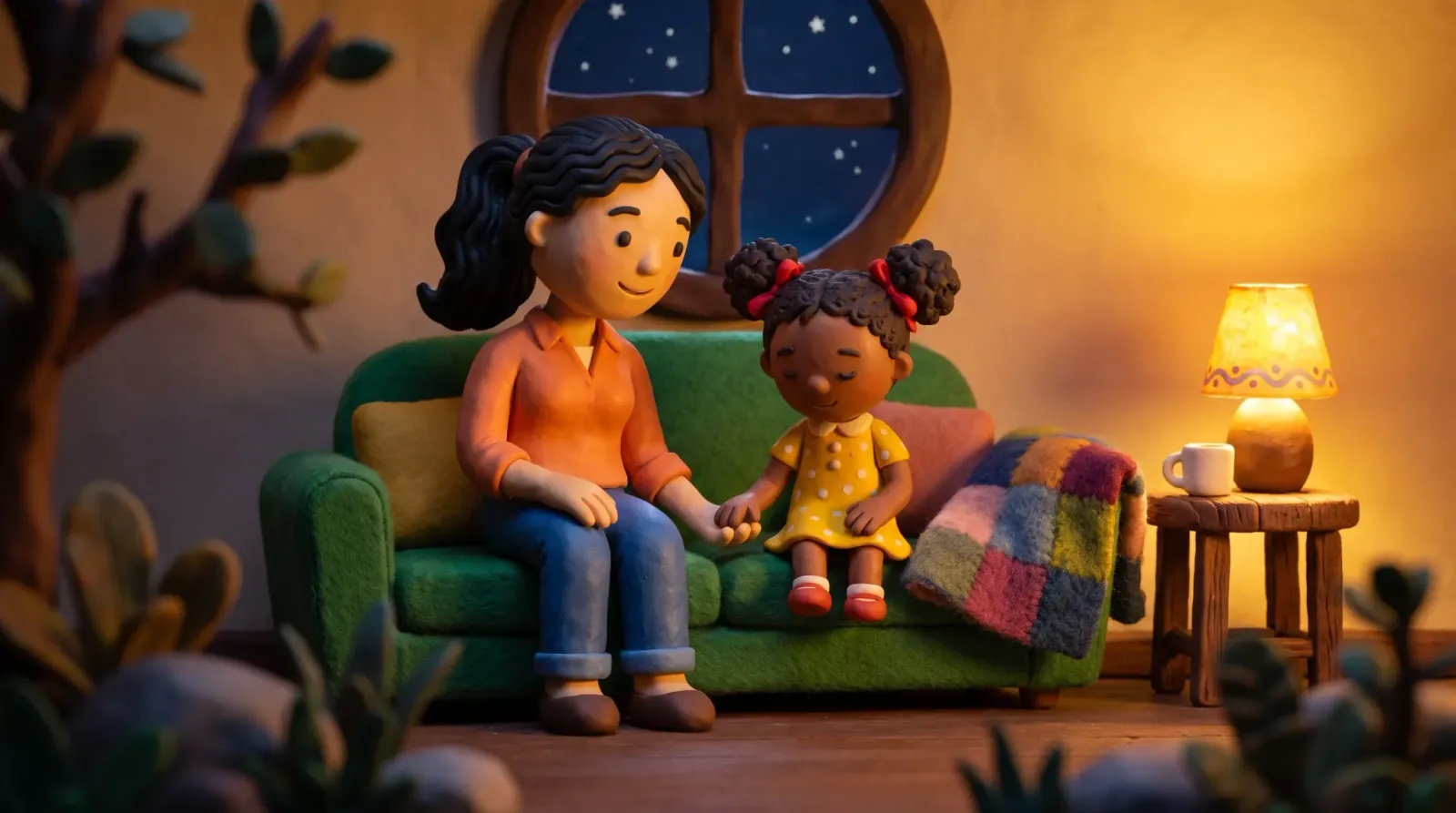 Mom Ana and Lia end the day with a prayer on the couch.
When your child doesn’t want to pray, or forgets
Give a reluctant kid some say in it. Let them choose which prayer from this page the family uses this week, or ask them to pray for the dog. If the answer is still no, pray out loud yourself, keep it short and try again tomorrow night.
To help verses like these stick, see Bible verses for kids. For ways to live out faith as a family during the week, try these Bible activities for kids.
Keep going as a family
On nights when your child is still bouncing off the walls, a clay picture book or a narrated psalm in our app, Terra Sinai, can bring the energy down before prayer time.
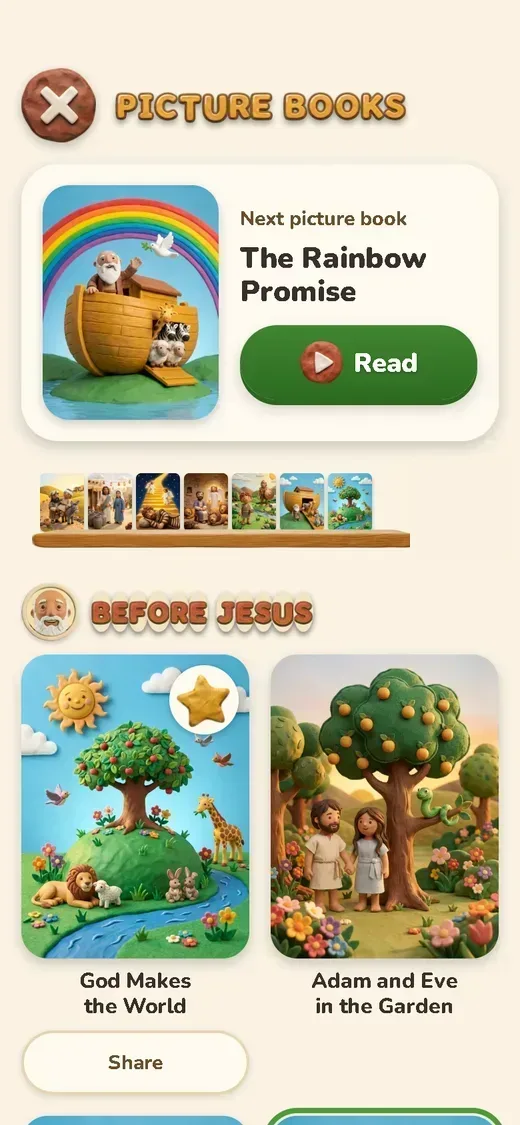 The picture book shelf, with The Rainbow Promise up front.
For daytime fun, our Bible games page has ideas the whole family can play.
How this guide was made. Our editorial team wrote these prayers in October 2026 and kept them short on purpose; change any word to fit your family’s tradition. Bible verses are quoted from the Berean Standard Bible. Ages and timings are our suggestions. Developmental milestones come from the CDC, and the sleep guidance comes from the AAP. For questions about your child’s sleep or development, talk with your pediatrician.
Sources
- CDC, Milestones by 4 Years
- American Academy of Pediatrics, Toddler Won’t Go to Sleep? 7 Tips to Help End Bedtime Battles, HealthyChildren.org
- American Academy of Pediatrics, Healthy Sleep Habits: How Many Hours Does Your Child Need?, HealthyChildren.org
- American Academy of Pediatrics, How to Keep Your Sleeping Baby Safe: AAP Policy Explained, HealthyChildren.org (nothing in the crib but a fitted sheet for babies under 1)
- Berean Standard Bible, Matthew 6 and the other verses quoted, text from bible.helloao.org
Frequently asked questions
What is a good short bedtime prayer for a child?
Try this one: "God, thank You for today. Take care of my family and me tonight. Amen." Two lines are plenty at bedtime. Give it one fixed spot, like right after the last book, and keep it there every night. Before long, your child will start saying it before you do.
What age can kids start learning to pray?
By kindergarten age, many kids can pray on their own in their own words. It builds up in small steps before that: a 3- or 4-year-old can usually finish "Thank You, God, for...," and plenty of 2-year-olds will chime in with "amen." It even starts before they talk, when they hear you pray. These ages are our own rough guide, with no study behind them.
How do I teach my child to pray in their own words?
Start by modeling it: pray out loud about your own day for a sentence or two. Then ask what they liked today and what was tough, and hand them a starter like "Thank You for...," "I'm sorry for...," "Help me with..." or "Please take care of..." Take whatever comes out, word for word.
Does a child have to close their eyes and fold their hands to pray?
Any posture works, since the Bible doesn't set one. Some kids pray snuggled under the covers, some on the couch next to a parent, some holding hands in a circle at dinner. If folded hands or closed eyes help a wiggly kid settle, use them the same way each time, so your child knows prayer has started.
Can I teach the Lord's Prayer to a young child?
Sure. Jesus taught it to His disciples (Matthew 6:9-13), and its lines are short enough to take one a week, starting with "Our Father in heaven." Give each line a hand motion your preschooler can do: arms up for "heaven," a pat on the tummy for "daily bread," a hug for "forgive us."
What do I say when my child asks why God didn't answer a prayer?
This one often comes up after a pet dies or a grandparent stays sick. Keep the answer short and honest: "I don't know why. I know God loves you, and you can keep telling Him how you feel." If you have a story from your own life about waiting on God, tell it in a minute or less.
Keep reading
-
Bible activities for kids: 15 easy ideas
15 Bible activities for kids to do at home with everyday supplies: crafts, puppets, a recipe, a treasure hunt, music and painting, with ages and steps. Read article -
Bible stories for kids: 10 to read aloud
Ten short Bible stories for kids ages 2 to 7, written to read aloud in 4 to 10 minutes, with suggested ages, questions to talk about and a bedtime routine. Read article -
How to teach the Bible to kids, age by age
An age-by-age guide to teaching kids the Bible, with a 15-minute family devotional and a ready-to-teach David and Goliath lesson with questions by age. Read article